



Key takeaways
Key points
Emerging markets have been one of the best performing regions this year, vindicating our start of year call. However, the nature of investing in this region has changed from being less of a macro/US dollar driven story and more about the structural dominance of technology and AI globally.
Outperformance of the MSCI Emerging Markets Index has been narrow to say the least, with the top three stocks (Taiwan Semiconductor, Samsung and SK Hynix) growing to account for 30% of the overall index6. But their ascent hasn’t occurred by chance, rather driven by strong fundamental earnings growth as more context heavy inference workloads create structural bottlenecks in the memory chip market.
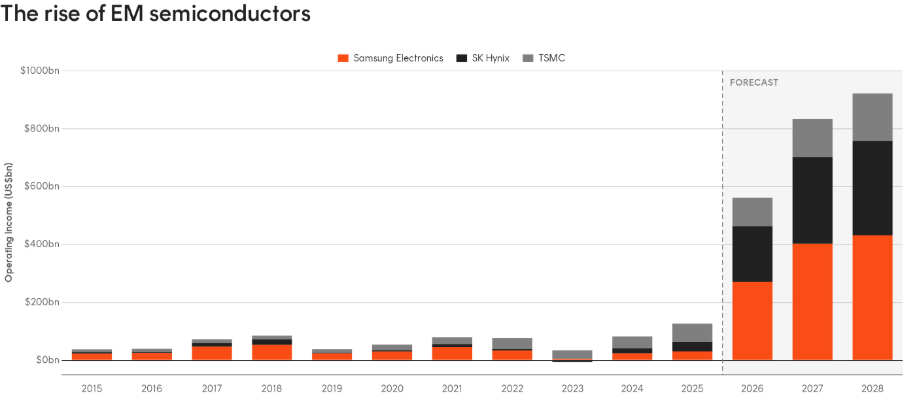
Source: Bloomberg. Operating income for Samsung Electronics, SK Hynix and Taiwan Semiconductor Manufacturing Company, converted to US dollars, by fiscal year. Reported actuals to 2025; 2026 to 2028 are Bloomberg consensus estimates. All three have December fiscal year ends. Korea and Taiwan are both classified as emerging markets under the MSCI methodology. As at 17 August 2026.
One market that’s become a direct beneficiary of this dynamic has been South Korea, driven in large part by Samsung and SK Hynix which together account for more than half of the KOSPI index and two thirds of high bandwidth memory production.
However, that’s also created significant single stock and index level volatility which has been fuelled by the South Korean government’s decision to approve the trading of single stock leveraged products in late May. After a 118% rally from the start of the year to 22 June, the KOSPI index then pulled back significantly by ~38% to local lows set on 30 July7, in part driven by the unwinding of speculative, leveraged positioning rather than by a deterioration in company fundamentals. One high profile casualty was US hedge fund, Situational Awareness, that held a highly concentrated leveraged position in SK Hynix.
Across the East China Sea, Taiwan’s stock market may also be prone to bouts of volatility given TSMC, the world’s largest and most advanced chip manufacturing company, accounts for ~40% of the local index. At the national accounts level, broad tech-related exports including electronics, AI servers and integrated circuits accounted for more than three quarters of Taiwan’s total exports8.
While a reflection of where the demand is within the AI supply chain, the narrowness and rotation we’ve seen in emerging markets may create challenges to how asset allocators invest in this region. Timing sector and company winners becomes even more difficult as illustrated in the chart below with many Australian domiciled active managers underperforming the MSCI EM Index despite the conventional wisdom that less efficient markets like EM provide a fertile hunting ground for alpha generation.
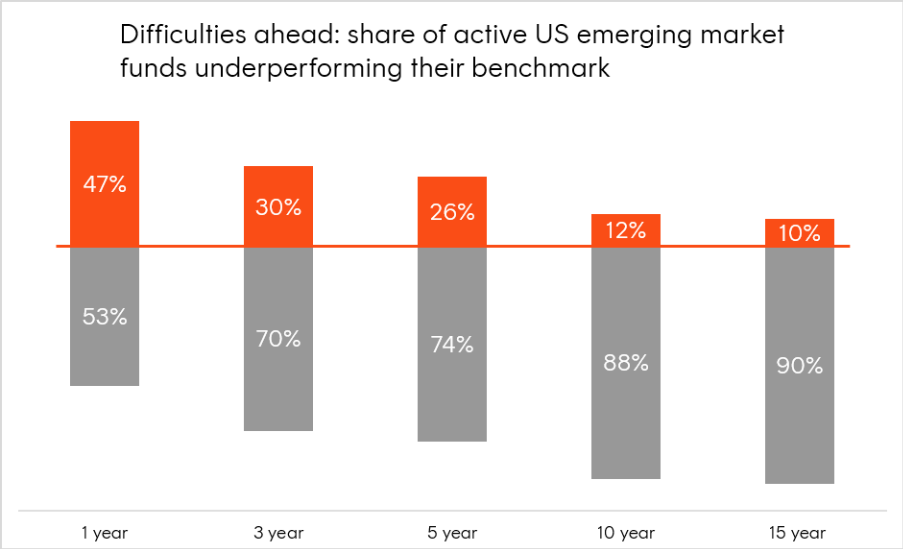
Source: SPIVA U.S. Year-End 2025. As at 31 December 2025. Past performance is not an indicator of future performance. You cannot invest directly in an index.
Looking ahead, we still think emerging markets remain appealing even after its rally given attractive forward valuations and a strong earnings growth outlook led by the AI infrastructure build out. Beyond AI, other countries like India provide differentiated sources of growth supported by strong momentum in domestic private consumption and services activity. China also looks attractive given lower valuations and is home to a fast-growing local AI ecosystem spanning domestic chips, models and semiconductor equipment manufacturers.
One headwind worth considering is the strength in the US dollar index this year given heightened risk of capital flight as this marks a stark change from the 9.5%9 fall the index experienced just last year. Concentration risk should also be considered, although this is not necessarily a bad thing and rather reflects the market leadership that TSMC, Samsung and SK Hynix will likely retain off the back of structural tightness in the memory chip market and continued upward revisions to hyperscaler capex.
Investors seeking a simple, low-cost and tax-efficient passive exposure to emerging markets may consider the BEMG MSCI Emerging Markets Complex ETF.
There are risks associated with an investment in BEMG, including market risk, emerging markets risk, currency risk and derivatives risk. Investment value can go up and down. An investment in the Fund should only be considered as a part of a broader portfolio, taking into account your particular circumstances, including your tolerance for risk. For more information on risks and other features of the Fund, please see the Product Disclosure Statement and Target Market Determination, both available at www.betashares.com.au.
The MSCI Emerging Markets Index captures large and mid cap representation across 24 Emerging Markets (EM) countries. The index covers approximately 85% of the free float-adjusted market capitalization in each country.
Index Disclaimer
The MSCI indexes are the exclusive property of MSCI Inc. (“MSCI”). MSCI and the MSCI index names are service mark(s) of MSCI or its affiliates and have been licensed for use for certain purposes by Betashares. The financial products referred to herein are not sponsored, endorsed, or promoted by MSCI, and MSCI bears no liability with respect to any such financial products or any index on which such financial products are based. The PDS contains a more detailed description of the limited relationship MSCI has with Betashares and any relevant financial products. No purchaser, seller or holder of this product, or any other person or entity, should use or refer to any MSCI trade name, trademark or service mark to sponsor, endorse, market or promote this product without first contacting MSCI to determine whether MSCI’s permission is required. Under no circumstances may any person or entity claim any affiliation with MSCI without the prior written permission of MSCI.