




Key global developments in September
- Military conflict in the Middle East escalated in September, with renewed US-Iran attacks and Houthi strikes on Saudi Arabia’s East-West pipeline pushing oil prices sharply higher. Prices eased back late in the month, however, as Saudi Arabia found alternative export routes, though Brent crude still ended the month 14% higher.
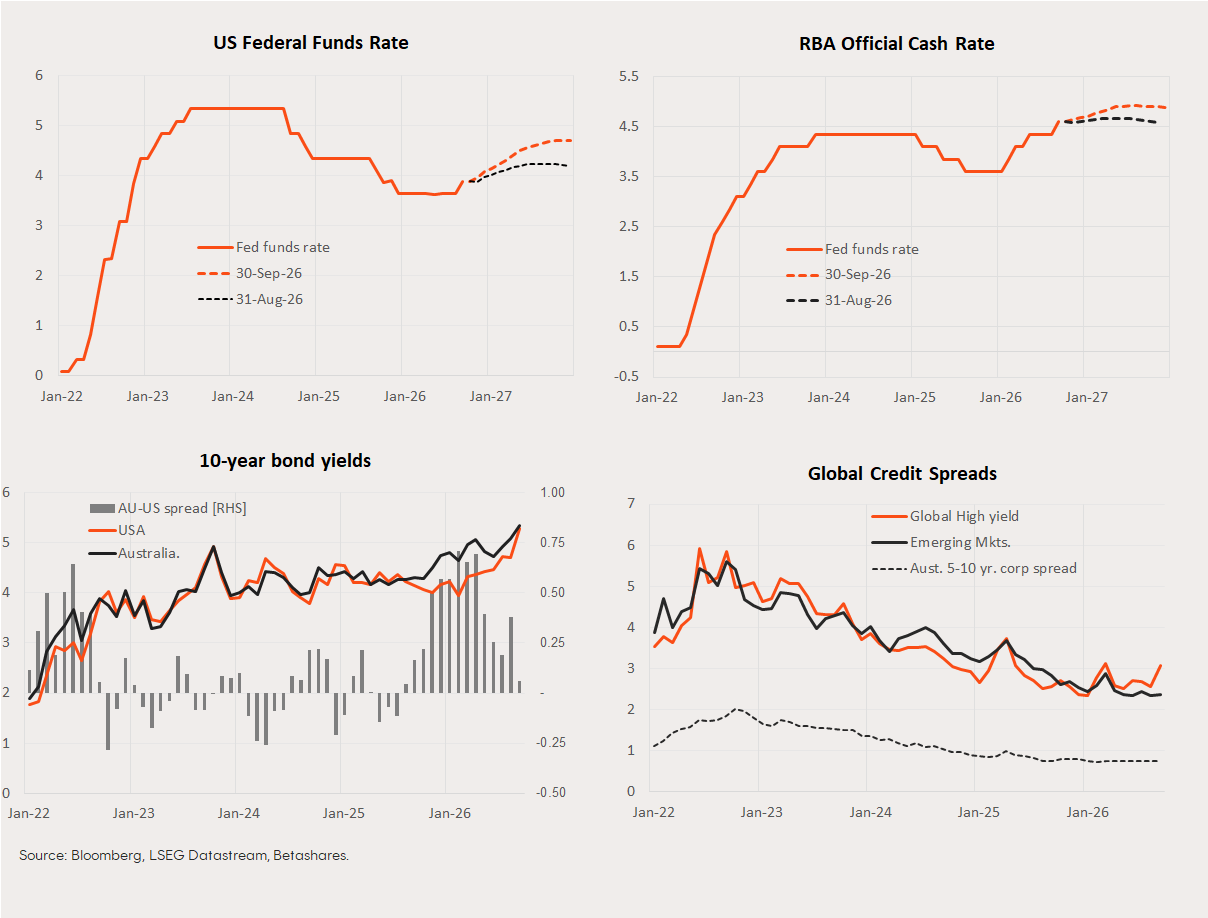
- Inflation fears also prompted a wave of global policy tightening. The US Federal Reserve raised rates 0.25% after a strong 162k gain in August payrolls and a firmer-than-expected 0.3% rise in core CPI. The European Central Bank lifted rates to 2.5%, while the Bank of Japan delivered a “dovish hike” to 1.25%.
- Upbeat US business surveys and hawkish Fed commentary sparked a global bond sell-off – US 10-year yields pushed above 5% for the first time in almost two decades.
- AI remained a mixed bag. Industry leaders warned about the long-term risks of the technology, though continued strong demand for AI and semiconductor products underpinned technology shares and corporate earnings.
- In Australia, the Reserve Bank raised the cash rate 0.25% to 4.60%, its fourth increase this year. It cited “materialising” inflation risks from higher oil prices, the AI investment boom and tight local capacity. Economic data was mixed. The 0.4% gain in Q2 GDP was soft, but still a bit firmer than the RBA expected. House prices kept falling while the unemployment rate rose to 4.6% despite still reasonable employment gains. Monthly inflation remained volatile, with a firm 0.5% gain in trimmed mean inflation in July, followed by a smaller 0.2% gain in August.
Interest rates
- US rate hike expectations rose sharply over the past month. Markets now expect the Fed funds rate to reach around 4.8% in 12 months, up 0.58% from a month earlier – implying three further rate hikes. US 10-year bond yields jumped 0.58% to 5.29%. Markets attach only a 25% chance of a rate hike at the next Fed meeting later this month.
- In Australia, the market’s one-year ahead cash rate expectations rose 0.28% to 4.9%, implying only one further rate hike. Markets see only a 20% chance of a rate hike next month. Local 10-year bond yields rose 0.26% to 5.35%, with the spread over US 10-year rates narrowing further.
- Global high yield spreads spiked 0.5% higher in the month, though emerging market and local credit spreads remained contained.
Commodity prices
- The benchmark index of global commodity prices* was broadly flat in September (+0.3%) after a 5.2% gain in August, with gains in energy offsetting weakness elsewhere.
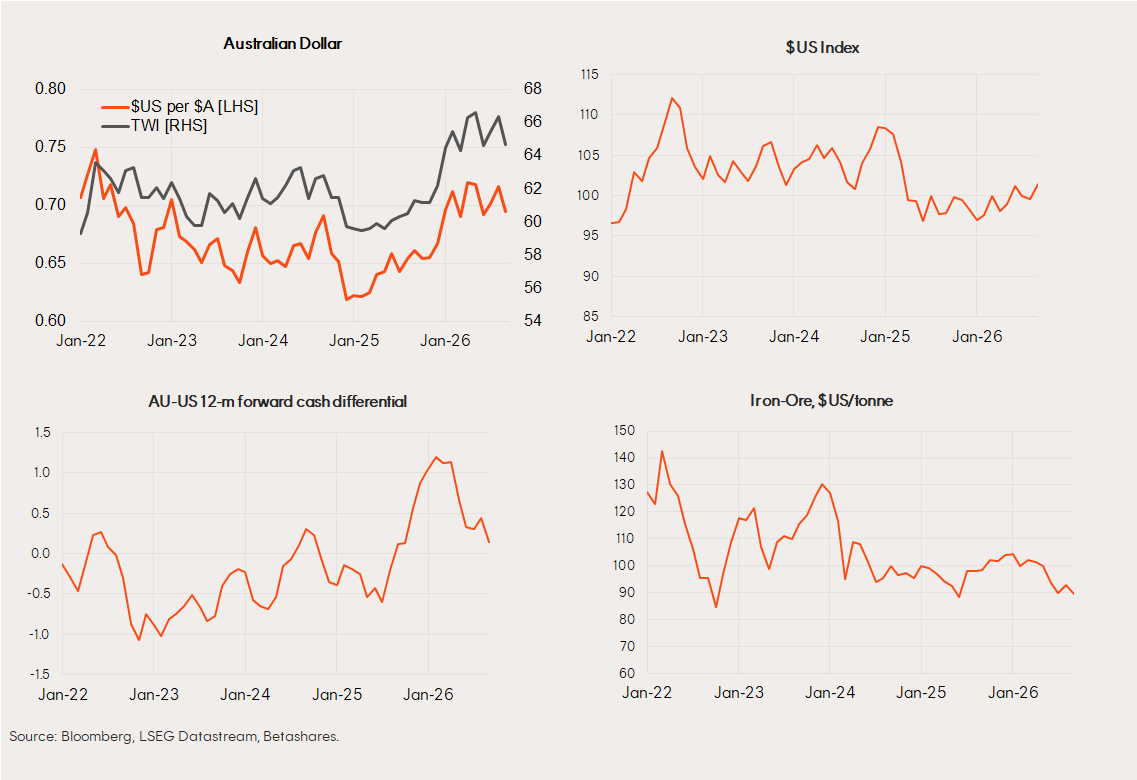
- Gold prices fell 6.3%, giving back much of August’s rebound as rising bond yields and a firmer $US weighed on the non-yielding metal. Oil was the standout, rising 14% to $US 103/barrel as the Iran conflict escalated.
- Iron ore fell 3.6% and agricultural prices fell 5.2%. Industrial metals held up better, easing only 0.9%. AI, defence and clean energy investment continue to support demand for metals such as copper, helping to offset fears that higher global interest rates could slow global growth.
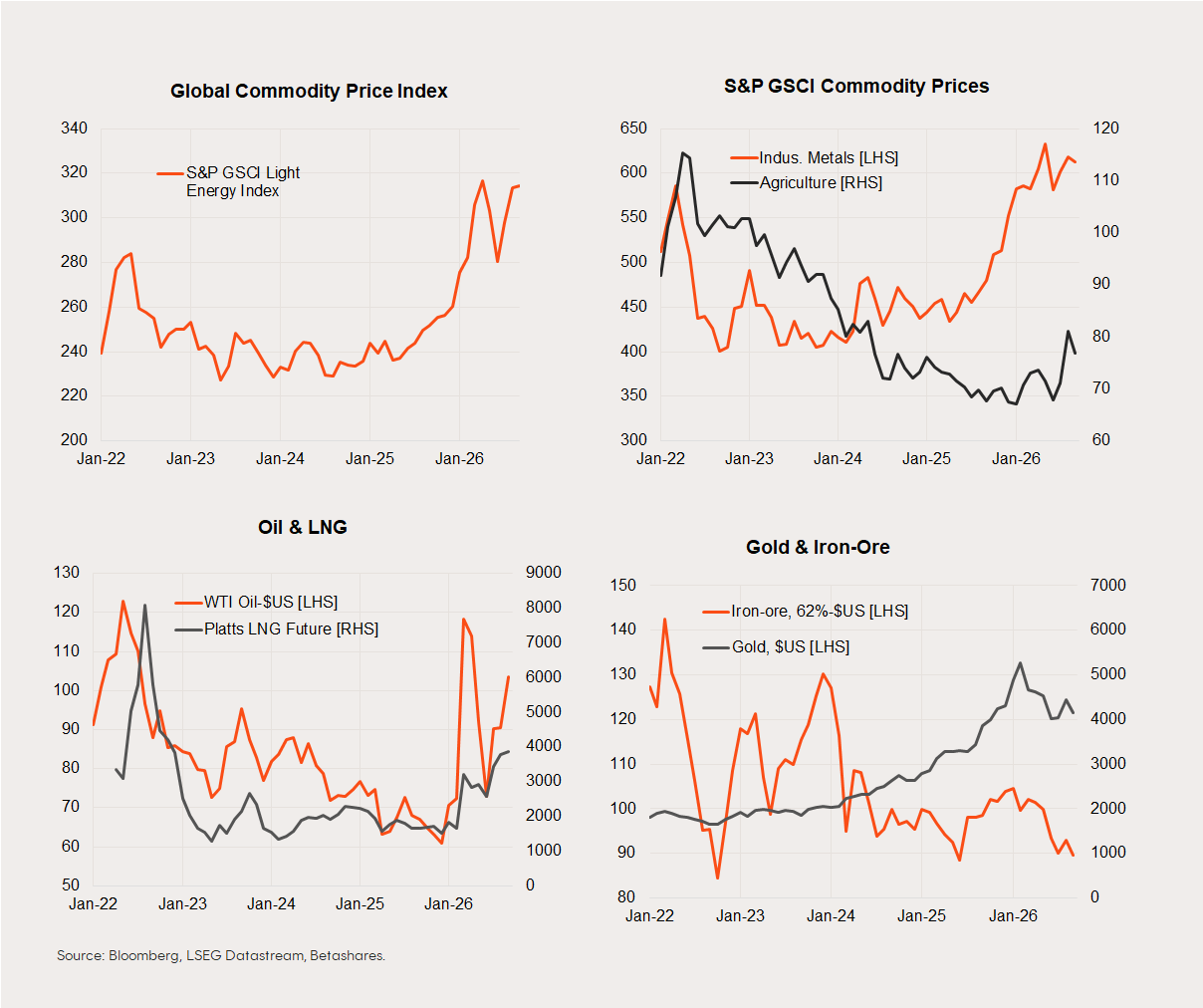
*Represented by the S&P GSCI Light Energy Index, which includes a range of prices covering energy, metals, agriculture and livestock.
Exchange rates
- The $A fell 3.0% against the $US in September to US69.5c, and by 2.6% in trade-weighted terms. Driving the decline was a firmer $US (+1.8%), as US rate expectations rose more quickly than those in other major economies. Weaker commodity prices and a risk-off tone in equity markets also weighed on the $A.
- The outlook for the $A remains mixed. A further RBA hike in November could provide some support, but this may be offset by continued $US strength if the Fed keeps raising rates.
Global equities
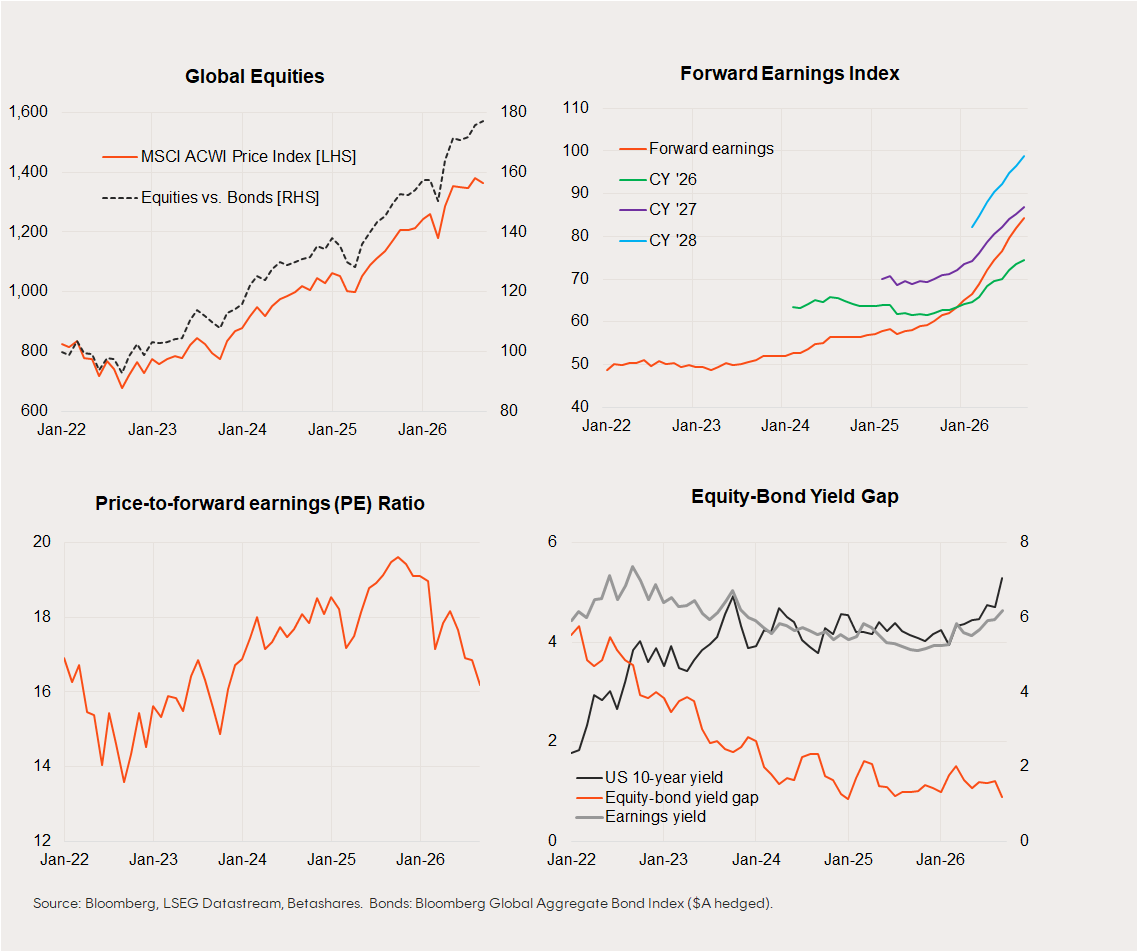
- Global equities returned -1.1% in local currency terms but rose 1.8% in unhedged $A terms, courtesy of the weaker $A.
- The decline reflected a 4% fall in the forward PE ratio to 16.2 as bond yields rose. This more than offset a solid 3.0% gain in forward earnings. That said, the global equity risk premium has narrowed to around 0.9% – the low end of its range in recent years.
- Of the major markets, only Japan (+1.1%) posted a gain, as a weaker yen after the Bank of Japan’s dovish hike supported exporters and AI-related stocks. Emerging markets (-0.6%) and the S&P 500 (-0.7%) held up relatively well, supported by technology. Europe (-3.0%) fared worst, reflecting its greater exposure to higher energy prices and rising regional bond yields.
- Global earnings expectations remain upbeat, with 17% expected further growth in forward earnings by end-2027. PE valuations are at the lower end of their range over the past three years, though further increases in bond yields remain the key threat to the outlook.
Australian equities
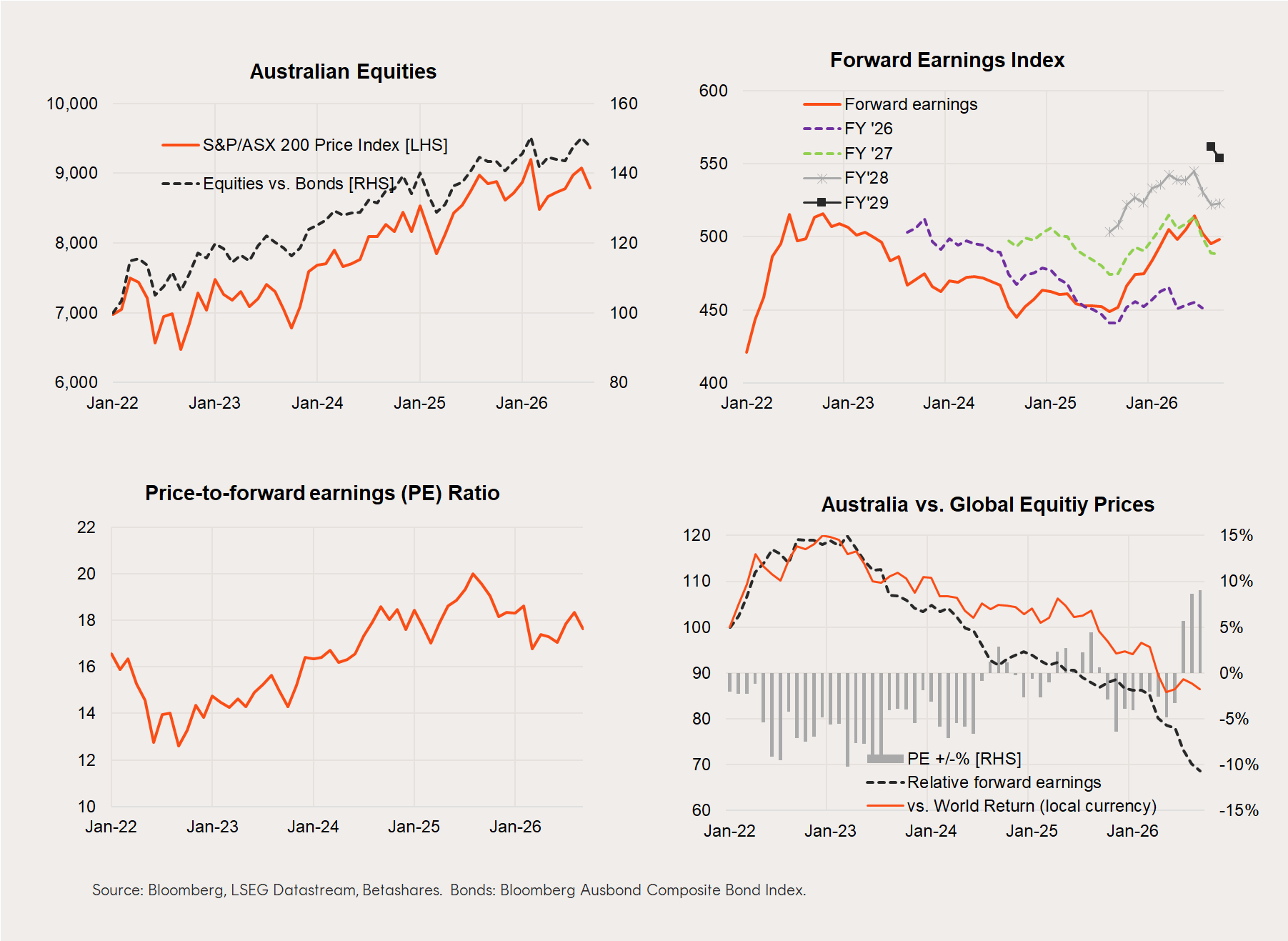
- Australian equities returned -2.4% in September, as the forward PE ratio fell 4% to 17.6 while forward earnings eked out a 0.7% gain.
- Current earnings expectations are consistent with 8% growth in forward earnings by end-2027. That’s weaker than global markets – and more vulnerable to downgrades given the soft local economy and rising interest rates.
- At 17.6, the forward PE ratio ended September at a 9% premium to global markets. Australia’s weaker earnings outlook and relatively expensive valuations point to continued underperformance versus global peers.
Equity themes/trends
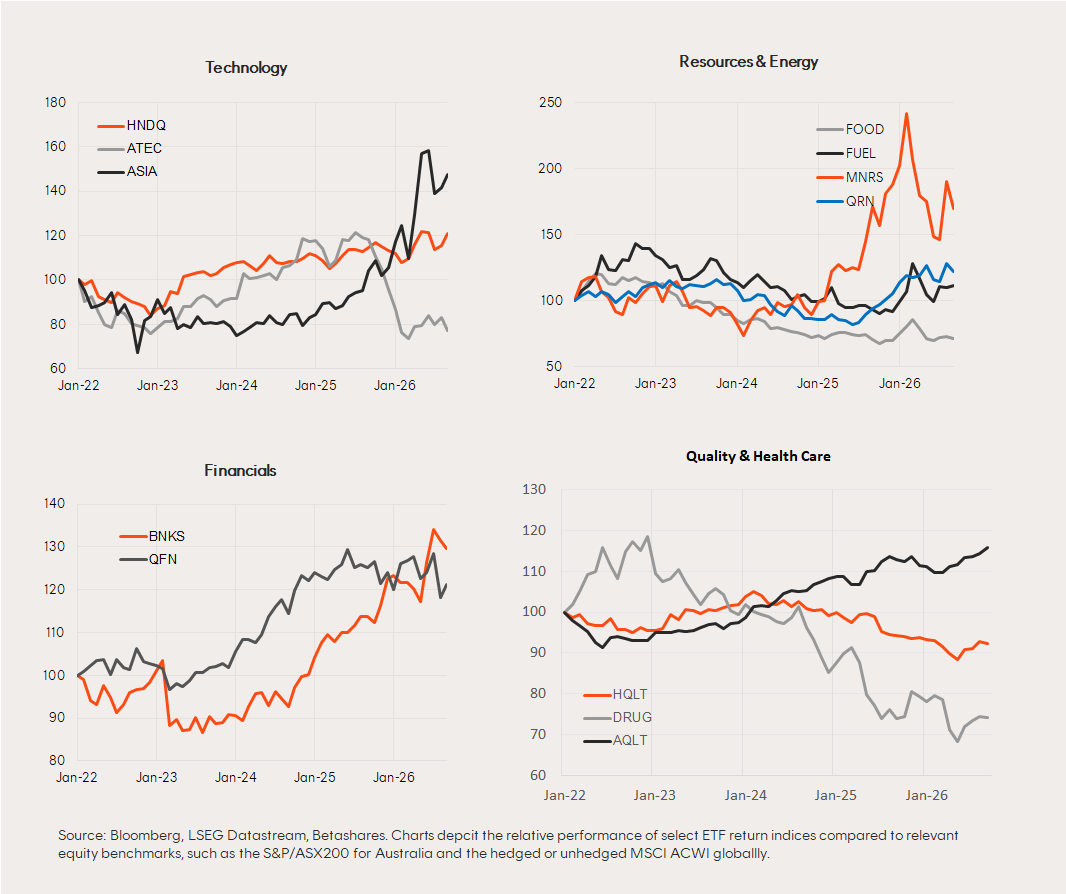
- Technology continued its recent spate of outperformance in the month, led by cybersecurity (HACK, +7.8%) and Asian technology (ASIA, +5.8%), along with the Nasdaq-100 (HNDQ, +3.3%). Local technology stocks (ATEC, -9.7%), however, fell sharply.
- The commodity area pulled back in the month, with MNRS and QRE down 11.9% and 6.8%, while FUEL was flat despite higher oil prices.
- Despite higher bond yields, global banks (BNKS, -2.5%) underperformed, while local financials (QFN, +0.2%) held up relatively well.
- Global health care has performed well of late, while DRUG (-1.6%) underperformed slightly in the month. Global (HQLT) and local (AQLT) quality ETF exposures have generally outperformed in recent months also.
Past performance is not indicative of future performance of any index or ETF.