


Global week in review: Continued tech jitters
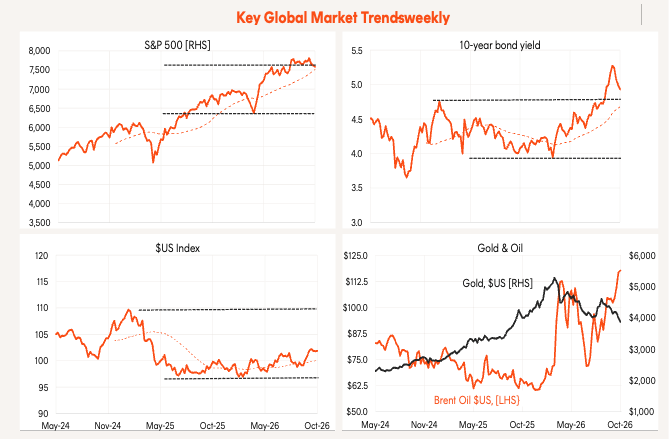
Global stocks sold off further last week, reflecting continued AI jitters, firmer oil prices and uncertainty ahead of this week’s US midterm elections. Bond yields eased further, reflecting safe-haven flows.

Source: Betashares, Bloomberg.
US stocks nervously edged higher for much of last week, although gave it all back with a broad-based sell-off on Friday. AI-exposed stocks fared the worst, continuing a pullback in this theme for the past few weeks and a rotation to more defensive sectors.
Of note, AI-related concerns have moved from debt markets – and less financially secure neoclouds – to the bluechip US hyperscalers, as the mounting cost of the data centre rollout becomes ever more apparent. What seems to have shocked markets this past week, though it shouldn’t have been a surprise, is the fact that the huge capital spending plans of the hyperscalers has now resulted in several moving into negative free cash flow. S&P delivered Meta a credit downgrade on Friday.
Alphabet shares plunged almost 13% on Thursday – their worst day on record, wiping around $US500 billion off teh company’s market value due to less than impressive earnings and slower growth in search activity. Of most note, free cash flow was negative $US9.1 billion as capital spending hit $US51 billion. Microsoft, by contrast, beat expectations with positive free cash flow.
Although the market is clearly worried, all the hyperscalers have little choice but to keep spending billions to stay in the AI race lest they get disrupted and left behind. AI has effectively made their previous solid business moats much more vulnerable to attack.
The Fed delivered a hawkish hold, leaving rates at 3.75-4.00%. Governor Cook and Cleveland Fed President Hammack dissented in favour of a 0.25% hike, and Chair Warsh again refused to offer forward guidance.
This week’s US data, however, only reinforced the market view this was a rate hike delayed not denied. US GDP grew 3.4% annualised in the September quarter (versus 3.2% expected), core PCE inflation was firm, with a 0.3% lift in September, in line with market expectations, while jobless claims fell even further to the very low level of 194,000. The market now attaches a 73% chance to a December hike. Oil also stayed elevated, with Brent near $US118 a barrel.
Other central banks produced surprises. The Reserve Bank of New Zealand held at 2.75% on a 4-3 vote when a hike was all but priced, though it flagged tighter policy is likely. The Bank of Canada hiked 0.25% to 2.50%. The ECB held at 2.50% as expected, but President Lagarde pointed to a December hike with eurozone inflation at 3.8% – and announced she will step down in February 2027. The Bank of Japan also held rates at 1.25% on Friday.
Global week ahead: US midterms & payrolls
Two key events this week are the US midterm elections on Tuesday and October payrolls on Friday (US time).
Two concerns face investors over Tuesday’s midterm elections: will Democrats achieve a ‘clean sweep’ of both the House and Senate and, if so, what might that mean for economic policy going forward? According to the latest odds on Polymarket, there is a 71% chance. At the very least, Democrats seem a sure bet to take back the House.
While Democrats won’t be able to pass laws without President Trump’s signature, it can and likely will frustrate Budget negotiations – raising the risk of yet more Government shutdowns, which could in turn add to upward pressure on bond yields. Also, with elections over, there’s the question of whether President Trump will launch new attacks on Iran, as some market reports suggest.
Friday’s payrolls report is expected to show a subdued gain of 60k, after a weak 29k in September, with the unemployment rate steady at 4.2%. The weakness in employment is at odds with the very low level of jobless claims, suggesting reduced supply, along with easing demand, is behind the employment slowdown. A strong payrolls result would cement a December Fed hike; a weak one would give the Fed’s patient members some cover.
Elsewhere, the Bank of England is widely expected to hike 0.25% to 4.00% on Thursday (11pm AEDT) – its first increase of 2026.
Global equity trends: Tech reversal
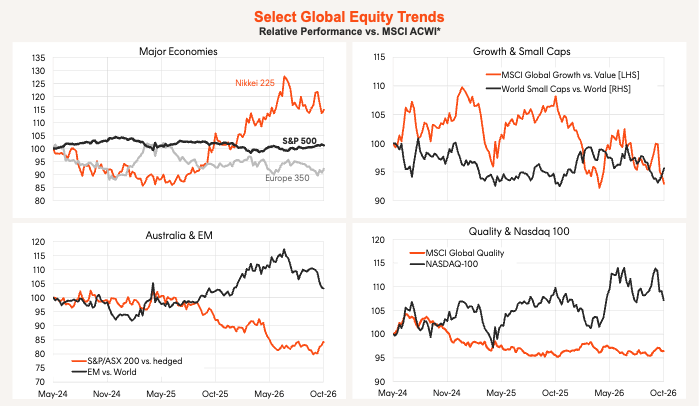
After a brief rebound in relative performance over recent months, popular AI trades underperformed again for the third week in a row. Broadly speaking, the ‘AI trade’ has been on the nose since mid-June, with underperformance by Japan, emerging markets and the Nasdaq 100 evident.
While there have been concerns over AI capex and debt funding, the pullback has also broadly coincided with the leap higher in oil prices and inflation concerns over this period. That said, the tech rout has been such that long-term bond yields have eased back in recent weeks following earlier strong gains.
*All but value factors. Local currency basis. Source: Betashares, Bloomberg.
Australia week in review: Hot CPI
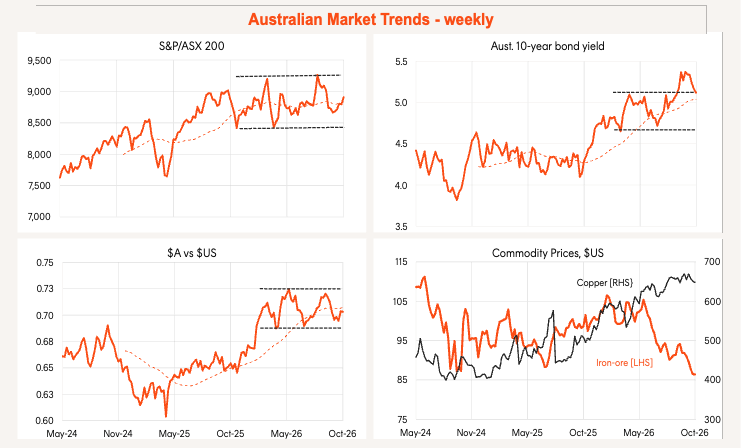
Local equities held up last week, although this did not reflect the US sell-off on Friday. That said, the market is so far only off 0.3% in Monday morning trade. This could be the ‘Steve Bradbury’ rally, where Australia holds up if the global tech sector continues to topple over.

Source: Betashares, Bloomberg.
Local news hardly provided any reason to cheer. As Deputy Governor Hauser warned, the Q3 CPI report was “materially worse” than the RBA expected back in August. The quarterly trimmed mean rose 1.0% – in line with market forecasts but above the RBA’s 0.8% – while headline inflation jumped to 4.3% from 4.0% on higher fuel costs.
The odds of a hike tomorrow jumped to 80% from around 60%.
Local equity market trends: Defensives favoured
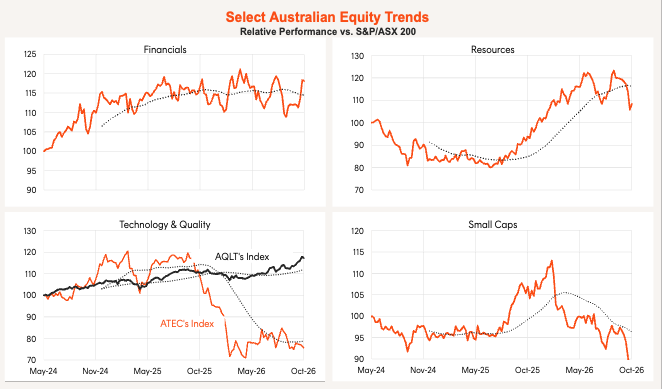
Materials enjoyed a bounce back last week after the previous week’s pummelling. As noted above, however, the deterioration in risk sentiment in recent weeks has tended to undermine the performance of resources, leaving investors to favour financials as a ‘safe haven’ trade. Of course, that’s despite the fact the local economy and credit growth is slowing, and house prices continue to slump.
Along with financials, sectors considered defensive and in favour include health care, utilities, consumer staples and property. In terms of factors, local quality continues to steadily outperform. Small caps continue to underperform.
Source: Betashares, Bloomberg.
Australia week ahead: RBA to hike
This week’s main event is the RBA decision at 2.30pm tomorrow – Melbourne Cup Day.
To my mind, a rate hike is a red-hot favourite, taking the cash rate to 4.85%, the highest level since November 2008. The trimmed mean has confirmed the upside inflation risks flagged by the RBA in recent months and, notwithstanding a pre-emptive hike in September, there seems little reason to wait until December before hiking rates again.
Of interest will be whether the Board decision is again unanimous.
Have a great week!