

Global equities rebounded last week, helped by initial hopes of a US-Iran peace deal and improved technology sentiment given investor interest in this week’s Anthropic IPO. The equity gains came despite a renewed surge in bond yields following a higher-than-expected US inflation report and hawkish Fed rhetoric.
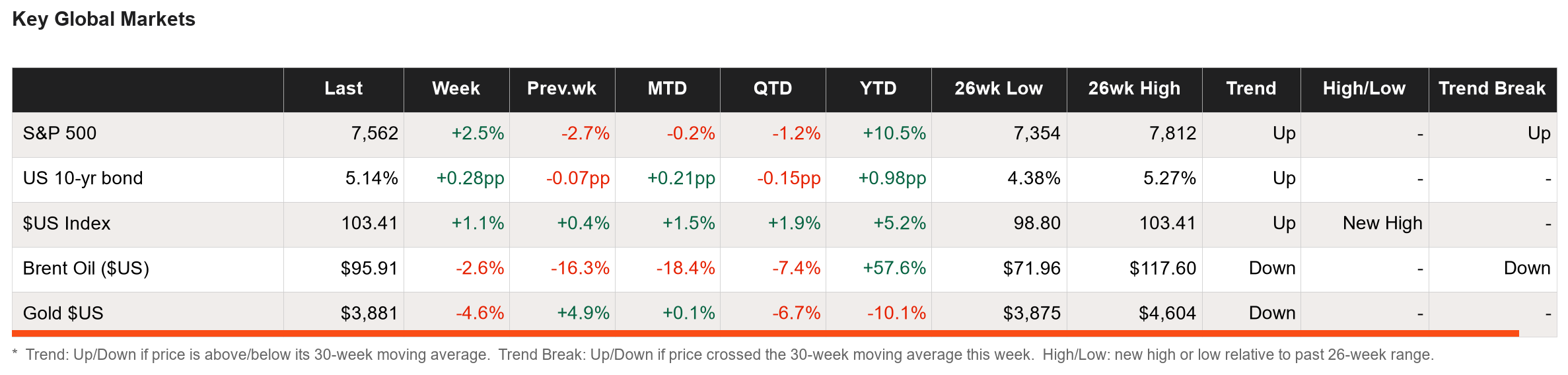
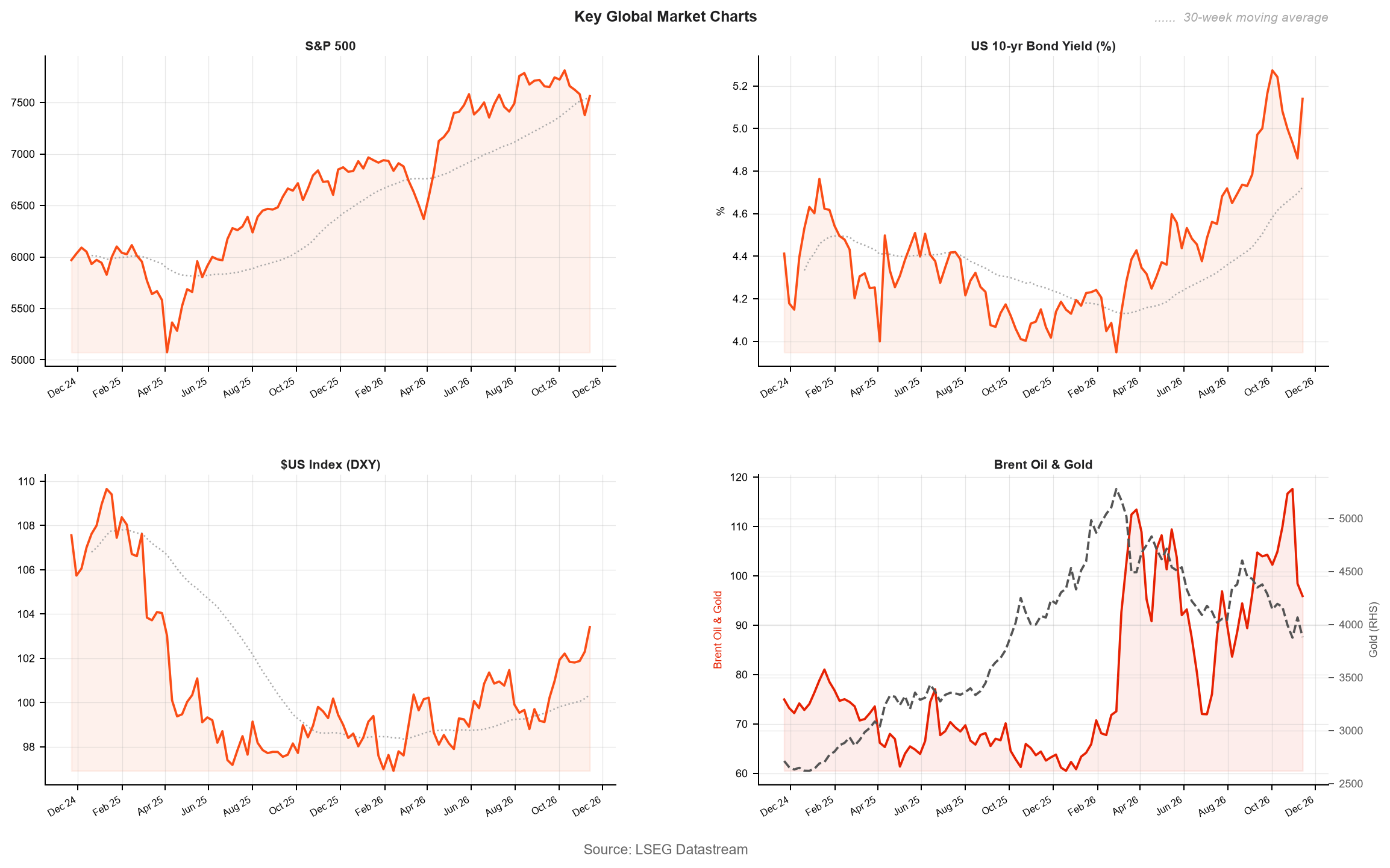
A key positive last week was the further decline in oil prices, with Brent crude down 2.6% to $US95.91 a barrel, its second consecutive weekly decline, as markets weighed the possibility of a US-Iran peace deal. That deal remains elusive; Trump said Friday the US ‘could forgo’ it, sending prices modestly higher.
Also positive was strong investor interest in this week’s Anthropic IPO, which was heavily oversubscribed. Technology stocks fared well, despite the drop in Nvidia’s share price given the resignation of CEO Jensen Huang.
Less pleasing was the slightly higher-than-expected US consumer price inflation report for October. Once again, core prices rose 0.3%, defying market hopes for a lower monthly gain of 0.2%. It was enough to have Fed Governor Waller backing a December rate hike and even suggesting a 0.5% move. US 10-year bond yields surged 0.28% to be back above 5%.
No surprise given the rise in bond yields and Fed tightening fears, gold prices fell 4.8% to $US3,880 an ounce.
Global equity trends: AI trade stages a comeback
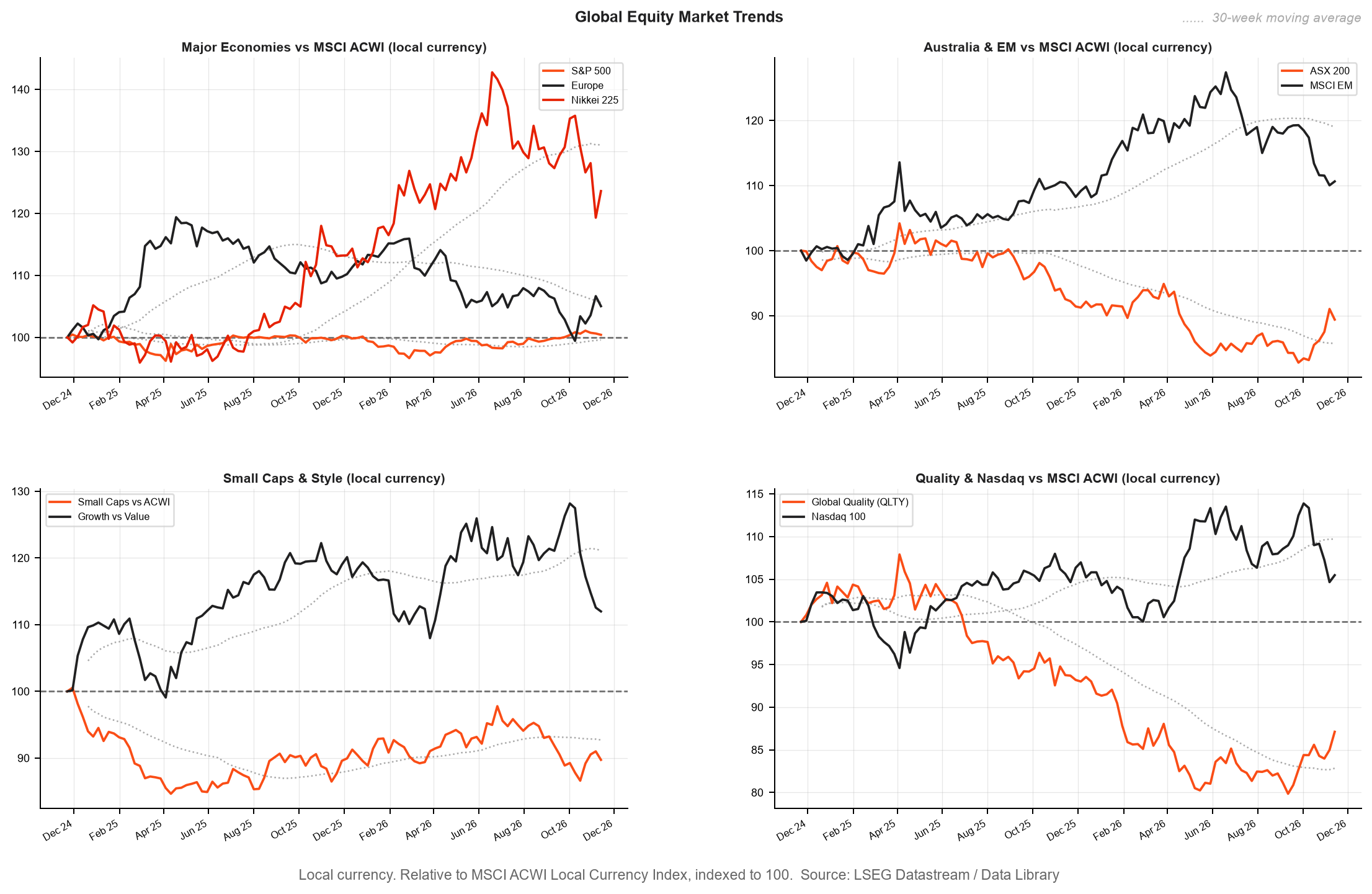
The beaten-down technology/AI theme bounced back last week, though there’s still a risk this is a dead cat bounce rather than a resumption of trend outperformance. That said, two positives last week were the limited contagion from the sell-off in Nvidia and the well-subscribed Anthropic IPO.
At this stage, the winners of the tech sell-off have been “old world” value plays such as Australia and Europe. Global quality has also demonstrated feisty outperformance over recent weeks.
Global week ahead: Nvidia, Anthropic and the Fed
Key technology-related events this week include Nvidia’s third-quarter earnings report on Tuesday evening US time and Anthropic’s IPO on Wednesday. Investors will seek assurance from Nvidia’s result that data centre demand remains strong. The result will be delivered by interim CEO Colette Kress, whose previous role was Chief Financial Officer.
On the macro side, US October retail sales on Tuesday and the Fed minutes on Wednesday round out the calendar. Fed Chair Warsh speaks Monday.
Geopolitics could be a positive next week, with Presidents Trump and Xi scheduled to meet at the APEC summit in Shenzhen on Tuesday and Wednesday. Markets will watch for any thaw in US-China trade tensions or any fallout from the Nvidia spying scandal.
Australia week in review: confidence crumbles
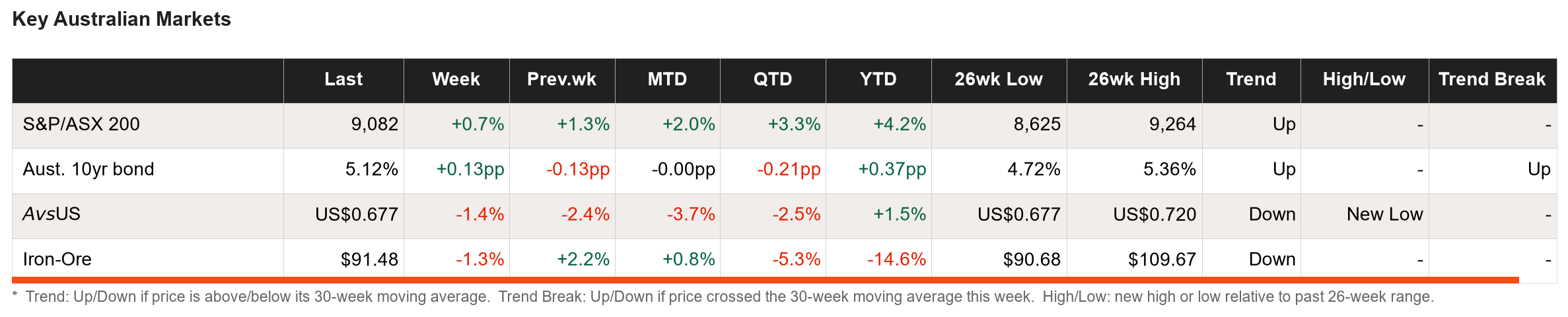
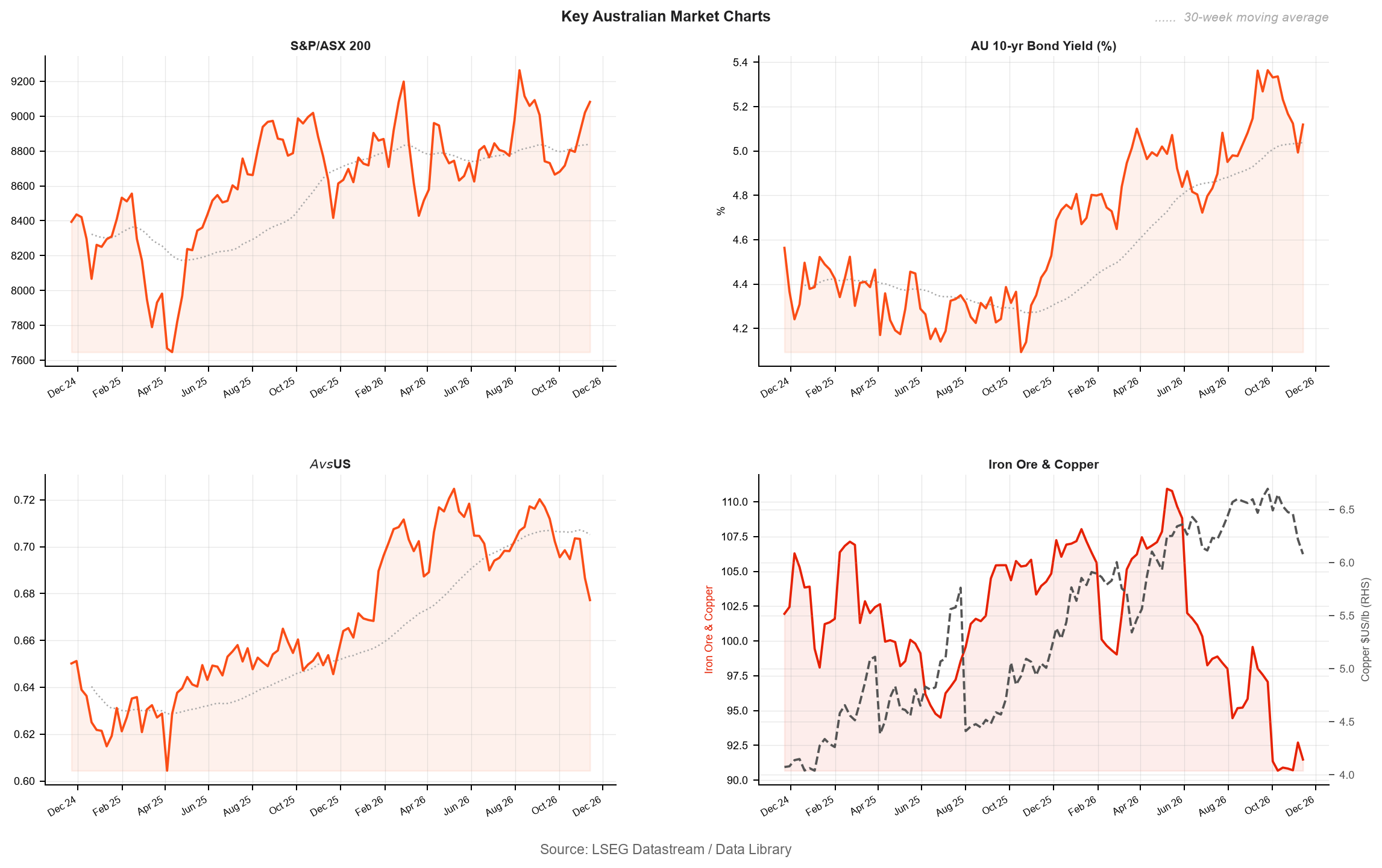
The ASX 200 managed a modest 0.7% gain for the week to close at 9,082, holding up reasonably well despite softening domestic data and a sharply weaker Australian dollar.
As expected, updated reports on business and consumer sentiment were bleak. The Westpac consumer sentiment survey fell 2.7% in November to its lowest level since the previous period of rate hike pessimism in late 2022. The mortgage-holder sub-index plunged to the lowest reading since the survey began in 1994.
The NAB monthly business survey for October was equally grim: the indices of both confidence and conditions eased further, with the former now well below long-run average levels though the latter remains only modestly below average. Forward orders were especially weak.
Also noteworthy last week was a further plunge in home lending in Q3, with weakness in both owner-occupier and investor lending and for new and existing dwellings. No surprise given the May Budget changes,investor lending for established dwellings was the weakest segment by far, with volumes down a lazy 36% in the quarter. To my mind, the biggest surprise was not the sharp drop in investor lending, but the fact there was any investor property interest at all.
The Australian dollar fell to around US67.75 cents – a ten-month low – as increased US rate hike expectations and soft local data eroded Australia’s interest rate allure.
Local equity market trends: quality shines, small caps sink
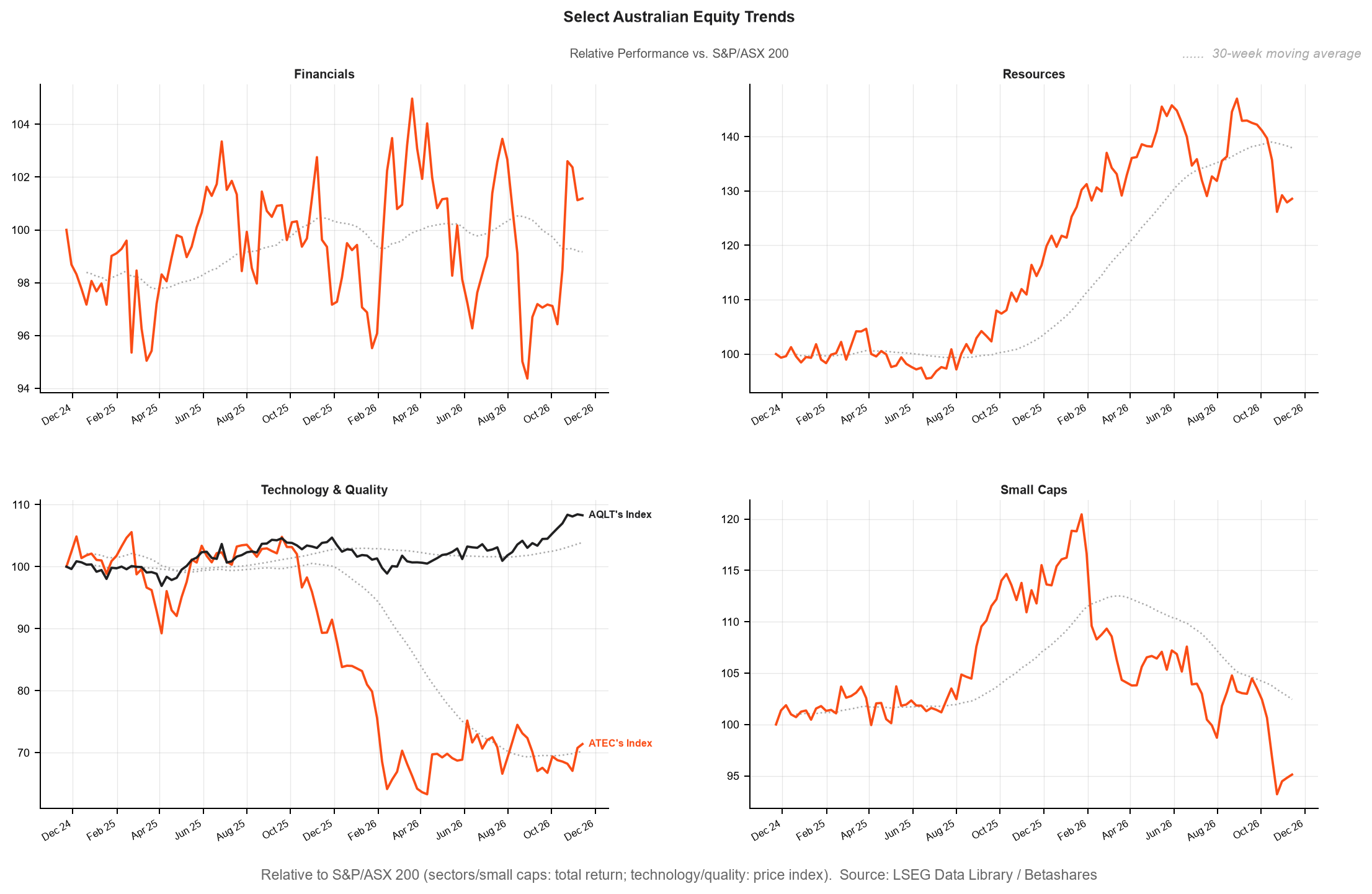
Local resource sector relative performance has become correlated with the global AI trade of late, and the sector accordingly attracted some interest last week. Financial sector relative performance remains choppy.
Some evident themes are the continued gradual outperformance of quality, the ongoing bottoming out in the relative performance of technology and still dire relative performance of small caps.
Australia week ahead: wages and jobs in focus
Key local highlights this week include the RBA minutes of the November meeting on Tuesday, especially given the 6-3 split vote supporting a rate hike. RBA Governor Bullock also addresses the ASIC Annual Forum on Tuesday morning.
Thanks to the 4.75% increase in minimum-award wages, the Q3 Wage Price Index on Wednesday is expected to show slightly firmer quarterly wage growth of 1.0% after a 0.8% gain in Q2. That would see annual wage growth lift from 3.2% to 3.4% which, ordinarily, would be consistent with the RBA’s 2-3% inflation target were it not for our currently abysmal productivity performance.
The October labour force report is on Thursday. Monthly employment has been volatile of late, not helped by changes in the survey design which may have affected seasonal patterns. After a shock 39k job loss in September, employment is expected to bounce back 30k, with the unemployment rate expected to remain steady at 4.7%.
Lower oil prices and weak local data have all but assured the RBA will leave rates on hold next month. My base case remains sticky inflation will see the RBA hike in February, though recent very weak economic data and the decline in oil prices has that view at risk.
Have a great week!