

Bitcoin and the broader crypto market came under pressure over the past fortnight, with the sell-off amplified by the 29 October Binance breach, weaker US technology shares and ETF outflows.
The outcome of the 3 November US midterm elections also contributed to added uncertainty around the outlook for crypto legislation but was only one contributor to the broader risk-off move. Bitcoin briefly fell below US$76K before recovering some ground, leaving investors focused on whether the recent correction is a temporary reset or a more sustained reversal.
Over the seven days to 8 November 2026, Bitcoin and Ethereum fell by -2.77%% and -1.59%, respectively. Bitcoin’s market capitalisation was US$1.52 trillion, while the global crypto market stood at US$2.54 trillion. Bitcoin’s market dominance was 60%.
| Price | High | Low | Change from previous week | |
|---|---|---|---|---|
| BTC (in US$) | $75,725 | $80,827 | $75,067 | -2.77% |
| ETH (in US$) | $2,230 | $2,439 | $2,216 | -1.59% |
Source: CoinMarketCap. As at 8 November 2026. Past performance is not indicative of future performance. Performance is shown in US dollars and does not consider any USD/AUD currency movements.
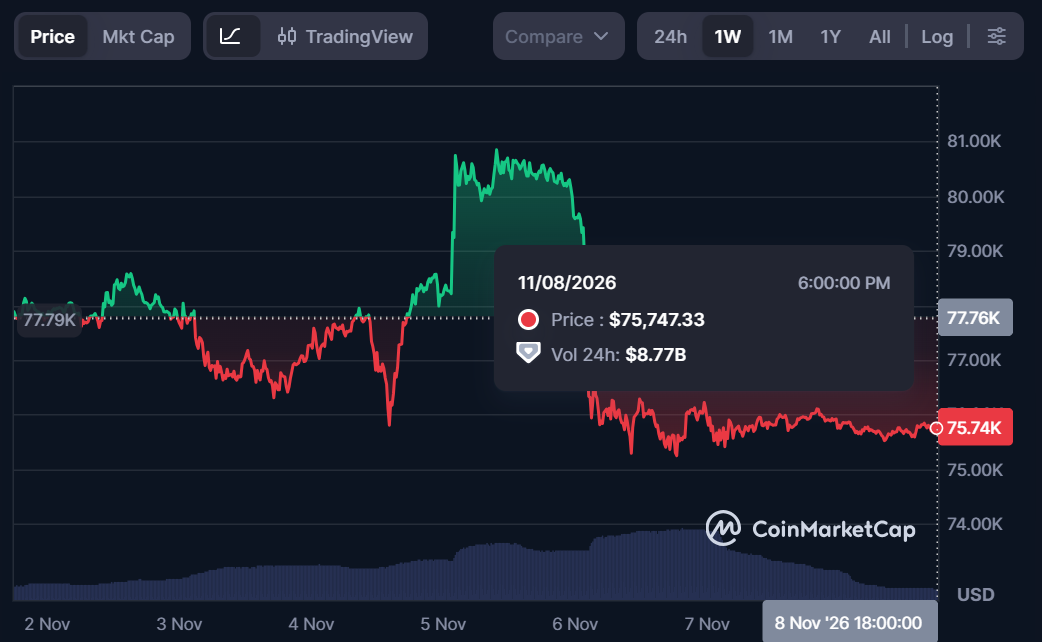
Source: CoinMarketCap. Past performance is not indicative of future performance.
Crypto news we’re watching
Binance backstops losses after record breach
Binance says approximately US$6.34 billion in digital assets were affected by its 29 October security breach, the largest crypto theft on record. The exchange says it has reserved more than enough of its own resources to cover customer losses and reported on 3 November that 98% of affected token assets had been replenished. Approximately US$2.85 billion in assets had been frozen or intercepted at that point.¹
Binance has committed to making customers whole, but that does not mean all stolen assets have been recovered. The incident exposes the operational risks that remain even at the industry’s largest exchanges, and makes stronger custody controls, independent verification and financial resilience central to mainstream adoption.
Circle shows the scale of digital dollar infrastructure
Circle reported US$865 million in third-quarter revenue and reserve income, up 17% year on year. Adjusted EBITDA rose 85% to US$317 million, while USDC on-chain transaction volume increased 49% to US$13.9 trillion. Circle has also agreed to acquire Singapore-based cross-border payments platform Tazapay, subject to regulatory approvals, with completion expected in 2027.²
Stablecoins are becoming part of financial infrastructure, but on-chain transaction volume does not necessarily represent payment activity. The key question is whether wider adoption and related services can support durable revenue beyond reserve income.
CRYP company spotlight
Hut 8 converts power into long-term AI contracts
Hut 8 has fully commercialised its Beacon Point AI data centre campus, signing a second 352 MW IT lease with its existing tenant. The deal lifts expected base-term contract value across its AI data centre portfolio to about US$26.6 billion. Hut 8 also increased energy capacity under exclusivity by 1,300 MW to 3,180 MW.³
The expansion shows how crypto infrastructure companies are seeking growth beyond Bitcoin mining. Power access and data centre capacity are valuable, but delivering these projects will require substantial investment. The contracted value is also dependent on successful delivery, rather than revenue already earned.
Hut 8 is held in the CRYP Crypto Innovators ETF. CRYP provides exposure to global companies involved in the crypto economy.5
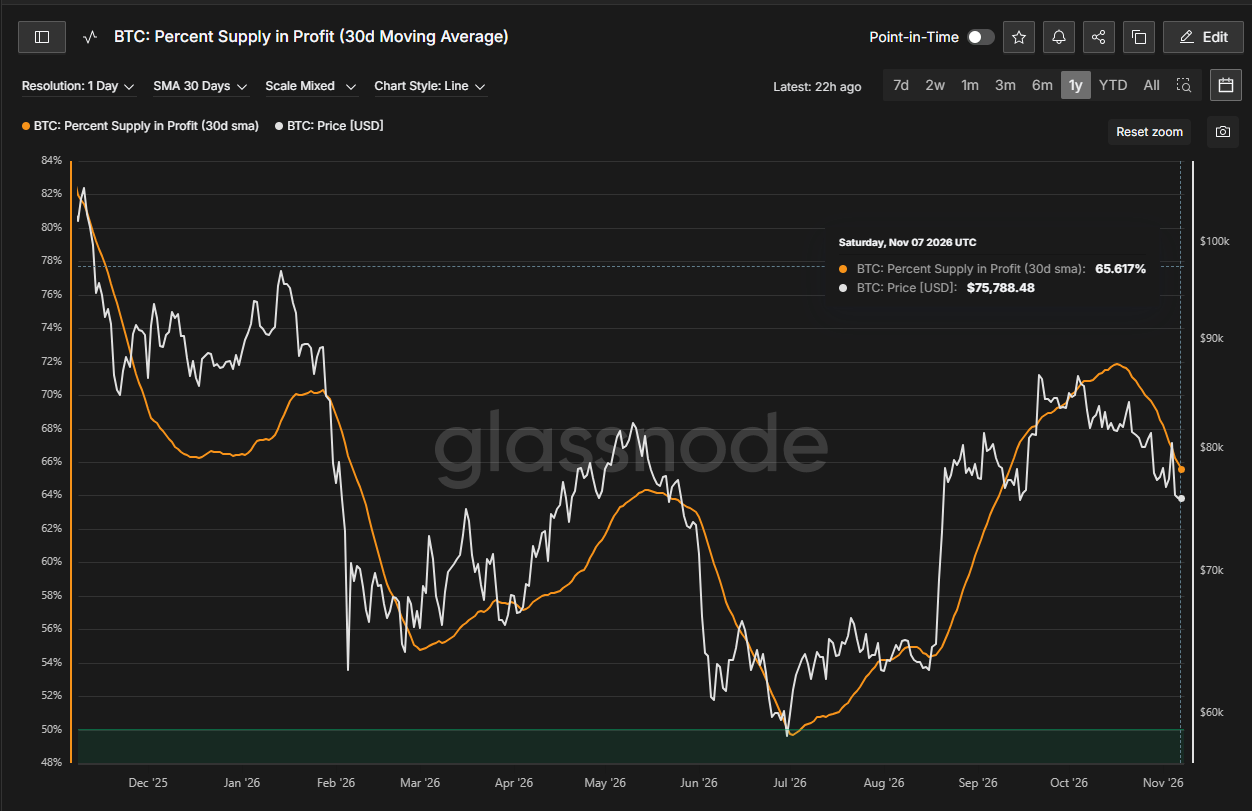
Bitcoin (BTC): Percent Supply in Profit (30d Moving Average)
This chart measures the percentage of Bitcoin’s circulating supply whose last on-chain movement was at a price below today’s price. A reading above 50% means more of the measured supply is in profit than in loss.
According to Glassnode, 65.6% of Bitcoin’s supply was in profit on 7 November, down from around 71.5% in October. Profitability has eased with the price, but most supply remains in profit.
Source: Glassnode. Past performance is not indicative of future performance.
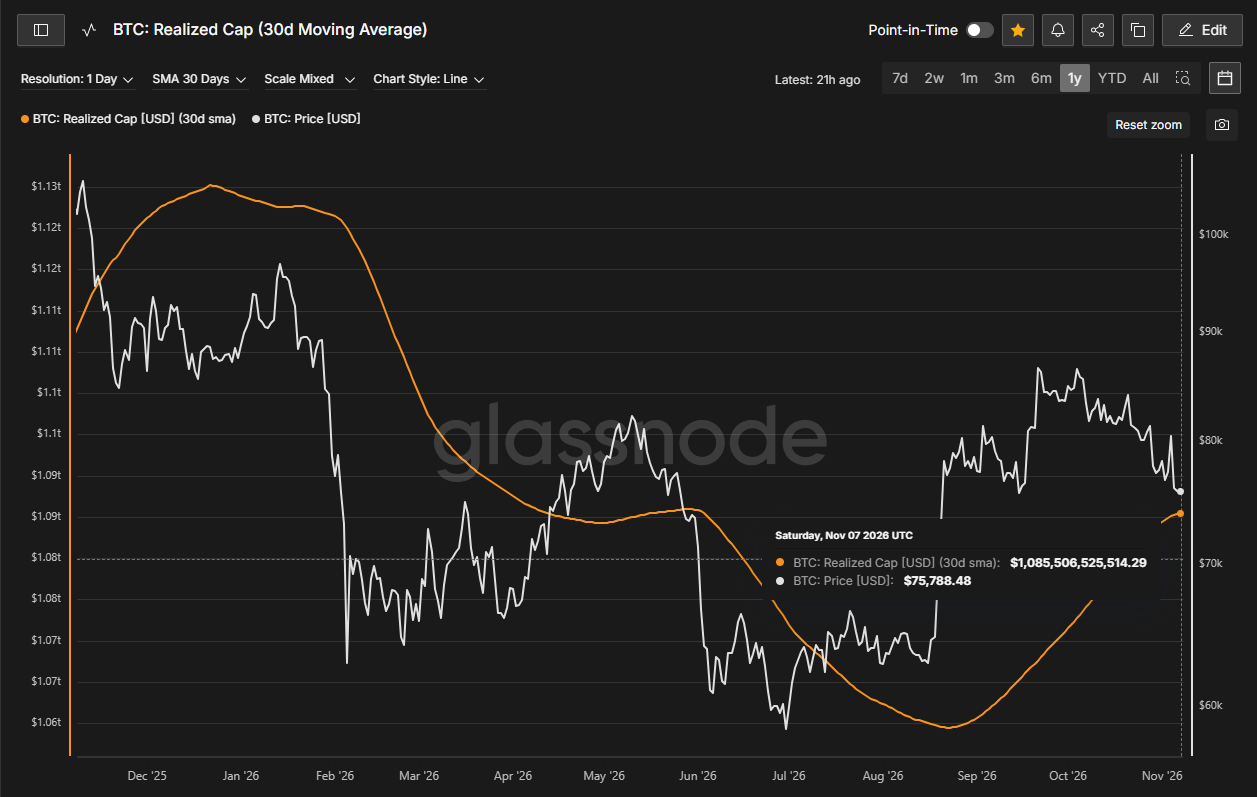
Bitcoin (BTC): Realised Cap (30-day moving average)
Realised cap values each bitcoin at the price it last moved on-chain, providing an estimate of Bitcoin’s aggregate cost basis. The 30-day average declined from its late-2025 high to a low around August 2026, then turned higher as BTC’s price retreated from more recent highs.
Glassnode’s 30-day average realised cap stood at approximately US$1.086 trillion on 7 November. Its recovery from the August low, despite weaker spot prices, suggests the network’s aggregate on-chain cost basis has begun to rebuild. This does not, on its own, confirm fresh net capital inflows.
Source: Glassnode. Past performance is not indicative of future performance.
Altcoin news
Most leading cryptocurrencies came under pressure over the past fortnight, but TRON (TRX) showed relative resilience. According to Token Terminal’s Q3 report, highlighted by TRON DAO, TRON processed US$2.18 trillion in stablecoin transfers, with average USDT supply on the network of US$90.75 billion and 1.08 billion transactions during the quarter. The numbers reinforce TRON’s growing role as infrastructure for dollar-denominated payments, even when token prices weaken. ⁶