



For financial adviser and wholesale client use only. Not to be distributed or made available to any retail clients.
Key points
The US 10-year Treasury yield closed above 5% last week, its highest level since 2007, while the 30-year yield also remains around 19-year highs. A “five-handle” on the 10-year is a line in the sand for many global investors, a level that hasn’t been sustainably breached in nearly two decades and could prove to be a catalyst for rebalancing out of risk assets into government bonds.
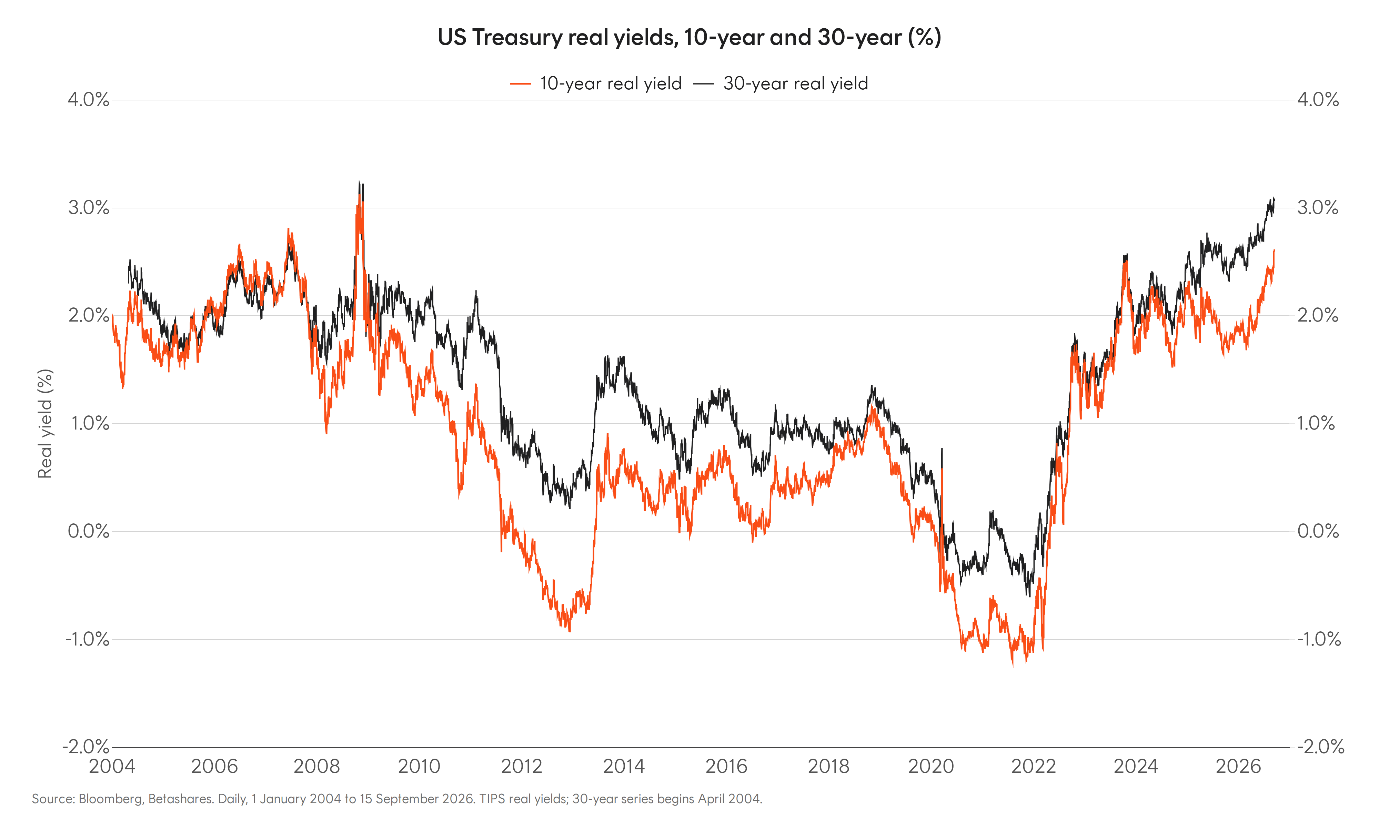
Real yields are doing much of the heavy lifting rather than long-term inflation expectations, with the 10-year real yield (indexed to US CPI) at 2.6% and the 30-year real yield above 3%, with both at post-GFC highs. The catalyst for the most recent rise in yields are fresh gains in crude oil after a shutdown of Saudi Arabia’s East-West pipeline, heavy Treasury and AI-related corporate issuance. The Federal Reserve also raised benchmark interest rates last week, their first time since 2023.
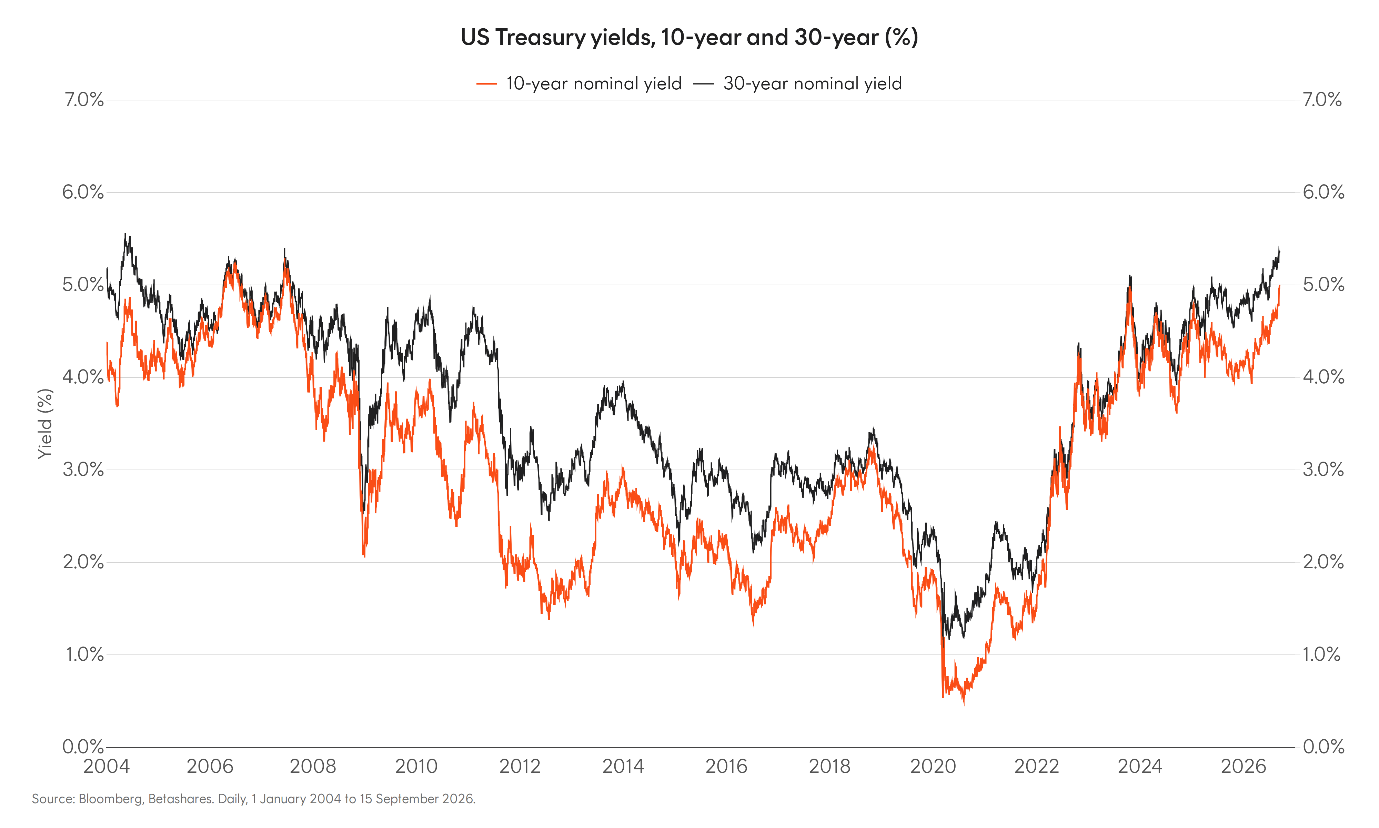
Initial conditions matter a lot for fixed income investors, and a real yield of 2.6% is more than double the average between 2000 and 2020 and sits above most estimates for trend US growth. Financial conditions should begin to tighten meaningfully at these levels, and the higher real yields climb, the greater chance something breaks in the real economy or risk assets. History also warns against aggressive tightening into supply shocks.
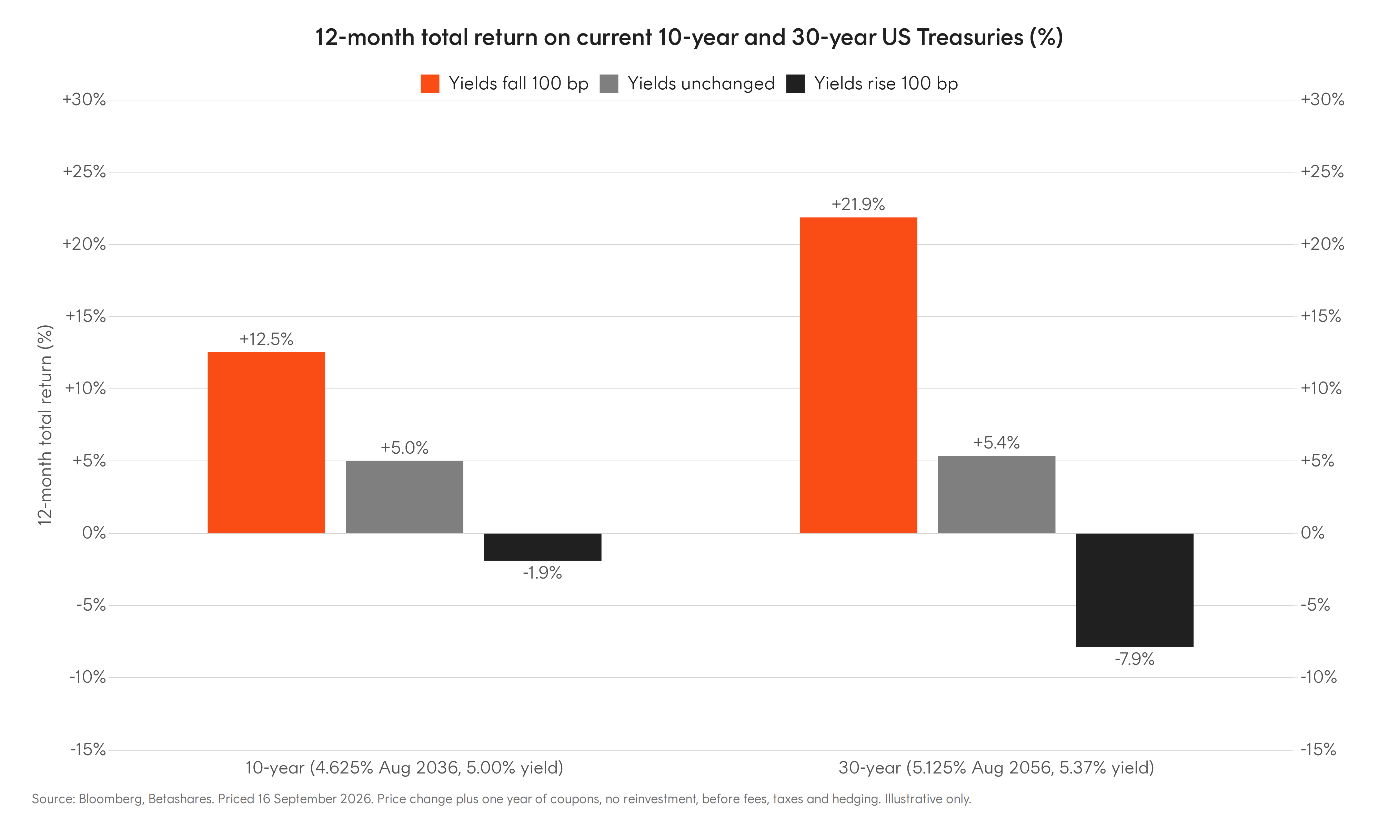
Less appreciated about long-term bonds is the value of convexity, which provides asymmetric upside vs downside. For a 10-year Treasury issued at par today, a 100-basis point rise over the next 12 months would produce a capital price loss of 6.9% (total return of -1.9%), while a 100-basis point yield decline would produce a 7.5% gain (total return of 12.5%) over the same period. For a 30-year point, the asymmetry is even wider.
Betashares offers the largest range of US Treasury ETFs in the Australian market, so investors can match the exposure with their view and risk tolerance.
- US10 U.S. Treasury Bond 7-10 Year Currency Hedged ETF provides cost-effective exposure to the benchmark 7-10 year part of the US Treasury bond universe, offering a local yield to maturity of 4.96%, with AUD-hedging benefits adding a further +0.48% p.a.
- GGOV US Treasury Bond 20+ Year Currency Hedged ETF targets the “ultra-long” 20+ year sector where the convexity is greatest and is currently providing a local currency yield to maturity of 5.42%, with AUD-hedging benefits adding another 0.48% p.a. in carry. For investors more concerned about a policy error and inflation overshoot.
- UTIP Inflation-Protected U.S. Treasury Bond Currency Hedged ETF captures a real yield of 2.48% above US CPI from exposure to the broad universe of US inflation-indexed Treasuries, with AUD-hedging benefits adding another +0.49% p.a. in carry. All three funds are hedged to Australian dollars have made a TOFA hedging election to improve tax efficiency.
For investors looking for a capital efficient way to add duration:
- GGFD Geared Long US Treasury Bond Currency Hedged Complex ETF offers geared exposure to 10-year US Treasury bonds via futures contracts, with the longest effective duration of any Australian-listed bond ETF at around 21 years.
- Conversely, BBFD Geared Short US Treasury Bond Currency Hedged Complex ETF provides a geared short exposure to 10-year US Treasury bonds, a simple way to remove duration from portfolios or position for a further rise in yields.