

David Bassanese
8 minutes reading time
Global week in review: easing oil prices
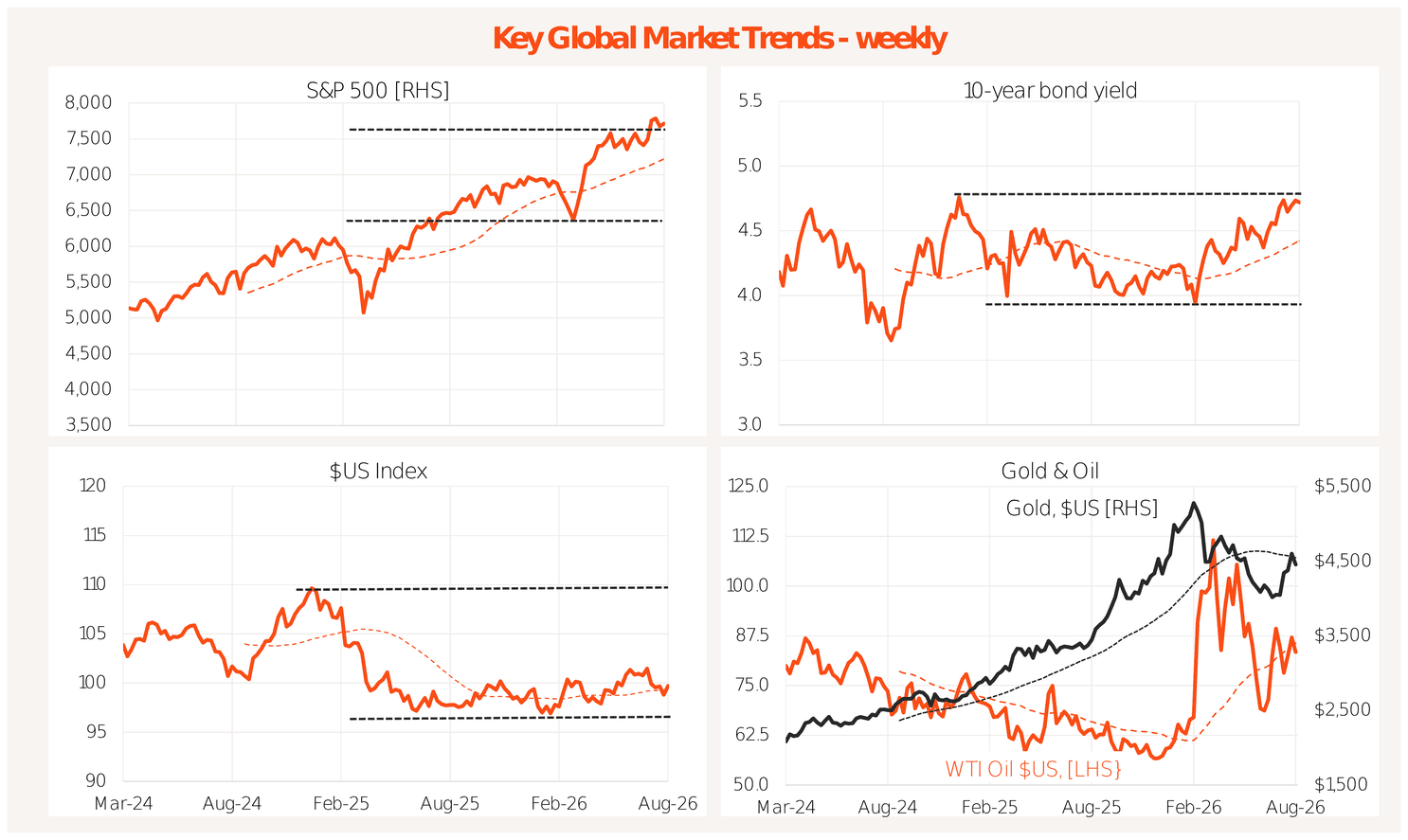
US equities inched back last week as easing oil prices and a reassuring Nvidia earnings update supported sentiment, despite more hawkish commentary from Fed chair Kevin Warsh.

Source: Betashares, Bloomberg.
Who needs a deal? Oil prices eased back last week with reports suggesting Iran and Oman were negotiating a deal to manage shipping traffic through the Strait of Hormuz. It could be that the Strait is reopened again without Iran needing to strike a deal with the US. Whether the US accepts this remains to be seen. The US may well continue to apply economic and military pressure to achieve concessions over Iran’s nuclear activity – though if oil starts to flow again this lingering dispute won’t matter as much for markets.
Also not striking a deal is Canada, which has essentially dared the US to inflict tariff pain, to which it will retaliate and just deal with domestically as best it can. Given Trump seems to renege on deals so readily, many countries may be deciding simply not to play his game.
In other news, Nvidia’s earnings update came as a great relief to markets. The fact that earnings comfortably beat expectations was probably no surprise, but the market took comfort that the company expected 70% growth in revenue next financial year. For now at least demand for computer chips to power the AI rollout remains strong.
Fed chair Warsh did inflict a sobering reality on markets by Friday, however, warning that US inflation remains too high and higher rates could be coming if it did not continue to ease back to the 2% target.
Of course, we’ve heard that before, yet the Fed kept rates on hold at the last two policy meetings despite more troublesome inflation reports than we’ve seen recently. With a soft labour market report and relatively more benign inflation readings for June and July, the case for a near-term US rate increase has actually lessened since these policy meetings. Only last week, the July measure of the core US personal consumption deflator rose only 0.2% – in line with market expectations.
Despite that, Warsh’s hawkish warning last week has the market placing a 60% probability on a rate hike at the September policy meeting. Key to the near-term rate outlook however will be Friday’s US payrolls report and the August CPI report on September 11. My base case remains that the Fed will remain on hold this year.
Global week ahead: US payrolls
The global highlight this week will be Friday’s US August payrolls report.
After a surprise 23k drop in employment in July, the market anticipated a 55k bounce back in August – keeping the unemployment rate steady at 4.1%. If so, such a modest rebound would support concerns that the labour market is slowing, further strengthening the case for the Fed to remain on hold next month.
For the Fed, however, also of note is the recent dip in the unemployment rate, suggesting some of the slowdown in employment growth is not just weakening demand but also slowing supply, due to both population ageing and the immigration slowdown.
Global equity trends: Technology strongest performer
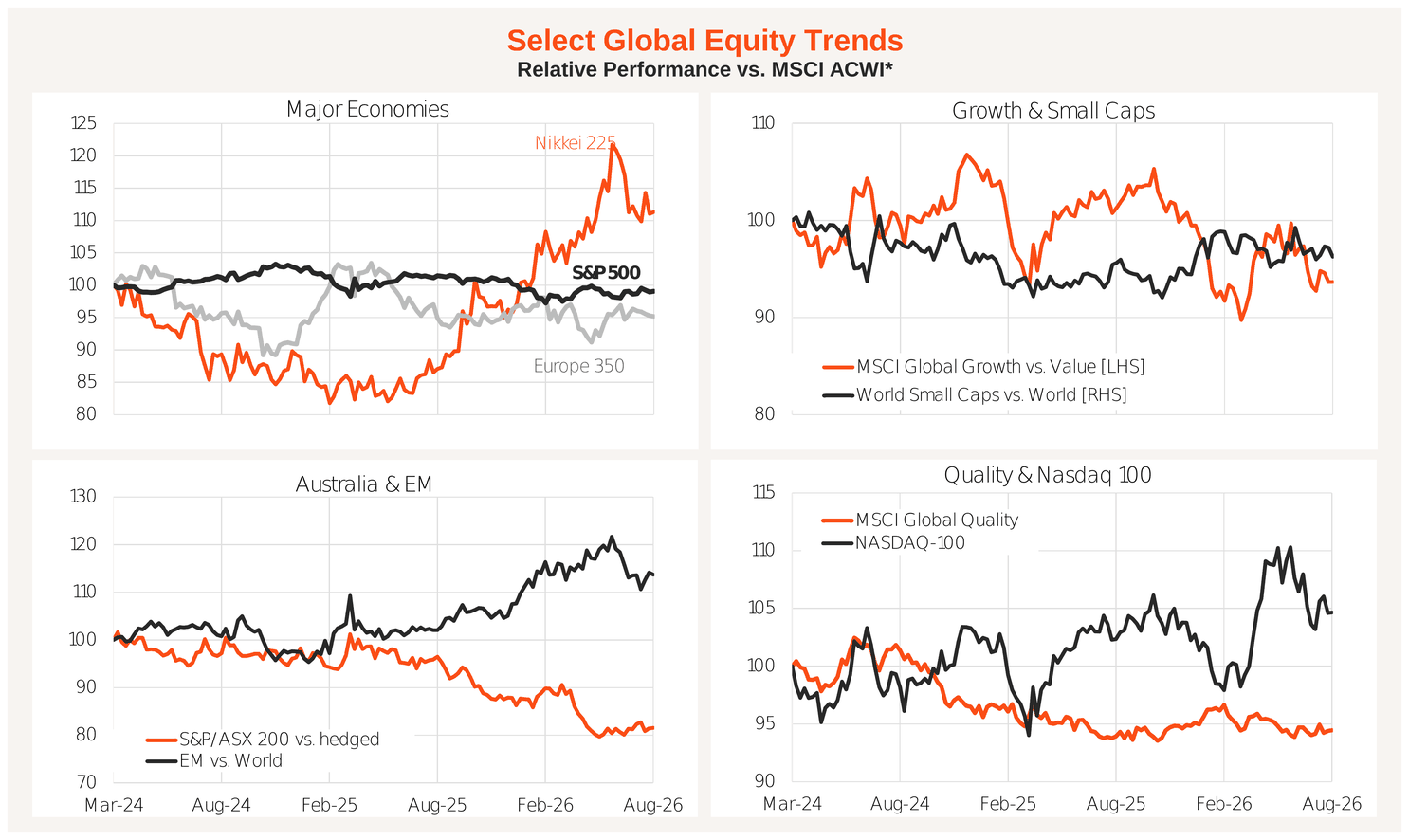
Easing oil prices saw the energy sector underperform last week, while technology and financials fared best. There were modest gains across developed markets, though the emerging market complex was flat.
Sector trends remain choppy, with technology underperforming since mid-year and more value-orientated sectors such as financials and energy taking up the baton.
*All but value factors. Local currency basis. Source: Betashares, Bloomberg.
Australia week in review: Hot July CPI
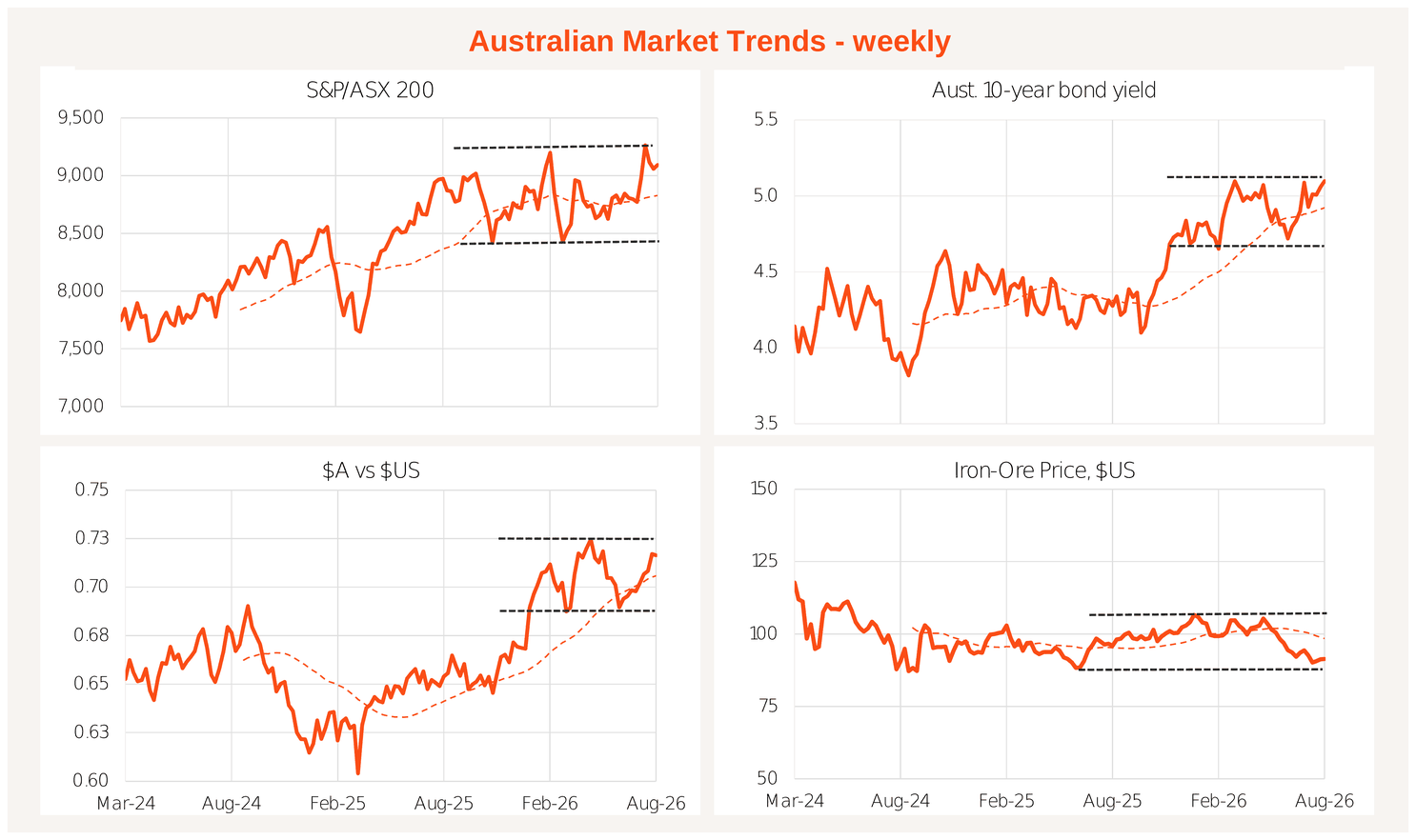
Local stocks moved higher last week, despite a firm local CPI report, with positive global sentiment providing support.

Source: Betashares, Bloomberg.
Local economic data last week was mixed, with weaker-than-expected reports on capital spending and construction, yet a surprisingly strong showing for consumer spending. But the big news of course was the higher-than-expected gain in “trimmed” mean underlying inflation.
Although construction activity declined by 2.1% in the June quarter, the underlying picture is one of housing, data centre and renewable energy strength, partly offset by easing in once-strong public infrastructure projects. Some of the June quarter weakness also reflected a drop in lumpy spending on offshore LNG projects which, due to different calculation methods, won’t be reflected in this week’s national accounts estimates of business investment.
What will be reflected in the national accounts, however, is the capital spending fall of 3.6% in the quarter, led by an unwind of the March quarter surge in data-centre-related spending. Overall capital spending plans for this financial year, however, remain robust.
With the business investment outlook still broadly firm, hopes for an inflation-easing slowdown in economic growth rest on consumer spending. In that regard, the 1.1% nominal gain in the household spending indicator (HSI) in July (and 7% growth over the year) would worry the RBA, though the linkage between this measure of spending and household spending in the national accounts has not been especially close. In the December and March quarters, for example, real growth in the HSI was 0.9% and 0.8% respectively, compared to gains of only 0.4% and 0.5% in the national accounts measure of consumer spending in each of those quarters. Real HSI spending in the June quarter slowed to 0.7%.
As noted above, the major news last week was the higher-than-expected 0.5% gain in trimmed mean inflation in July, with strength in market services and consumer durables. If sustained, such a monthly pace would force the RBA to upgrade its inflation outlook, likely also resulting in higher interest rates.
The hope, however, is that some of the inflation pressure last month reflected a one-off pass through of an increase in minimum award wages and possibly some seasonality in price increases at the start of each new financial year not yet fully captured by the ABS seasonal adjustment process. These doubts suggest the RBA may want to see at least one more inflation report before deciding to raise rates again.
Indeed, also released last week were the minutes to the RBA’s August policy meeting. Although inflation remains stubbornly high, the RBA reasoned that the recency of its interest rate increases – and tentative signs they were working to slow economic growth and inflation – meant it could afford to wait a while longer before deciding if it needed to do more.
The key appears to be whether economic developments over the next few months require the RBA to revise up its inflation forecasts – and last week’s CPI and HSI reports add to the risk that it may have to.
Of course, we get another GDP and labour market report before the RBA meets again in late September. But the Bank won’t have the advantage of seeing another monthly CPI report, which is due one day after the next RBA decision. Although strong GDP and/or employment reports could tip the RBA into raising rates next month, it still seems more likely November will be the next window of opportunity following the release of the September quarter CPI in late October – especially given doubts about the “signal” in last week’s July monthly CPI report.
All up, my base case remains that the RBA is on hold, as some of the increase in July inflation reflected one-off and seasonal factors – though I’m more nervous about this call than I was a week ago!
Local equity market trends: Rotation to resources
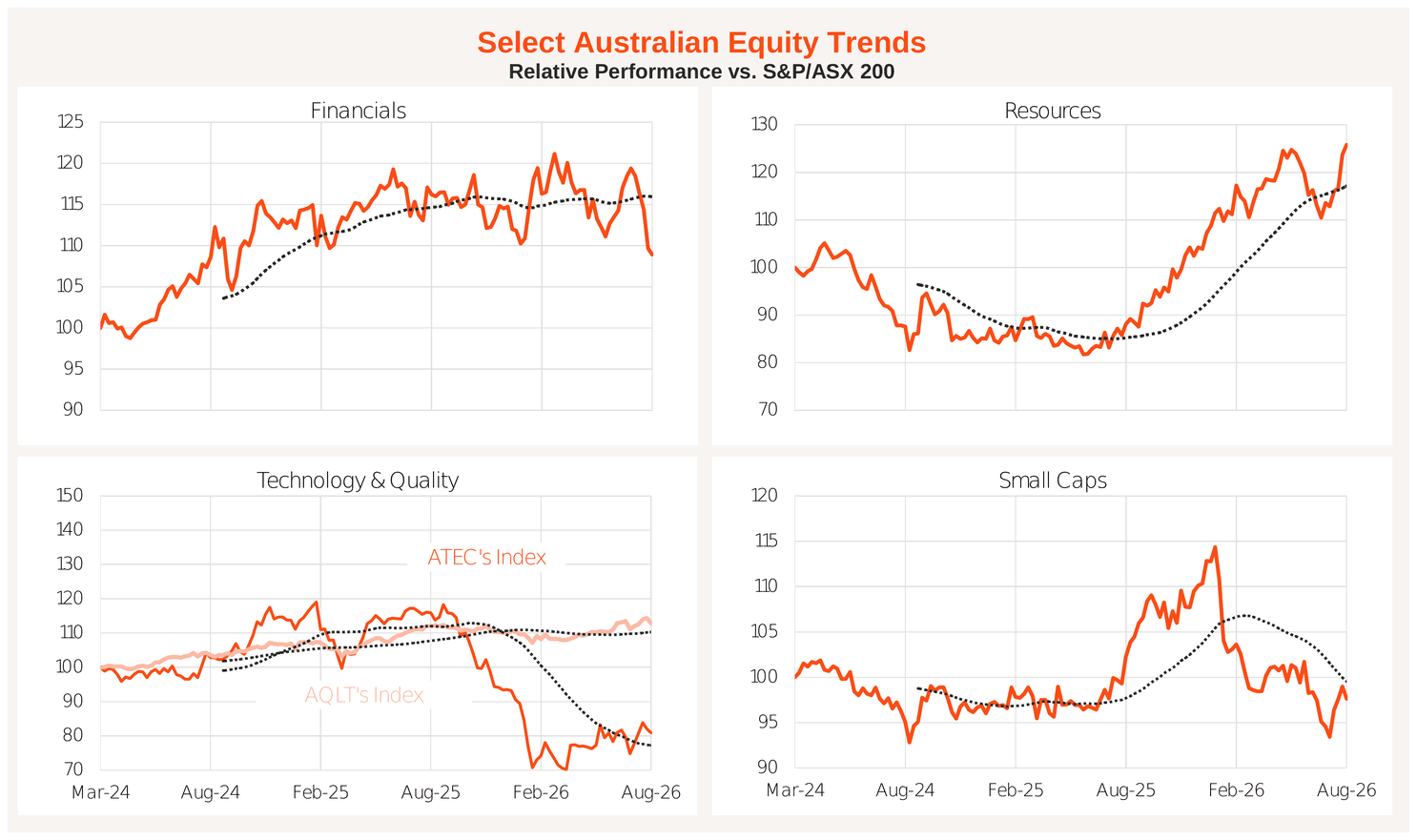
The materials sector was the standout last week as the AI and clean energy capital spending booms supported key commodity prices such as copper. Energy eased back in line with lower oil prices while fears of a near-term RBA rate hike – following the hot July CPI report – hurt the financial and consumer discretionary sectors.
Despite the weak domestic outlook, small cap relative performance has bounced higher in recent weeks, while technology is at least no longer underperforming.
Source: Betashares, Bloomberg.
Australia week ahead: Q2 GDP
Although there are several partial indicators still to come, this Wednesday’s June quarter GDP report is likely to show the economy remains relatively soft.
After a gain of only 0.3% in the March quarter (which was in part boosted by a strong data centre investment), current market estimates centre on another relatively subdued 0.3% gain. Dampening the June quarter result will be a likely fall back in business investment following the March quarter data-centre-related surge.
One wild card, however, will be consumer spending – with the HSI measure hinting at a potentially stronger gain than the 0.4% evident in the March quarter. However, as noted above, the HSI has tended to overstate the national-accounts measure of consumer spending in recent quarters.
Have a great week!