

From 1 July 2027, the Capital Gains Tax (CGT) for individuals, trusts and partnerships will be calculated based on cost base indexation with the removal of the 50% discount. Advisers and their clients do have alternatives that are not necessarily impacted by the new CGT rules, such as superannuation and structures like investment bonds. However most individuals are likely to continue holding at least some assets in their own name, so understanding the new CGT rules is imperative for advisers.
One critical aspect of the new rules is that how the cost base is calculated for a capital gain differs from that of a capital loss. This asymmetric treatment can create a tax drag.
Under indexation, the cost base of each asset increases in line with CPI over the holding period. But if the asset is sold for:
- Greater than the indexed cost base: a capital gain is recognised, calculated as sale proceeds less the indexed cost base
- Between the original and indexed cost bases: there is no capital gain or loss
- Less than the original cost base: a capital loss is recognised, calculated as sale proceeds less the original cost base. Indexation does not apply to losses.
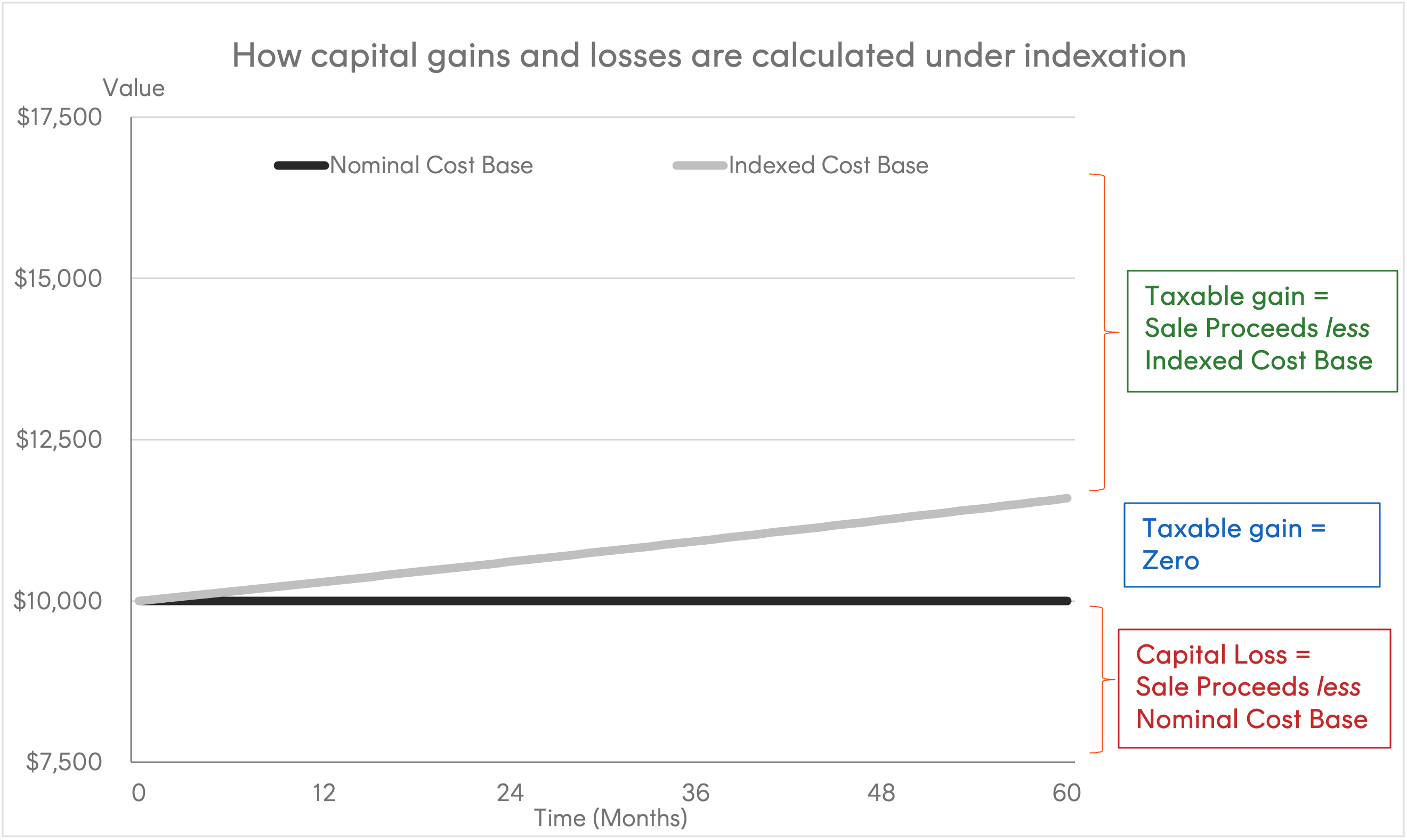
Hypothetical example only, assumes cumulative indexation factor of 1.15 over five years. Indexation shown as a linear increase for simplicity. Actual tax outcomes will vary depending on individual circumstances. This is not financial, tax or legal advice.
We coined the phrase ‘Triangle of Sadness’ to describe the widening gap between the indexed and nominal cost base, and the impact of this asymmetric tax treatment. For investors holding a portfolio of direct shares, that asymmetry can result in tax being paid on a real economic gain that simply isn’t there. For this reason, we argue that a low turnover index tracking ETF is a more tax efficient vehicle under the new CGT rules than holding a portfolio of shares directly in an individual’s own name. We have written about this topic in the past, to explain the mechanics of how CGT is applied at a share portfolio level (here) and to qualify the potential impact (here).
But the Triangle of Sadness still exists, even for ETF investors
The asymmetric CGT treatment is acute for a stock portfolio, due to the high level of single stock volatility and price dispersion. But it still can apply to an individual holding multiple ETFs in their own name.
Consider the following hypothetical example. An individual invests $20,000 across two ETFs, $10,000 into an Equity ETF and $10,000 into a Bond ETF. The investor sells both five years later when their indexed cost base is $11,500 each, with disposal proceeds of $14,000 and $10,000, respectively.
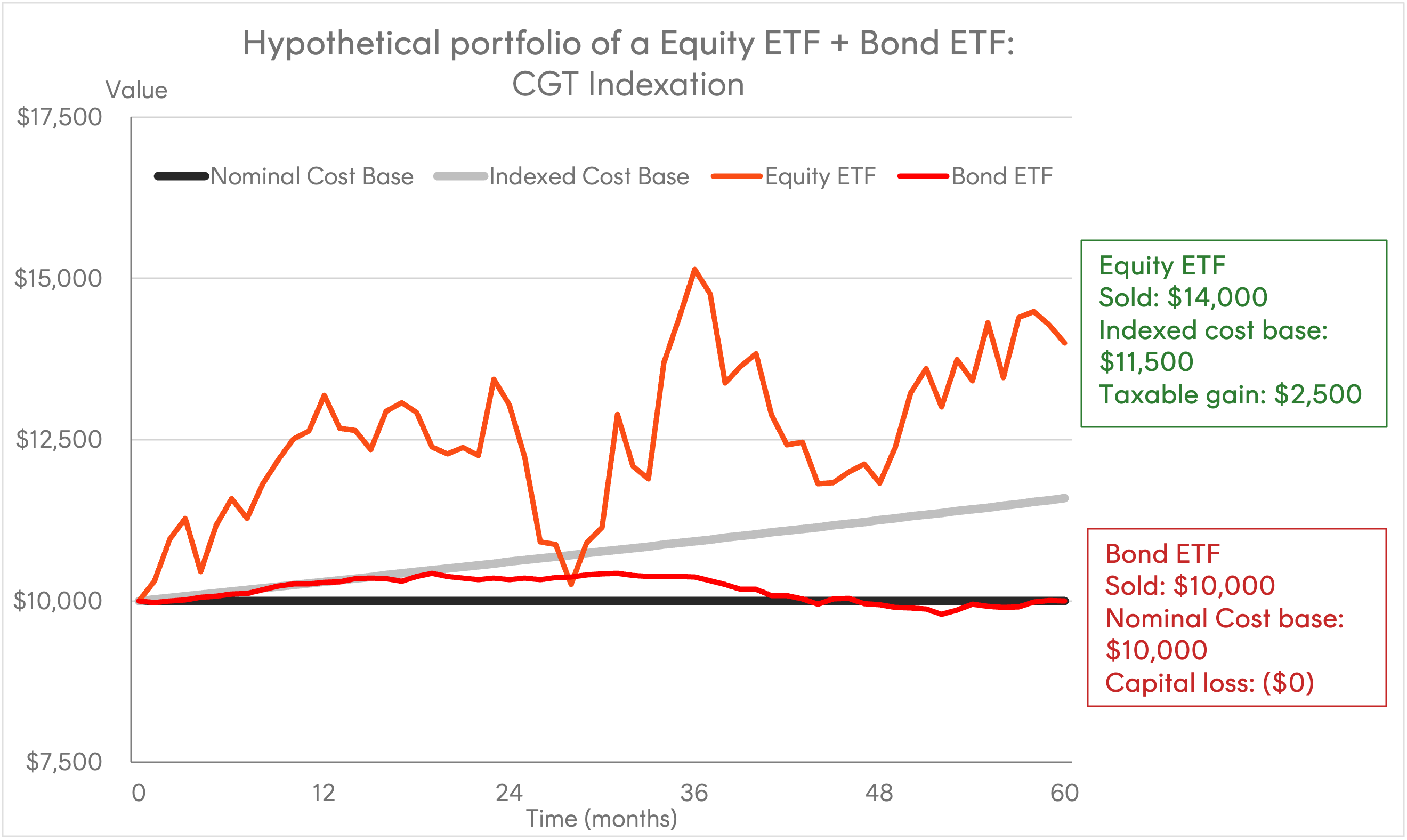
Hypothetical example, assuming CGT indexation treatment, purchase price of each ETF holding is $10,000 and each are held on capital account for 5 years with a cumulative indexation factor of 1.15, before being sold for the figures shown. Actual tax outcomes will vary depending on individual circumstances. This is not financial, tax or legal advice.
The real capital gains are calculated at the individual asset level, with a taxable gain of $2,500 for the Equity ETF and no gain or loss on the Bond ETF. However, at a portfolio level the nominal gain is $4,000 ($24,000 sale proceeds less $20,000 cost), while the indexed cost base has increased by $3,000 to $23,000, so the real, post-indexation portfolio gain is only $1,000. Yet the investor is taxed on $2,500, which is 2.5x the real portfolio gain.
How does a Diversified ETF help?
Now consider the same two ETFs held within a single Diversified ETF. The investor’s cost base is the unit price they paid for the Diversified ETF, not the prices of the underlying ETFs. The Diversified ETF itself is the CGT asset, indexation is applied on that asset, and capital gains calculated based on what that asset is sold for, there is no look through to the underlying ETFs.
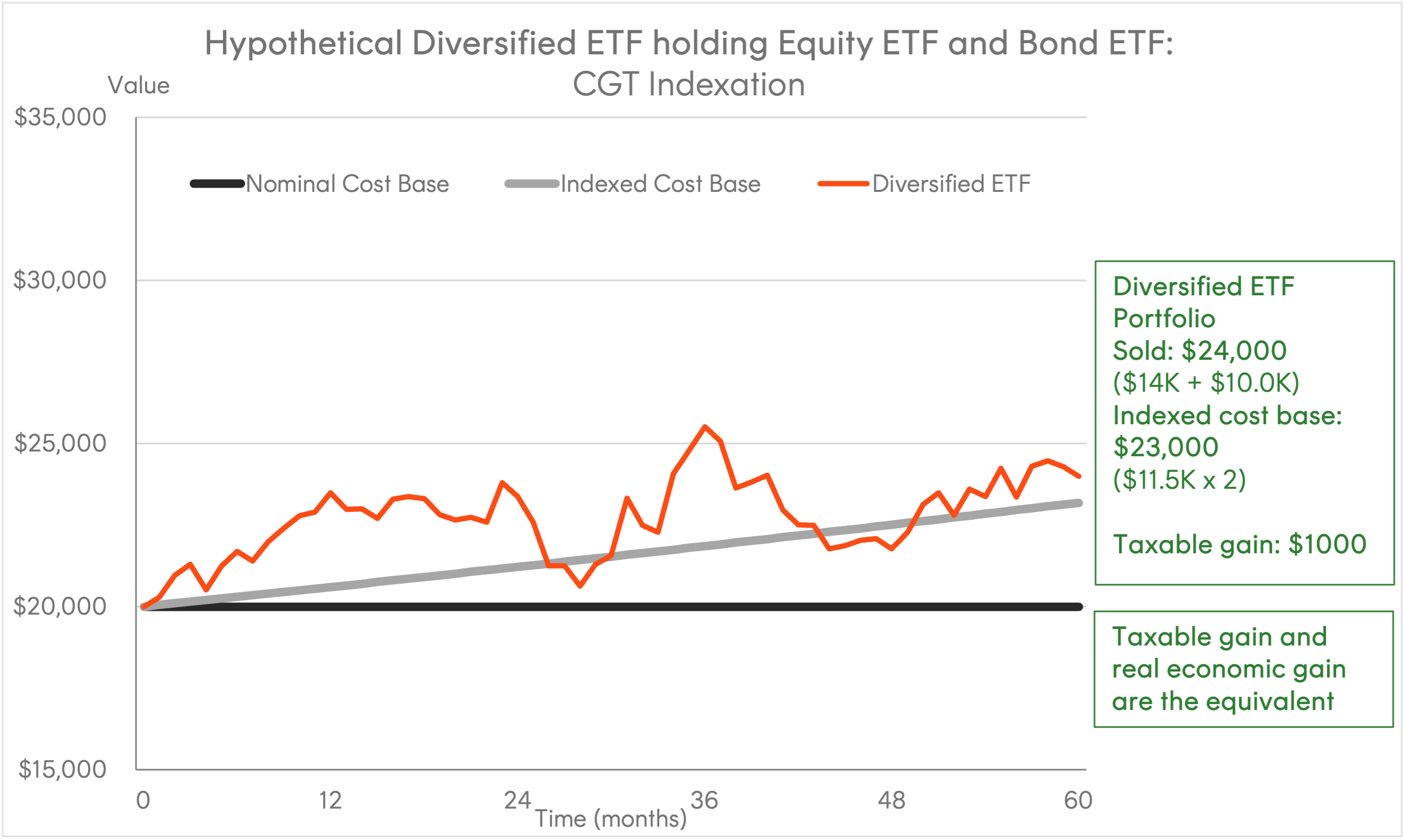
Hypothetical example, assuming CGT indexation treatment, purchase price of Diversified ETF holding is $20,000 and it is held on capital account for 5 years with a cumulative indexation factor of 1.15, before being sold for the figure shown. Actual tax outcomes will vary depending on individual circumstances. This is not financial, tax or legal advice.
In the example above, the investor’s cost base is $20,000 and they sell the ETF for $24,000 five years later (the sum of the values of the underlying ETFs at the time). Indexation applies to the entire cost base, resulting in a taxable gain of $1,000, matching the portfolio level real economic gain. The investor is not penalised with a higher tax bill as a result of the Bond ETF underperforming inflation from a capital growth perspective.
The ability to aggregate at a portfolio level by using a Diversified ETF can be very effective for an individual investor, particularly where their risk profile dictates some allocation to defensive assets like cash or bonds. Such assets are unlikely to generate capital growth in line with inflation, so by pooling these assets with equities the aggregate portfolio level taxable capital gain will likely be meaningfully lower.
Depending on asset performance and weighting to defensive assets, an individual holding a multi asset Diversified ETF may pay little or even no CGT under cost base indexation. Indeed, indexation may be more favourable than the former CGT discount wherever capital growth runs below roughly twice CPI, an outcome that is reasonably likely for a Diversified ETF with a balanced or even a growth risk profile.1
Taken to the extreme, one might even think of cash held on the sidelines as a missed opportunity to shelter capital gains generated in the sharemarket.
There is one important caveat to the argument above for a Diversified ETF. The example shown assumes there is no rebalancing of the two underlying ETFs back to the Diversified ETF’s target asset allocation. Rebalancing turnover within the Diversified ETF is likely to lead to some capital gains being distributed to the investors in that ETF, and a tax drag that detracts from after-tax performance at the margin.
However, Betashares has adopted a rebalancing strategy that seeks to minimise unnecessary portfolio turnover and builds the diversified portfolios out of index tracking ETFs, which are generally very efficient at reducing ongoing CGT distributed to investors, as discussed here.
Betashares Multi Asset Diversified ETF range
Our multi asset Diversified ETFs provide exposure to over 2,000 companies and 12,000 bonds across Australian and global markets.2 With management fees of 0.19% p.a., the lowest fee amongst all-in-one Diversified ETFs available in Australia3, they are professionally constructed in a range of risk profiles to match different clients’ investment objectives and risk tolerances.
| Ticker | ETF Name | Risk profile | Growth / Defensive | Management Fee* |
|---|---|---|---|---|
| DHHF | Betashares All Growth ETF | All Growth | 100% Growth | 0.19% p.a. |
| DVHG | Betashares Diversified High Growth ETF | High Growth | 90% Growth / 10% Defensive | 0.19% p.a. |
| DVGR | Betashares Diversified Growth ETF | Growth | 75% Growth / 25% Defensive | 0.19% p.a. |
| DVBA | Betashares Diversified Balanced ETF | Balanced | 60% Growth / 40% Defensive | 0.19% p.a. |
Above and beyond the efficient tax outcomes under CGT indexation, these Betashares Diversified ETFs offer additional structural advantages that are not necessarily found in the Diversified ETF offerings from other providers. Our Diversified ETFs:
- Are built using only ETFs, not unlisted funds. Utilising ETFs as the sole underlying funds instead of unlisted managed funds comes with key benefits. ETFs can be more tax-efficient than actively managed unlisted funds because they generally have lower portfolio turnover and better mechanisms for limiting capital gains passed on to continuing investors.
- Are managed using tax-aware rebalancing. The rebalancing strategy seeks to minimise unnecessary portfolio turnover and the realisation of capital gains, while keeping each Fund aligned with its target asset allocation and intended risk profile.
- Ensure currency hedging is tax efficient. The currency-hedged underlying ETFs each have 100% of assets elected into TOFA. For investors, this can improve the alignment between the tax treatment of the currency hedge and the underlying investment exposure, reducing tax distortions and improving after-tax efficiency over time.