



Last week’s talks between the US and China delivered few major breakthroughs on core issues such as the Middle East, rare earth export controls and Taiwan. While an extended trade truce and a new AI safety channel may ease near-term tensions, unresolved issues around the former topics mentioned may cause further volatility for global markets and Australia’s ASX 200 as we head into the final quarter of the year.
1: Form over substance – trade truce extended
The US and China have agreed to extend a bilateral trade truce that was set to expire in November through to January 10, 2027.
While this may temporarily ease near-term tensions, US-China trade has continued to weaken post 2019 with the US’ goods trade deficit with China contracting significantly from its peak of US$417 billion in 2018 to just US$200 billion last year.
Significant tariffs imposed during Trump’s second administration in April last year accelerated this trend with triple digit levies causing Chinese shipments to plunge.
However, the aggregate US trade imbalance has not shrunk so much as redistributed, with deficits against Vietnam, Taiwan and India all hitting record highs as supply chains shifted to other Asian manufacturing hubs rather than returning to American shores.
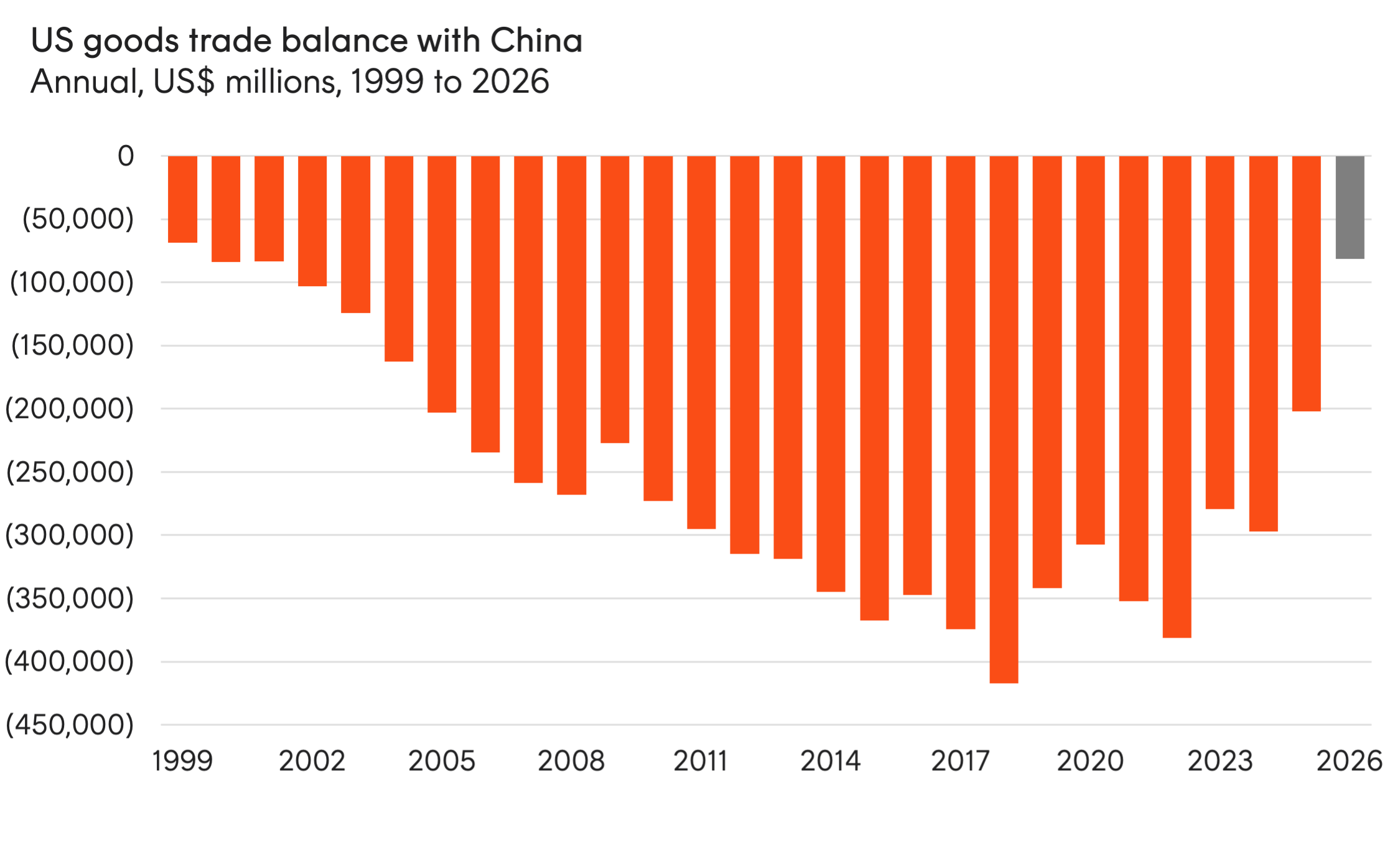
Source: U.S. Bureau of Economic Analysis. 1999 to June 2026. Balance on goods; 2026 covers January to June only.
2: How would a US diesel export ban affect refining margins and prices at the servo?
The Trump administration is considering a 90-day restriction on US diesel exports to combat record-high domestic fuel prices. In the short term, some US regions could see some price relief as tankers originally destined for Europe or Asia are redirected back into the American fuel system, temporarily boosting supply.
While this may address voter concern around cost-of-living pressures with midterm elections approaching, the effect is unlikely to last as refiners would eventually slow production in response, tightening supply and push prices back up.
For Australian consumers, and our mining and agricultural industries which rely heavily on diesel imports, the policy could be particularly painful as reduced US diesel availability on global markets intensifies competition for alternative supplies and would likely drive import costs higher.
Non-US refiners could instead benefit from rising international crack spreads, or the price difference between crude oil and the petroleum products made from it such as gasoline, diesel and jet fuel.
ICE gasoil crack spread vs Brent
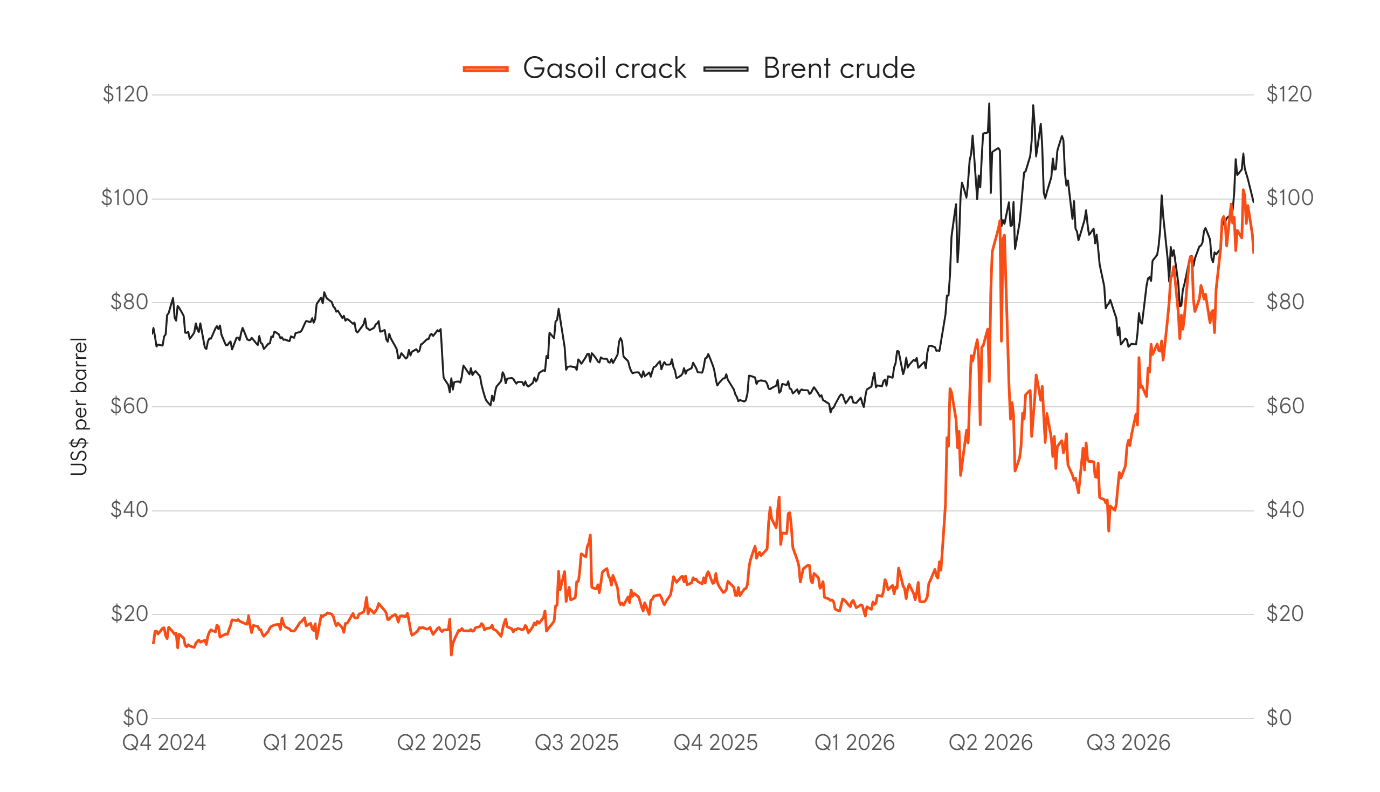
Source: Bloomberg, Betashares. Gasoil converted from tonnes to barrels at 7.45 bbl per tonne, then less Brent crude. The crack is a proxy for diesel refining margins: a wider crack means diesel is richer relative to crude.
3: Show me the money!
There’s no doubt that AI related investments have been a key driving force for stock market returns and overall economic growth. But with more than US$1 trillion in hyperscaler capex expected next year the rate of growth of this figure will likely slow due to increasing external financing requirements and potential bottlenecks from government restrictions on data centre construction or slowdown in frontier model roll-out.
Increasingly, investors are becoming more granular and asking what revenues are required to generate a return on these investments.
Goldman Sachs Investment Research group estimate that the hyperscalers would need to generate annual AI revenues of roughly US$300 billion in the next few years to break even on their average annual capex investments in 2026 and 2027.
These estimates reflect their expectations for average annual AI capex in 2026 and 2027. The breakeven revenues required for this capex represent the sum of annual depreciation and operating expenses.
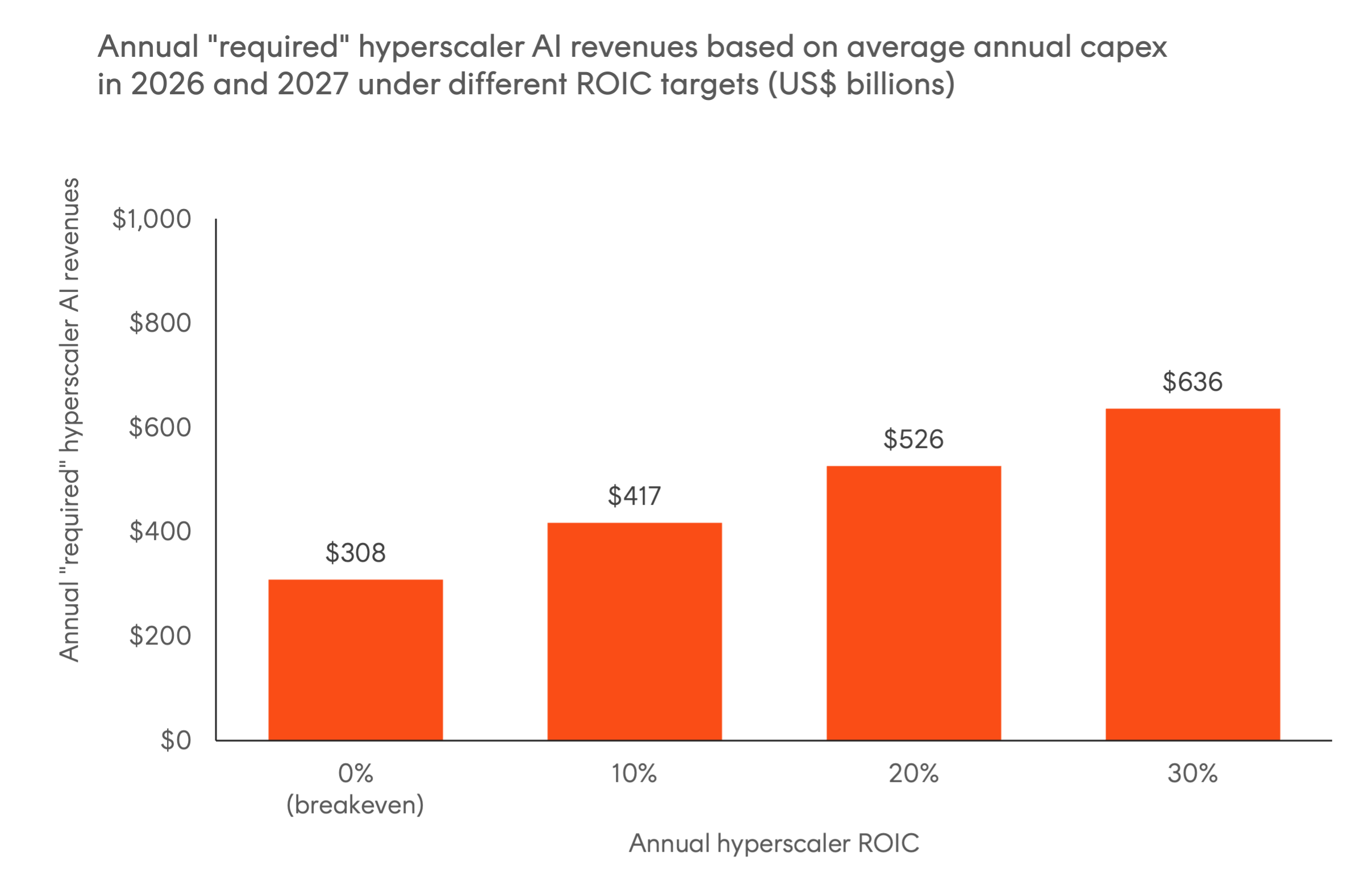
Source: Goldman Sachs Global Investment Research. Hyperscalers include AMZN, GOOGL, META, MSFT, ORCL, and SPCX. “Required” AI revenues equal the sum of the estimated annual depreciation, annual operating expenses, and return on invested capital using gross capex, based on Goldman Sachs estimate of average annual AI capex in 2026 and 2027.
4: Earnings strength muscling through higher bond yields
The US 10-year government bond yield climbed above 5% this month, its highest level since 2007, as persistent inflation and resilient growth data reinforce a higher for longer narrative, while structural pressures from ballooning fiscal deficits, heavy bond issuance and the capital demands of the AI infrastructure buildout have kept additional upward pressure on the long end.
Yet US equity markets have remained sanguine off the back of strong earnings growth which has absorbed the higher discount rate and modestly compressed price-to-earnings multiples. The equity risk premium, a form of ‘compensation’ for investing in stocks vis a vis bonds, has broadly remained stable even despite rising bond yields.
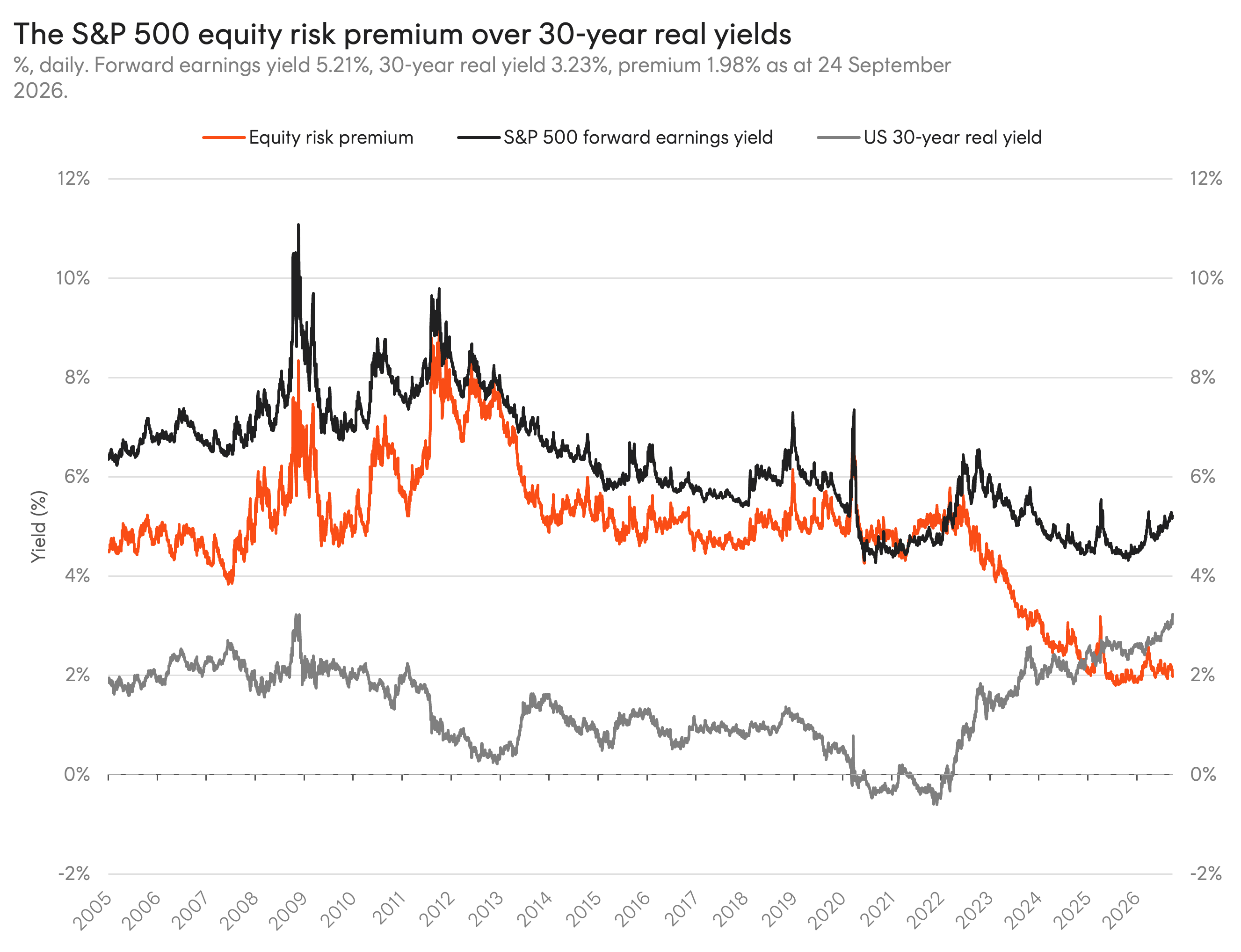
Source: Bloomberg, Betashares. As at 24 September 2026. The forward earnings yield is the inverse of the S&P 500’s blended 12-month forward price-to-earnings ratio on consensus earnings estimates. The real yield is the generic 30-year US Treasury inflation-indexed yield. The equity risk premium is the difference between the two.
5: Running out of luck?
Australia’s stock market however continues to struggle, down 3.6% for the month1 and flat for the year. Earnings growth has not kept pace with its global counterparts with the equity risk premium nil.
Yesterday’s rate rise, including three earlier ones this year, continue to pressure certain pockets of the market such as consumer discretionary with companies like JB HiFi, Harvey Norman and Premier Investments all facing headwinds. Overall, productivity growth remains weak and the effects of the government’s landmark tax reforms will likely remain an overhang for house prices, consumer spending through the wealth effect, and the broader financials sector.
One positive is Australia’s materials sector which has benefited from the structural rise in copper prices, supporting miners such as BHP and Rio Tinto.
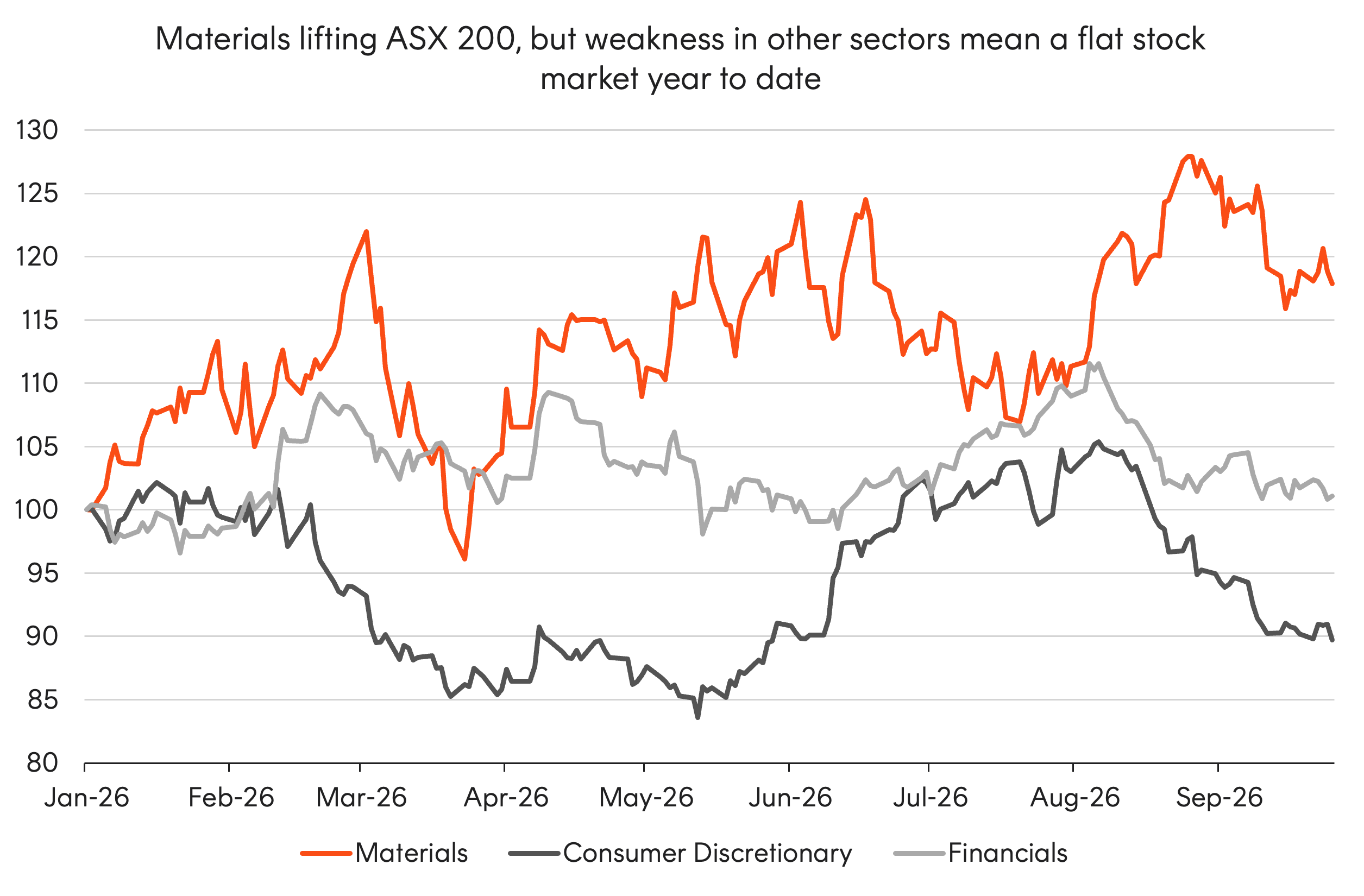
Source: Bloomberg, Betashares. 1 January 2026 to 25 September 2026. S&P/ASX 200 Materials, Consumer Discretionary and Financials sector indices (total return, gross dividends) have been rebased to 100, as at 1 January 2026. Past performance is not an indicator of future performance. You cannot invest directly in an index.