



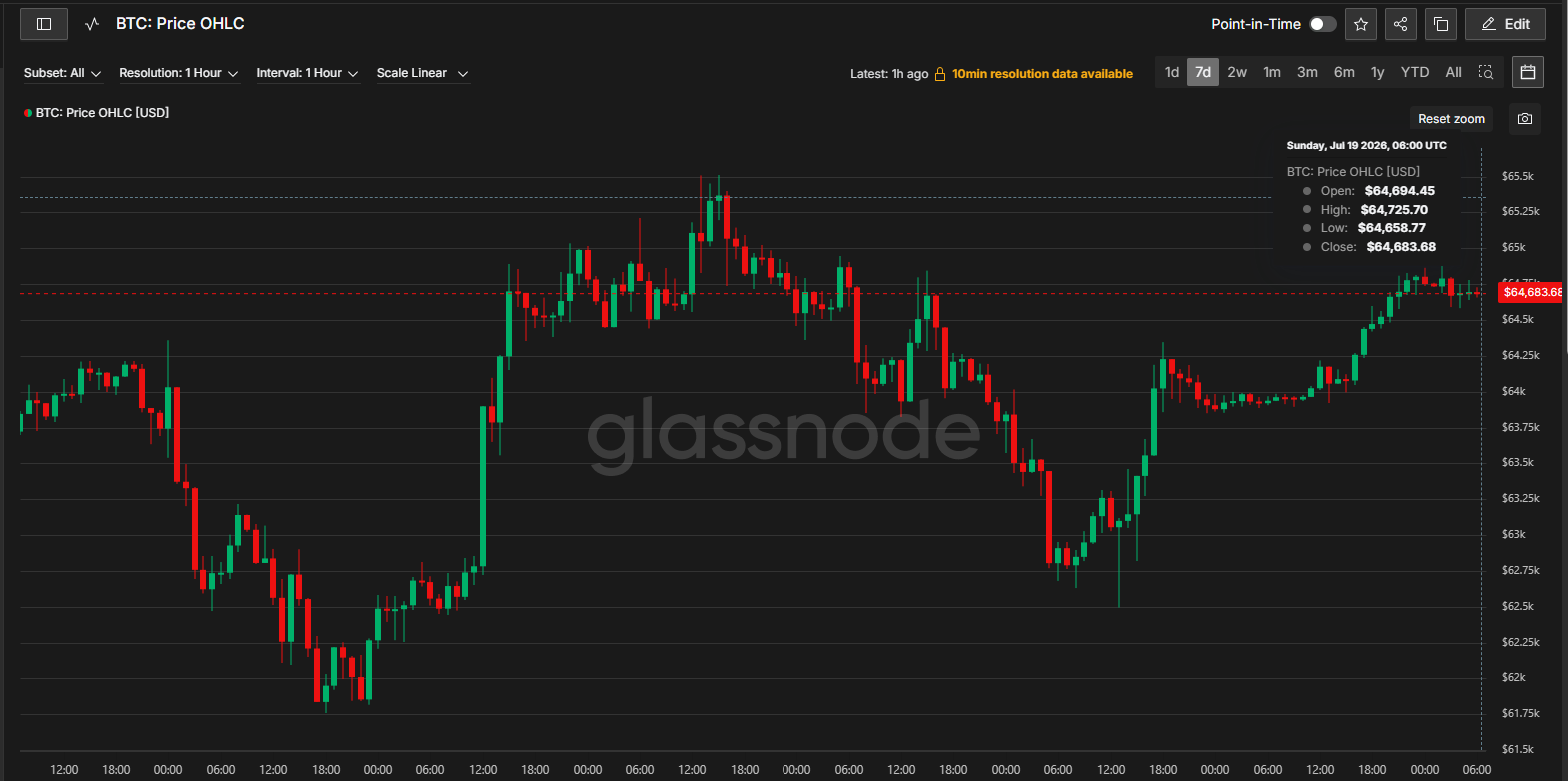
Bitcoin and the broader crypto market finished the week marginally higher, with Bitcoin hitting as high as $65K on lower-than-expected CPI numbers before settling just below.
Over the seven days to 19 July 2026, Bitcoin and Ethereum edged higher by 1.29% and 3.97%, respectively. Bitcoin’s market capitalisation is at US$1.29 trillion, while the global crypto market sits at US$2.21 trillion. Bitcoin’s market dominance sits at 58.7%.
| Price | High | Low | Change from previous week | |
|---|---|---|---|---|
| BTC (in US$) | $64,675 | $65,421, | $61,849 | 1.29% |
| ETH (in US$) | $1,868 | $1,938 | $1,750 | 3.97% |
Source: CoinMarketCap. As at 19 July 2026. Past performance is not indicative of future performance. Performance is shown in US dollars and does not consider any USD/AUD currency movements.
Source: Glassnode. Past performance is not indicative of future performance.
Crypto news we’re watching
Tokenisation becomes a strategic priority
A new Broadridge survey shows tokenisation is no longer being treated as a future experiment, with 84% of financial firms now viewing it as strategically important. The findings suggest institutions are moving from early exploration towards practical implementation, with many expecting tokenised and traditional assets to operate side by side rather than in separate systems1.
Tokenisation is increasingly being viewed as part of future market infrastructure, not just a crypto use case. As firms invest in hybrid systems that connect traditional rails with blockchain-based assets, the direction of travel is becoming clearer: tokenisation is moving from concept to operating model.
Circle moves closer to the banking system
Circle Internet Group shares surged on 10 July after the company received OCC approval (the Office of the Comptroller of the Currency — the federal agency that charters and supervises national banks) to establish Circle National Trust Bank, a separate Circle entity that will provide digital asset custody and oversee key aspects of USDC reserve management giving the USDC issuer a stronger regulated footing as stablecoin competition intensifies. The approval allows Circle to bring key functions such as reserve management and institutional custody closer to direct federal oversight, strengthening the regulated infrastructure supporting USDC.2
Stablecoin issuers are no longer just trying to build crypto payment rails: they are increasingly moving into the regulated banking perimeter. For Circle, the charter strengthens credibility with institutions and supports the broader theme that digital dollars are becoming part of mainstream financial infrastructure.
CRYP company spotlight
Power becomes the scarce asset
TeraWulf’s CEO argues the AI infrastructure race is not simply about access to power, but access to the right kind of power. As AI demand accelerates, grid-ready megawatts with the right location, connectivity and infrastructure are becoming increasingly scarce and valuable. Bitcoin miners with high-quality power assets are being re-rated as AI infrastructure providers, not just crypto miners.3
TeraWulf has secured a 20-year lease with AI company Anthropic for around 401 MW of critical IT capacity at its Kentucky data campus. The deal is expected to generate US$19 billion in contracted revenue.
TeraWulf is held in the CRYP Crypto Innovators ETF5. CRYP provides exposure to global companies at the forefront of the crypto economy.5
Bitcoin (BTC): Price Drawdown from ATH
This chart shows the percent drawdown of the asset’s price from the previous all-time high.
According to Glassnode data as of 18 July 2026, Bitcoin’s current drawdown sits at around -48%, having recovered from a recent low of -53%. While still significant, the current drawdown remains well below the -75% decline seen in the November 2022 bear market, making this cycle’s correction less severe so far.

Source: Glassnode. Past performance is not indicative of future performance.
Bitcoin (BTC): Long-Term Holder Net Position Change
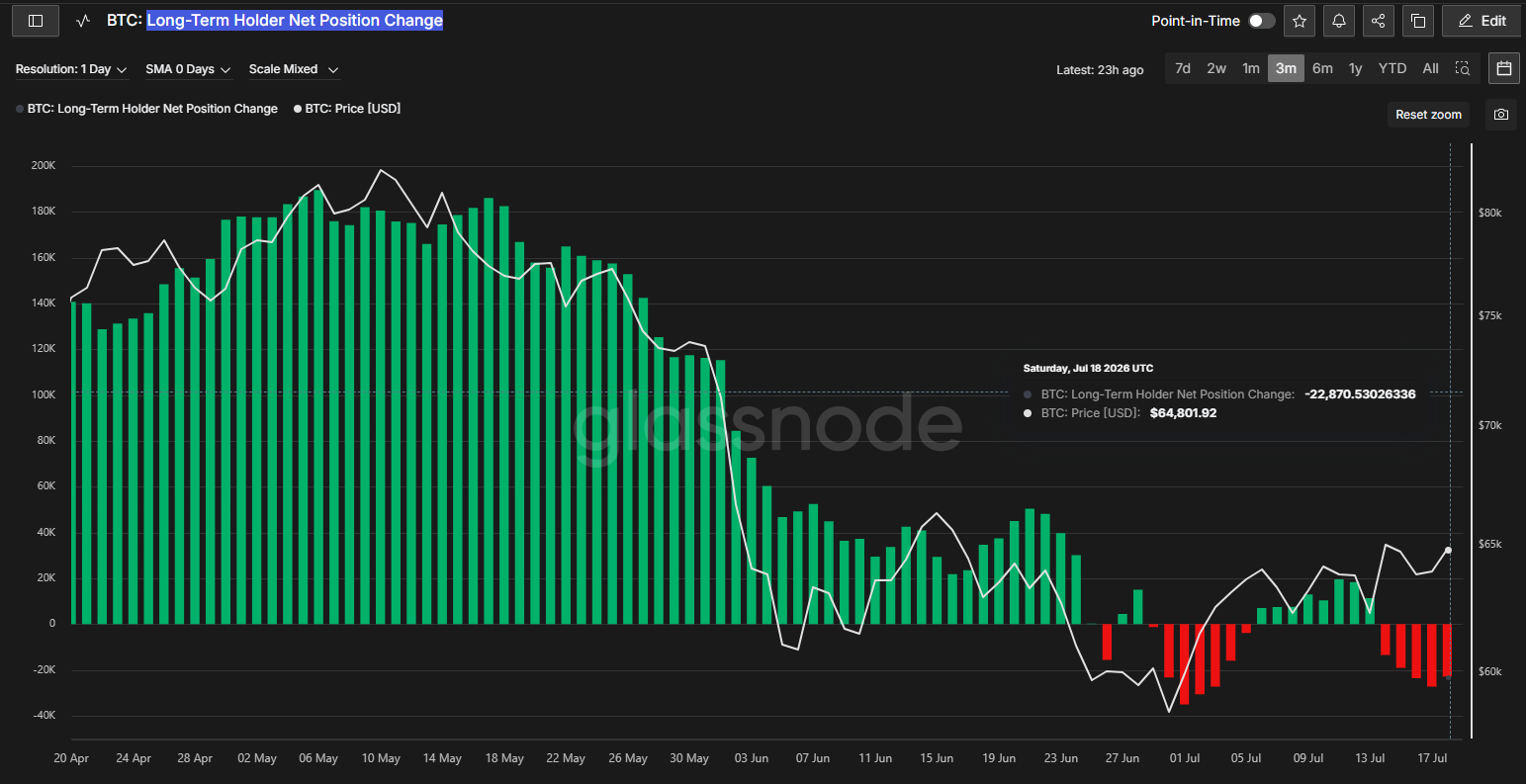
This chart shows Bitcoin Long-Term Holder (LTH) Net Position Change, which measures whether long-term holders (addresses holding BTC for at least 155 days) are accumulating or distributing Bitcoin.
According to data from Glassnode as of 18 July 2026, Bitcoin’s long-term holders have shifted from months of accumulation to modest net distribution, suggesting experienced investors are beginning to realise profits after the recent rally. The selling remains relatively contained compared with previous cycle peaks and appears to be absorbed by ongoing institutional demand, making it a sign of capital rotation rather than broad market capitulation.
Source: Glassnode. Past performance is not indicative of future performance.
Altcoin news
Top 20 altcoins were mixed over the 7 days to 19 July. However, there is some positive movement and focus lately on Zcash (ZEC) as its planned Tachyon upgrade aims to scale private transactions towards mainstream payment levels. If successful, it would strengthen the case for Zcash as more than a privacy coin, positioning it as potential infrastructure for high-volume private digital payments6.
Off the Chain is published every second Tuesday. It provides the latest news on bitcoin and the rest of the crypto market, along with analysis and insights into the world of crypto.
It provides general information only and is not a recommendation to invest in any crypto asset, crypto-focused company or investment product.