

David Bassanese
7 minutes reading time
Global week in review: Peace hopes and payrolls
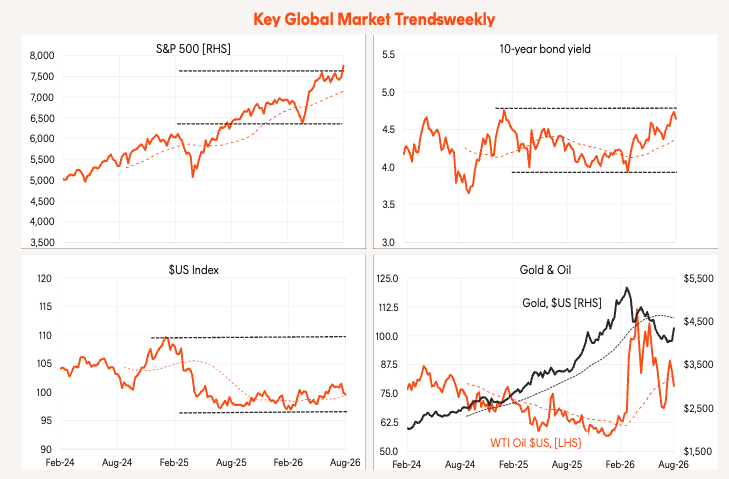
US equities rose further last week, helped by ongoing US-Iran peace deal hopes and soft economic data that reduced the odds of a near-term interest rate increase. Solid corporate earnings results also helped. Oil prices, bond yields and the $US eased, which in turn supported a rebound in gold prices.

Source: Betashares, Bloomberg.
The focus on the Iran front last week was on reports that Iran and Oman were negotiating shipping routes through the Strait of Hormuz. Meanwhile, sporadic Houthi attacks from Yemen were reminding everyone that the alternate oil route through the Red Sea could be just as problematic. The US appears to be waiting on the sidelines for now, while Iran has listed a string of demands before it will reopen the Strait. In short, as I noted last week, Iran still seems to hold the cards, and the US is hoping it can extricate itself from the conflict in the least embarrassing way possible.
In other news, both the US June job opening data and July payrolls report were weaker than expected, which reduced the odds of a Fed rate hike at the September policy meeting. Markets now roughly see a 50% chance of a September hike, though still have a full rate hike priced by year-end.
Indeed, despite the June drop, job openings and hiring are still at reasonable levels. What’s more, the surprise 23k drop in US employment last month did appear to partly reflect seasonal distortions due to the irregular timing of school holidays – given there was a 49,600 drop in local government education. Employment in leisure areas such as restaurants also dropped notably, likely reflecting post-World Cup effects. Note the US unemployment rate actually ticked down, from 4.2% to 4.1%.
US earnings reports were mixed last week, with investors less than impressed with the results from SpaceX and AMD due to concern over high AI-related spending. Other companies fared better, with investors impressed by the results from Atlassian and Airbnb. The Nasdaq-100 still managed a 5.1% return last week, with mega-caps Meta and Amazon doing well.
Global week ahead: US CPI
A key test for markets this week will be the July US CPI report. Markets anticipate a still reasonably modest 0.2% gain in core prices during the month, following a lower-than-expected flat result in June. If so, annual core CPI inflation would ease from 2.6% to 2.5% and likely make traders even more confident the Fed won’t raise rates next month.
Global equity trends: Technology bounce back
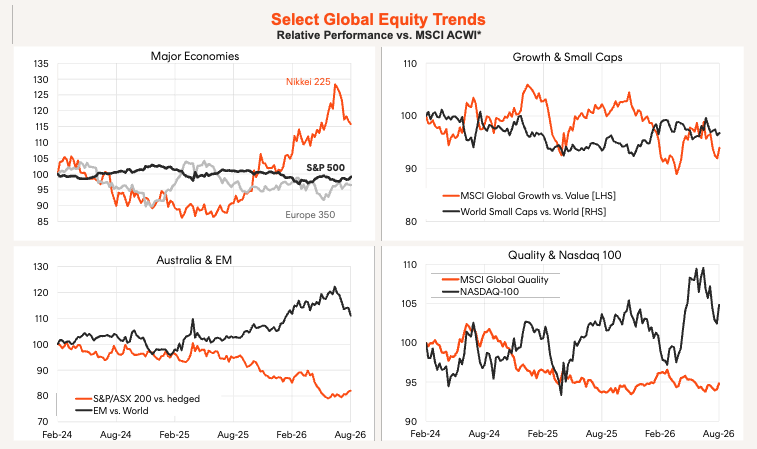
Technology and materials were the two strongest performing global sectors last week. Sector trends have been choppy of late, with technology underperforming since mid-year, and more value-orientated sectors such as financials and energy taking up the baton.
Even Australia and Europe have been holding up better of late as the heat comes out of the technology trade. Although even US performance has held up well, with investors merely rotating from technology into non-technology sectors.
A big test for technology and the AI trade is when/if the US-Iran conflict ends, with oil prices and bond yields easing. If technology fails to shine then, it suggests a more structural driver of underperformance related to underlying AI bubble concerns.
*All but value factors. Local currency basis. Source: Betashares, Bloomberg.
Australia week in review: House price declines
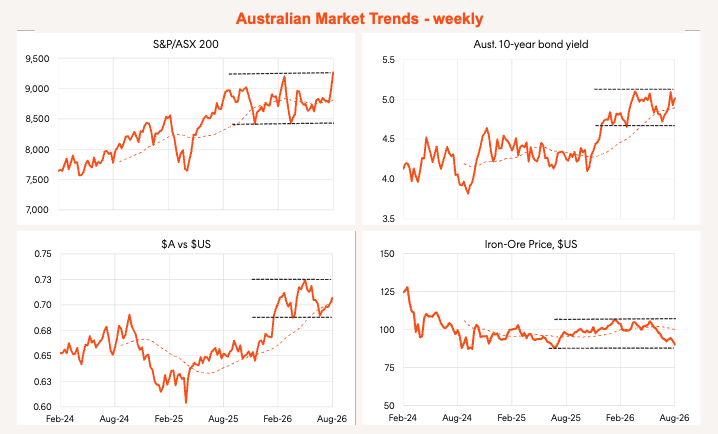
Local stocks bounced further last week, helped by global gains but also growing confidence that local policy rates may have peaked.

Source: Betashares, Bloomberg.
Key local highlights last week were household spending and house prices.
At face value last week’s report on consumer spending suggested surprise resilience from households in the June quarter. According to the Household Spending Indicator (HSI), nominal spending rose 0.8% in June – above market expectations for only a 0.2% gain. This followed a solid 1.2% gain in May. And we can’t just blame higher inflation, with volumes up 0.7% in the quarter.
Does this mean consumer spending will be strong in the Q2 GDP report due on September 2, placing pressure on the RBA to raise interest rates?
Not necessarily, as the relationship between HSI and the Australian National Accounts (ANA) measure of household spending is not especially strong. The HSI measure of real spending has been stronger than that of the ANA in the past two quarters. In the December 2025 and March 2026 quarters, for example, the HSI measure rose by 0.9% and 0.8% respectively – compared with gains of only 0.4% and 0.5% in the ANA measure.
Not helping consumer spending of course is the ongoing tale of woe from the housing sector, with national house prices down a further 0.7% in July and with signs of a broadening of the weakness from Sydney and Melbourne to other capital cities. Given the past two house-price corrections were around 8-9%, the 1.6% correction to date means we’re still early days in the current downturn. Given recent RBA rate increases, together with the Government’s increased taxation of property investors, the latest downturn could well be larger, potentially 10 to 15%.
Recent local equity gains have been impressive, despite the sluggish local economic outlook. For that we can thank the global backdrop – with ongoing hopes of an end to the Iran conflict – and reduced fear of further local interest rate hikes. Local equity market optimism could be tested in the current earnings reporting season, however, with the risk of downgrades due to ongoing cost pressures and sluggish local demand.
Local equity market trends: Rotation to resources
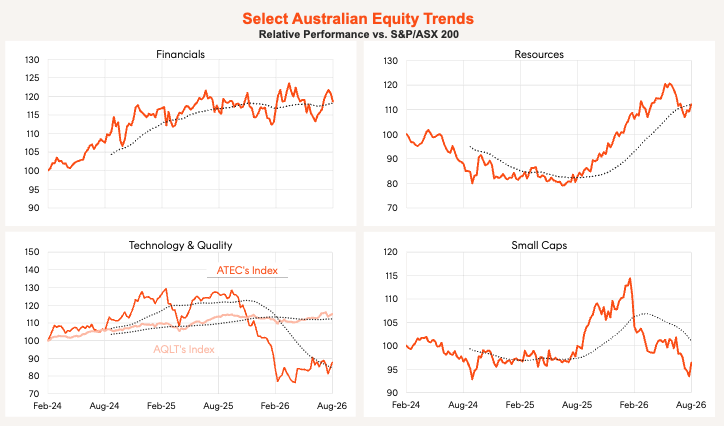
As was the case globally, materials and technology enjoyed the strongest sector performances last week. Among mega-caps, there’s been a tentative rotation back to resources from financials in recent weeks. Small-cap relative performance also bounced back last week. The beaten-up technology sector also is stabilising, with a tentative recovery underway.
Source: Betashares, Bloomberg.
Australia week ahead: Hawkish RBA hold
According to the futures markets, there’s zero chance the RBA will raise rates at this week’s policy meeting. This follows the lower-than-expected Q2 CPI result and ongoing reports of the downturn in house prices. For traders, it would seem to offer a beautiful asymmetric bet: bet on a rate rise and there’s little downside if you’re wrong, and wonderful upside in the remote chance that you’re right.
Of course, it does seem that the RBA can afford to keep rates steady again this month – especially given risks around exactly how far house prices will fall in the current downturn. With underlying inflation still uncomfortably high, however, the RBA will continue to talk tough this week and retain a firm tightening bias.
In terms of equities markets, a key further test will be the earnings reporting season, especially the results from the Commonwealth Bank on Wednesday.
Have a great week!