



More than a year after Australia’s mandatory climate reporting regime came into force, the first meaningful evidence of how it is working has arrived. The picture is more nuanced than either supporters or sceptics expected.
By early May 2026, 259 sustainability reports had been lodged for the financial year ending 31 December 2025, including 34 from listed entities and 225 from unlisted entities.1 The early reporters were concentrated in some of the sectors most exposed to climate transition and physical risk: mining, construction and materials, financial services, oil and gas, and electricity.
For a regime described by ASIC as a once-in-a-generation shift in reporting practice, that is a serious first test. However, the harder question, and the one investors will care about most, is whether these reports are producing decision-useful information or simply a more formal version of the sustainability narrative companies were already publishing.
A baseline, not a benchmark
ASIC’s early assessment, first set out in a written release and then expanded by Commissioner Kate O’Rourke at the Responsible Investment Association Australasia conference in May, was both encouraging and cautionary.2 The regulator acknowledged the scale of the task. In O’Rourke’s words, Australia’s new climate reporting regime represents a generational change in reporting requirements. The first wave of reporters was not simply following an established path. In many cases, it was building one.
But ASIC’s more important message was that the first wave should be treated as a baseline for comparability and consistency, not as the benchmark for future reporting quality. That distinction matters: a baseline tells the market where reporting practice has started, while a benchmark tells it what “good” looks like.
ASIC is not suggesting the early reports fall short. Rather, it is treating them as a useful starting point for a reporting regime that is expected to mature over time.
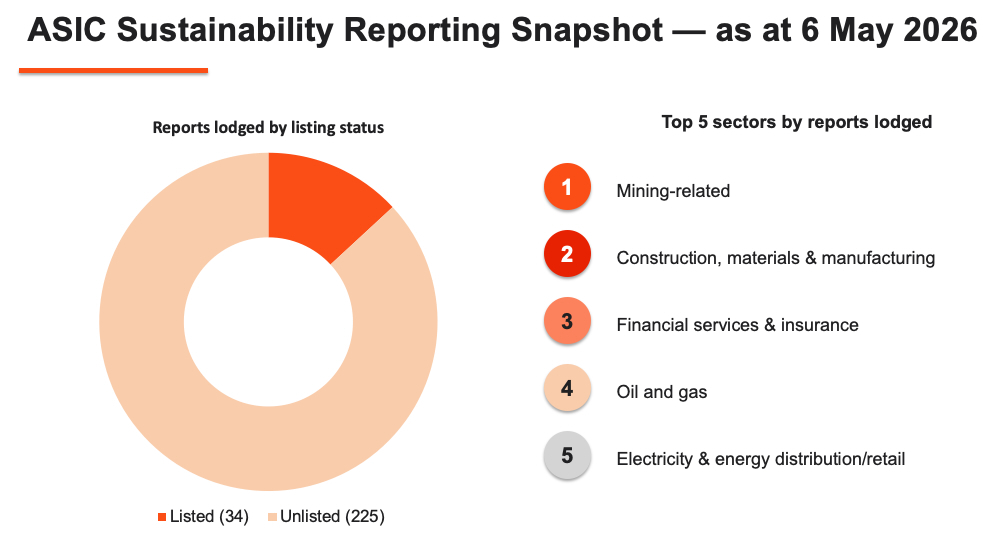
Source: ASIC, ‘ASIC issues early observations on sustainability reporting ahead of 30 June 2026’ (18 May 2026). Note: ASIC published sector order only; it did not disclose the number of reports lodged per sector.
ASIC’s desktop review of a sample of listed Group 1 reports identified six recurring weaknesses.3
The first was the use of disclaimers that cut across the statutory purpose of the regime. Some entities included language suggesting that investors should not rely on the sustainability report when making investment decisions. Others appeared to limit responsibility for parts of the report. ASIC’s position is clear in that, in a mandatory reporting document prepared under the Corporations Act, this is not careful drafting. It is not permitted.
The second weakness was more revealing. Some companies failed to connect what had already happened to what might happen next. ASIC found instances where entities had previously disclosed financial impacts from extreme weather events yet had not identified similar risks as relevant to their future prospects. If floods, extreme heat, storms or other climate-related events have impacted assets, operations or earnings, the market will expect the company to explain how that experience has shaped its view of future risk.
The other issues were more technical, but still material. ASIC pointed to unclear judgements and assumptions. It warned against voluntary climate commentary overwhelming the mandatory disclosures. It also identified imprecise cross-referencing to material outside the statutory report and inconsistent approaches to climate-related targets.
That last point matters, especially for heavy emitters. A climate-related target does not need to be a voluntary net zero pledge or a polished corporate commitment. It may arise because the law effectively imposes one, including through mechanisms such as the Safeguard Mechanism.
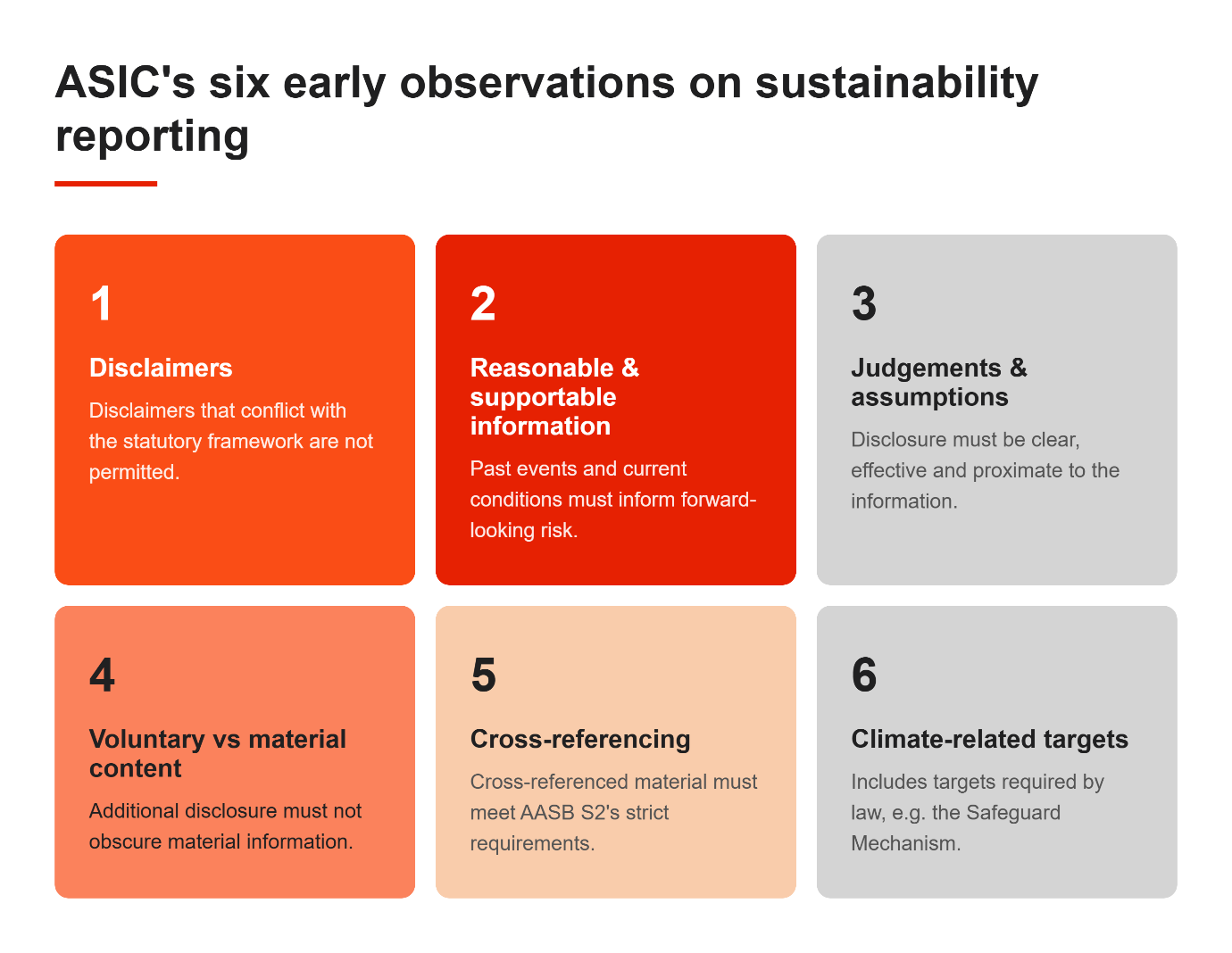
Source: ASIC, ‘ASIC issues early observations on sustainability reporting ahead of 30 June 2026’ (18 May 2026).
None of these observations amount to a damning verdict.
ASIC has been careful to acknowledge the progress already made. Compared with the voluntary disclosure era, the regulator has seen an increase in both the quantity and quality of climate-related financial information. Standardised requirements are beginning to do what they were designed to do: improve consistency, lift comparability and give investors a more reliable basis for assessment.
The tone is also worth noting. ASIC’s posture has been supportive rather than punitive. That reflects the reality of the transition period, but support should not be confused with leniency.
The detail behind the disclosures
KPMG’s review of the first 30 Group 1 reporters builds on ASIC’s qualitative observations with quantitative detail. The headline finding is one investors should treat as one of the year’s most important data points. Structural compliance has arrived before decision-useful disclosure.
That is not a criticism so much as a marker of where the regime currently stands. KPMG found that the first wave of reports showed a clear focus on robust practices and compliance, particularly in governance and risk integration. In practical terms, companies have been building the foundations first: governance structures, reporting architecture, risk processes and baseline disclosures.
The next phase will be harder. A base report is not the same as a mature report. Deeper strategic insight, more quantitative analysis and clearer links to financial impacts are still developing. The assurance picture tells a similar story. All opinions issued so far have been unmodified, which is encouraging. But KPMG also warns that maintaining unmodified opinions may become more difficult as assurance expands into more complex areas of the standard in future years.4
Governance is the most mature pillar of the first reporting cycle. Every entity in KPMG’s cohort referred to board-level engagement. Almost all of them, 97%, identified an audit or risk committee rather than a standalone sustainability committee as the body responsible for overseeing climate-related risks and opportunities.
That is an understandable default. Climate risk increasingly belongs inside the core machinery of enterprise risk, financial reporting and capital allocation.
But integration is not the same as effectiveness. For some boards, placing climate oversight with the audit or risk committee may ensure it is considered alongside other material business risks. For others, it may simply add another complex topic to an already crowded agenda. A dedicated sustainability committee is not necessarily a weakness if it brings sharper expertise, deeper scrutiny and clear escalation back to the full board.
The real question is not which committee owns the issue, but rather if climate-related risks and opportunities are being considered with sufficient expertise, frequency and influence to shape strategy and capital allocation.
KPMG’s caution is useful here. While most entities disclosed that the board or a board committee was informed about climate-related matters, many were less clear on how that actually happened. The disclosure did not always explain the quality of information communicated, the frequency of reporting or how it shaped decisions.
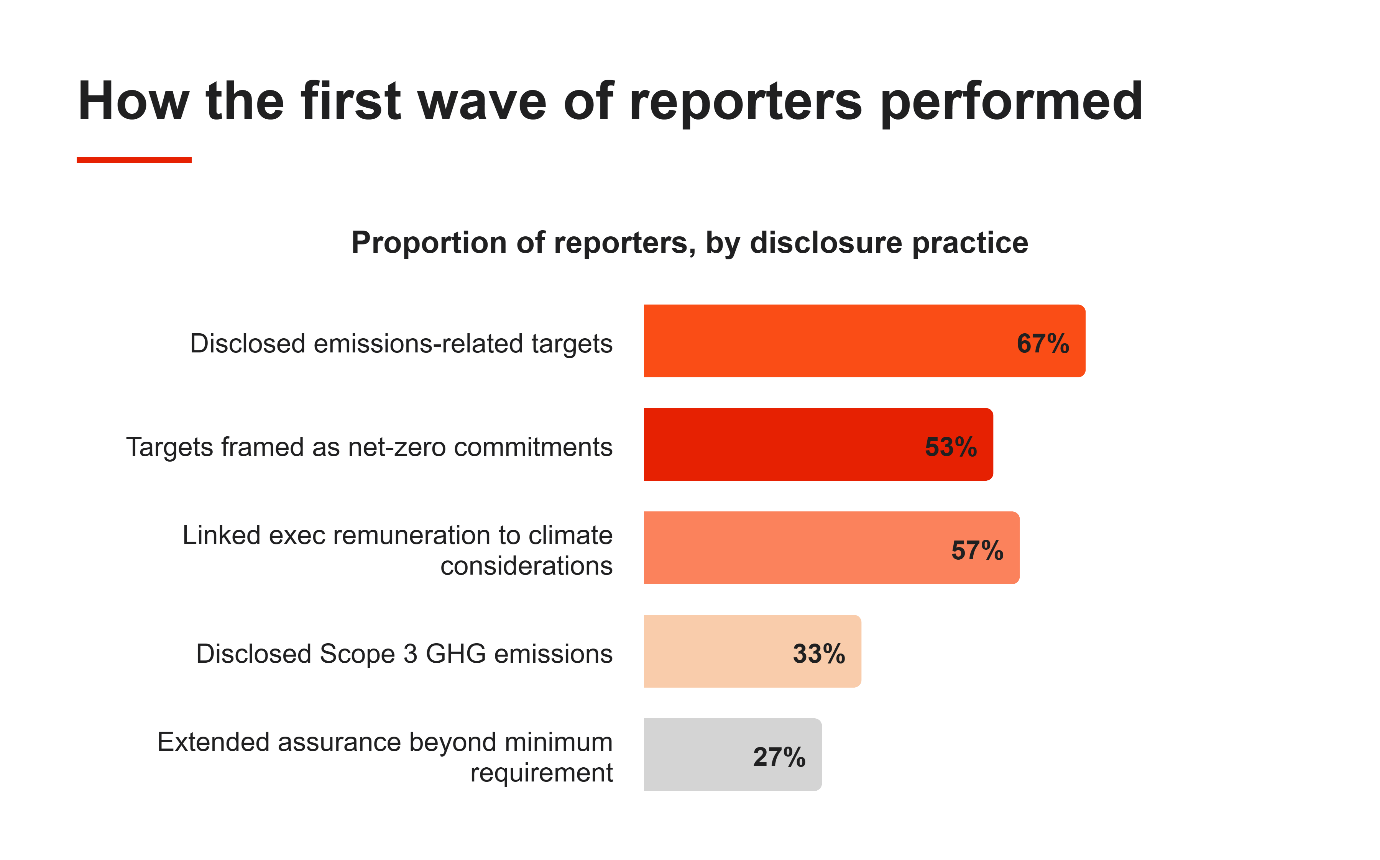
Source: Source: KPMG, ‘AASB S2 First Impressions — Early Findings Report’ (March 2026), n=30 Group 1 entities.
Assurance practice is also bifurcating in a way that is useful as a quality signal. KPMG found that 27% of entities extended assurance beyond the regulatory minimum, with extended-assurance entities far more likely to have disclosed and assured Scope 3 emissions than those relying on minimum assurance.5 Larger entities led this trend; half of entities above $10 billion in revenue sought extended assurance, against just over a third of those under $1 billion. For an investor trying to triage 259 reports quickly, assurance scope is a reasonable proxy for how seriously an entity is treating the exercise.
What it means for investors
The practical takeaway from year one for responsible investment teams is to treat report length, presentation quality and structural completeness as weak signals, and assurance scope, quantification depth and Scope 3 disclosure as the stronger indicators of reporting quality. The entities doing the latter are disproportionately the larger, more exposed reporters in energy, mining and financials, which is unsurprising but also means comparability across smaller and mid-cap names remains genuinely difficult this year.
ASIC’s own framing, that the baseline must not become the benchmark, is as much a message to investors and asset owners as it is to companies.6 Engagement priorities for the upcoming Group 2 cohort, and for second-year Group 1 reporters facing mandatory Scope 3 disclosure from FY28, should focus on whether entities are building genuine data infrastructure now, rather than treating this year’s compliance as the finished product. The Federal Government’s foreshadowed reforms to assurance settings and reporting thresholds, flagged in the May Budget, add a further layer of uncertainty worth watching, since any softening of Scope 3 or assurance requirements would directly affect the comparability gains the regime has only just begun to deliver.7
ASIC has indicated its fuller review, covering both listed and unlisted reporters, will be published in the second half of 2026.8 That report, rather than this first snapshot, will be the more reliable test of whether Australian climate disclosure is converging towards genuine decision-usefulness or simply becoming more elaborately compliant.