

David Bassanese
6 minutes reading time
Key global developments in August
- Despite the end of the US-Iran peace deal, military conflict was fairly contained over the month with the US moving to pressure Iran economically instead. Oil prices rose modestly, amid reports of Iran and Oman seeking agreement on their joint management of trade flows through the Strait of Hormuz – even in the absence of an explicit peace deal with the US.
- Confidence in the AI thematic was bolstered by a strong earnings report from leading chipmaker Nvidia, which also forecast strong growth in revenues in the coming year.
- Bond yields remained under upward pressure due to US public debt concerns and a warning from US Federal Reserve Chair Kevin Warsh of higher US policy rates if inflation stayed uncomfortably high.
- In Australia, a higher-than-expected July inflation report added to concerns of further Reserve Bank interest rate hikes. With house prices also falling, the domestic outlook remains subdued despite strength in housing construction and AI and clean energy related business investment.
- Despite soft Chinese domestic demand, strength in AI and clean-energy related global investment is supporting the price of some commodities such as copper, which in turn is adding the share price performance of local mining stocks.
Interest rates
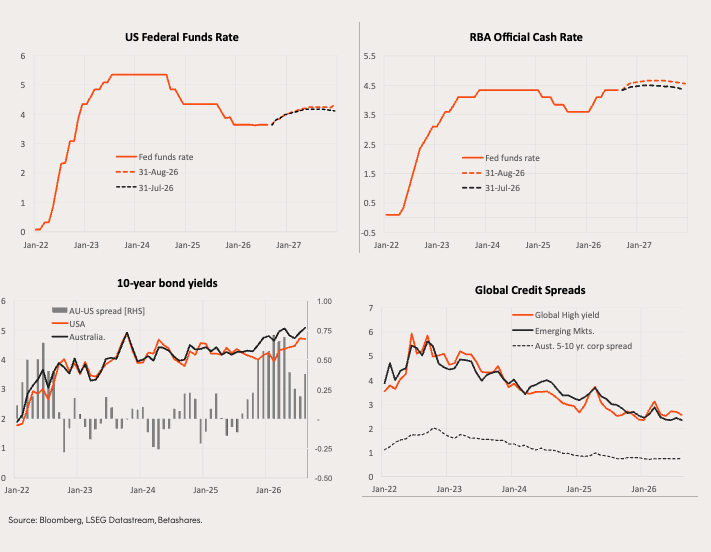
- Monetary policy tightening expectations firmed modestly in the US, but more so in Australia, over the past month. Markets have fully priced one further rate hike in both countries by year end. While there is a risk of further policy tightening in both countries, my base case remains that rates will remain on hold this year – suggesting fixed-rate bonds offer reasonable value at current yields.
- Despite policy tightening fears, US 10-year bond yields eased 0.02% to 4.71% p.a., whereas Australian 10-year yields rose 0.17% to 5.09% p.a., resulting in a rebound in the Australian-US 10-year bond yield differential to 0.38%. Bond yields in both markets have trended moderately higher since late 2025, due to a shift from rate cut to rate hike expectations.
- Credit spreads continued to tighten, supported by resilient global economic growth.
Commodity prices
- Broad strength in commodity prices led the benchmark index of global commodity prices* to rise a further 5.2% in August after a 6.1% increase in July.
- Gold prices rebounded 9.7%, supported by a softer $US. Despite ongoing Middle East tensions, oil prices only lifted a modest 1.1%.
- The ongoing Iran war is underpinning energy prices while strong global business investment associated with AI, defence spending and the clean energy transition is supporting industrial metal prices such as copper. Subdued Chinese domestic demand continues to limit gains in iron-ore prices.
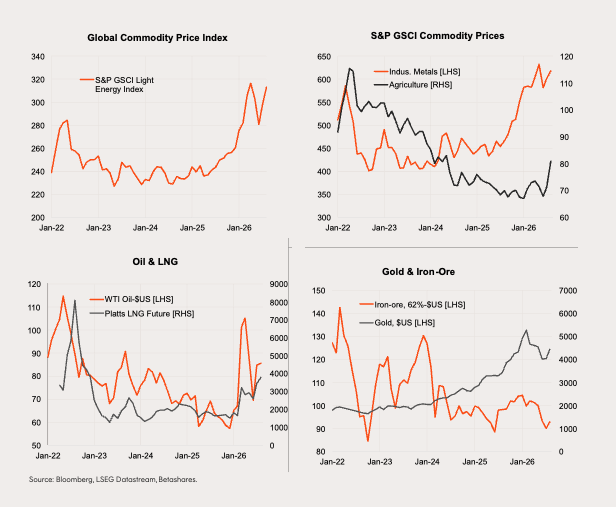
*Represented by the S&P GSCI Light Energy Index, which includes a range of prices covering energy, metals, agriculture and livestock.
Exchange rates
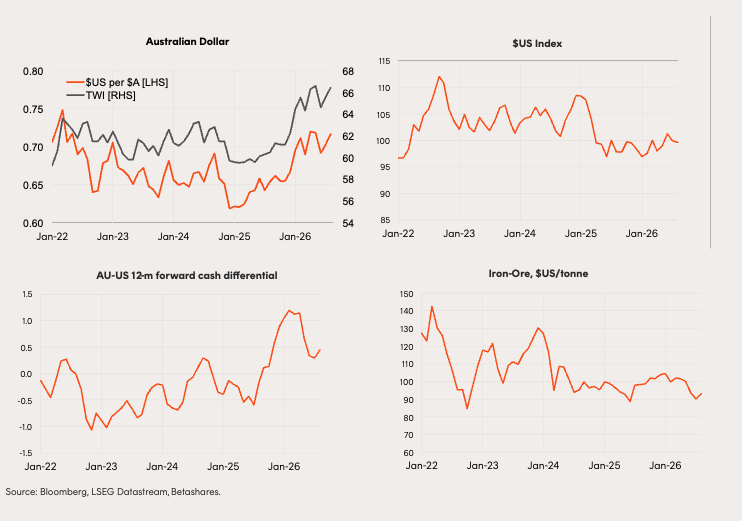
- The $A rose 2.1% against the $US in August to US71.6c, and by 1.4% in trade-weighted terms. The gain reflected a modestly weaker $US in global markets and a widening in Australian-US interest rate differentials.
- The $A outlook is mixed, with policy tightening expectations broadly aligned in both the US and Australia.
Global equities
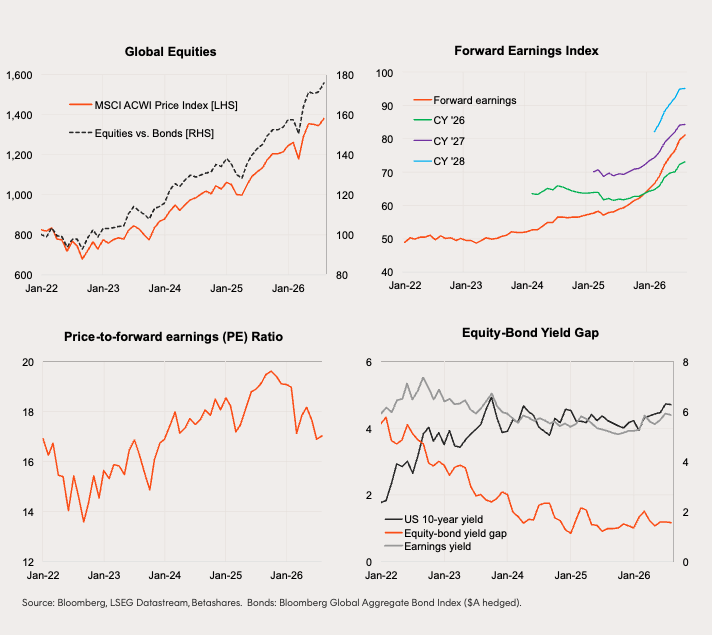
- Global equities returned 2.7% in local currency terms, though only 0.7% in unhedged $A terms due to further strength in the $A.
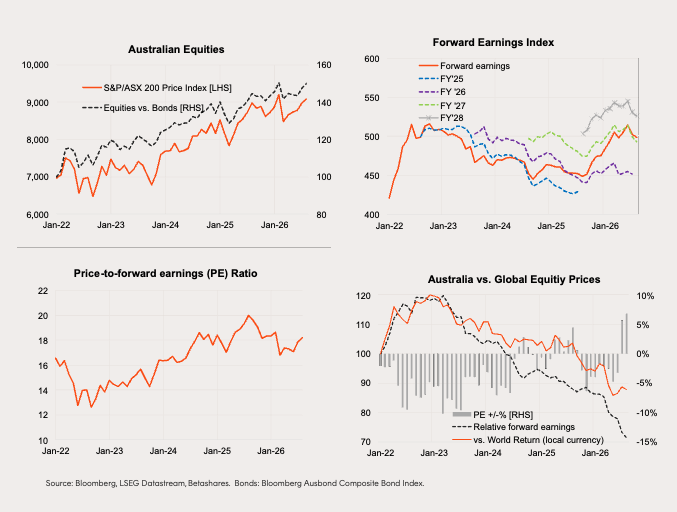
- The gain in equities reflected ongoing strength in forward earnings and a rebound in the PE ratio to 17.0. The global forward PE ratio remains below its recent end-month peak of 19.6 in October last year. More than offsetting this, forward earnings have increased solidly over the same period.
- Global earnings expectations remain upbeat, with 17.3% expected further growth in forward earnings by end-2027. PE valuations are at the lower end of their range over the past three years. Assuming relatively contained bond yields and continued strength in corporate earnings, the global equity outlook remains encouraging.
Australian equities
- Australian equities returned 1.5% in August, supported by a rebound in valuations despite further weakness in forward earnings.
- Current earnings expectations are consistent with 8.7% growth in forward earnings by end-2027 – good, but weaker than that of global markets, and with a likely greater risk of being downgraded due to the softening local economy.
- At 18.2, the forward PE ratio ended July trading at a 7% premium to global markets. Australia’s weaker earnings outlook and relatively expensive valuations suggest a continued trend of equity underperformance versus global peers – though one potential offset would be if global technology stocks sold off on renewed AI bubble fears.
Equity themes/trends
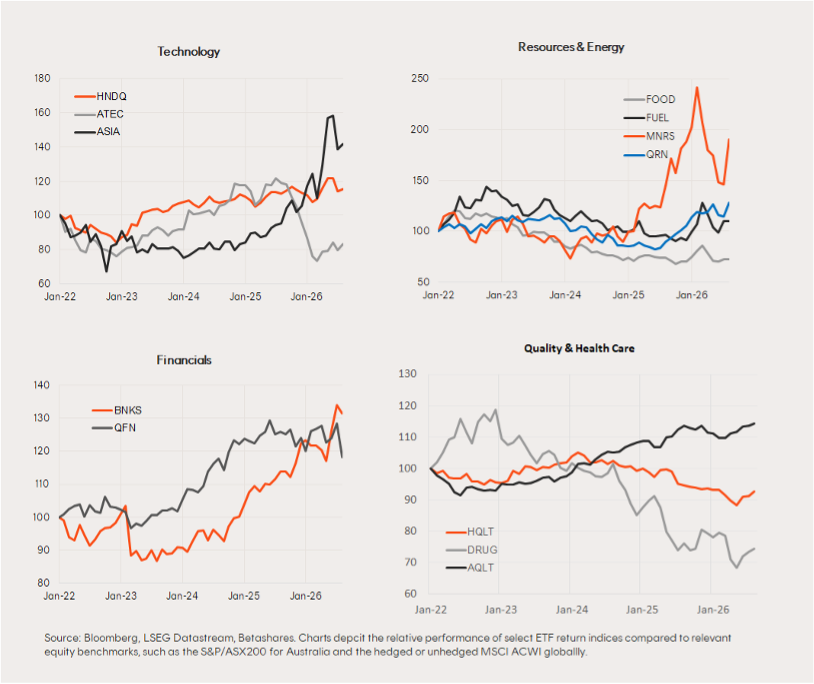
- Technology, resources and banks have been some of the best performers in global markets in recent times, consistent with the AI and related commodities boom along with rising bond yields supporting global banks.
- Indeed, the rebound in gold prices in August saw a strong rebound in global gold miners (MNRS) though global energy (FUEL) and local resource companies (QRE) also performed well. Technology exposures (ASIA and HNDQ) also performed well. Global bank (BNKS) relative performance dipped in the month, while local financials (QFN) have underperformed over a longer period.
- Australian and global quality performance has also improved of late, partly reflecting some investor interest in more defensive sectors such as health care.
Past performance is not indicative of future performance of any index or ETF.