


If higher repayments and rising living costs have made you more careful with money this year, the latest consumer sentiment survey shows how widely that feeling is shared.
Consumer sentiment, measured through the Westpac-Melbourne Institute Index fell 2.7% to 78.2% in November, its lowest level since late 20221. The result came as households faced the fifth rate rise of the year.
Over the longer term, shares have told a different story. The S&P/ASX 200 returned 7% a year over the five years to 20 November 2026, or 40.3% in total. That includes the sharp fall the market experienced last week – a reminder that markets rarely move in a straight line.
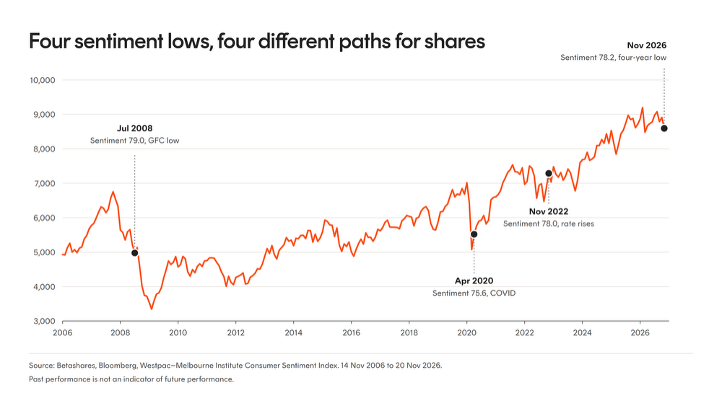
It’s a useful reminder that how we feel about the economy can differ from how investments perform over the long term. It’s possible to feel cautious about the economy and still feel confident in your long-term plan.
Why markets and emotions don’t always match
Consumer sentiment surveys ask people how they feel about their finances and the economy. Most of us answer based on what we’ve recently experienced. We think about the latest rate rise, what we paid to fill up the car and how much the weekly shop now costs.
Share prices reflect expectations about the future. A company’s value depends partly on the profits it’s likely to earn in the years ahead, so the market is always weighing up what comes next. By the time a tough period shows up in a survey, investors have often started looking towards the recovery.
You can see this in other markets too. When October’s jobs figures showed unemployment rising to 4.9%, bond markets moved straight away to price in rate cuts by late 2027, long before most households are likely to feel any relief.2
What history tells us
Periods of low sentiment haven’t always been bad times for investors. In some past downturns, the sharemarket was already on its way back by the time Australians felt worst about money.
In April 2020, as COVID lockdowns began and many Australians were worried about their jobs, consumer sentiment fell to 75.6%. The ASX 200 had already reached its low on 23 March and rose about 49% in the year that followed.
In November 2022, after a run of rate rises and inflation above 7%, sentiment fell to 78.0. Yet the ASX 200 rose 6.6% that month. It then had a choppy 2023, but by December 2023 had reached its highest monthly close on record.
Not every recovery happens quickly. During the global financial crisis, shares continued to fall for months after sentiment reached its low, and it took many years for the market to regain its previous high.
In each of these periods, both confidence and the sharemarket eventually recovered, but the timing differed. It’s a reminder that sentiment alone can’t tell us what markets will do next.
Keeping your plan on track
You can’t control interest rates or how the market moves from month to month. You can control how you invest, and a few simple habits can make it easier to stay on track.
Keep investing regularly. When you contribute a set amount each month, your money can buy more units when prices are lower and fewer when they’re higher. You don’t have to guess when sentiment will turn, and regular contributions can help you move towards your goals.
Betashares Direct’s Auto-invest allows you to set up recurring, brokerage-free investments into up to five Betashares ETFs, so your plan can keep running in the background. You can pause, adjust or stop contributions at any time.
Keep a cash buffer for bills and emergencies. If higher repayments are putting pressure on your budget, money set aside can help cover expenses without needing to sell investments at a time that doesn’t suit you.
Stay diversified. Markets can still have setbacks, as recent weeks have shown, and rates could stay high for some time. Spreading your money across different investments means you’re less reliant on any one investment doing well.
A diversified ETF can do much of that work in a single investment. For example, the DHHF Diversified All Growth ETF offers exposure to thousands of companies across Australian, developed and emerging markets in a single ETF.
Sentiment has recovered after each of these past lows, and the sharemarket has often moved first. If you have an investment plan that suits your circumstances, you’re already following the habits that have helped Australians through past periods like this one. A dip in consumer confidence doesn’t have to derail a long-term plan.