

Global sharemarkets fell sharply last week, led by companies linked to artificial intelligence (AI), before Jensen Huang’s return as Nvidia CEO sparked a rebound on Monday. This note looks at what drove the sell-off, what the rebound does and doesn’t resolve, and what could come next.
What happened last week?
Last Friday capped a rough week on Wall Street. US shares fell sharply, with the technology-heavy Nasdaq 100 index hit hardest. The broader S&P 500 index ended the week in “correction” territory, meaning it had fallen more than 10% from its record high on 6 October. The Nasdaq 100 had fallen even further from its peak.1
Why?
The AI sell-off reflected three concerns weighing on the market at once: fears around the AI buildout, Nvidia’s internal problems and the risk of further rate hikes from the US Federal Reserve.
The AI buildout. Ever since the launch of ChatGPT in late 2022, there has been a rush among global tech companies to build data centres to train and run power-hungry AI models such as ChatGPT (known as large language models, or LLMs). This surge in investment has underpinned a surge in profits among chip makers and cloud computing providers. However, it has also eaten into the spare cash of the hyperscalers, the giant cloud computing companies such as Amazon, Microsoft and Alphabet. These companies have increasingly needed to borrow money or raise funds from shareholders to pay for it.
There are two concerns around the buildout.
First, that it could end soon, especially given the rising cost of investment funding and increased regulatory scrutiny in the wake of the US Democrats’ strong showing in the recent midterm elections. The fear is that a slowdown in AI investment could lead to a slowdown in the profits boom, which has been a major driver of global sharemarket gains in recent years.
A second, somewhat conflicting, concern is whether the investment boom has been excessive, and unlikely to earn companies in the AI ecosystem a decent return on investment.
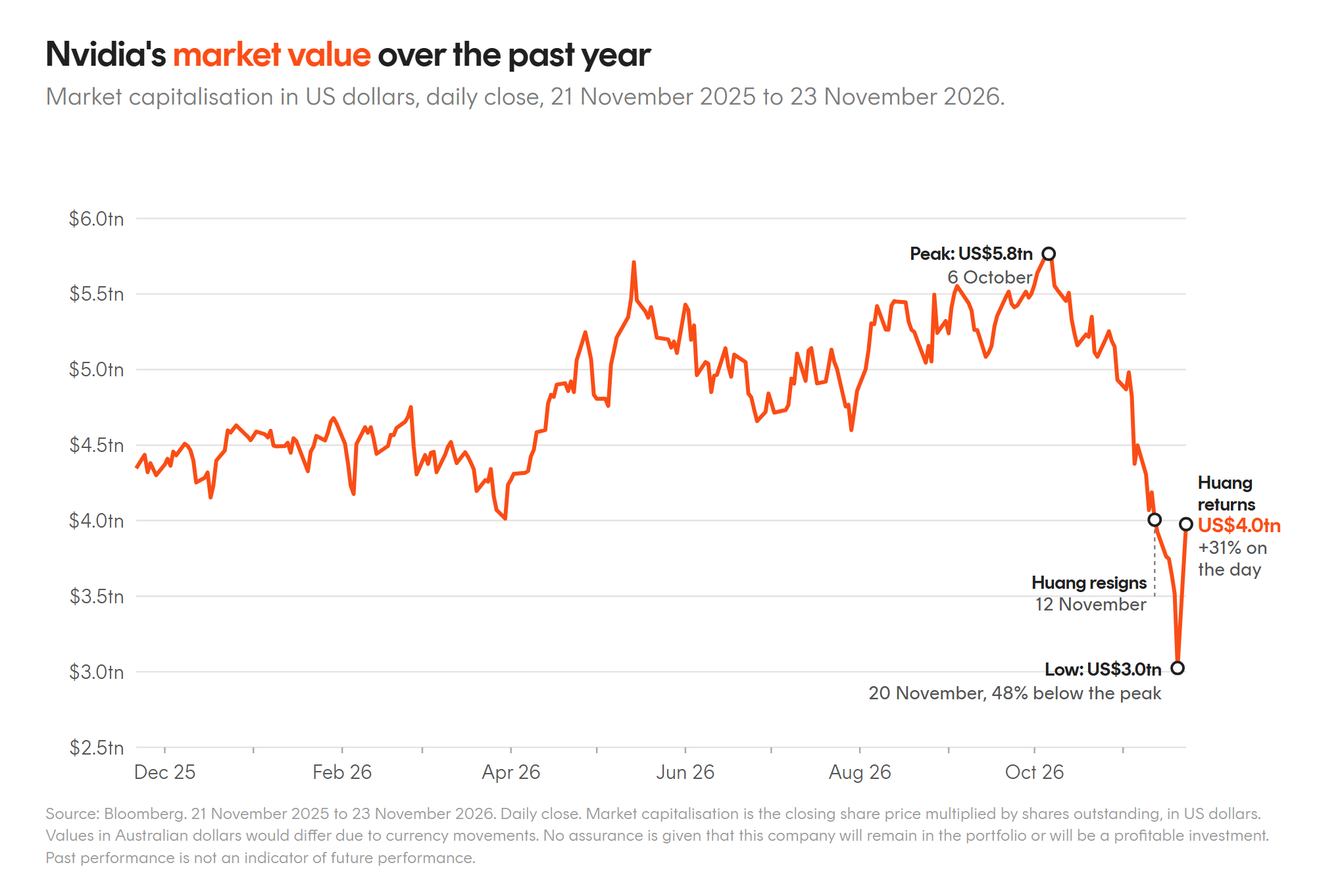
Nvidia’s internal problem. With a near-monopoly on the chips required to power the AI boom, Nvidia has been at the epicentre of the AI ecosystem in recent years. It has not only provided chips to the established hyperscalers but helped fund a myriad of smaller players in the industry, such as the so-called “neo-clouds” (newer, smaller companies that rent out AI computing power). The resignation of Nvidia’s longstanding CEO Jensen Huang on 12 November raised a range of concerns. These included whether Nvidia would keep investing in other AI companies, and whether US national security concerns could reduce chip supply and data centre construction in Asia.
The Fed. The last concern is a rising fear that the US Federal Reserve may need to keep raising interest rates sharply to contain inflation. This is partly AI related, as the investment boom has added to both US economic growth and price rises. At present, markets fully expect another Fed rate hike next month, and several more in 2027.
Further US rate hikes pose several risks, such as weakening US economic growth and raising the cost of AI-related debt funding.
Huang’s return
On Monday, Jensen Huang’s return as CEO sparked a sharp rebound. Nvidia’s share price surged and the gains spread to other AI-related companies, lifting both the Nasdaq 100 and the S&P 500. The rebound helped steady sentiment towards the broader AI theme. Markets now expect Huang to resume backing the cash-hungry neo-clouds, which rely on Nvidia’s financial support to fund their buildouts.
However, whether the rebound lasts is likely to depend on more than Huang’s return. While Nvidia’s business remains exceptionally strong, with revenue doubling year on year2, markets still have to weigh up ongoing investigations relating to US export controls (rules limiting overseas sales of advanced chips), uncertainty over sales to China and questions about how Nvidia is governed under Huang.
Huang is due to appear before a US Senate hearing on 3 December, where he is expected to be questioned about export controls and the recent leadership controversy.
Other parts of the AI industry, beyond Nvidia and other chipmakers, also need to deliver. Markets are watching for continued strong cloud revenue and profit margins from the hyperscalers, AI developers such as Anthropic turning their products into revenue, and growing adoption and productivity gains among the businesses and people using AI and AI-enabled software.
Where to from here?
The main near-term concern for markets is a cutback in AI investment, as this poses a direct risk to the related boom in company profits. Yet it’s not clear the AI investment boom will end any time soon and, even if there were some moderation, this may offer some blessings in disguise.
With appetite for AI services continuing to ramp up rather than slow down, there appears to be little reason to expect an imminent investment slowdown. According to Goldman Sachs estimates, spending by the US hyperscalers on data centres and other long-term assets (known as capital spending) is forecast to reach US$1.2 trillion next year, up around 50% on 2026 levels, and rise a further 16% in 2028 to US$1.4 trillion.3
In line with this strong investment outlook, expectations for US company earnings also remain upbeat, with analysts forecasting 17% earnings growth for S&P 500 companies next year4. AI investment is likely to slow eventually, though this may lead to slower profit growth rather than a collapse in company profits.
With the S&P 500 and Nasdaq 100 already well below their recent peaks, much of the risk is arguably already reflected in share prices. The S&P 500 ended last week trading at 16.5 times its expected earnings over the next 12 months. This measure, known as the forward price-to-earnings ratio, shows how much the market is paying for each dollar of expected company profits. It is down from a recent peak of 23 in October 2025 and below its 10-year average of 19.5
Indeed, it is historically rare for major sharemarket indices such as the S&P 500 to fall much further from this point, unless there is a US recession. And, supported by the AI boom, the US economy is still growing solidly and appears far from recession.
Of course, risks from interest rates and regulation are likely to remain as we head into 2027. However, if the AI investment boom moderates, this may reduce the need for further Fed rate hikes, and could even lead to rate cuts. If oil prices continue to ease, that could also help. A more moderate AI rollout could also ease pressure on hyperscaler finances and slow the potential disruption AI poses to many existing tech companies.
Investment implications
If the recent sell-off proves to be a correction rather than the start of a drawn-out downturn, the NDQ Nasdaq 100 ETF and its currency-hedged version (HNDQ Nasdaq 100 Currency Hedged ETF) offer exposure to the large US technology and growth companies, including those at the centre of the AI theme. Currency hedging aims to reduce the effect of movements between the Australian and US dollars on returns.
Keeping the long view
Sharp falls can feel alarming, but they’re a normal part of investing in shares. Sharemarkets have weathered many corrections before and historically gone on to recover, although the past is no guarantee of the future.
Rather than reacting to every swing in AI sentiment, it can help to focus on what’s within your control. That means holding a portfolio spread across different regions, sectors and asset classes, adding to it regularly, and keeping costs low. A diversified portfolio won’t avoid every fall, but it can smooth out the bumps and make it easier to stick with your plan when markets turn choppy.
The AI story may still have a long way to run, and there are likely to be more ups and downs along the way. For those with a long time horizon, periods like this are a reminder of why patience and diversification remain sound foundations for building wealth.