


Artificial intelligence is reshaping investment priorities across the corporate world. Alongside the significant spending on data centres, chips and power infrastructure, companies across all industries are investing in AI to improve supply chains, automate operations and develop new products and services.
Funding this investment while preserving financial flexibility is becoming an increasingly important consideration.
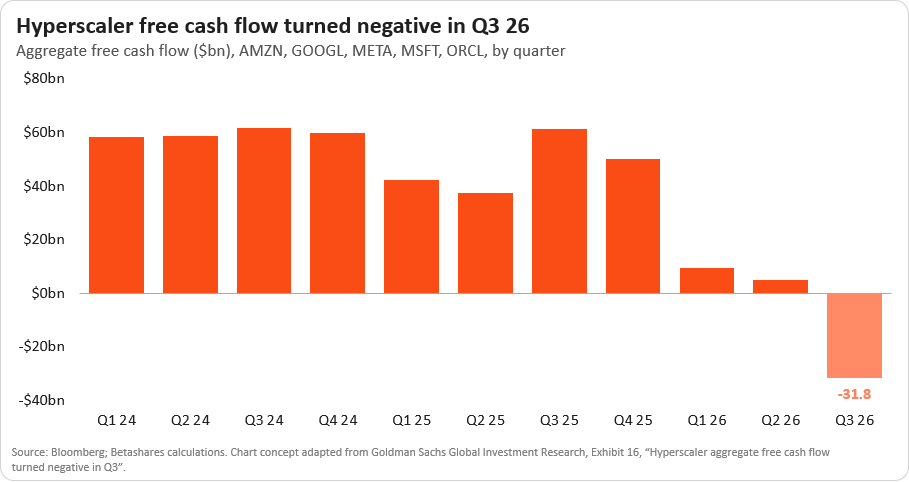
These heightened capital demands are particularly evident among the hyperscalers leading the AI infrastructure buildout, where spending is now weighing heavily on free cash flow. Free cash flow is the cash remaining from a company’s operations after deducting capital expenditure.
In Q3 2026, the combined free cash flow of Amazon, Alphabet, Meta, Microsoft and Oracle turned negative, recording an outflow of more than US$31 billion.
This illustrates how investment in future growth can absorb cash even at some of the world’s most profitable businesses, highlighting the importance of strong cash flow and access to funding.
The growing cost of funding growth
These capital demands are now filtering through to corporate bond markets. Already this year, US investment grade companies have issued a record US$1.88 trillion in bonds, with the five hyperscalers referred to above accounting for more than US$370 billion, or around one fifth of the total.1 The IMF expects external financing to play an increasingly important role for corporations as AI investment expands.2
This increased bond supply, alongside inflation pressures, higher oil prices and central bank rate rises, is contributing to higher borrowing costs for businesses.
The Bloomberg US Corporate Index’s yield to worst provides a broad gauge of borrowing rates available for investment grade companies. At the time of writing, it stood at 6.01%, just below its highest level in three years.
Higher borrowing costs have implications across the wider sharemarket, as more expensive new or refinanced debt can weigh on profits and reduce the cash available for investment and shareholder returns. Against this backdrop, the ability to fund investment internally provides a clear advantage.
Companies that consistently generate surplus cash have greater flexibility to pursue growth opportunities, return capital to shareholders, while reducing their dependence on external funding.
The growing appeal of cash flow kings
The CFLO Global Cash Flow Kings ETF offers exposure to 200 global companies selected for high and consistent free cash flow generation relative to their asset base, strong growth in free cash flow and relatively low levels of debt.
This focus is reflected in the portfolio’s cash generation profile. At the most recent rebalance, weighted average free cash flow relative to assets was 18.6% for CFLO’s holdings, more than twice that of the broader developed market universe excluding CFLO holdings. As the chart below illustrates, the gap has also widened significantly in recent years.
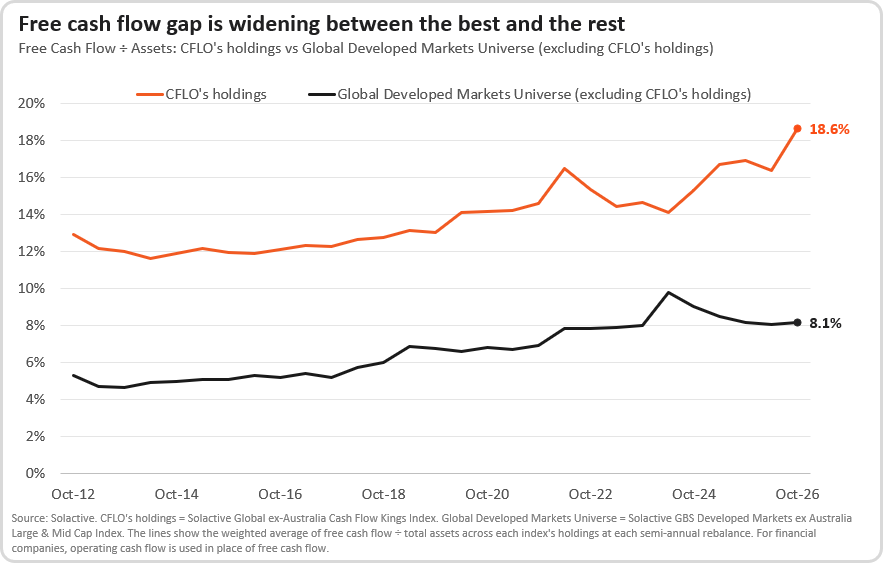
Strong cash generation and relatively low debt are particularly valuable in an environment of rising borrowing costs. These characteristics can help companies sustain investment in future growth while limiting their reliance on more expensive external funding.
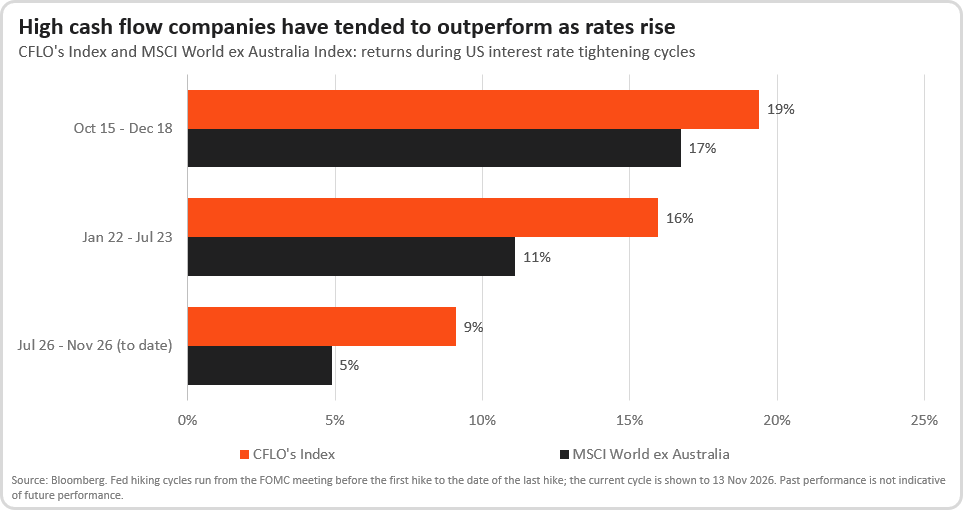
Consistent with this investment case, CFLO’s index has outperformed the MSCI World ex-Australia Index in each of the three US interest rate tightening cycles that began since index inception in 2006, including the current cycle to date, as shown below.
Cash flow strength with broad market exposure
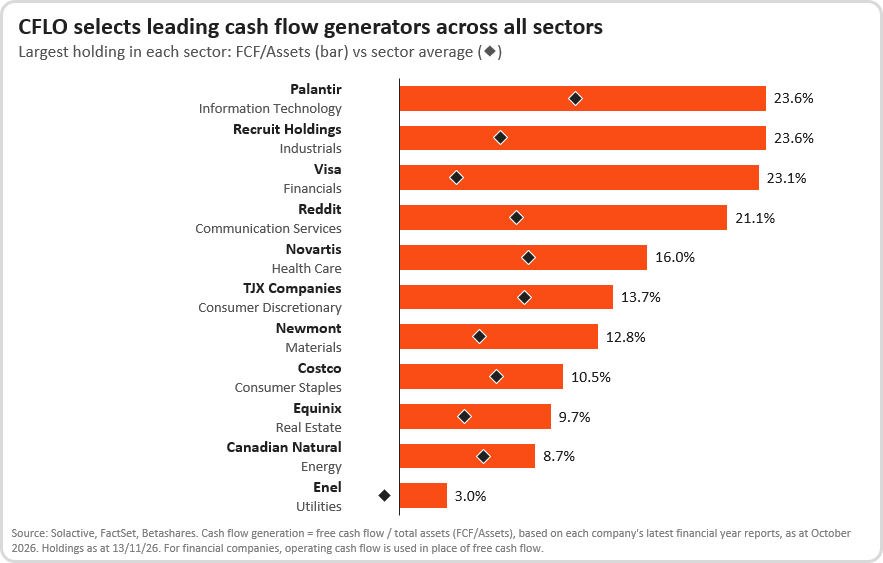
CFLO combines a focus on strong cash generation with diversified exposure across developed markets. Its index is designed to align sector weights with those of the underlying investment universe, while also limiting deviations in country weights.
The chart below highlights the portfolio’s largest holding in each sector and compares its free cash flow generation with the corresponding sector average. This illustrates how CFLO’s focus on strong cash generation extends across a broad range of industries.
As companies continue to invest heavily in future growth while borrowing costs remain elevated, the ability to generate surplus cash provides valuable financial flexibility. CFLO combines strong cash flow generation, relatively low debt and broad market exposure.
Since inception, CFLO’s index has returned 10.56% p.a., compared with 8.92% p.a. for the MSCI World ex Australia Index. For investors navigating higher interest rates, CFLO offers a diversified way to favour companies better placed to fund investment internally and manage changing financing conditions.