



The AI trade remains a key driving force of global economic growth. Investment into AI-related infrastructure is driving strong corporate earnings growth across the IT sector which remains a key contributor to US and AI-linked Asian equity markets. However, beneath the surface there has been considerable rotation between industry groups driven by shifting narratives as the AI trade evolves.
Semiconductor companies, for example, have been the standout performer within the US Information Technology sector, reporting earnings growth of 135%. Leading GPU, memory and custom ASIC chip makers continue to reap the rewards from massive hyperscaler capital investments being made to build out data centre compute capacity.
Nvidia is one such beneficiary, holding the mantle of the world’s largest company over the past year. Its quarterly results due tomorrow morning (AEST) will give the market a clearer read on the durability of the AI capex cycle. While the results are likely to be solid, supported by positive 2026 capex revisions from hyperscalers, expectations are already high so guidance on other factors such as gross margins, Rubin and Vera CPU rack demand will be the more likely drivers of the share price movement post earnings announcement.
Software on the other hand has lagged its hardware peers this year despite signs of revival throughout the Q2 2026 US reporting season. The brief but eventful ‘SaaSpocalypse’ episode injected fears around the future of legacy software business models given the threat that new agentic AI tools presented at the time. Terminal valuations compressed significantly across the sector; however, markets have since moved beyond pricing in this worst-case scenario and have instead become more discerning around potential winners and losers. Cybersecurity, for example, initially sold off in sympathy alongside the broader software industry but has staged a remarkable recovery since its March/April lows with investors recognising opportunities in oversold platform leaders such as Crowdstrike and Palo Alto Networks.
Between the semiconductor and software layer of the AI supply chain are the US hyperscalers which face growing investor scrutiny over the returns they can generate on capex spending, expected to total ~US$800 billion this year. That’s created some stress in the credit markets where widening credit spreads are reflecting concern around the ability for these companies to finance their data centre commitments as free cash flows have fallen sharply from their 2024 highs.
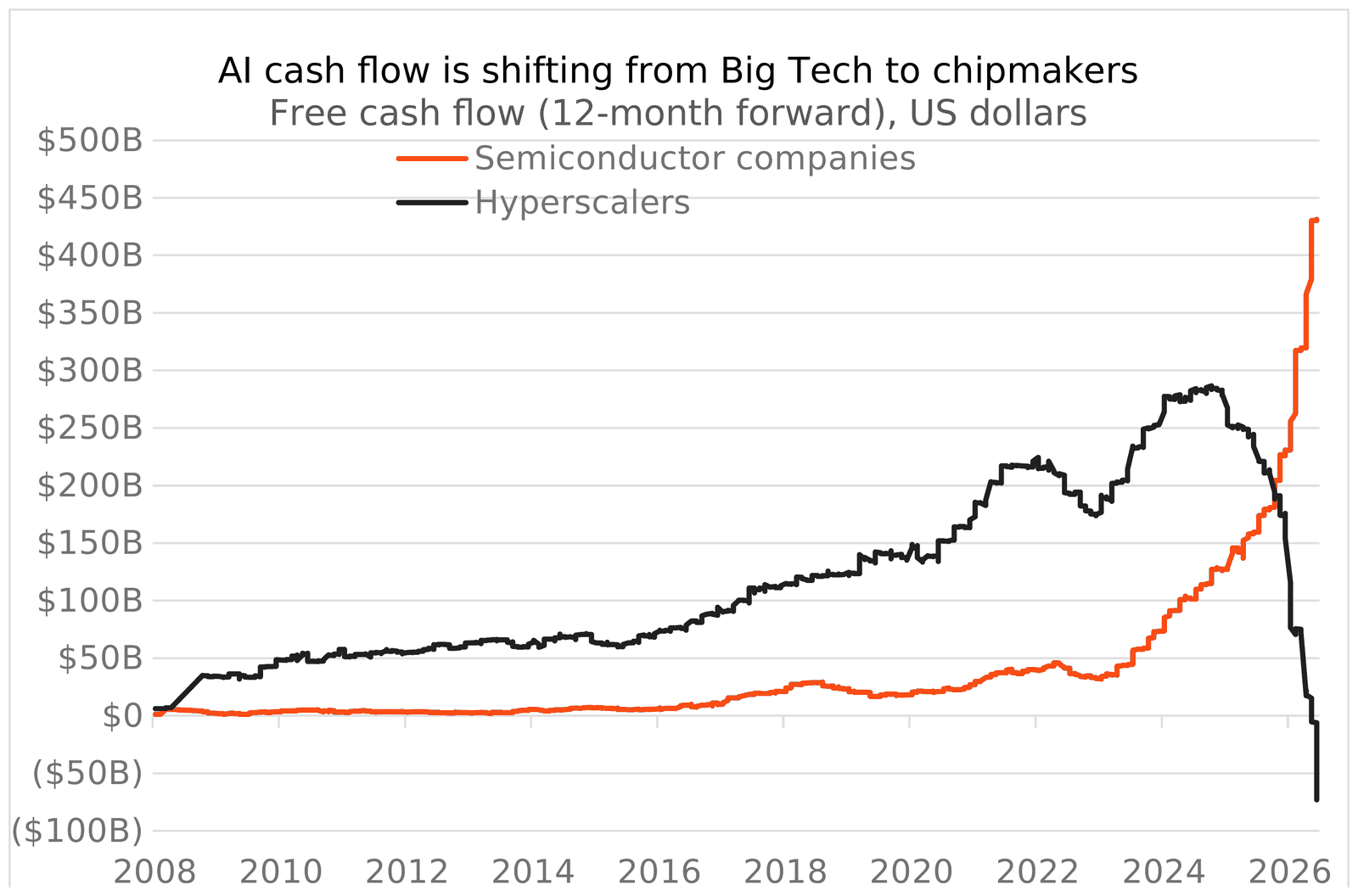
Source: Bloomberg. As at 30 July 2026. Hyperscalers = Amazon, Google, Meta, Microsoft, Oracle. Semiconductor companies = Nvidia, Micron, Broadcom, Applied Materials
Equity markets on the other hand care more about whether capex spending will increase the pace of AI monetisation, margins and earnings.
Despite Amazon reporting negative free cash flows for Q2 2026, its share price rose 15% the following day on the strength of its cloud business unit, Amazon Web Services, which grew revenues by 37%. AWS margins have also increased from 33% to 39% from Q2 2025 to Q2 2026 and now account for around 60% of Amazon’s group operating profit.
In addition to Google Cloud Platform and Microsoft Azure, revenues across the three main cloud service providers grew by 43% on a US$364 billion trailing twelve-month revenue base in Q2. This is an extraordinary rate of growth on an already substantial revenue base, with growth likely to remain elevated.
Enterprise AI adoption continues to accelerate as increasingly multi-step agentic AI workloads drive sustained growth in inference demand. Demand for AI compute continues to exceed available supply, while rapidly growing contracted backlogs provide high visibility into future revenues. Together, persistent demand and capacity constraints suggest that much of the incremental infrastructure being deployed can be absorbed and monetised quickly as it comes online, supporting continued elevated cloud growth.
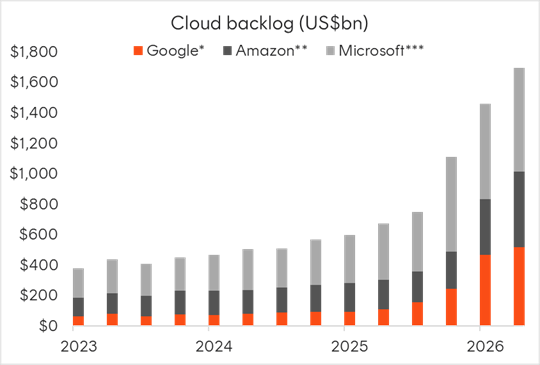
Source: BCA Research, Fiscal.AI. * Revenue backlog. ** Remaining performance obligations (Q2 2026 values not available). *** Commercial remaining performance obligations.
From an end user demand perspective, we expect overall AI adoption and usage to continue intensifying as inference costs decline and AI becomes more economically viable across an expanding range of platforms. This is consistent with a form of Jevons paradox whereby the falling cost of intelligence increases aggregate demand for compute, rather than less. This should support continued demand for US frontier models (e.g., Claude and GPT), but increasing competition from lower cost, Chinese open models (e.g., DeepSeek and Moonshot AI’s Kimi K3) could erode the pricing power and pressure margins of the frontier AI labs over time. However, some of this margin compression could be offset by lower training costs, and we see a growing case for profit pools to accrue elsewhere in the AI supply chain given compute remains the constraint.
The AI theme should continue to support equity markets, although we expect the path to remain non-linear as leadership rotates across the AI value chain. Rapid technological change makes it increasingly difficult to identify the ultimate winners at an individual stock-level. A diversified, indexed-based approach such as that provided by the Betashares Nasdaq 100 ETF (ASX: NDQ) may therefore offer a more robust way to capture the broader theme.
There are risks associated with an investment in NDQ, including market risk, country risk, currency risk and sector risk. Investment value can go up and down. An investment in the Fund should only be considered as a part of a broader portfolio, taking into account your client’s circumstances, including their tolerance for risk. For more information on risks and other features of the Fund, please see the Product Disclosure Statement and Target Market Determination, both available at www.betashares.com.au.