

Justin Arzadon
6 minutes reading time


If you’d rather hear this edition of Off the Chain, click the player below:



The broader crypto market moved steadily higher, with Bitcoin recording its strongest week since September 2025 and reclaiming the US$71K level. It has shown notable resilience during the Middle East conflict, outperforming both equities (US and Australian) and gold (in USD terms) since tensions began.
Bitcoin and Ethereum were up 6.36% and 8.19% respectively over the seven days to 15 March 2026. Bitcoin’s market capitalisation is US$1.42 trillion while the global crypto market capitalisation sits at US$2.43 trillion. Bitcoin’s market dominance is at 58.8%.
|
Price |
High |
Low |
Change from previous week |
|
|
BTC (in US$) |
$71,441 |
$73,828 |
$65,660 |
6.36% |
|
ETH (in US$) |
$2,107 |
$2,201 |
$1,921 |
8.19% |
Source: CoinMarketCap. As at 15 March 2026. Past performance is not indicative of future performance. Performance is shown in US dollars and does not consider any USD/AUD currency movements.
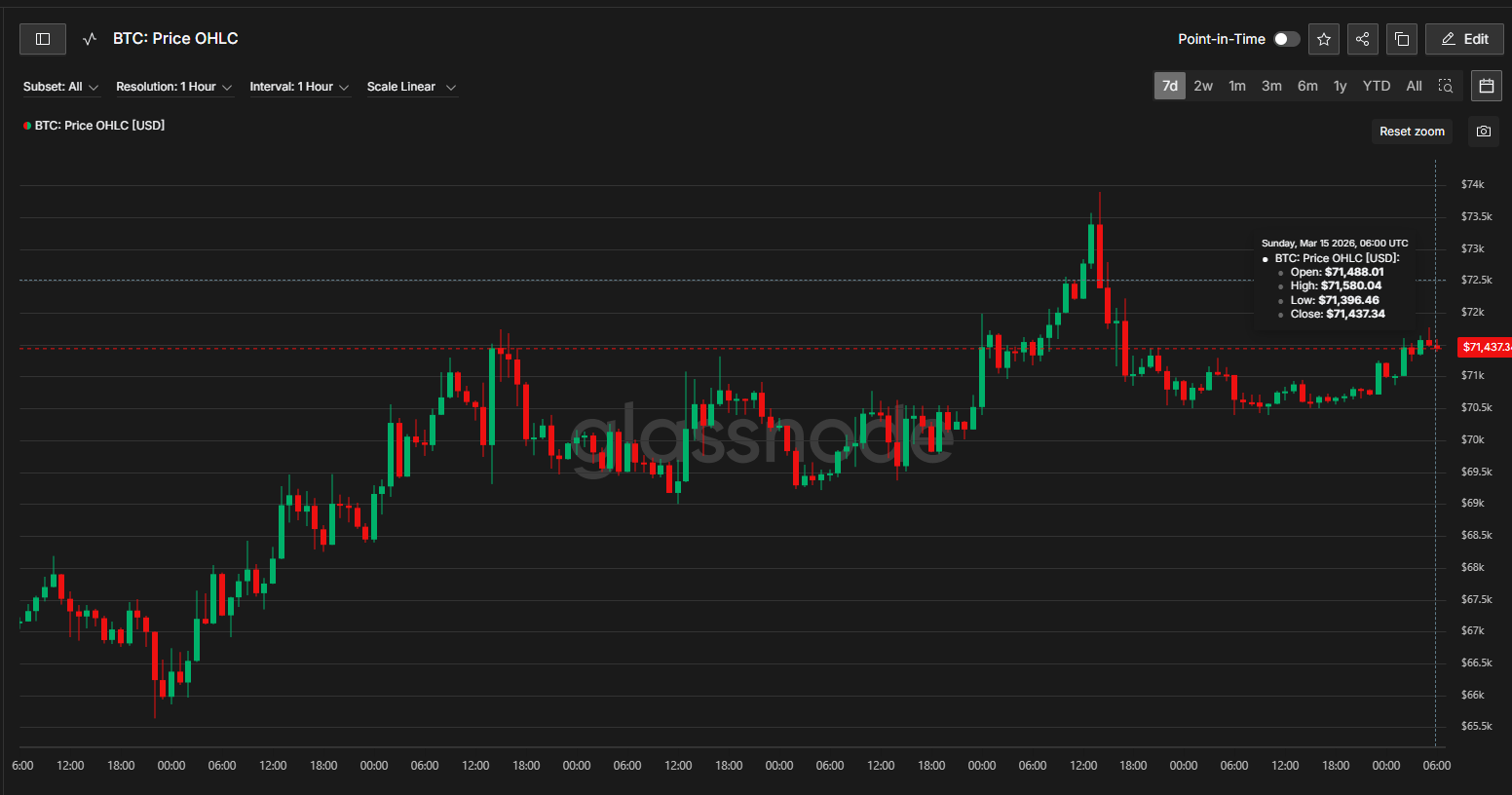
Source: Glassnode. Past performance is not indicative of future performance.
Crypto news we’re watching
Kraken plugs crypto into the Federal Reserve’s payment rails
Kraken’s approval to access the US central bank’s core payments system may be the clearest integration signal of the past fortnight. Through Kraken Financial, the firm can now use Fedwire (the electronic system for moving large sums of money and securities run by the Federal Reserve) for institutional dollar transfers, placing a crypto-native operator on settlement infrastructure that has been historically reserved for banks and credit unions.
That matters because the real constraint for institutional crypto has never been trading venues alone. It has been accessing the financial plumbing – settlement rails, custody and payments finality inside the traditional system. Bank resistance remains strong and the approval is limited. But the boundary between crypto firms and the mainstream payments system has moved meaningfully inward with this move.1
Ripple moves to secure an AFSL
Meanwhile, Ripple is seeking to strengthen its presence in Australia by seeking an Australian Financial Services Licence (AFSL), which would allow it to expand its regulated cross-border payment services into the region. The move would also enable Ripple to operate under Australia’s financial regulatory framework and integrate blockchain-based settlement into traditional payment flows.
The broader signal is continued integration. Rather than operating outside the financial system, some crypto infrastructure providers are increasingly pursuing licences and seeking to work within existing payment rails.2
CRYP company spotlight
BlackRock introduces staking-enabled Ethereum ETF
BlackRock has launched a staking-enabled3 Ethereum ETF, allowing investors to gain exposure to ETH while also earning staking rewards within a regulated fund structure. The product combines price exposure with yield, responding to growing demand from investors who want crypto returns packaged in familiar ETF vehicles.4
Blackrock (NYSE: BLK) is currently held in the Betashares Crypto Innovators ETF (ASX: CRYP).5 CRYP provides exposure to global companies at the forefront of the crypto economy.6
Bitcoin (BTC): US Spot ETF Net Flows
This tracks whether coins are moving onto exchanges (potential selling pressure) or off exchanges (accumulation or custody). Large, sustained inflows often precede volatility because they signal that holders are preparing liquidity for potential selling.
According to data from Glassnode, as of 14 March 2026, US crypto ETFs have experienced net inflows – which has been helping to drive prices higher over the last two weeks.
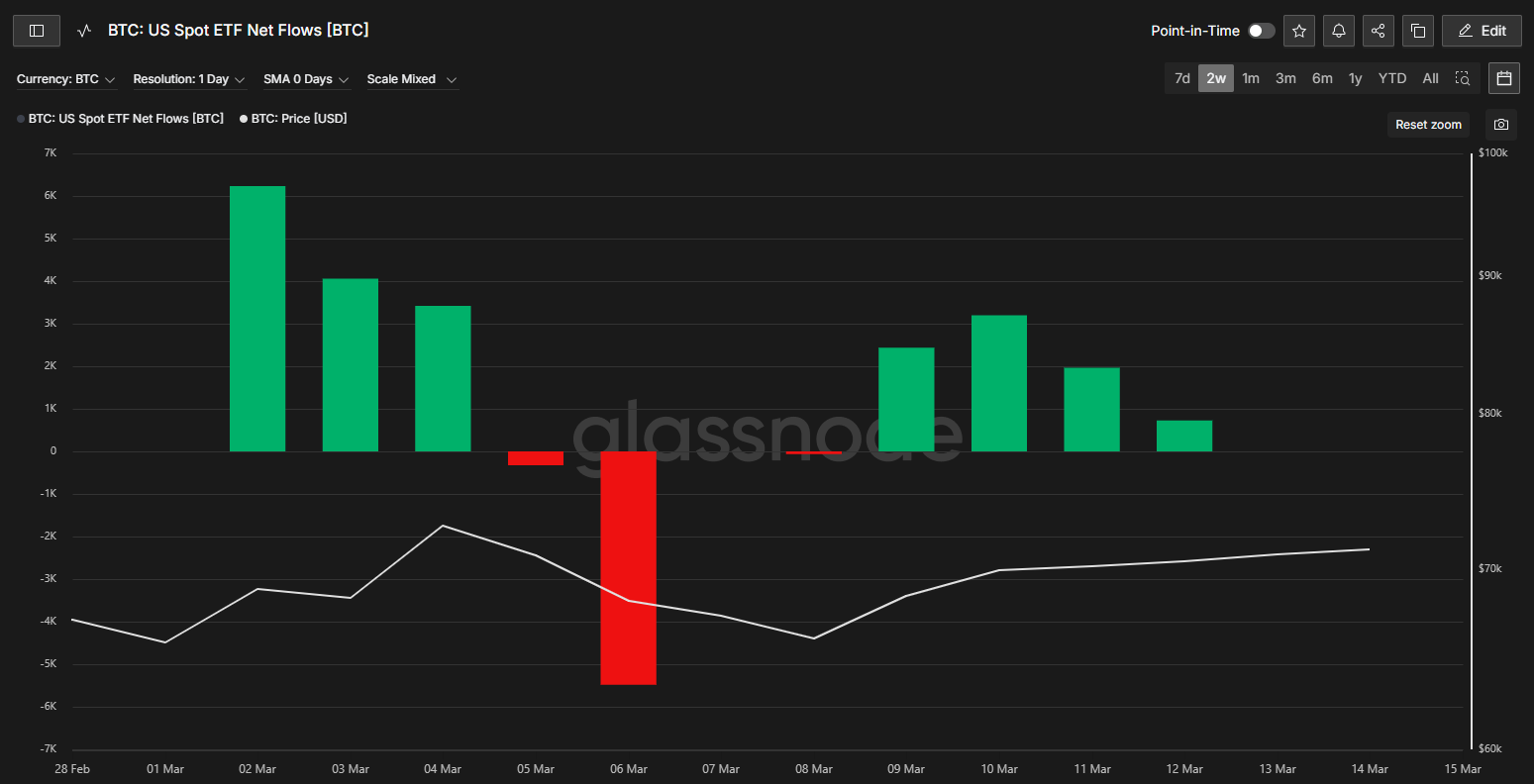
Source: Glassnode. Past performance is not indicative of future performance.
Bitcoin (BTC): Realised Price
Realised Price measures the average cost basis of all coins based on their last on-chain movement. When the market price trades above the realised price, the aggregate market is in profit and long-term holders tend to distribute. When below, capitulation historically occurs. Institutions also use this metric as a structural support or stress level for Bitcoin’s cycle.
According to data from Glassnode, as of 14 March 2026, the spread between market and realised price has dropped close to US$17K, narrowing from the much wider gaps typically seen during the strongest phases of previous bull markets.
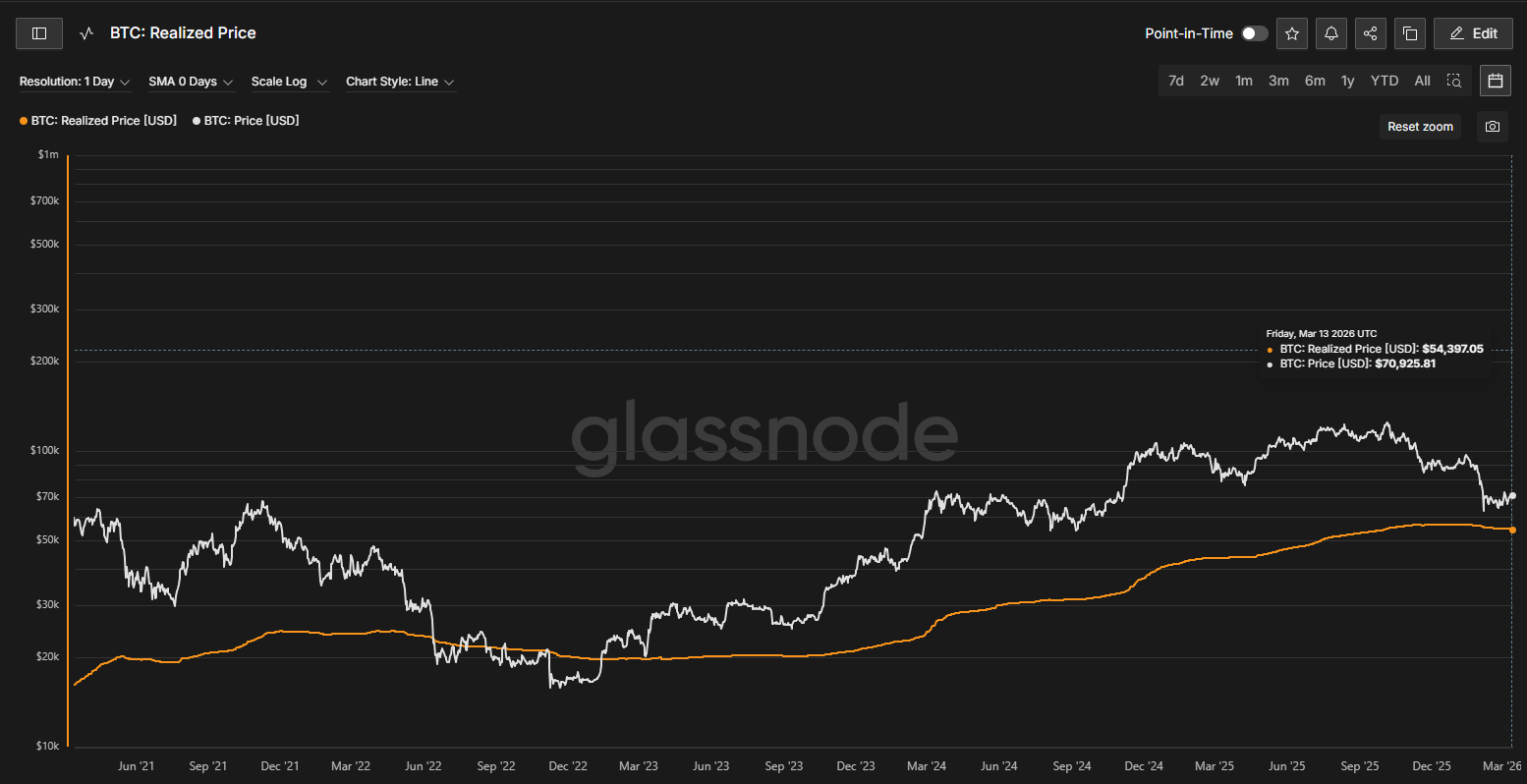
Source: Glassnode. Past performance is not indicative of future performance.
Altcoin news
Most top 20 altcoins ended up higher over the last seven days to 15 March. Hyperliquid (HYPE) was the leader once again, rising over 26% last week. The recent momentum has been driven by real trading activity and its role as a 24/7 venue for macro markets.
As geopolitical tensions in the Middle East have intensified, traders turned to the platform’s perpetual futures to position on oil while traditional markets were closed, pushing oil-linked contracts past US$1 billion in daily volume. HYPE’s activity also highlights how crypto derivatives venues are increasingly becoming round-the-clock markets for global risk.7
Investing in crypto assets or crypto-focused companies is not suitable for all investors and should only be considered by investors who (i) fully understand their features and risks or after consulting a professional financial adviser, and (ii) who have an extremely high tolerance for risk and the capacity to absorb a rapid loss of some or all of their investment. Any investment in crypto assets or crypto-focused companies should only be considered as a very small component of an investor’s overall portfolio.
References:
- https://www.ft.com/content/d84aea52-0cdd-4f8c-a08d-d14925b5b6ab
- https://fintechmagazine.com/news/ripple-targets-afsl-to-bolster-australian-payments
- Staking lets holders lock up their cryptocurrency to help operate a blockchain network, and in return they receive rewards – like earning interest or yield. Staked cryptocurrency ETFs are not yet approved for listing in Australia.
- https://news.bitcoin.com/blackrock-launches-ethereum-staking-etf-with-dividend-yield/
- As at 13 March 2026. No assurance is given that this company will remain in the portfolio or will be a profitable investment.
- CRYP does not invest in crypto assets directly and does not track price movements of any crypto assets. For more information on risks and other features of CRYP, please see the Product Disclosure Statement and Target Market Determination (TMD), available at www.betashares.com.au.
- https://fortune.com/2026/03/14/hyperliquid-iran-oil-trade-weekend-markets-24-7/
It provides general information only and is not a recommendation to invest in any crypto asset, crypto-focused company or investment product.