




Global week in review: Fed hikes as expected
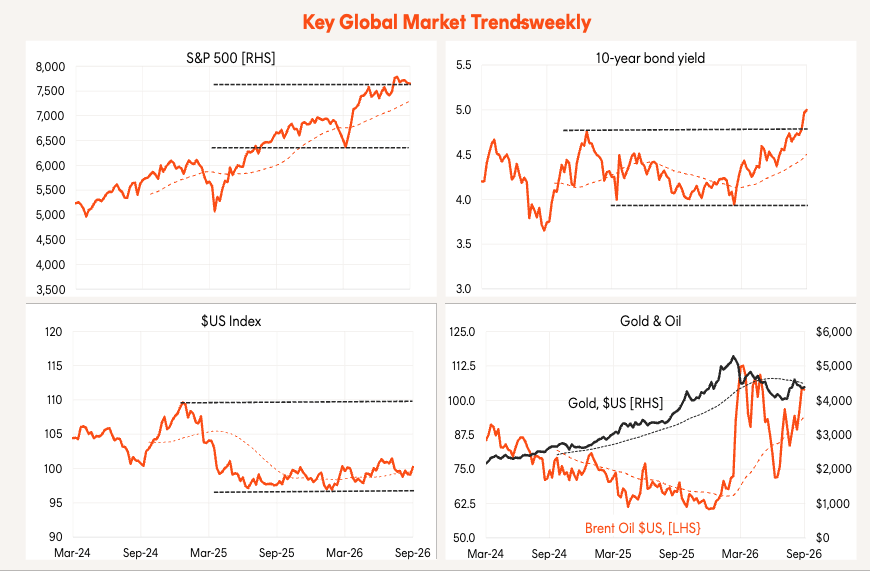
US equities were broadly flat last week, with investors unsure whether to rejoice or weep following the Fed’s widely expected rate hike. Technology did better with US President Trump pushing back on industry calls for greater AI regulation. Oil prices eased, with Saudi Arabia trying hard to keep exporting oil in the face of Houthi attacks.

Source: Betashares, Bloomberg.
After a lot of talk, the Fed finally walked the walk last week with a 0.25% rate increase. Importantly, despite a relatively hawkish stance by Fed Chair Kevin Warsh, with the risk of more rate rises ahead, long-term bond yields remained relatively steady and equity markets largely shrugged.
In short, it may have been a case of “sell the rumour, buy the fact”. At this stage, it does seem likely the Fed will hike rates at least once more this year – potentially as early as next month just ahead of the midterm election.
The muted market reaction, however, suggests investors have likely taken some comfort from the fact the Fed seems serious about tackling above-target inflation after all. Continued resilient global economic growth and corporate earnings – underpinned by the AI boom – is also helping support equity markets at a time of other geopolitical and interest rate concerns.
The Bank of Japan also raised rates as widely expected, though it was considered a “dovish hike” in that two of the nine board members voted against a rate hike and Governor Ueda played down expectations of aggressive further hikes in the near term. The yen weakened a little in the aftermath.
In terms of the war in Iran, oil prices eased last week despite ongoing Houthi attacks targeting Saudi Arabia. Markets took some comfort from reports that the Saudis are still managing to export oil, by using smaller ships that run the gauntlet through the Strait of Hormuz and then load up larger ships waiting in the Gulf of Oman.
Finally, there was some relief in the technology sector with US President Trump playing down the need to impose “guardrails” on further AI development.
Global week ahead: Trump-Xi meeting
There’s little in the way of major economic data this week, though a few Fed members will likely share their views on the interest rate outlook.
One highlight is the upcoming meeting between US President Trump and Chinese leader Xi Jinping. Likely high on the agenda and of market interest will be any outcomes regarding trade, the Iran war and artificial intelligence.
Sadly, it seems unlikely that any major agreement will be forged in any of these areas, with Trump branding AI security concerns a “hoax” and China likely unwilling to agree to tougher sanctions on Iran. The meeting might end up with China yet again offering a tokenistic pledge to buy more US agricultural products.
Developments in Iran and any talk of potential AI regulation outside of the United States will also be on investor radars.
Global equity trends: Technology firms again
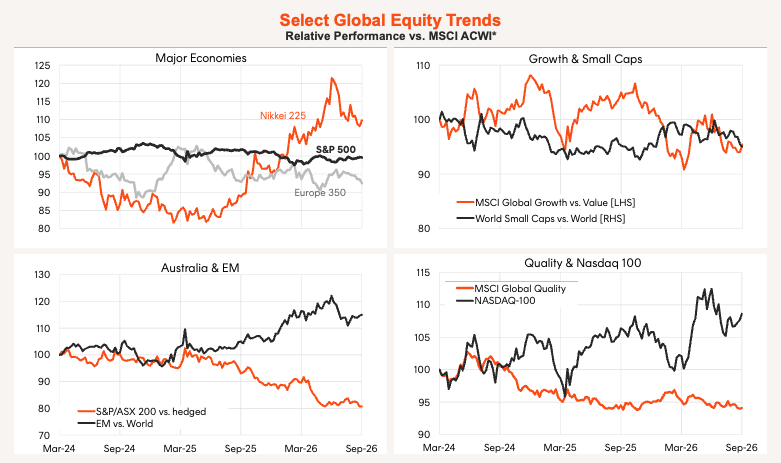
Despite AI concerns, the global technology sector ended higher again last week while energy and health care pulled back further.
Sector trends remain choppy, though there’s been some bounce back in the relative performance of technology – along with the US and emerging markets – in recent weeks.
*All but value factors. Local currency basis. Source: Betashares, Bloomberg.
Australia week in review: RBA talking tough
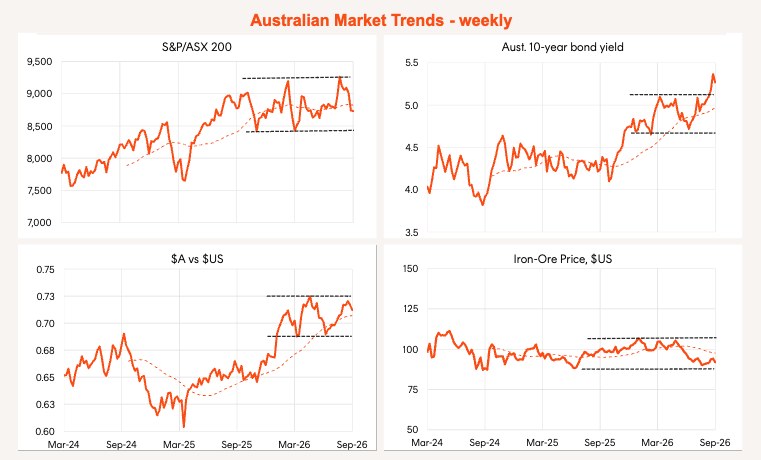
With little in the way of major local data, markets were focused on several further public outings by RBA officials. Their concerns over inflation gave local investors little reason to cheer.

Source: Betashares, Bloomberg.
Indeed, last week’s Fed rate rise will likely add to pressure on the Reserve Bank to raise interest rates again. That’s because the RBA essentially needs to respond to the same global forces other central banks are dealing with – namely the rebound in oil prices and a growing realisation that the AI boom, in the short-run at least, is adding to rather than detracting from inflation.
The RBA has essentially said in recent months that it will raise rates further if it feels a need to revise up its current inflation forecasts, noting that risks to inflation remained on the upside. Speaking in Canberra on Friday, Governor Bullock conceded “some of these upside risks to inflation appear to be materialising”.
My base case shifted last week, with the RBA now expected to raise rates at its policy meeting later this month, with a 50% chance of a follow-up rate rise in November.
Further rate rises will add to the downward pressure on house prices, which in turn risks more substantial slowing in consumer spending and housing construction.The sad reality is that lower house prices will be seen by the RBA as part of the transmission mechanism whereby higher rates help slow economic growth and bring down inflation.
Local equity market trends: Defensives favoured
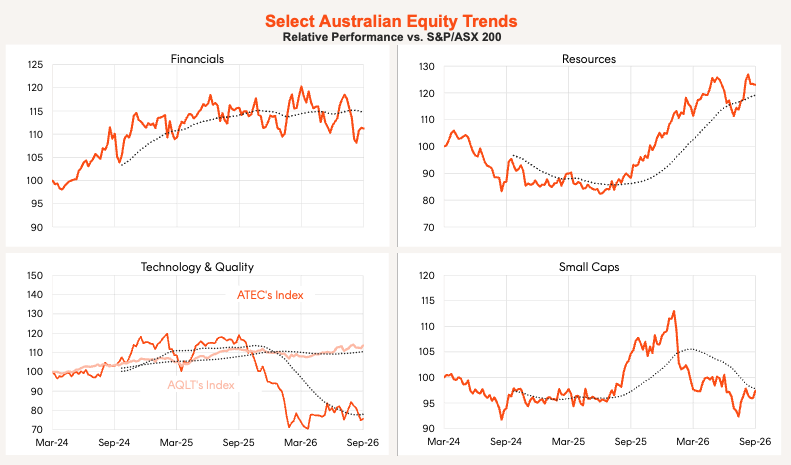
The defensive health care sector did best last week while the interest rate sensitive property sector fared the worst.
As is the case globally, sector trends remain choppy. The resource sector’s recent outperformance is being challenged by higher global interest rates and the risk to global growth that this entails. If anything, the current macro backdrop favours local defensive sectors.
Source: Betashares, Bloomberg.
Australia week ahead: Labour market report
This Thursday’s local labour market report for August will be one of the last major data points for the RBA to consider before next week’s policy meeting. Given the RBA’s stated concerns with inflation, it would take a particularly weak employment report, which seems unlikely, for it to definitively rule out a rate rise this month.
As it stands, the market expects a modest 20k rebound in employment (after a decline of 16k in July) which would keep the unemployment rate steady at 4.5%.
Treasurer Chalmers is also on course to hand down the latest intergenerational report today. According to reports, however, his hoped-for good news story of a decline in the projected level of debt decades ahead has been undermined by an apparently dodgy assumption about long-run assumed productivity growth.
Treasury, it seems, will maintain a long-run productivity growth assumption of 1.2% p.a., even though the 20-year average has been only 0.8%. Treasury will justify this assumption by returning to a forecast based on the past 30-year, rather than 20-year average.
Of course, it’s hard to say whether using a 30 or 20-year average is the best way to derive a long-run productivity growth assumption. That said, it does seem overly convenient the Treasurer has decided to “cherry-pick” a new time period which just so happens to avoid a downgrade to the productivity growth estimate which, in turn, would have all but eliminated the projected decline in public debt to be outlined in the report.
Have a great week!
