


Key points
Crude may range trading, but a new risk is emerging
Having touched US$100 a barrel in late July, Brent crude has eased again, amid an unpredictable de-escalations and re-escalations in the US-Iran conflict. Adding a new dimension to the conflict, the Houthis now threaten passage through the Bab al-Mandeb Strait, but this has not pushed oil prices to the levels seen in March-May. A key factor here is that oil from Saudi Arabia’s Red Sea ports can still make it to key customers in Asia without passing through that Strait, by instead taking the longer route via the Suez Canal. This increases cost at the margin, but does not stop supply outright.
The Strait of Hormuz is different, in that there is no alternative shipping route. Passage through that body of water matters much more. One might suggest that Iran has an incentive to escalate when Brent falls to around US$70 a barrel, to boost potential export income, and the US has an incentive to deescalate when it hits US$100, so as to not spook markets.
Despite easing in crude prices, the market for refined petroleum products (petrol, diesel, jet fuel, etc) has continued to tighten with refiner margins now at record highs. This has been caused by the extreme price volatility and intermittent crude supply getting through the Strait of Hormuz, but there is also another reason – the war in Ukraine.
Ukraine changes the game
Ukraine has adopted a new strategy in its war against Russia, and it may be working. Using long-range drones to strike up to 2,500kms from Ukraine’s border, it has hit at least 24 of Russia’s 34 major oil refineries. There have been reports that as much as 43% of Russia’s refining capacity has been taken out1, leading to petrol shortages across Russia. The drop in production is also impacting global markets: Russia has banned diesel exports from 8 July, and has separately placed restrictions on gasoline and jet fuel shipments. Diesel refining margins in Europe have ratchetted higher throughout July, even when Crude prices have eased.
European Diesel Refining Margins (ICE gasoil crack spreads) vs Brent Crude Oil Prices: July 2024 – July 2026
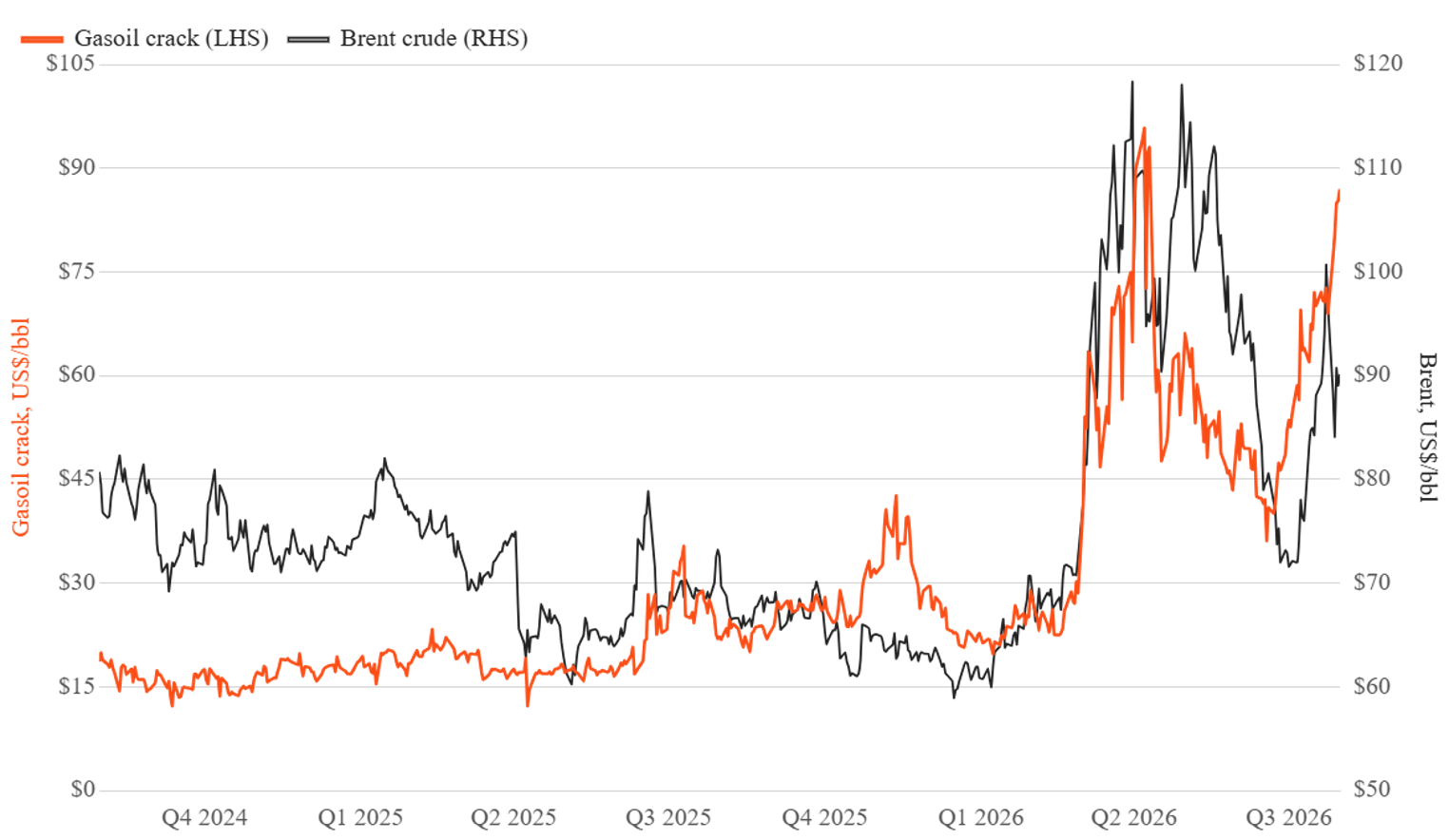
Source: Bloomberg, Betashares. Gasoil crack, left axis; Brent crude, right axis. Both US$ per barrel. As at 31 Jul 2026. Gasoil converted from tonnes to barrels at 7.45 bbl per tonne, then less Brent crude. The crack is a proxy for diesel refining margins: a wider crack means diesel is richer relative to crude.
How to get exposure to downstream energy
High refined product prices don’t bode well for inflation and economies globally, due to our dependence on fuels like diesel for agriculture, freight and industrial activities. Investors may want to consider what exposures can instead benefit in such an environment, particularly if the broader equity market comes under pressure.
Refiners are the most obvious winner. Geelong refiner Viva Energy said it expected its H1 2026 EBITDA to be more than double the year prior. But the main ASX listed energy names, like Woodside, Santos, Beach Energy and Karoon are upstream producers. Their earnings are driven by commodity prices (oil, LNG), not the so-called “crack spreads”.
Another alternative for Australian investors is FUEL Global Energy Companies Currency Hedged ETF. FUEL offers exposure to global energy companies that are larger and more vertically integrated than Australian-listed energy companies. This includes companies like TotalEnergies, BP and Shell2 that have a greater share of refining activity in Europe, where margins have surged since Russian production has been taken out of the market. These three companies recently announced strong Q2 refining and oil trading earnings and Goldman Sachs continues to see upside to refining margins into the second half of 2026.3 But refined margins are up across the board, so integrated US giants like Exxon Mobil also stand to benefit.
With US Midterm elections in November, President Trump could be willing to offer Iran concessions to get crude flowing through the Strait of Hormuz. But ironically lower crude prices and the loss of Russian refining capacity may mean the world’s largest oil companies can continue to generate high margins from their refining activities.
