

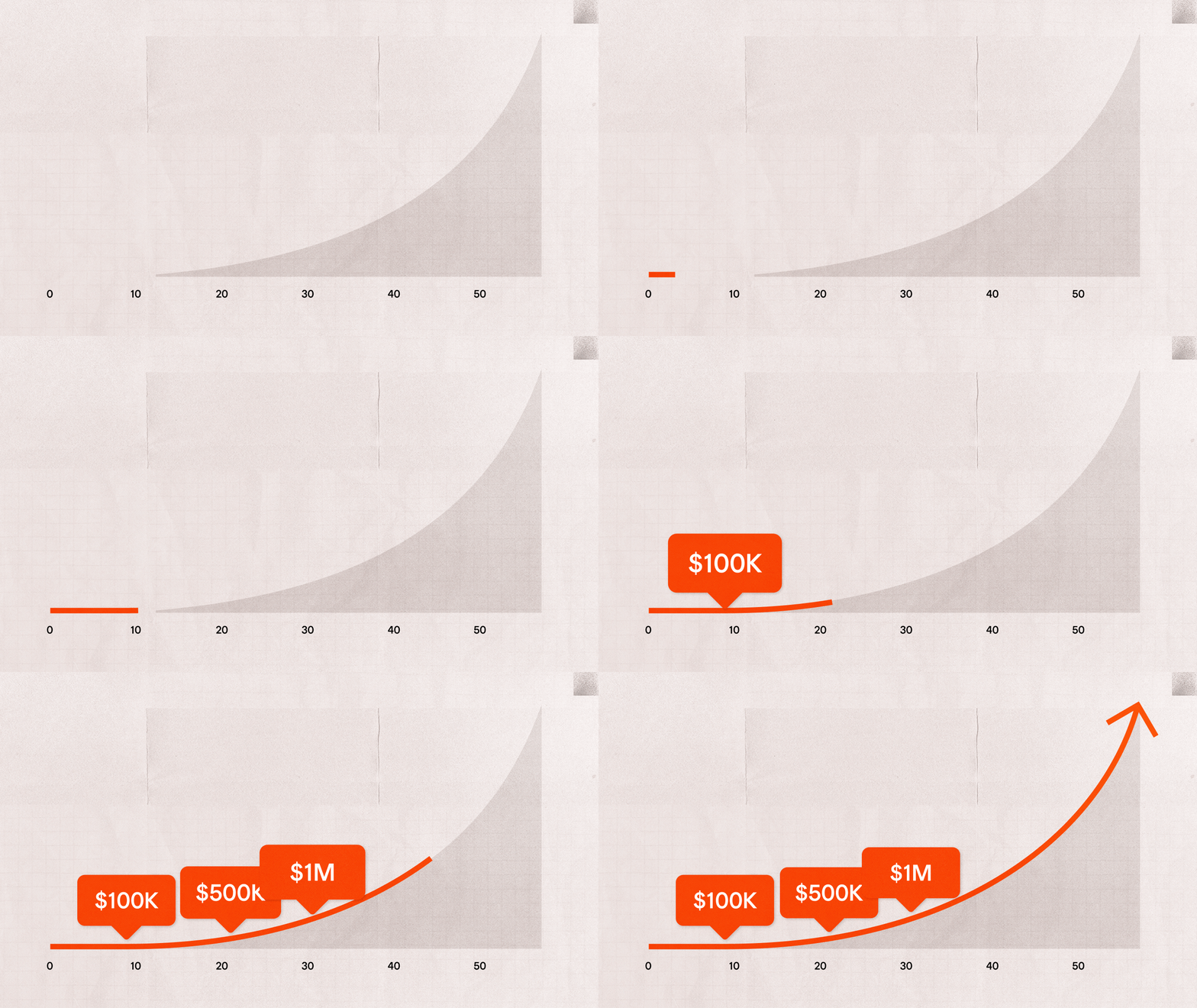


Warren Buffett’s partner in crime, the late great Charlie Munger, once described the first $100,000 as the hardest part of building wealth.
Speaking at a Berkshire Hathaway shareholder meeting in the late 1990s, Munger said, “the hard part for most people is the first $100,000.” He even suggested investors should consider walking everywhere and living off meals paid for by coupons if that’s what it took to get there.
Now building your first $100,000 probably doesn’t require walking as your only mode of transport or hunting for the cheapest deal every time you eat. But Munger had a point about it being a major milestone.
When you’re starting from zero, most of the heavy lifting comes from you. Spending less than you earn and consistently putting money aside are the main levers you can pull. But now that you’ve hit this figure, compounding starts to do more of the hard work, the way your portfolio is structured becomes more important and tax matters more than ever before.
Whether you’re approaching $100,000, have reached that milestone or are working towards it, it can be a useful point to ask: does the strategy that got me here still make sense for where I’m going next?
The power of compounding starts to take effect
One of the biggest changes as your portfolio grows is that your money will start making a much more noticeable contribution to your progress.
We can see this through the time taken to get to $100,000 and then the subsequent $100,000 intervals after the initial hurdle. Say you invest $10,000 every year and earn an average return of 7% a year. Under those assumptions, it takes almost eight years to build your first $100,000. But the next $100,000 takes just over five years. The one after that takes less than four. By the time you’re going from $900,000 to $1 million, it takes just 1.35 years.
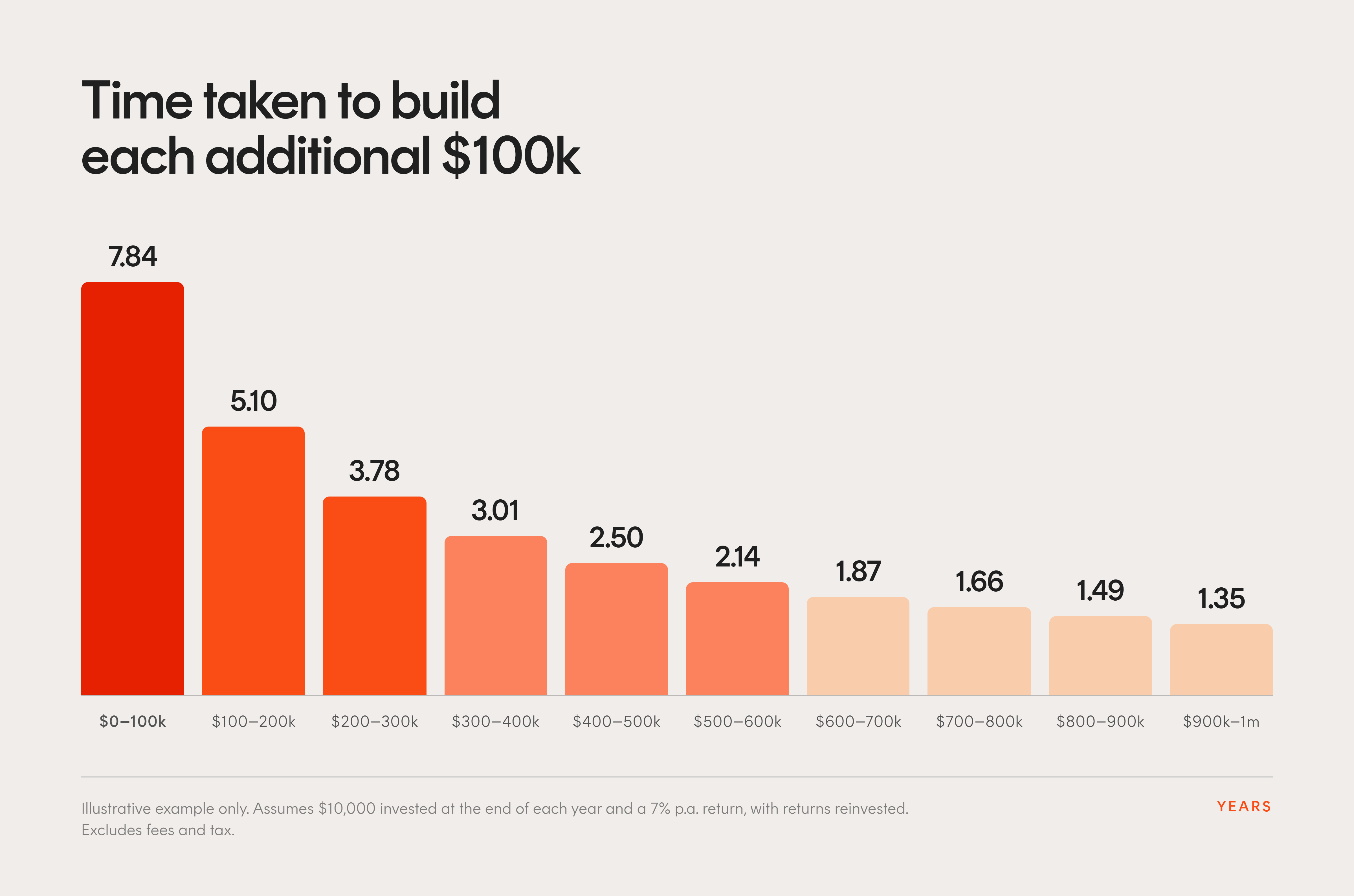
Importantly, you haven’t increased the amount you’re investing each year. The difference is that there is increasingly more money in your portfolio earning returns and compounding alongside your contributions.
That’s one of the most rewarding parts of reaching this stage. In the early years, progress is largely driven by how much you can consistently put away. As your portfolio grows, staying invested and giving your money time to compound becomes an increasingly powerful part of the equation.
Time for a portfolio health check
Building towards a larger portfolio can also be a good excuse to stop and look under the hood of your portfolio.
If you had the foresight to buy Nvidia or another AI player a few years ago, you may have seen it grow into a much larger position than originally intended. A holding that started as 10% of your portfolio might now make up 20% or 30%, leaving you more exposed to one company or sector than you realised. If that’s happened, it may be worth rebalancing your portfolio. That doesn’t necessarily mean selling the investment.
Directing future contributions elsewhere can also gradually reduce its weight in your portfolio. Betashares Direct’s Auto-invest feature lets you set up recurring investments into up to five Betashares ETFs brokerage-free, which can help gradually shift your allocation without needing to sell existing investments.
At the same time, it’s easy to keep adding ETFs whenever a shiny new one catches your eye. But there can be a point where too many ETFs can create unexpected overlap. Some that look different on the surface may ultimately own many of the same underlying companies, leaving you less diversified than you thought.
So once your portfolio reaches six figures, it’s worth taking some time to understand exactly what you own.
Tax matters more
The tax consequences of making changes to your portfolio can become more significant as your portfolio grows. If an investment you bought for $5,000 is now worth $20,000, selling it means you’re realising a sizeable capital gain.
So before making changes to a larger portfolio, it’s worth checking a few things first.
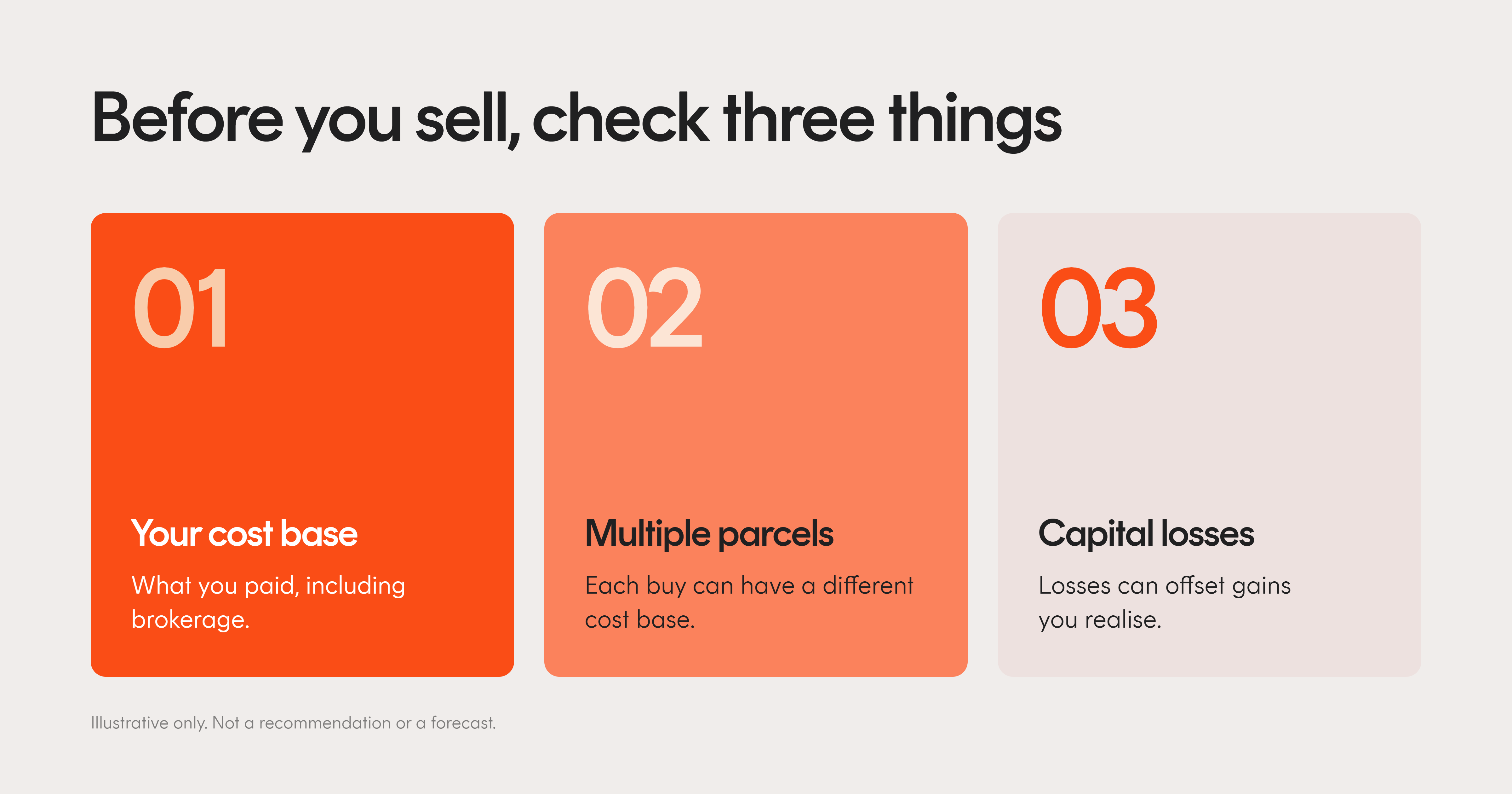
The first is your cost base. That’s the amount that you paid for an investment, including costs like brokerage, and helps determine the capital gain or loss when you sell. You can usually find this information in your trade confirmations or transaction history.
If you’ve bought the same investment multiple times, each parcel may have a different cost base. ETFs can require an extra step, as amounts reported in annual tax or AMMA statements can adjust your cost base. Keeping those statements together, or using a portfolio tracking tool, can make life much easier when it comes time to sell.
Capital losses can also be used to offset capital gains. If you sell an investment at a loss, that loss can generally be used to reduce capital gains realised elsewhere in your portfolio. If you don’t use the full loss in that financial year, the remainder can generally be carried forward and used against future capital gains.
Don’t overcomplicate what worked
Reaching $100,000 doesn’t mean you suddenly need to start looking at technical stock charts or staying up late to keep up with company news from overseas.
The habits that helped build your first $100,000, like spending less than you earn, investing regularly, staying diversified and keeping costs low, will still be habits that help build the next $100,000.
If anything, there may now be even more reason to resist the temptation to constantly tinker. Unnecessary trading, chasing the latest investment idea or making emotional decisions can easily get in the way of a strategy that has already served you well.
Charlie Munger’s point wasn’t that everything becomes easy once you reach $100,000. It was that getting a meaningful amount of money invested in the first place is often the hardest part.
So, well done. Keep going. We’ll see you at the next $100,000.