




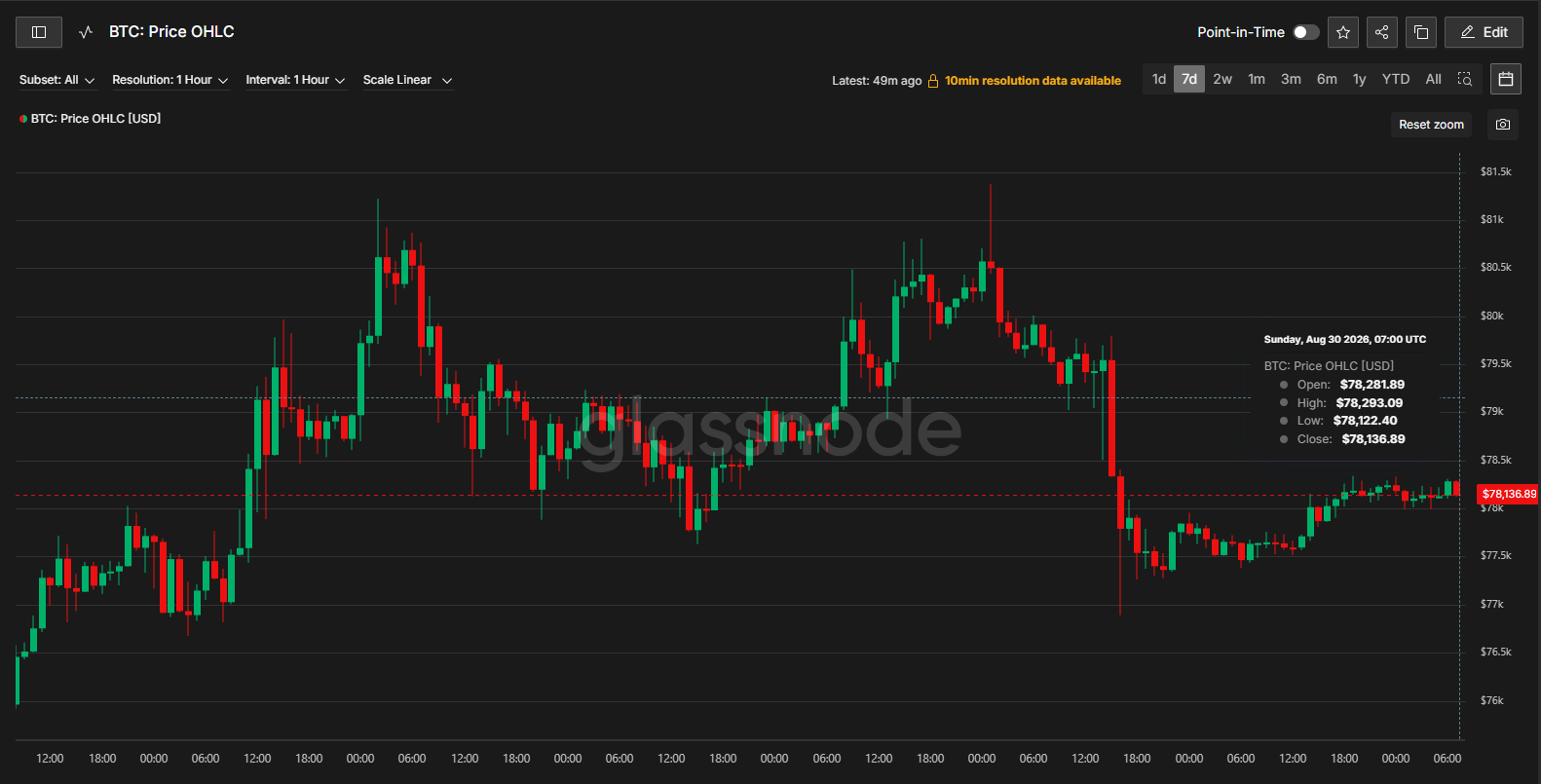
Bitcoin and the broader crypto market moved higher over the past week, extending a sharp two-week rally that began after the US Treasury announced an expansion of long-dated bond buybacks. Bitcoin briefly traded above US$81K, its highest level since February, as softer yields, a weaker US dollar, renewed ETF demand and short covering helped fuel momentum.
While the seven-day move was more modest, the two-week rebound was significant and pushed Bitcoin back toward the top of its recent trading range.
Over the seven days to 30 August 2026, Bitcoin and Ethereum were higher by 2.93% and 2.91% respectively. Bitcoin’s market capitalisation rose to US$1.56 trillion, while the global crypto market reached US$2.63 trillion. Bitcoin’s market dominance rose to 59.5%.
Source: Glassnode. Past performance is not indicative of future performance.
| Price | High | Low | Change from previous week | |
|---|---|---|---|---|
| BTC (in US$) | $78,128 | $81,051 | $75,916 | 2.93% |
| ETH (in US$) | $2,456 | $2,546 | $2,391 | 2.91% |
Source: CoinMarketCap. As at 30 August 2026. Past performance is not indicative of future performance. Performance is shown in US dollars and does not consider any USD/AUD currency movements.
Crypto news we’re watching
SEC opens the door to crypto capital raising
The SEC has proposed “Regulation Crypto Assets”, a new framework designed to create clearer pathways for certain crypto projects to raise capital under US securities laws. The proposal would introduce two exemptions from registration: one for offerings of up to US$5 million over four years, and another for offerings of up to US$75 million over a 12-month period, with issuers still required to provide principles-based disclosures and remain subject to anti-fraud and anti-manipulation rules.1
Rather than relying only on enforcement or pushing activity offshore, the SEC is attempting to build a tailored regime for crypto capital formation inside the existing securities framework. If adopted, it could give crypto issuers a more defined path to raise capital, while also bringing stronger disclosure standards and investor protections into the market.
Stablecoin competition moves into banking
Banks that once pushed back against stablecoins are now reportedly considering launching their own, with JPMorgan among those to have evaluated whether it needs a dollar-backed token. The shift reflects a more defensive posture from the banking sector, as stablecoins continue to move beyond crypto trading and into payments, treasury management and settlement2.
Rather than trying to slow stablecoins down, some are beginning to position themselves inside the market, either through their own stablecoins or tokenised deposit networks. This evolution could contribute to a new phase of competition between crypto-native issuers, banks and payment networks over who controls the next layer of digital money infrastructure.
CRYP company spotlight
Crypto moves into the institutional mainstream
Galaxy Digital has been selected to be a validator for Morgan Stanley Investment Management’s new Ethereum and Solana ETPs. The mandate embeds Galaxy directly into institutional staking infrastructure, rather than simply providing trading or custody. It is a clear example of a listed crypto-native firm becoming part of institutional infrastructure.3
Galaxy Digital is held in the CRYP Crypto Innovators ETF4. CRYP provides exposure to global companies at the forefront of the crypto economy.5
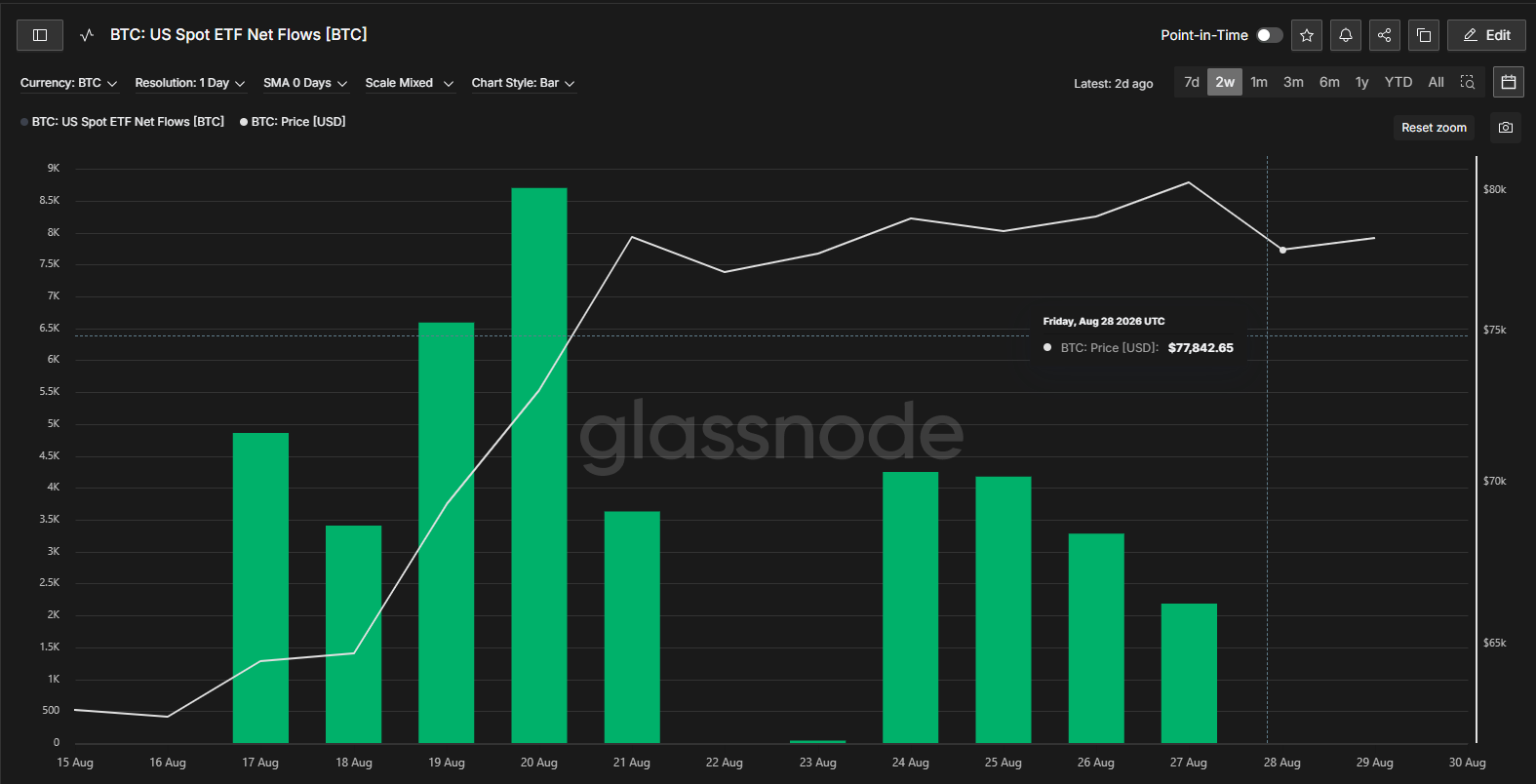
Bitcoin (BTC): US Spot ETF Net Flows [BTC]
US spot ETF net flows track the daily money moving into or out of major US-listed Bitcoin and Ethereum ETFs.
Positive flows mean more money is entering the ETF market, which can indicate stronger investor demand. Negative flows mean money is leaving the ETF market, which can suggest weaker demand or increased selling pressure.
The metric is based on holdings data reported by ETF issuers and converted into US dollars, so updates can be delayed outside normal trading hours or over weekends.
According to Glassnode data as of 28 August 2026, US spot Bitcoin ETF flows were broadly positive over the period, with several strong inflow days suggesting continued demand through regulated ETF channels. While Bitcoin’s price rallied alongside those inflows, momentum began to fade late in the week, indicating ETF demand remains supportive but not enough on its own to prevent short-term price consolidation.
Source: Glassnode. Past performance is not indicative of future performance.
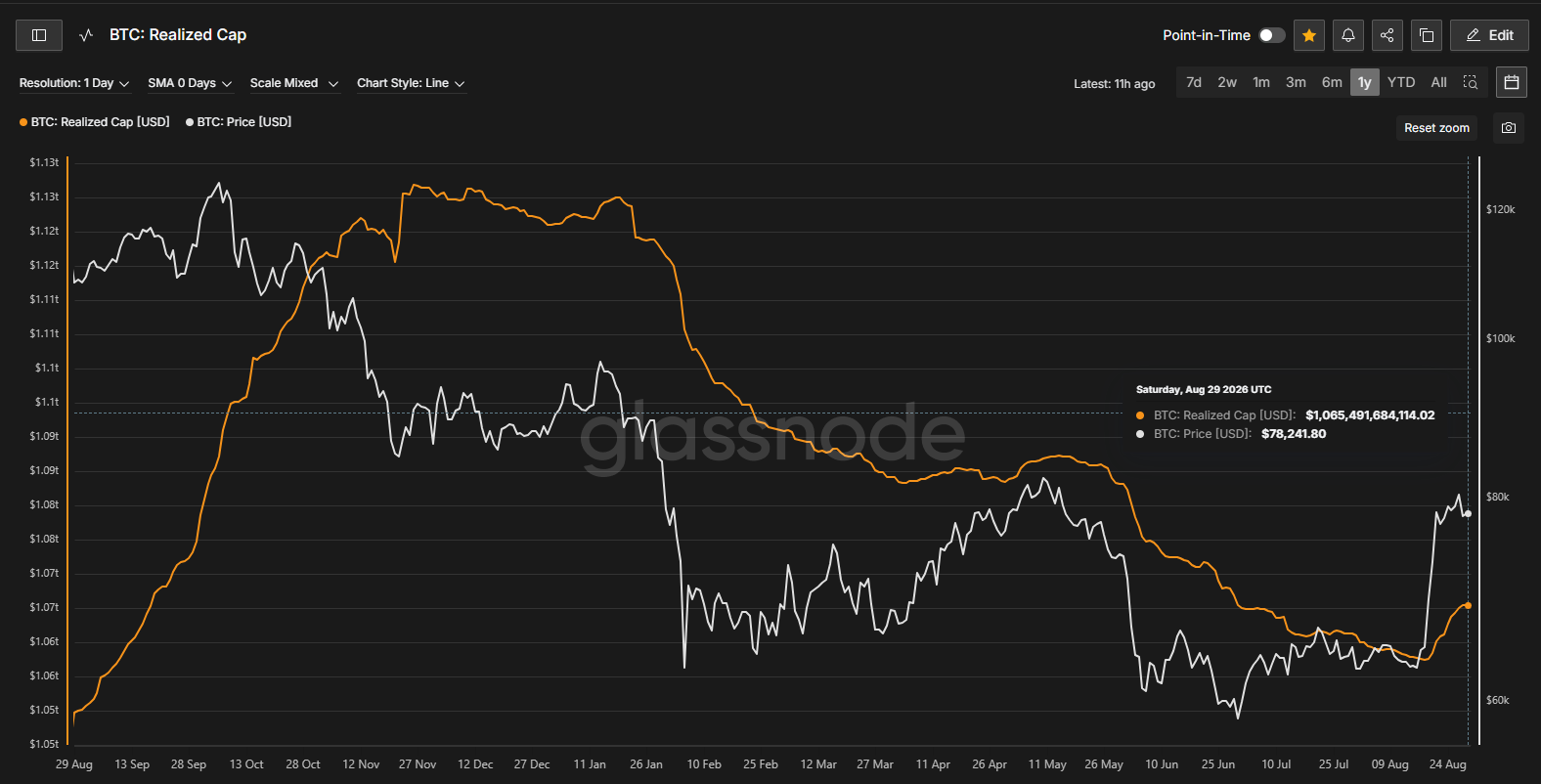
Bitcoin (BTC): Realised Cap
Realised Cap estimates the total value of Bitcoin based on the price each coin last moved at, rather than today’s market price. In simple terms, it gives a better sense of the network’s aggregate cost base, showing how much capital is effectively stored in Bitcoin on-chain.
According to data from Glassnode as of 29 August 2026, Bitcoin’s realised cap has begun to recover from recent lows, suggesting capital is gradually rebuilding on-chain as institutional ETF demand returns.
Source: Glassnode. Past performance is not indicative of future performance.
Altcoin news
Many of the Top 20 altcoins continued their run higher; with Solana outperforming major cryptocurrencies this week as institutional demand and network activity strengthened simultaneously. US spot SOL ETFs reached record cumulative inflows, while Bitwise’s staking ETF passed US$1 billion in assets, providing a clearer institutional bid for the token. Record transaction volumes and growing tokenised-asset activity added fundamental support, suggesting the rally was driven by more than a broad-market rebound6.
Investing in crypto-assets or companies servicing crypto-asset markets should be considered very high risk. Exposure to crypto assets involves substantially higher risk than traditional investments due to their speculative nature and the very high volatility of crypto-asset markets.
Investing in crypto assets or crypto-focused companies is not suitable for all investors and should only be considered by investors who (i) fully understand their features and risks or after consulting a professional financial adviser, and (ii) who have an extremely high tolerance for risk and the capacity to absorb a rapid of some or all of their investment. Any investment in crypto assets or crypto-focused companies should only be considered as a very small component of an investor’s overall portfolio.