


Justin Arzadon
6 minutes reading time
- Digital assets


If you prefer to listen to Off the Chain, you can listen here:



Bitcoin and Ethereum were up 5.94% and 8.46% respectively over the seven days to 1 March 2026. Bitcoin’s market capitalisation is US$1.33 trillion while the global crypto market sits at US$2.31 trillion. Bitcoin’s market dominance is at 58%.
|
Price |
High |
Low |
Change from previous week |
|
|
BTC (in US$) |
$66,944 |
$69,512 |
$62,709 |
5.94% |
|
ETH (in US$) |
$1,999 |
$2,122 |
$1,814 |
8.46% |
Source: CoinMarketCap. As at 27 February 2026. Past performance is not indicative of future performance. Performance is shown in US dollars and does not consider any USD/AUD currency movements.
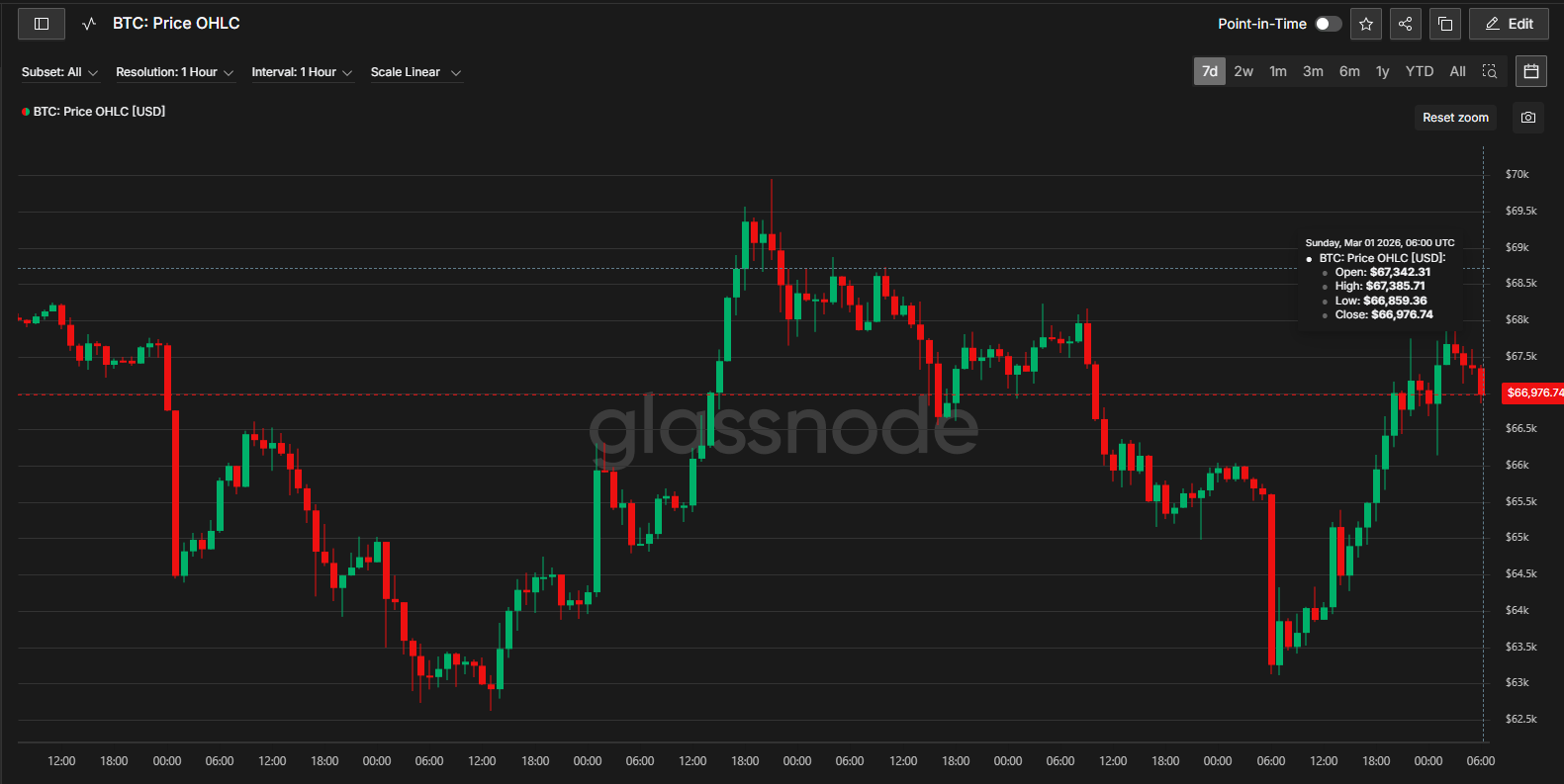
Source: Glassnode. Past performance is not indicative of future performance.
Crypto news we’re watching
Meta integrates stablecoin payments
Meta is reportedly preparing to integrate stablecoin payments across its platforms in the second half of the year, likely through a third-party provider such as Stripe, rather than launching its own token.
After the failure of its Libra project, this strategy appears to be more pragmatic: plug into existing dollar-backed infrastructure and embed payments directly into Facebook, Instagram and WhatsApp’s 3+ billion user ecosystem. The shift in the regulatory backdrop in the US has also possibly informed this timing, because stablecoin integration is structurally more feasible now than it was in 2019.
More broadly, if a platform of Meta’s scale integrates stablecoins, it may signal that digital dollars have stopped being a niche product and has started to become more common.1
Tether freezes funds
Tether, the world’s largest stablecoin issuer, says it has frozen roughly US$4.2 billion in USDT linked to illicit activity, with the vast majority blocked since 2023. With more than US$180 billion of dollar-pegged tokens now in circulation – up from about $70 billion three years ago – the company has the technical ability to freeze wallet balances at the request of law enforcement agencies. As an example, it recently assisted the US Justice Department in freezing nearly US$61 million tied to so-called ‘pig butchering’ fraud schemes.
It has also blocked wallets connected to human trafficking, sanctioned entities and conflict-related activity, including funds on the Russian exchange Garantex. The broader takeaway is that stablecoins and their integration into global compliance frameworks is scaling rapidly. In my view, the narrative is shifting from “unregulated shadow money” to programmable dollars operating with increasing oversight2.
CRYP company spotlight
Circle surges
Shares in Circle Internet Group (NYSE: CRCL) jumped after delivering a stronger than expected fourth quarter. Demand for USDC (which Circle issues) is continuing to expand, and the earnings profile shows that stablecoin issuers are evolving into high-margin financial infrastructure businesses.3
Circle Internet Group is held in the Betashares Crypto Innovators ETF (ASX: CRYP)4. CRYP provides exposure to global companies at the forefront of the crypto economy.5
Bitcoin (BTC): 4yr Compound Annual Growth Rate (CAGR)
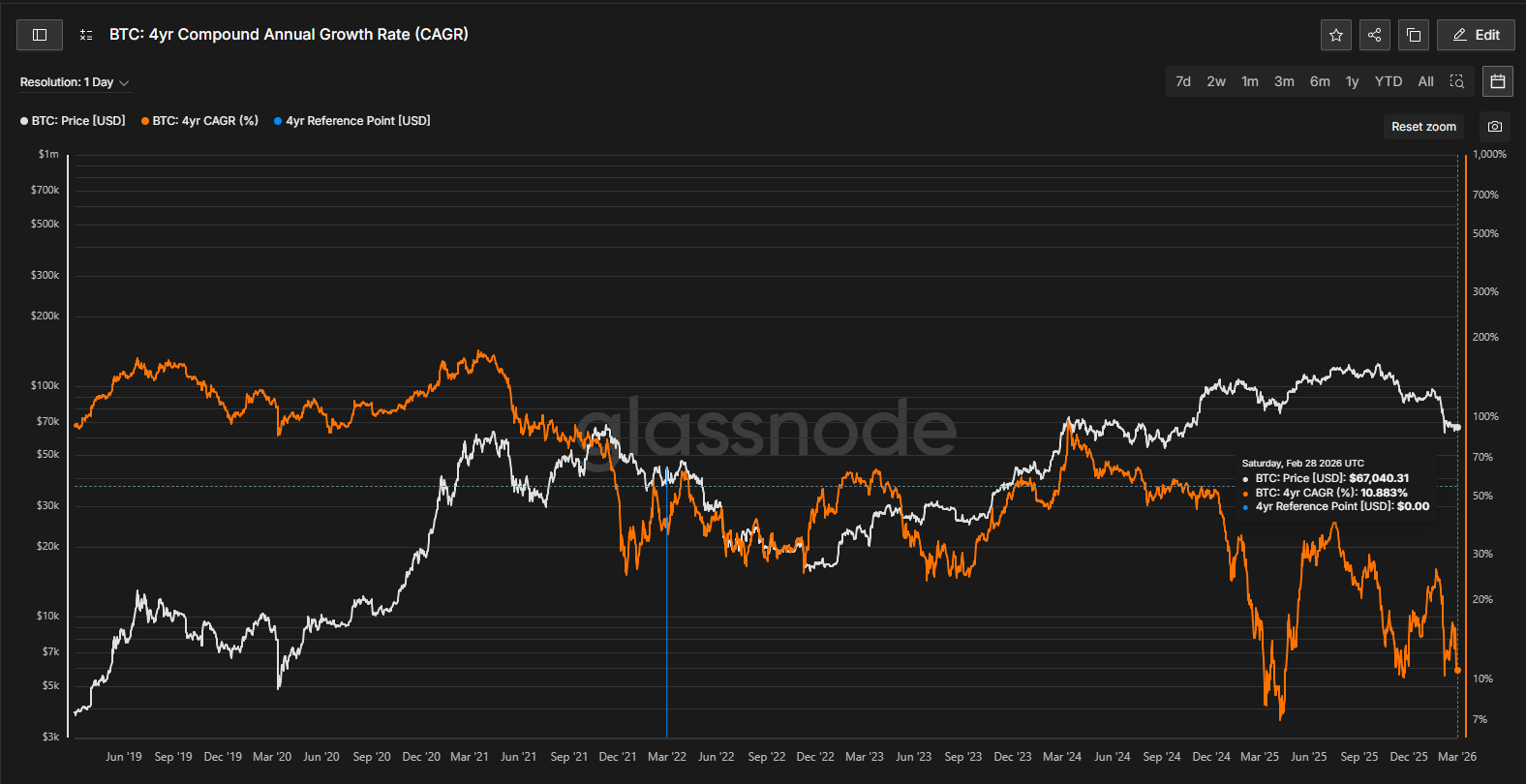
This chart presents the 4yr compound annual growth rate (CAGR) for Bitcoin through history. The 4yr period was selected to capture both the classic halving cycle, whilst also accounting for the typical bull/bear cycle which tends of be of a similar duration.
According to data from Glassnode, as of 27 February 2026, Bitcoin’s 4yr CAGR has declined to just 10% at current prices. This means investors who bought and held Bitcoin over the past four years are now earning returns broadly in line with long run sharemarket averages.
Source: Glassnode. Past performance is not indicative of future performance.
Bitcoin (BTC): Percent Supply in Profit
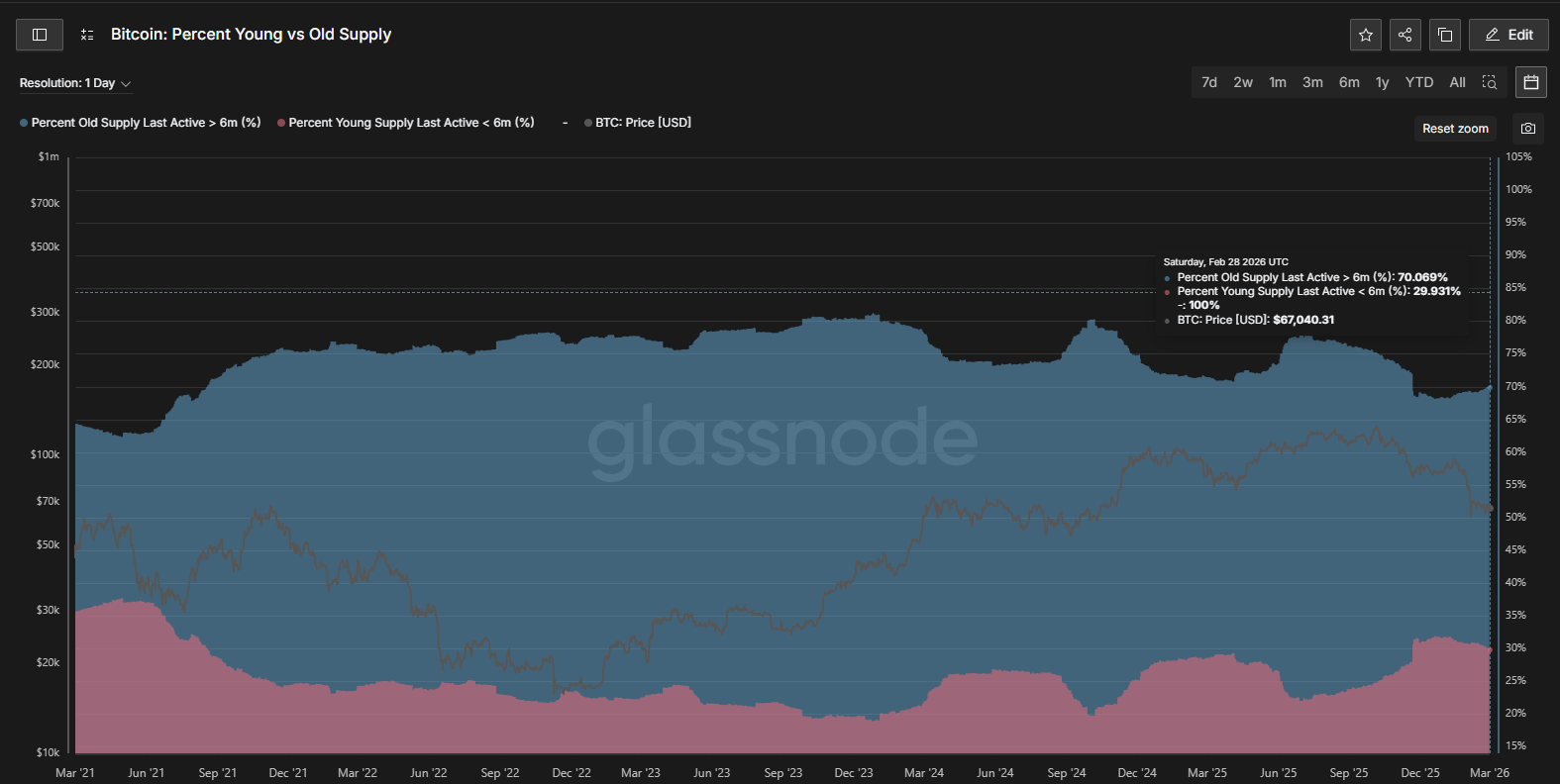
This chart presents the percentage of the circulating supply which has transacted within the last six months alongside the percentage of the circulating supply which has remained dormant for longer than six months.
- Coins which have not transacted for at least six months in blue are considerably less likely to be spent on any given day and referred to as ‘old’ coins.
- Coins which have transacted within the last five to six months in red are believed to be the most likely to be spent on any given day and referred to as ‘young’ coins.
According to data from Glassnode, as of 27 February 2026, so-called ‘young’ coins sit at 30% while ‘old’ coins close to 70%. This skew may suggest that the Bitcoin market is in consolidation rather than exuberance.
Source: Glassnode. Past performance is not indicative of future performance.
Altcoin news
Most top 20 altcoins ended up slightly higher over the last seven days to 27 February 2026. However, the standout was Hyperliquid (HYPE). HYPE has returned 16.3% and 54.22% over the last seven days and one year respectively.
Hyperliquid’s strength is being underwritten by fundamentals. Total-value-locked (TVL) has surged from near-zero in early 2024 to above US$6 billion, with protocol fees consistently hitting US$6–12 million on active trading days.
All this suggests real perpetual DEX volume and broader institutional access are allowing HYPE to trade more independently, rather than simply mirroring broader altcoin swings6.
References:
4. As at 27 February 2026. No assurance is given that this company will remain in the portfolio or will be a profitable investment.
5. CRYP does not invest in crypto assets directly and does not track price movements of any crypto assets. For more information on risks and other features of CRYP, please see the Product Disclosure Statement and Target Market Determination (TMD), available at www.betashares.com.au.
6. https://ambcrypto.com/hyperliquid-defies-altcoin-weakness-whats-driving-hypes-demand/
Off the Chain is published every second Tuesday. It provides the latest news on bitcoin and the rest of the crypto market, along with analysis and insights into the world of crypto.
It provides general information only and is not a recommendation to invest in any crypto asset, crypto-focused company or investment product.