


Hugh Lam
8 minutes reading time


“The ChatGPT moment for robotics is here. Breakthroughs in physical AI are unlocking entirely new applications.”
— Jensen Huang, founder and CEO of Nvidia
The global robotics industry is undergoing one of the most profound structural shifts in its history. What was once a market dominated by factory floor automation is expanding rapidly into a new generation of intelligent machines capable of operating in dynamic, human-oriented environments.
Globally, the robotic market is projected to reach US$111 billion by 20301, driven by persistent labour shortages, accelerating AI adoption, and better unit economics from increased competition. Goldman Sachs forecasts the global humanoid robot market alone could reach US$38 billion by 2035, up more than sixfold from a previous projection of US$6 billion2.
Exhibit 1: Robots took centre stage throughout the CCTV Lunar New Year Gala in China 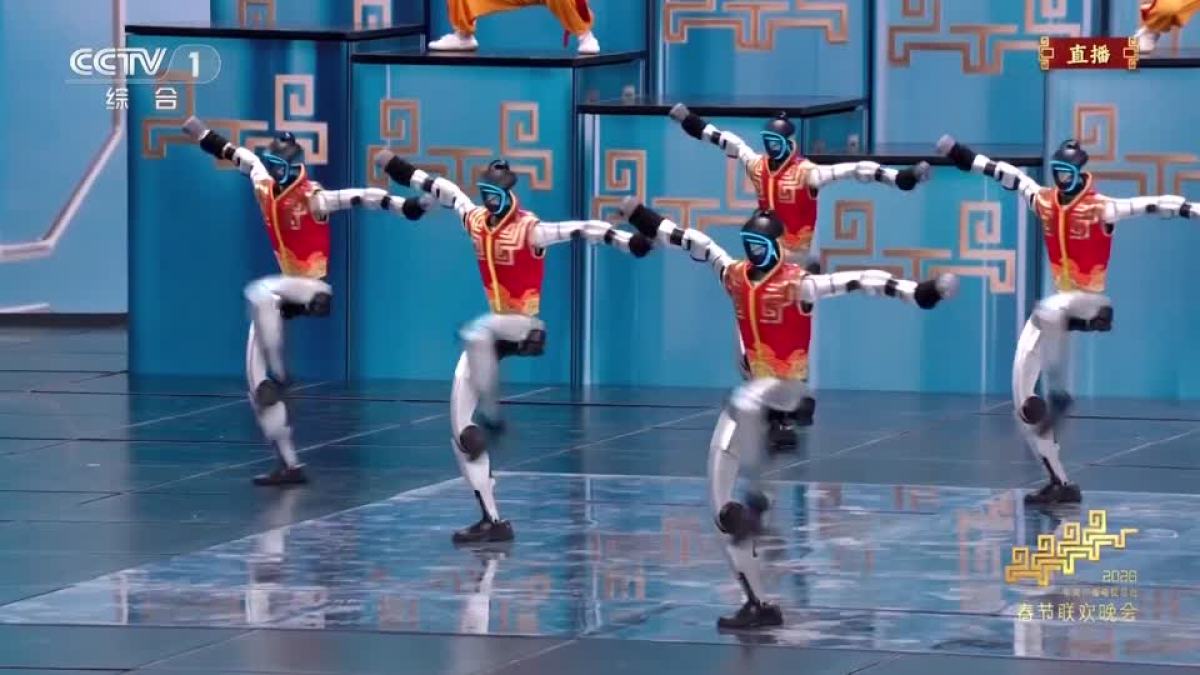
Stepping into the real world
For much of the last decade, the AI story was primarily software driven; however, rapid improvements in embodied AI technology have enabled robots to operate in real world environments, moving away from research demos to commercial deployment.
Mercedes-Benz is using Nvidia’s Omniverse platform to design and optimise their auto manufacturing processes in a fully simulated environment before deploying in the real world.
Schaeffler Group, a German manufacturer of rolling element bearings, is already using two-legged robots to carry 25-pound baskets of bearing components back and forth for hours straight.
While Elon Musk envisions ramping up production of humanoid robot Optimus Gen 3 to 50,000 units this year alone.
Underpinning these and many other deployments is NVIDIA’s Isaac GR00T N1. N1 was launched in March 2025 as the world’s first open foundation model for generalised humanoid reasoning. The majority of humanoid developers use N1 as the common AI ‘brain’ for their robots.
Clearly, the demand for physical robotics is manifesting in areas of the economy where workflows are often considered monotonous or dangerous, including high-energy power plants and logistics warehouses and manufacturing facilities. Roughly 16,000 humanoid robots were installed globally by the end of 20253, with annual shipments forecast to reach 115,000 units by 20274 — a near-sevenfold increase in just two years.
A key driver of physical robotics are global labour shortages which are already estimated at over 50 million people5, with Germany alone facing a projected 7 million worker deficit by 20356. Falling fertility rates and ageing populations are contributing to structurally smaller workforces that are expected to create upward pressure on labour costs. These demographic trends are pushing firms towards directing more capital towards automation and robotics solutions.
Robots are getting cheaper – fast
The cost of building a single humanoid robot has fallen dramatically. From anywhere between US$150,000 and US$500,000 just a few years ago, manufacturing costs dropped approximately 40% between 2022 and 2023 alone7, driven by cheaper components shared with mature electric vehicle supply chains and improving manufacturing techniques.
The best example of what this means in practice came in July 2025, when Chinese manufacturer Unitree launched its R1 humanoid at just US$5,9008. This follows their own G1 model at US$13,500 and H1 at US$90,0009, illustrating how rapidly the market is expanding across consumer, mid-market, and premium tiers.
Looking ahead, Yole Group forecasts the average selling price of a humanoid robot will fall from approximately US$75,000 today to around US$25,000 by 203510, driven by increased competition among Chinese OEMs (original equipment manufacturers), continued developments in embodied AI, and broader economies of scale that also brought down the cost of solar panels and EV batteries over time.
Exhibit 2: Price range considered viable for broad adoption
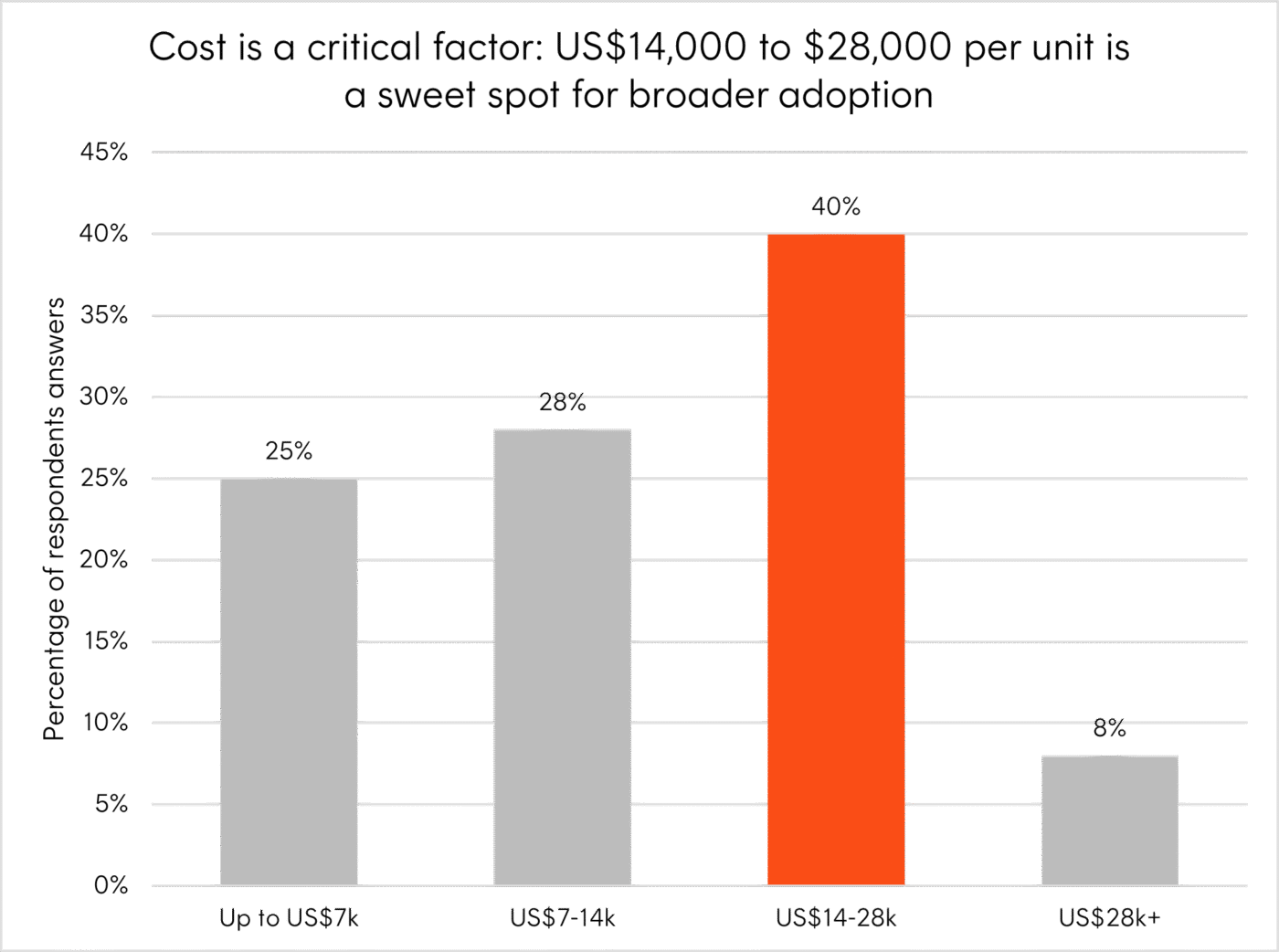
Source: AlphaWise, Morgan Stanley Research. Likely adopters n=53
Importantly, much of this cost deflation is being driven not by Western incumbents, but by Chinese manufacturers.
All roads lead to China when it comes to robotics
China has strong structural advantages when it comes to manufacturing and hardware supply chains, built over decades through industries like EV and consumer electronics. Because EV components, motors, batteries, and sensors, are very similar to those used in robotics, many companies pivoted to robot production using mostly domestic parts. As of January 2026, China accounted for two-thirds of global AI-driven robotics patent filings.
Exhibit 3: Monthly Patent Applications Mentioning “Humanoid” by Country
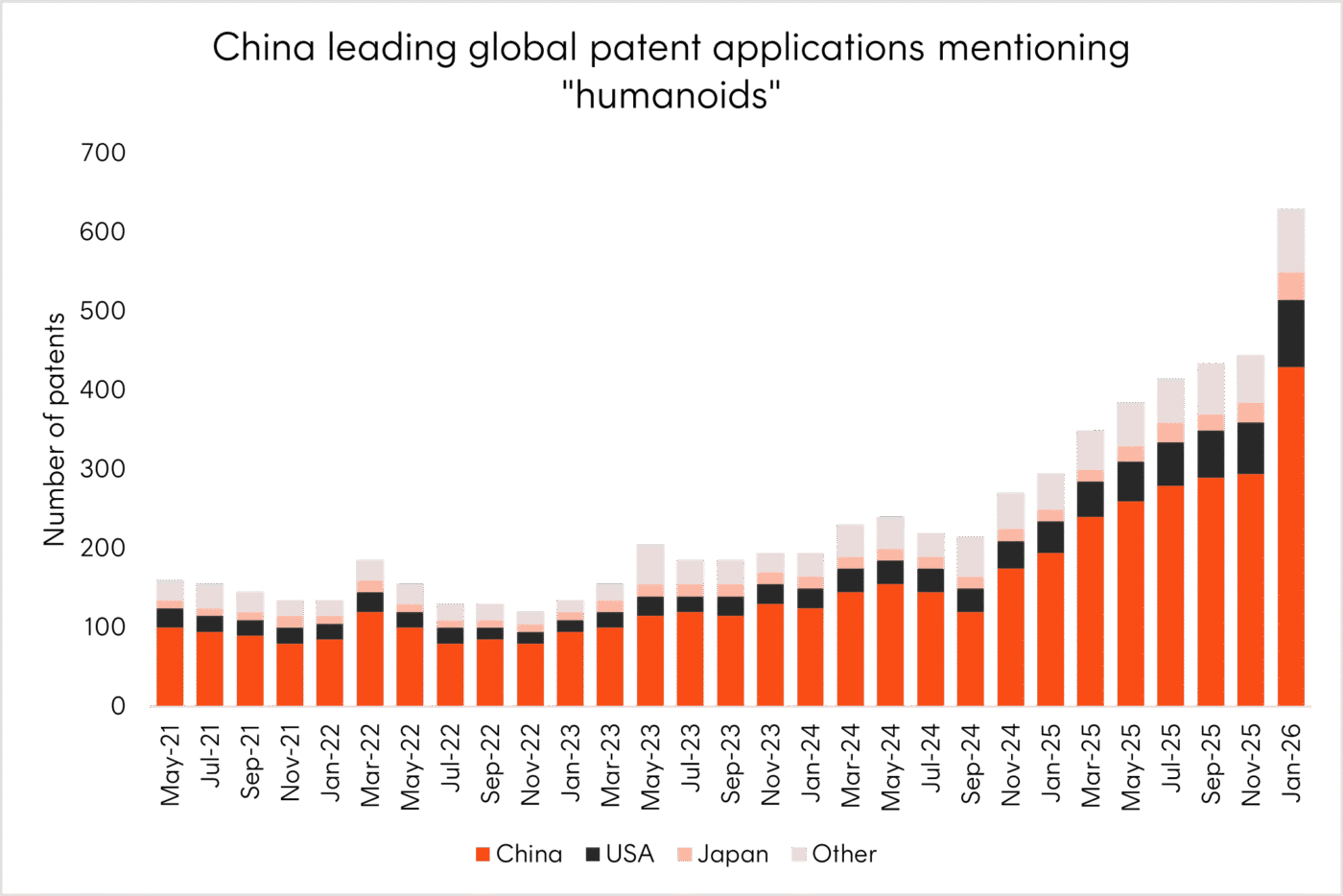
Source: Google Patents, Morgan Stanley Research. Note: Ordered by publishing date. According to Google Patents, may not capture 100% of patents.
Exhibit 4: Global patent applications mentioning ‘humanoid’ by office over the past five years
|
Rank |
Patent Office |
# Count |
|
1 |
China |
8,184 |
|
2 |
United States |
1,620 |
|
3 |
Japan |
1,142 |
|
4 |
World Intellectual Property Organization (WIPO) |
1,118 |
|
5 |
South Korea |
334 |
|
6 |
European Patent Office (EPO) |
226 |
|
7 |
Taiwan |
197 |
|
8 |
Germany |
111 |
|
9 |
Brazil |
24 |
|
10 |
Poland |
21 |
|
11 |
Canada |
17 |
|
12 |
Australia |
16 |
|
13 |
Great Britain |
16 |
|
14 |
Turkey |
15 |
|
15 |
France |
10 |
|
16 |
Spain |
7 |
|
17 |
Italy |
7 |
|
18 |
Eurasian Patent Organisation (EAPO) |
6 |
|
19 |
Romania |
4 |
|
20 |
Sweden |
3 |
Source: Google Patents, Morgan Stanley Research. Note: Exhibit limited to top 20.
China also has the green light at the national level, with the government designating AI and humanoids as core sectors of its 15th Five-Year Plan (2026–2030). Within China the value of high-tech manufacturing grew by 9.4%, while the output of industrial robots rose by 28% in 2025 alone11. IDC estimates China’s domestic humanoid robot expenditure will surge from US$1.4 billion in 2025 to US$77 billion by 203012.
Exhibit 5: 2024 Industrial Robot Installations (Top 10 Countries)
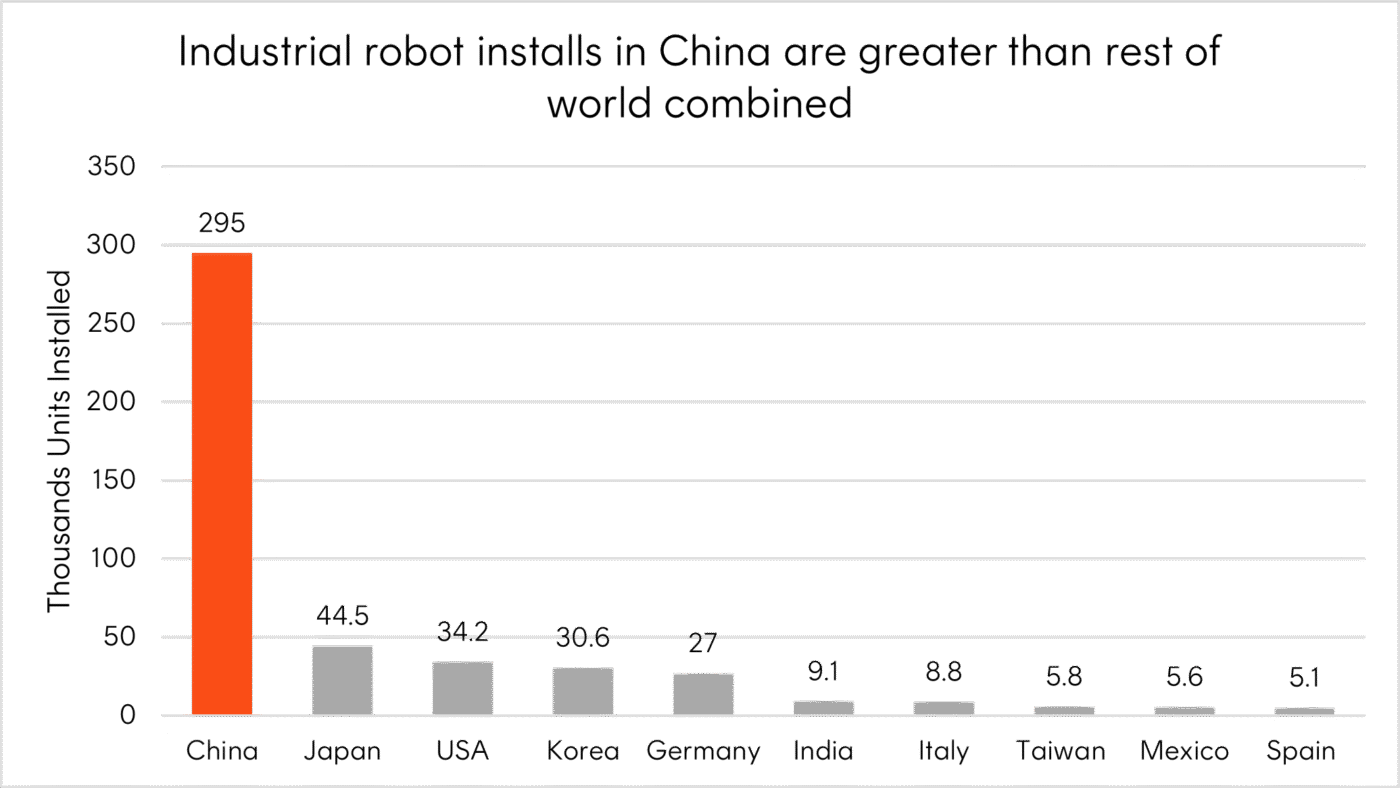
Source: International Federation of Robotics, Morgan Stanley Research
A better way to access the opportunity
For Australian investors seeking exposure to this structural shift, the RBTZ Global Robotics and Artificial Intelligence ETF has undergone a timely evolution in response to key development in the Robotics and AI landscape. The following changes took effect from 13 March 2026.
- New theme added: The index now explicitly includes a Humanoid Technology theme and has sharpened its AI definition to focus exclusively on AI that powers physical systems — chips, software, and platforms enabling robotics and autonomous operation.
- China A-share access: The index now includes companies listed on mainland Chinese exchanges via the Hong Kong Stock Connect program — giving investors direct exposure to some of the most consequential companies in the humanoid robotics value chain that were previously inaccessible. Chinese companies are subject to a 10% cap.
- Pre-revenue companies included: Recognising that many of the most exciting players next-gen robots and AI are still in early commercial stages, the index now admits pre-revenue companies actively developing relevant technologies, including humanoid and autonomous systems.
- Diversified revenue companies now eligible: The index also allows up to 10 large, strategically important companies — such as Tesla, Alphabet, and Xiaomi — that may not derive the majority of their revenues from robotics and AI today but are recognised as key contributors to the industry’s development. Each is subject to a 2% individual weight cap and a collective 10% cap.
Exhibit 5: Key holdings in the Betashares Global Robotics and Artificial Intelligence ETF (ASX: RBTZ)
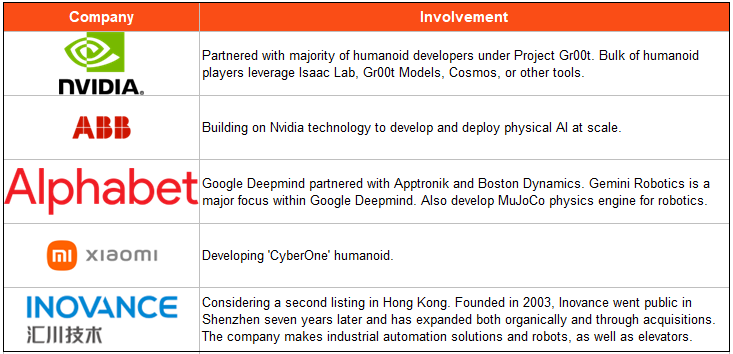
Source: Company announcements, Bloomberg, Reuters. No assurance is given that these companies will remain in the portfolio or will be profitable investments.
The bottom line
The robotics and physical AI theme have reached a genuine inflection point. Falling costs are bringing commercial deployment timelines forward — with mass adoption projected between 2027 and 2030. China’s manufacturing might is reshaping the competitive landscape, and the emergence of humanoid robots as a credible general-purpose labour substitute is transitioning from aspiration to reality.
For more information on the Betashares Global Robotics and Artificial Intelligence ETF (ASX: RBTZ), visit the fund’s web page here.
There are risks associated with an investment in RBTZ, including concentration risk, robotics & artificial intelligence companies risk, smaller companies risk, China investments risk and currency risk. Investment value can go up and down. An investment in the Fund should only be considered as a part of a broader portfolio, taking into account your particular circumstances, including your tolerance for risk. For more information on risks and other features of the Fund, please see the Product Disclosure Statement and Target Market Determination, both available on this website.
Sources:
1. https://www.abiresearch.com/blog/global-robotics-market-outlook ↑
2. https://www.goldmansachs.com/insights/articles/the-global-market-for-robots-could-reach-38-billion-by-2035 ↑
3. https://counterpointresearch.com/en/insights/Global-Humanoid-Robot-Installations-Reach-16,000-Units-in-2025-as-Mass-Production-Picks-Pace ↑
4. https://www.abiresearch.com/news-resources/chart-data/humanoid-robot-market-size-outlook ↑
5. https://investor.nvidia.com/news/press-release-details/2025/NVIDIA-Announces-Isaac-GR00T-N1–the-Worlds-First-Open-Humanoid-Robot-Foundation-Model–and-Simulation-Frameworks-to-Speed-Robot-Development/default.aspx ↑
6. https://www.dw.com/en/germanys-labor-crisis-is-an-economic-time-bomb/a-65522919 ↑
7. https://www.goldmansachs.com/pdfs/insights/pages/gs-research/global-automation-humanoid-robot-the-ai-accelerant/report.pdf ↑
8. https://www.scmp.com/tech/tech-trends/article/3319637/chinas-unitree-debuts-us5900-humanoid-robot-race-make-cheaper-products ↑
9. https://shop.unitree.com/en-au/collections/humanoid-robot ↑
10. https://www.yolegroup.com/press-release/humanoid-robots-2025-the-race-to-useful-intelligence/ ↑
11. 2026 Government Work Report ↑
12. https://global.chinadaily.com.cn/a/202601/05/WS695b1063a310d6866eb31ed3.html ↑