

Hugh Lam
4 minutes reading time


Each year, China’s National People’s Congress (NPC) and its political advisory body, the CPPCC, convene for what is known as the ‘Two Sessions’ meeting. Closely watched by investors around the world, it provides a rare and direct window into Beijing’s thinking on the economy with the country’s GDP growth target, fiscal priorities, and key policy agenda set for the year ahead.
In the following section, we look at key similarities and differences between the Two Sessions meeting this year and last year:
What changed and what didn’t? Key takeaways:
The most notable shift was the GDP target moving from a single figure of ‘around 5%’ to a range of 4.5–5%, signalling a deliberate move away from ‘growth at any cost’ toward prioritising high quality, sustainable development. While the softer target may be viewed negatively, the range provides more policy flexibility with room to either meet the minimum target or to surprise on the upside. Ultimately, the change reflects an acknowledgment from the Chinese government that the external trade environment remains highly uncertain and that recalibrating internal growth drivers away from exports toward consumption will take some time.
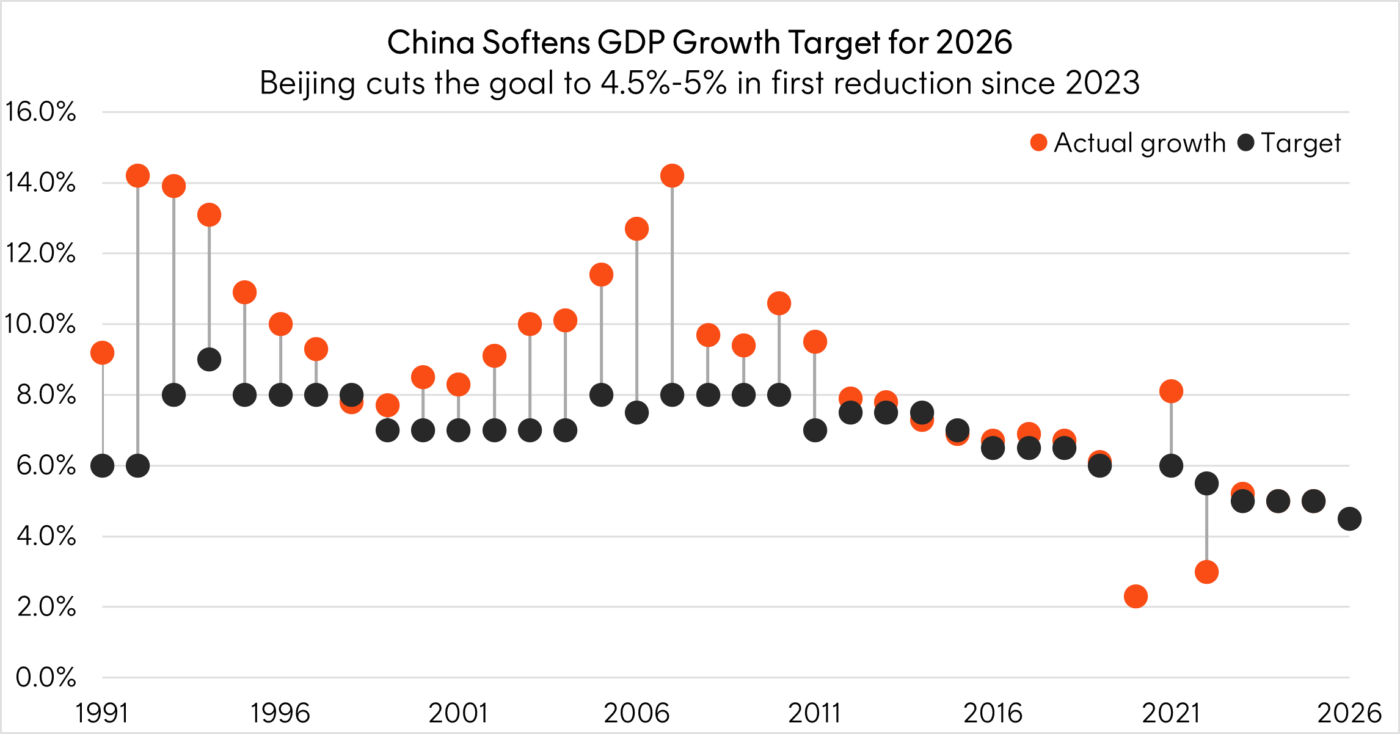
Source: National Bureau of Statistics, annual government work reports, Bloomberg. Note: China didn’t set an annual growth target for 2020, when the pandemic first hit. Figures represent the lower bound when targets are set as a range.
- That said, the scale of fiscal policy support largely remains the same with the deficit-to-GDP ratio target, local government special-purpose bonds and ultra-long special treasury bonds issuance amounts unchanged. However, bank recapitalisation bonds fell from 500bn yuan (2025) to 300bn yuan (2026), and the consumer trade-in program allocation fell modestly from 300bn yuan to 250bn yuan – likely an acknowledgement that the direct subsidies may have a ceiling in terms of their ability to materially shift consumer spending patterns in a population that is structurally inclined to save.
- Positively, self-sufficiency in strategically important industries such as in science and technology remain a key priority for the government. The AI Plus Initiative will expand to build AI technologies from the ground up whether that be through the development of AI agents, open-source AI communities and AI native business models. New infrastructure projects on hyper-scale intelligent computing clusters and electricity supply will also be launched.
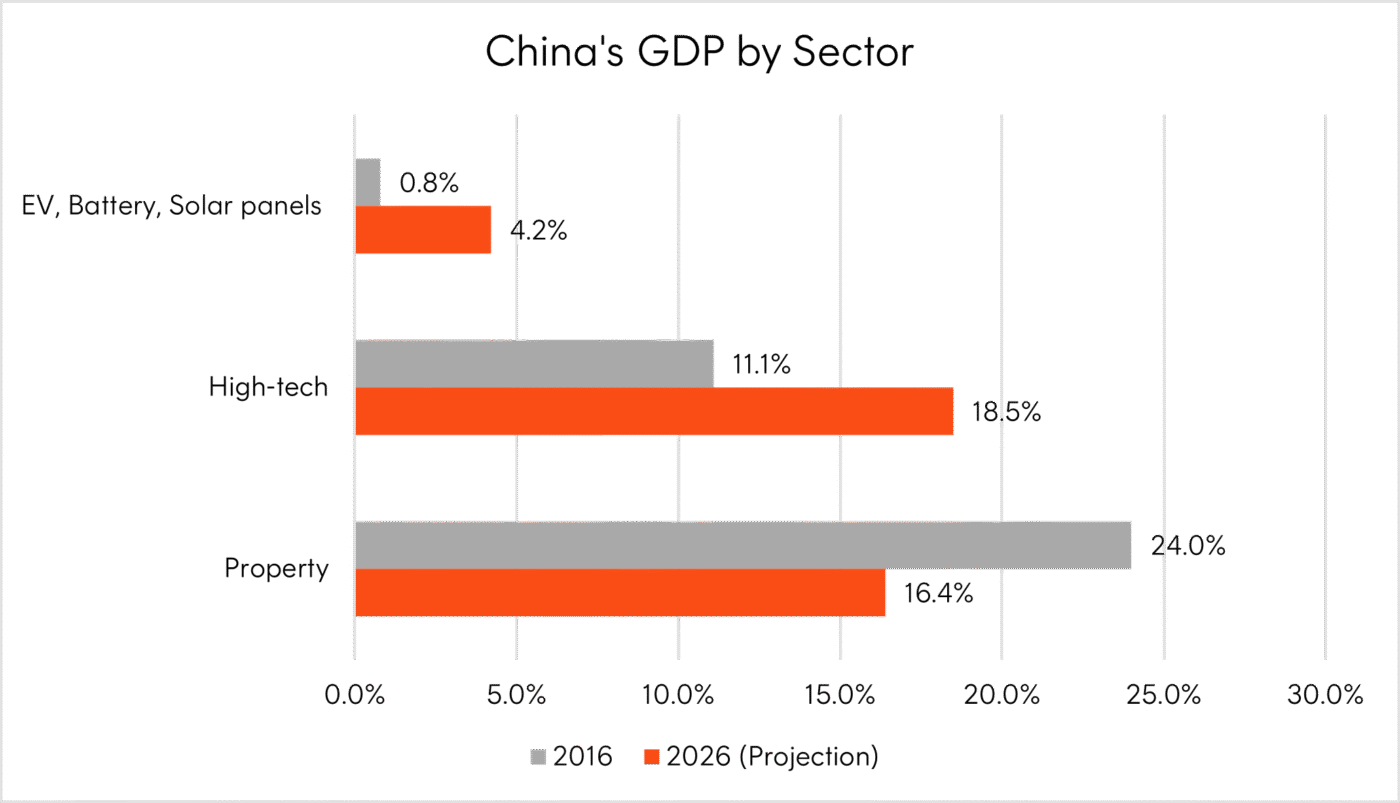
Source: Bloomberg Economics. As at 2024. Actual outcomes may vary.
What’s new? 15th Five-Year Plan
Perhaps the most significant and underappreciated aspect of this year’s Two Sessions is that the 2026 Government Work Report contains a new section presenting the 15th Five-Year Plan outline for 2026–2030. Some of the key targets include:
- R&D spending to grow at least 7% annually — sustaining the innovation investment trajectory of the 14th FYP period
- Digital economy core industries to reach 12.5% of GDP — up from ~10.5% today, representing a substantial structural shift in the economy’s composition
- Total CO₂ intensity reduction of 17% over the plan period — creating a durable, multi-year policy tailwind for clean energy and green technology
- 109 major projects across six areas, including 28 focused on new quality productive forces, 23 on new infrastructure, and 18 on the green and low-carbon transition.
Investment implications
All in all, the 2026 Two Sessions reinforces a selective rather than broad approach to Chinese equities. In our view, the policy mix increasingly rewards sectors tied to the innovation, self-sufficiency and clean energy themes – while penalising sectors reliant on infrastructure spending or consumer confidence that has yet to meaningfully recover.
Of course, ongoing developments in Iran remain a left tail risk for China from an energy supply perspective with sustained higher oil prices a net drag on economic growth. That said, China can replace lost volumes by increasing imports from other parts of the world like Saudi Arabia, Russia and Brazil.
The following is a summary of our key views within the China equity market:
| Bullish (+) | Cautious (-) |
|
China/Asia technology:
|
Consumer discretionary:
|
|
Renewables:
|
Old economy industrials:
|