



Australian private credit has been in the news lately, and not for the right reasons.
Bathla Group’s administrators met with creditors this month over roughly $3.4 billion of debt, a shockingly large number against a local private credit market that ASIC puts at only around $200 billion, and the lender list read like a directory of the industry1,2.
According to reporting from the Australian Financial Review3, one property credit fund had 24% of its assets lent to the group against a 20% single-borrower limit, was downgraded by its research house and has since suspended redemptions.
Worryingly, the policy backdrop is turning against many developers who have relied on rising prices to refinance, with the May budget’s changes to negative gearing taking the investor bid out of the property market, and the RBA is expected to hike rates further, as inflation remains sticky.
Private credit deserves its place in the market and can have a role to play in portfolios. Where post-GFC capital rules pushed the banks out of large parts of lending, private credit stepped in to fund businesses and developments that still needed capital, and ASIC itself has been at pains to say the sector is not inherently problematic or under widespread stress4.
The asset class is legitimate, but the question has always been the price paid for the risk taken. And in Australia, the risk is unusually concentrated towards real estate, and the more speculative end of that sector.
ASIC estimates that roughly half of the local market is real estate finance and singles out the concentration in higher-risk construction and development lending as a feature that sets Australia apart from private credit offshore.
Our local industry is young, opaque, and concentrated in the riskiest corner of lending, and it has a lot of growing up to do before it deserves comparison with the more established debt markets.
The questions to ask of any yield
Credit is not one homogeneous asset class. It spans lending to the world’s most creditworthy corporates through to financing a single half-built apartment project, and both can advertise an attractive yield.
As capital floods into a segment, competition pushes yields down even though the risk has not necessarily changed, so a manager determined to keep advertising a high yield can only do so by taking on riskier deals. The right question is not “what yield am I getting?” but “what did the manager have to do to produce it?”
First, how is the yield generated? Cash interest from an investment grade blue-chip corporate is a fundamentally different proposition from a developer selling or refinancing a project that may not yet be built. In private credit, the manager and intermediaries may also retain a substantial share of what the borrower pays through fees and other charges. Ask how much of that return reaches you, how much is absorbed along the way, and how much leverage sits behind the yield on offer.
Second, what protects you if something goes wrong? There is deep comfort in a loan “secured against property”, but a valuation is only an opinion until the asset is sold. Public Hospitality’s hotels carried around $1.8 billion in debt against assets that cost less than $300 million to assemble, and second-ranking lenders recovered effectively nothing6.
Around $1.3 billion of Bathla’s debt is secured against undeveloped land whose stated value, administrators warn, is not cash available to repay creditors. Even one of the country’s largest managers is reportedly struggling to sell a Sydney site on which it was senior secured lender, with offers well below the $270 million loan.
Third, will the liquidity terms hold when tested? In Australia, funds offering generous redemptions terms have too often tightened or suspended withdrawals as pressure built. One large real estate credit manager recently capped monthly redemptions at just 1% of the fund. The question is whether redemption terms reflect how readily the underlying loans can be sold or repaid, including in difficult markets.
Together these questions help establish whether income on offer is sufficient compensation for the risks involved, and diversification is also central to that assessment. The upside from any one loan is limited, while a default can result in a complete loss. Spreading exposure across borrows and sectors helps limit the damage any single default can do to the portfolio. In credit, diversification should really be non-negotiable.
Blue chips over black boxes: Australian investment grade bonds
Compare the Bathla creditors’ meeting recent developments in our public credit market. On 19 August, Alphabet priced its debut Australian dollar deal, involving A$5.5 billion issued across six tranches, the largest corporate Kangaroo deal on record.
The 10-year fixed line priced at 6.26% and the 20-year at 6.98% for an AA+ rated issuer, presenting very compelling value, contributing to an order book of more than $18 billion.
The Australian dollar investment grade bond market attracts a broad base of domestic and global investors, including pension funds, insurers, central banks, and sovereign wealth funds. That depth of demand, in turn, draws the world’s leading companies to issue here, giving them access to a large and diverse pool of capital, while offering Australian investors a wider choice of high-quality corporate borrowers.
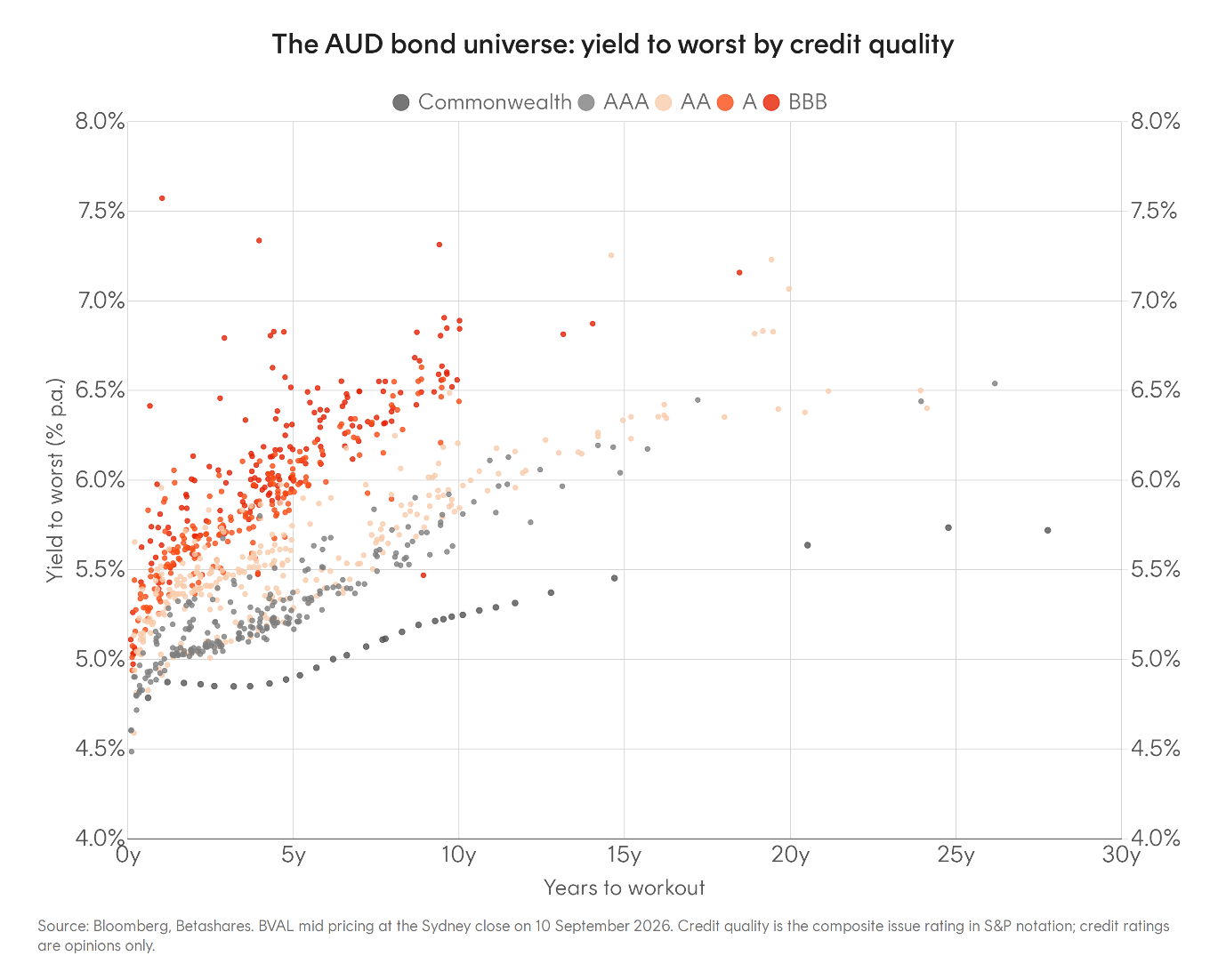
At the time of writing, 5–10-year A-rated AUD corporate bonds yield between 6.0 and 6.5%, and some BBB-rated AUD corporate bonds now yield above 7%. The market spans financials, utilities, infrastructure, communications, and other sectors. The exposure to real estate is primarily via large, established property groups such as Scentre Group, Stockland, and Vicinity.
Betashares offers several ways to access this market, allowing advisers and self-directed investors to choose the mix of credit exposure, interest rate risk, and even gearing to suit their needs.
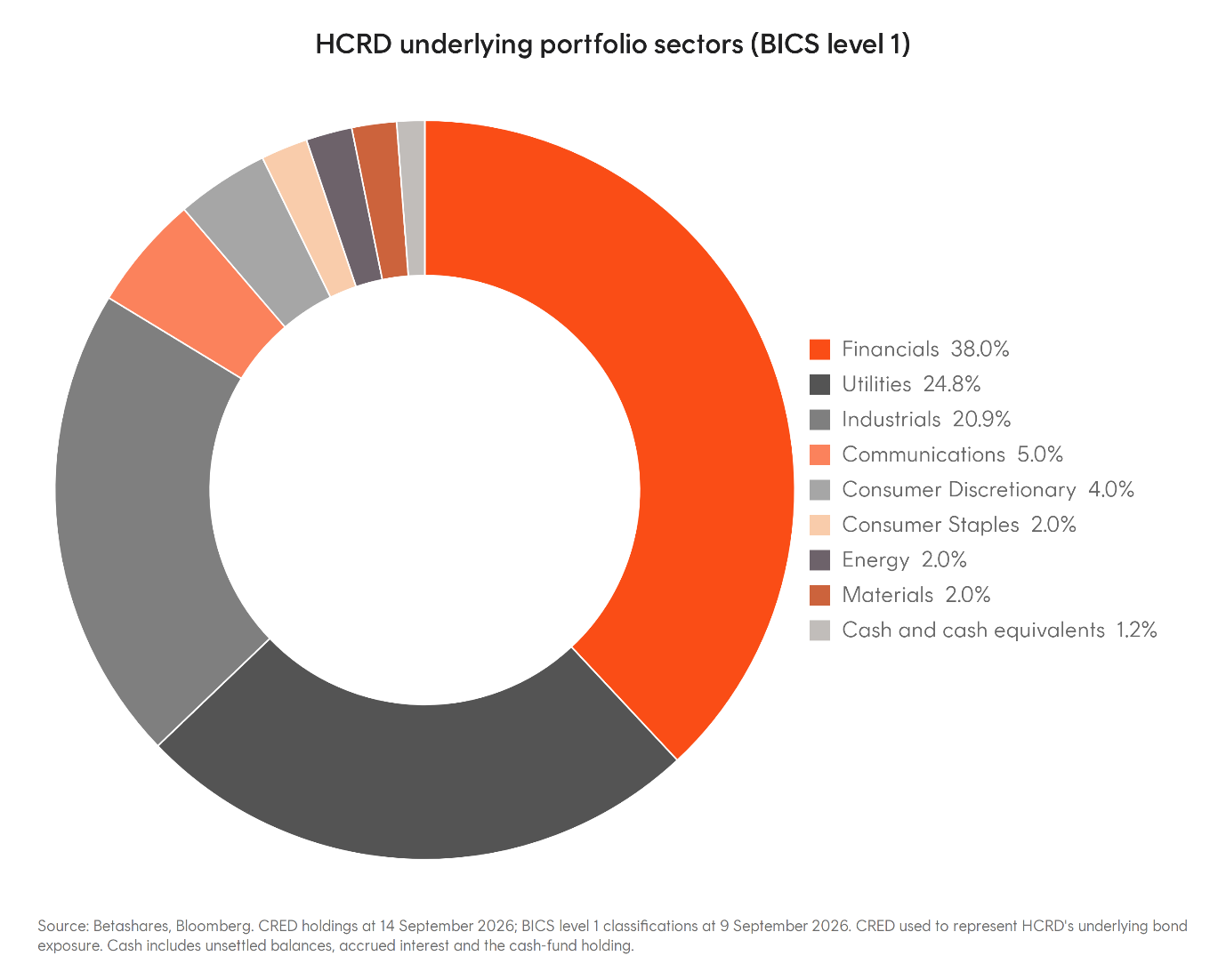
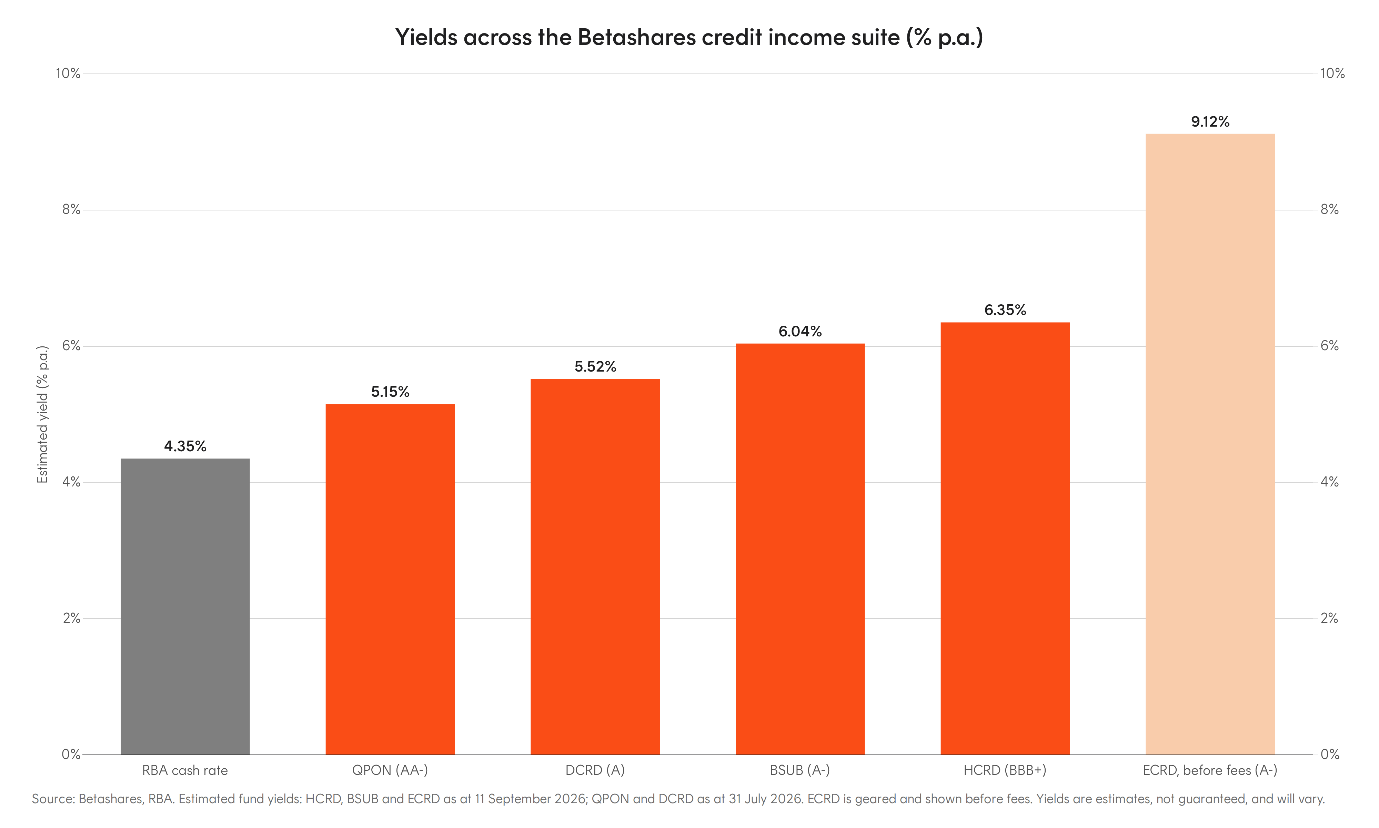
The HCRD Interest Rate Hedged Australian Investment Grade Corporate Bond ETF, which holds a diversified portfolio of corporate bond, with interest rate risk mitigated through hedging, has an estimated yield to worst (before fees of 0.25% p.a.) of 6.43% on a BBB+ average rating.
There’s also the BSUB Australian Major Bank Subordinated Debt ETF, which holds subordinated bonds issued by the big 4 banks, which currently offers 6.07% (before fees of 0.29% p.a.) at an A- average credit quality.
For investors who want more from the same universe, ECRD Australian Enhanced Credit Income Complex ETF applies cost-effective gearing to a 50/50 blend of HCRD and BSUB and produces an estimated yield to worst of 8.27% net of fees and a distribution yield running at around 7.5% p.a.
The gearing magnifies losses as well as gains, but with a listed, liquid, geared investment grade fund you know exactly how much leverage sits behind the yield.
US over Australia, corporates over real estate
The other alternative sits at the opposite end of the private credit family. US direct lending has been an institutional income allocation for more than two decades, operating largely through business development companies (BDCs) and interval funds that are registered with the SEC, subject to statutory leverage limits and required to publish quarterly financials and mark their portfolios to fair value.
The funds lend to established, predominantly private-equity backed companies across the US middle market, businesses with EBITDA typically between US$50 million and US$200 million, a segment that accounts for roughly a third of American private sector output. The yield comes from operating companies paying floating-rate interest on senior loans, driven by corporate earnings rather than the Australian property cycle, and the Cliffwater Direct Lending Index, the market’s benchmark, has delivered an annualised 9.53 per cent since inception 21 years ago, with only a single negative year.
Australian investors can access this market through the BPC Cliffwater Private Credit Fund, which spreads capital across some 30 lending partners and more than 4,000 underlying borrowers, with around 96 per cent of the portfolio in first-lien senior secured loans and no exposure to real estate development. Since its launch in Australia it has averaged an annualised 9 per cent net distribution yield. That is diversification and seniority working together, the structural antidote to the concentration and subordination risks running through Australian real estate credit.
Where this leaves advisers and investors
For advisers and self-directed investors, the decision is how much of an income portfolio should depend on assets that are difficult to value and may be tough to exit.
Access to capital matters both for funding spending and for portfolio rebalancing, and it’s essential that defensive asset can be used as dry powder to either take advantage of opportunities elsewhere or to get back to target weights.
An investment that pays distributions but cannot be sold leaves fewer options available and undermines tactical flexibility.
Australian investment grade credit deserves a close look for a wide range of investors. It offers income from established businesses whose creditworthiness has been independently assess by recognised agencies such as S&P Global Ratings, Moody’s, and Fitch, alongside diversification across borrowers and sectors, and provides the liquidity to adjust allocations as conditions change.
US corporate direct lending has been the ballast of institutional income portfolios since the early days of private credit. The Cliffwater Direct Lending Index (CDLI) now spans more than 21 years, and through the GFC, COVID and other global shocks it has recorded a positive return in every calendar year but one, compounding at 9.46% per annum from inception to June 2026.
These investments still carry credit and market risk, and liquidity does not guarantee a favourable sale price, but being able to trade gives flexibility that isn’t found in many private credit exposures.
Rethinking where yield comes from does not necessarily mean avoiding private credit, but being more considered about the risks involved.