

Hans Lee
5 minutes reading time


With cash rates on the rise after a short interest rate easing cycle in Australia, income-focused investing is back in the spotlight.
For Australian investors, the question has shifted to which vehicle to use. Dividend-paying shares, income ETFs and managed portfolios can each have a legitimate place in an income strategy, but they suit different investors in different ways.
Why income investing resonates in Australia
Australian investors have had a particularly strong affinity for income, shaped by a culture of retirement self-sufficiency, a large and active self-managed super fund ‘community’ and a franking credit system that has for a long time made dividend income tax efficient.
In fact, some studies have shown that building an income stream ranks among Australian investors’ top three priorities, sitting alongside capital growth and balancing risk and return.
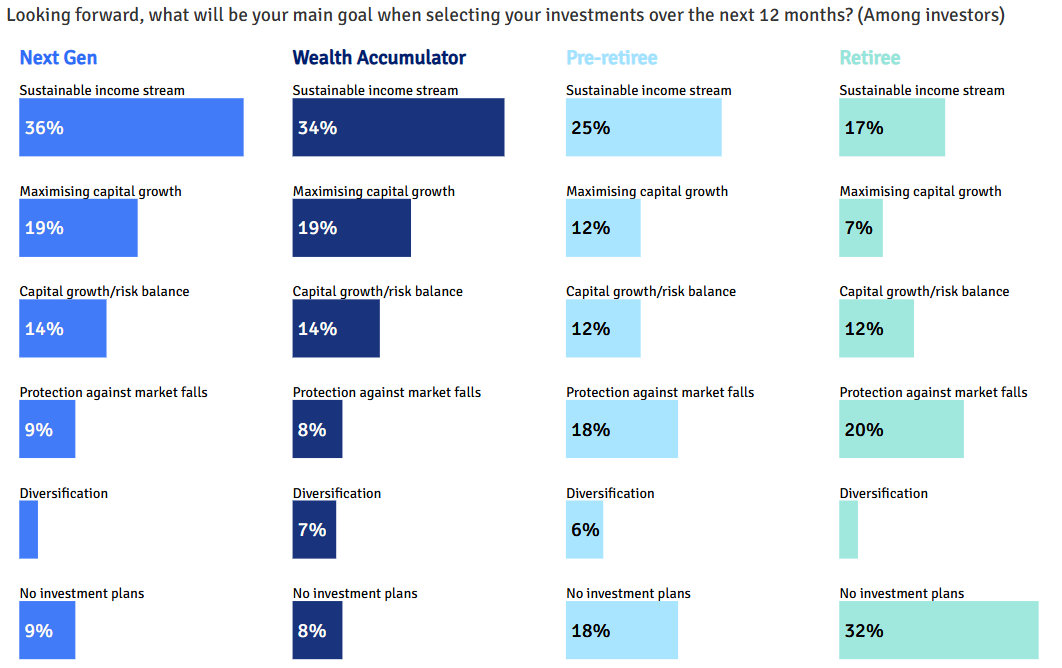
Source: ASX Australian Investor Study 2023. The study collated 5,519 complete responses. Next Gen investors are defined as being 18-24 years old. Wealth Accumulators are defined as being between 25-49 years old. Pre-Retirees are 50-64 years old. Retirees are 65+ year olds.
For some investors, there may be something intuitive about an investment that pays you regularly – it’s easier to stay invested through volatility when the portfolio is visibly working for you.
Direct shares
Direct share investing gives investors an ownership share in individual companies listed on the ASX or other exchanges, along with entitlement to any income those companies pay out. For Australian investors, that income has long carried an added advantage through the franking credit system.
Franking credits relating to shares in Australian companies can help to boost the effective return on dividend income for a wide range of investors: individuals on lower marginal tax rates, super funds in accumulation phase taxed at 15% and retirees drawing from a pension fund where earnings are tax-free. Where credits exceed the investor’s tax liability, the ATO refunds the difference in cash. It’s important to note that not all Australian investors will be able to receive the full value of franking credits, with the benefit of franking credits depending on an investor’s individual tax position and eligibility.
The picture at the broader share market level has become more complicated. The dividend yield on the ASX 200 has generally been drifting lower for some time, and the market has not been delivering the income it once did.
In addition, most dividend income paid out on the Australian share market flows from just two sectors: financials and resources. A portfolio built around banks and miners may feel good for income but introduces concentration and sector risk.
It should be said that individual opportunities do exist outside those sectors. Some ASX-listed companies have continued to pay attractive dividends. But finding them takes in-depth research either by yourself or with the assistance of a financial adviser.
Income ETFs
For investors who want income without the burden of researching individual companies, ETFs can be one of the most powerful tools available.
The Australian ETF market now covers strategies targeting high-yield Australian equities, global dividend payers, fixed income, infrastructure and more. That breadth of choice means investors who don’t have the time or inclination to pick individual stocks can still access well-constructed income strategies, often in a single trade at low cost.
Betashares provides access to one of the largest ranges of income ETFs in Australia.
Its low-cost Australian shares income ETF, HYLD S&P Australian Shares High Yield ETF , targets the 50 highest-yielding ASX-listed companies while applying quality screens with the aim of screening out potential ‘dividend traps’, such as companies projected to pay unsustainably high dividend yields.
For investors seeking income from global equities, the INCM S&P Global High Dividend Aristocrats ETF provides exposure to companies with at least 10 consecutive years of maintained or growing dividends each year. The strategy’s natural skew toward more ‘defensive’ equities sectors like energy, healthcare and consumer staples may additionally appeal to income investors seeking to navigate volatile markets.
Betashares also runs the Yield Maximiser range – these ETFs use a covered call strategy to generate additional income on top of the share dividends.
ETFs can pay income monthly, quarterly, semi-annually or annually. Refer to the fund page of individual ETFs to see what each fund pays when.
Managed portfolios
For self-directed investors who want their investments looked after by a professional manager, managed portfolios may also be an option to consider. On Betashares Direct, this kind of professional management is accessible to everyday investors – not just those with large account balances or an adviser relationship.
On Betashares Direct, self-directed investors can choose between two income-focused managed portfolio options. The Betashares Passive Income Portfolio provides diversified income exposure through a portfolio of index-based ETFs. For those seeking exposure to underlying actively managed ETFs, the JPMorgan Active Income Portfolio brings JPMorgan Asset Management ‘s institutional-grade, globally diversified income strategy to investors seeking income with a medium risk profile.
One platform, three options
For investors looking to generate regular income, there has never been more choice. But with choice comes responsibility – the mix of income assets (shares, ETFs or a managed portfolio) will look different for everyone depending on your tax position and risk tolerance. Betashares Direct brings the ability to access these three approaches in one place, providing investors with convenience and choice.
See the range of low-cost, diversified Portfolios