


Hans Lee
5 minutes reading time


Every investor has heard the golden rule of investing: buy low and sell high. This is the core tenet of fundamental investing, where the true worth of a company matters most.
The problem, however, is that few investors can achieve these two things perfectly. Emotions and timing have a habit of getting in the way – and that’s before you do the research to work out which stock you want to buy.
But what if an ETF could buy low and sell high on your behalf, systematically reducing positions when stocks get expensive and increasing exposure to them when they’re undervalued?
How automatic rebalancing works
Market-cap weighted ETFs like the A200 Australia 200 ETF offer exposure to hundreds of companies at an ultra low cost. In these funds, larger companies tend to receive larger positions in the fund.
The funds invest in an array of companies based on their weighting in the index. When an individual stock’s market cap becomes larger, you automatically own more of it. When its market cap decreases, you own less. It’s simple and cost-effective, which means you’re buying more as prices rise and less as they fall.
The strategy behind QOZ FTSE RAFI Australia 200 ETF flips this on its head. Instead of weighting each company by market cap, it weights companies based on four fundamental measures: book value, sales, cash flow and dividends. In other words, the companies generating the most revenue, producing the strongest cash flows and paying the highest dividends typically receive the largest positions.
Source: FTSE, Investopedia
What this looks like in practice
When a stock price runs ahead of its business performance, the fund will automatically ‘trim’ the exposure. When a quality business is trading cheaply, it increases the weighting. The buy-low, sell-high discipline happens systematically and without you needing to do anything extra yourself.
For example, the share prices of banks often rise during a credit boom. As their market cap grows, they take up a larger portion of market-cap weighted funds. But a fundamentally weighted fund such as QOZ would look to the cash earnings, dividends and net interest margins to determine how much weight a bank would carry in the fund. If the price has outpaced the fundamentals, it will hold less of that bank.
Similarly, if a quality mining company is struggling during a commodity downturn, a market-cap fund would have less exposure to it simply because it’s worth less on paper. But a fundamentally weighted fund would own more of it, providing the business fundamentals remain strong.
All this happens in the background when you invest in a fundamentally weighted ETF such as QOZ, meaning you don’t have to predict the tops or bottoms yourself.
The franking benefit worth noticing
QOZ’s investment strategy also provides a bonus for Australian investors. Since fundamental indexing weights toward companies with strong cash flows and consistent dividend payments, QOZ tends to capture more franking credits than traditional market-cap indexing.
For investors building wealth through dividends, this can make a meaningful difference to after-tax returns over time.
Note: Not all Australian investors will be able to receive the full value of franking credits.
QOZ’s track record
As at 30 January 2026, QOZ has outperformed the S&P/ASX 200 on a total return basis over every performance period, be it over one month or its near-13-year life. Over the past five years, QOZ has outperformed the S&P/ASX 200 by 2.74% per year (as at 30 January 2026), demonstrating that its approach has succeeded across different market conditions.
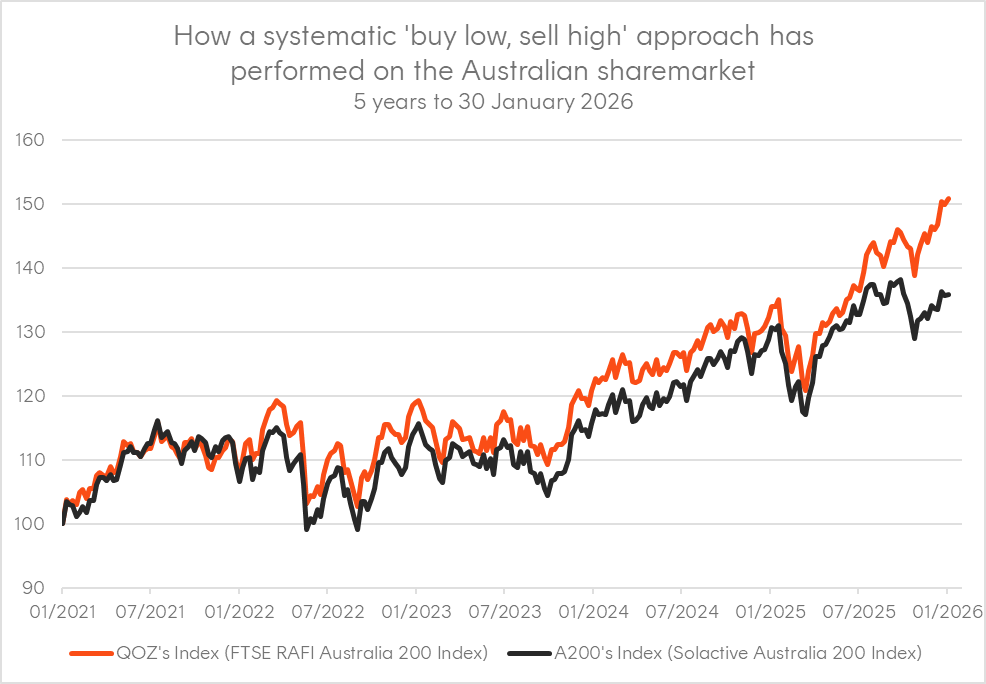 Source: Bloomberg. FTSE RAFI Australia 200 Index and Solactive Australia 200 Index have both been rebased to 100, as at 29 January 2021. Past performance is not an indicator of future performance. You cannot invest directly in an index.
The approach isn’t locked into value or growth stocks either. Because QOZ rebalances based on four distinct business metrics, the strategy naturally adapts to whatever the opportunity is. When value stocks lead, it’s there. When growth companies are showing relatively stronger fundamentals, the fund will hold those.
How this fits in your portfolio
If you’re already invested in Australian shares either individually or through an ETF such as A200, QOZ offers a compelling upgrade or complement to your existing position. You keep the same broad exposure to Australia’s largest companies but you add a systematic rebalancing discipline that works for you automatically.
A systematic approach to Australian shares
The hardest part of fundamental investing isn’t knowing what to do, it’s doing it consistently. QOZ handles the discipline for you, rebalancing based on what companies earn and deliver, not what the market is paying for them. To learn more, visit the QOZ fund page or Betashares Direct.
1 comment on this
Thanks Hans . Very useful articles !
Best wishes , Ramon Vasquez