

Hans Lee
5 minutes reading time


Most people couldn’t point to the Strait of Hormuz on a map. But when conflict flared around it last week, oil markets moved faster than they have in years, with the ripple effects reaching Australian investors almost immediately.
Here’s why a narrow stretch of water in the Middle East matters more to your money and life than you might expect.
A narrow stretch of water
The Strait of Hormuz sits between Iran and Oman, connecting the Persian Gulf to the open ocean.
According to the International Energy Agency, an average of 20 million barrels of crude oil and petroleum products passed through it every day in 2025, accounting for around 20% of global oil consumption and a quarter of all seaborne oil trade. Saudi Arabia, Iraq, the UAE, Kuwait and Qatar all rely on it as their primary export route.
The problem is that alternatives to the Strait are limited. Only Saudi Arabia and the UAE have pipelines capable of bypassing the Strait, and their combined capacity covers a fraction of normal daily flows. If shipments are significantly disrupted, as they are now, prices rise quickly.
One measure of that move was the spike seen in the OOO Crude Oil Index Currency Hedged Complex ETF which rose 45% in a single session, the largest one-day gain ever recorded for an ASX-listed ETF. However, it should be said that the following day, OOO fell 23% the following day – highlighting just how volatile energy markets can be.
This is not a new story
The scale of this week’s move was unusual but the nature of it was not. Oil prices have spiked during geopolitical crises many times over the past 50 years. The pattern tends to be consistent: uncertainty about supply sends prices higher, often well before the full picture is clear.
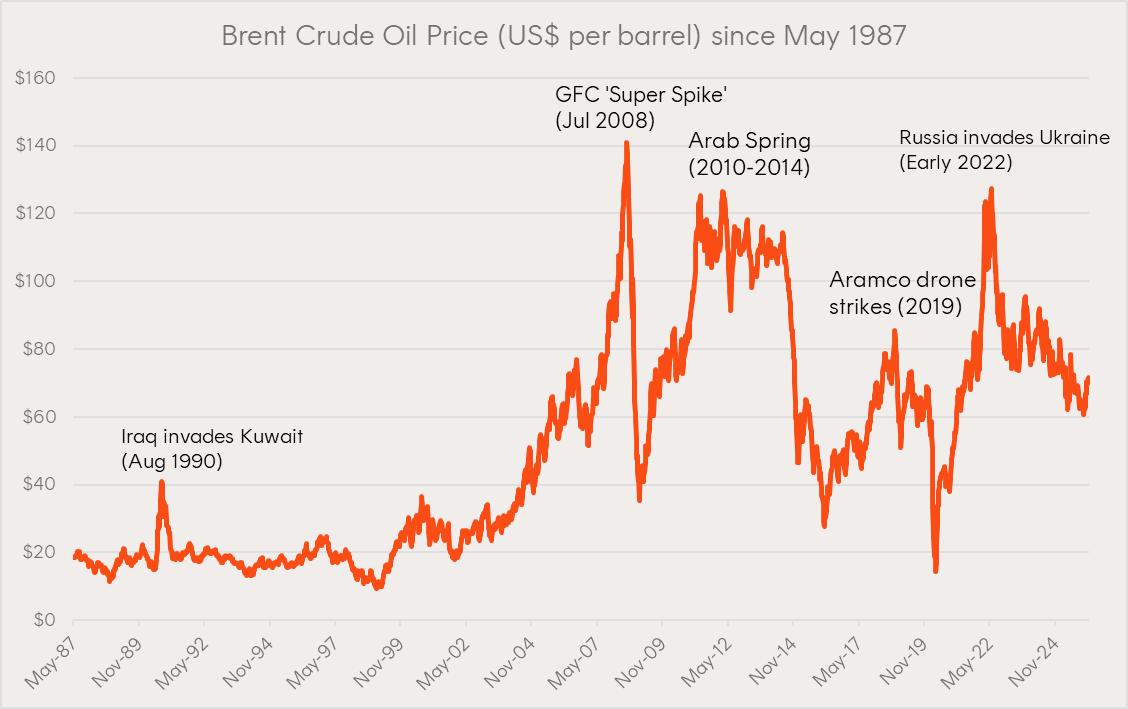
Source: U.S. Energy Information Administration via Federal Reserve of St. Louis. Data runs from 15 May 1987 to 27 February 2026.
What the chart also shows is that these spikes, however severe, have historically been followed by periods of stabilisation and decline. The more instructive lesson may be to look at what tends to trigger them in the first place.
Oil price shocks: A short history
|
Year |
Event |
What happened |
Oil price move |
|
1973 |
OPEC embargo |
Arab nations halt exports to the West |
+300% over months |
|
1990 |
Gulf War |
Iraq invades Kuwait, disrupting Gulf supply |
Doubled in weeks |
|
2007–08 |
GFC super spike |
Supply constraints met surging demand before the financial crisis broke |
+170% peak to trough |
|
2010–11 |
Arab Spring |
Political upheaval across North Africa and the Middle East raised supply fears |
+30% over months |
|
2019 |
Aramco drone strikes |
Drones attack two oil processing facilities in eastern Saudi Arabia |
+15% in one day |
|
2026 |
Strait of Hormuz tensions |
US and Israel strike Iran, leading to Iran effectively closing the passage. Oil surges above US$100 a barrel while OOO records the largest single-day ETF gain in ASX history |
Oil up sharply; ASX: OOO +45% in one session |
Sources: see below*
The point is not that investors should try to predict these events. It is that energy price shocks are a recurring feature of global markets. They tend to follow periods of geopolitical tension, and the events of the past week are a reminder that such periods are not a relic of history.
What does this mean for a long-term investor?
For most investors, the most appropriate response to a week like this is not a sudden change of direction.
“Despite the moves in oil, it’s our view that investors should maintain a well-diversified portfolio across equities, bonds and commodities,” said Cameron Gleeson, Senior Investment Strategist at Betashares.
“A balanced approach across asset classes and sectors helps manage volatility and supports more consistent long-term outcomes, rather than relying on any single exposure to drive returns and build wealth.”
For investors comfortable with the risks and who are seeking this kind of exposure, Betashares provides investors with two options:
- Betashares Crude Oil Index Currency Hedged Complex ETF (ASX: OOO), which seeks to track the performance of WTI crude oil futures and is currency hedged for Australian investors, and
- FUEL Global Energy Companies Currency Hedged ETF , which provides access to of the largest global energy companies (ex-Australia).
Both products are volatile by their nature because oil markets themselves can move quickly and significantly in either direction. Further, futures-based funds, such as OOO, carry additional complexity that can cause their returns to differ from the oil price itself.
Oil price volatility is expected to continue, although this will largely depend on how events in the region unfold. What is clearer is that history suggests these shocks are not exceptional events, but recurring ones. The investors who fare best are usually those who recognise the pattern and prepare for it.
*Table sources:
- 1973: Hamilton, J.D. (2011). Historical Oil Shocks. NBER Working Paper No. 16790. National Bureau of Economic Research.
- 1990: U.S. Energy Information Administration. Petroleum & Other Liquids: Spot Prices. eia.gov
- 2007–08: International Energy Agency. Oil Market Report, 2008. iea.org
- 2010–11: U.S. Energy Information Administration. What Drives Crude Oil Prices. eia.gov
- 2019: International Energy Agency. Oil Market Report, October 2019. iea.org
- 2026: Betashares, Bloomberg. Correct as at 9 March 2026.