




Key points
In the first two months of 2026, markets followed the playbook. Developed market equities outside the US, and emerging market equities, were outperforming with a strong global growth outlook and a weakening US dollar. Gold was trading at record highs while US indices were treading water on AI jitters.
Then, on the last day in February, the US and Israel launched attacks on Iran and began a war that remained ongoing towards the end of April.
What Trump may have hoped would be a swift operation, toppling the existing leadership and spurring protesters to install a new government, has instead become his trickiest geopolitical entanglement yet.
The short-term threat is the hit to global growth and the inflationary pressure from higher oil prices. The impact has started to show up in hard economic data with US headline CPI rising 0.6% in April lifting the annual rate to 3.8%, the highest in nearly three years. Inflationary pressure in Australia has already seen the RBA hike rates three times this year, the first coming before the war started in Iran. Put simply, the longer the war runs, the greater the risk to global economic growth. Our base case assumption remains a timely de-escalation without a severe shock to the global economy.
But in any case, it may be the longer-term implications that matter most for investors, long after any resolution in Iran.
Re-thinking portfolio satellites in a fracturing world
Portfolio satellites are used by investors alongside their main holdings to achieve specific goals. More than ever, some investors may consider using these satellites as hedges to geopolitical events.
Russia’s invasion of Ukraine accelerated defence spending and European energy diversification. The Iran conflict is now doing the same for global energy self-sufficiency while further fracturing the US security umbrella and embedding geopolitics as a structural driver of asset prices, rather than a short-lived disruption that markets quickly move past.
For investors, that may support the case for considering select hedges in portfolios to help reduce volatility through a potentially prolonged period of geopolitical tension and global order reshuffling. These include:
Defence contractors
Global defence stocks were among the best performing after the start of Trump’s second presidential term heading into 2026. However, the global defence sector’s performance has plateaued this year.
The likelihood of higher future defence spending has not changed; in fact, it has only increased on the back of the Iran war. Trump’s proposed US$1.5tn defence budget is unlikely to get through in totality but a budget defence allocation above US$1tn is a likelihood, a record discretionary amount.
More notably across the Atlantic, Europe’s rearmament is accelerating. EU defence budgets have nearly doubled from €218 billion in 2021 to a projected €392 billion in 20251, marking the first year all EU-NATO members have hit the 2% of GDP threshold. To unlock additional fiscal room, 17 member states have activated the EU’s national escape clause, permitting defence spending above Stability and Growth Pact limits through 20282. Germany alone has committed to €162 billion by 20293.
The pause in the defence stock rally has come as investors wait for this spending to turn into earnings. Large government defence contracts often come with significant lead times to delivery and realisation of corporate earnings. The strongest indication we have of these future earnings is defence contractor order books, and the major contractors we track have now collectively exceeded US$1 trillion in backlog for the first time in history4.
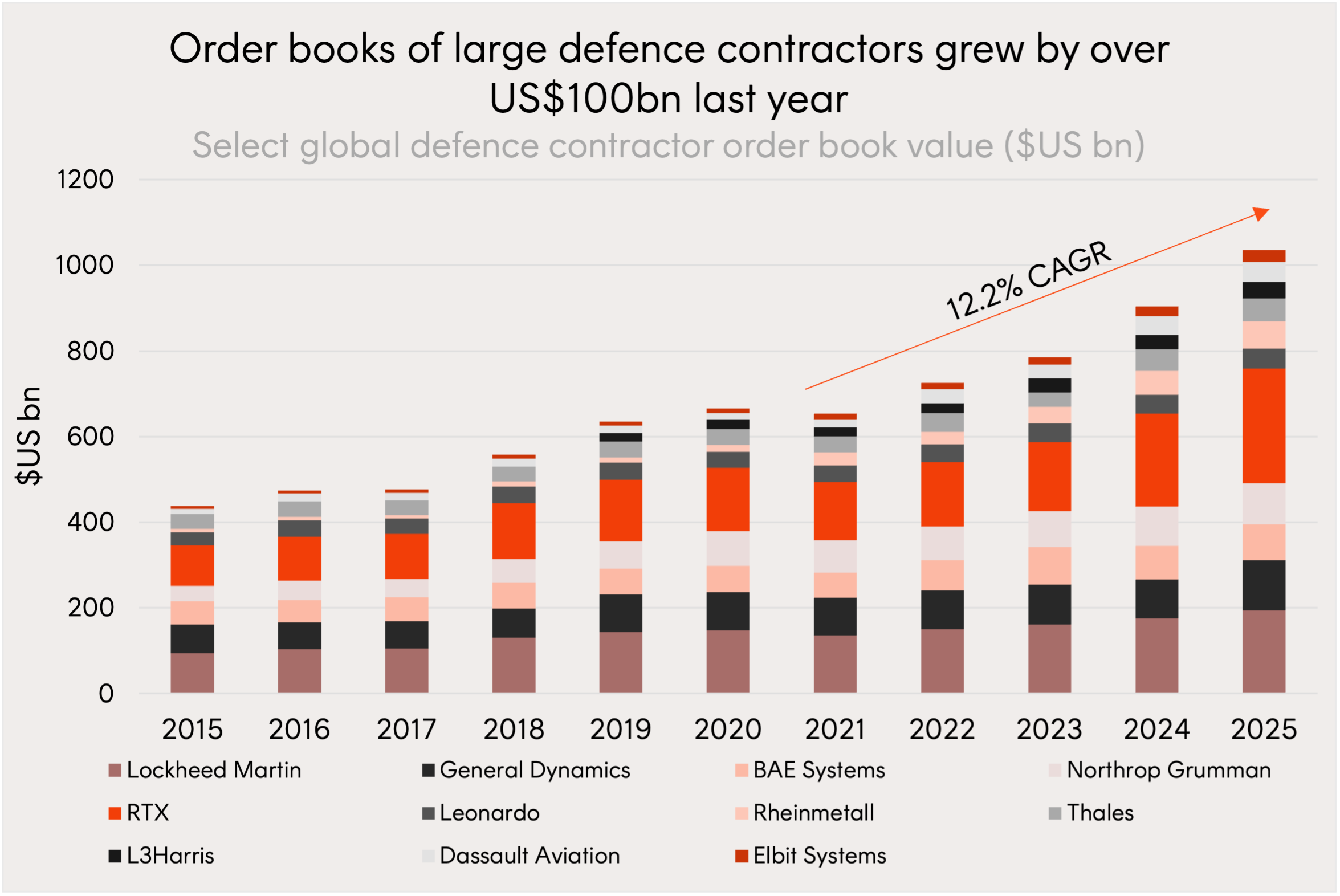
Source: Bloomberg, Betashares. Backlog order book value of select global defence contractors 2015 to 2025.
The direction of travel is clear, and defence contractors globally could be structural beneficiaries and a potential hedge to geopolitical threats that can cause broader equity market disruption.
Betashares Global Defence ETF (ASX: ARMR) is a simple way for Australian investors to gain exposure to the potential long term structural growth in the global defence sector.
ARMR’s index seeks to provide focused exposure to companies that are predominantly involved in defence, specifically those which derive more than 50% of their revenues from the development and manufacturing of military and defence equipment as well as defence technology.
ARMR currently holds 13 of the top 20 defence contractors in the world by defence revenue5, including US and European defence leaders like Lockheed Martin, Palantir Technologies, BAE Systems, Rheinmetall, and Thales (the 7 companies in the top 20 not held are either not ‘pure-play’ or not headquartered in NATO-aligned countries).6
Uranium and energy security
Russia’s invasion of Ukraine and the subsequent scramble to wean Europe off Russian oil and gas thrust energy security to the top of the policy agenda. The Iran conflict has now re-ignited energy self-sufficiency concerns globally. As governments reassess their baseload power (the minimum level of electricity a grid needs around the clock) and seek to reduce dependence on hostile suppliers, nuclear energy has re-emerged as a cornerstone of the solution.
As of the most recent COP30 (the United Nations annual climate change conference), 33 countries, including the US, France, UK, Japan, South Korea, Canada and the UAE, now back the pledge to triple global nuclear capacity by 2050.
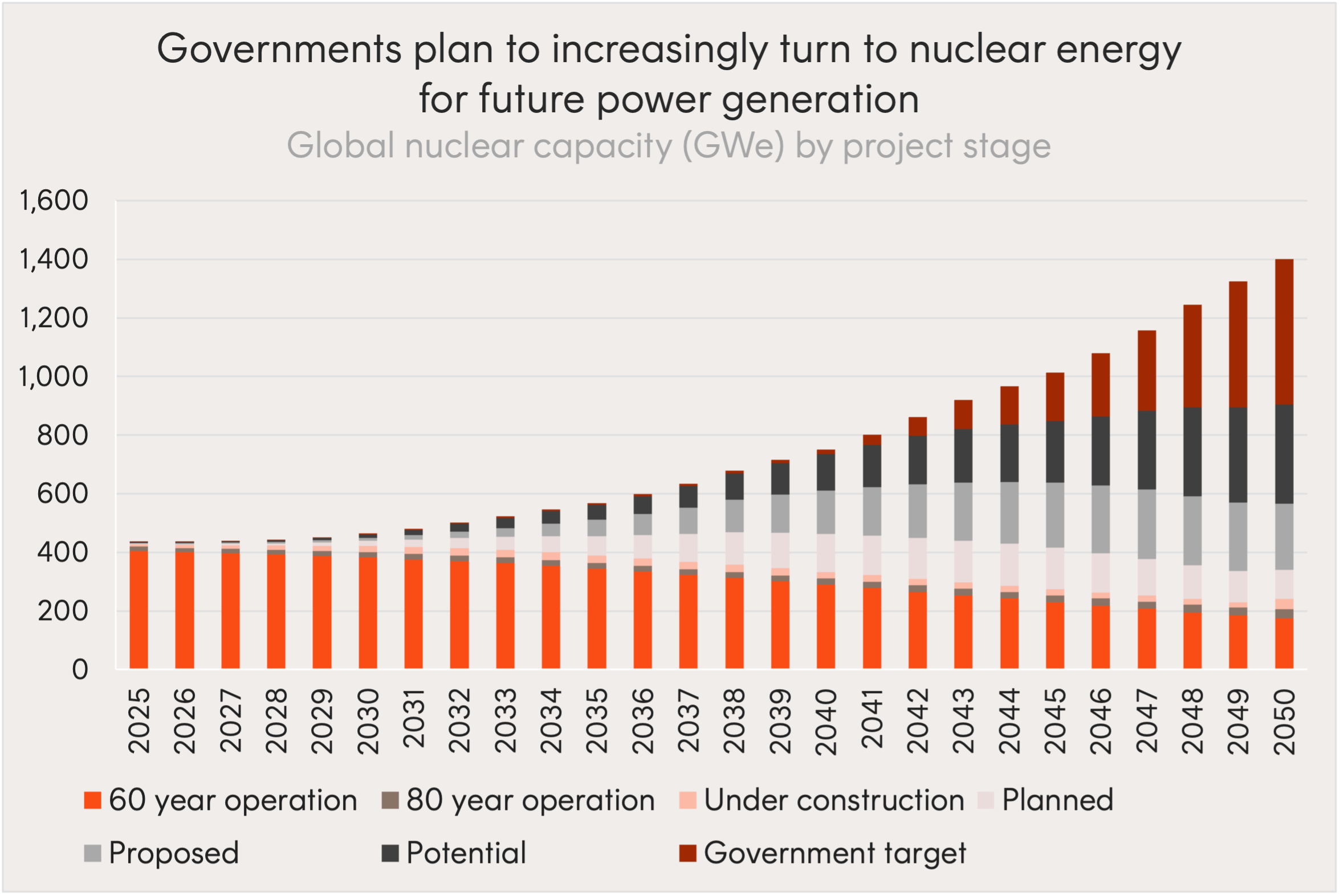
Source: World Nuclear Association (WNA). Assessment of global nuclear capacity (GWe) up to 2050.
With nuclear increasingly recognised as essential for energy independence, decarbonisation and AI-driven electricity demand, the uranium supply chain may be entering a period where demand outpaces supply, which could favour producers in allied nations.
Betashares Global Uranium ETF (ASX: URNM) provides exposure to a portfolio of leading companies in the global uranium industry.
URNM was the first uranium-focused equities ETF traded on the ASX. It provides exposure to a portfolio of global companies involved in the mining, exploration, development and production of uranium, plus companies that hold physical uranium or uranium royalties.
Investing in URNM can reduce stock-specific and geographic risk compared to investing in individual uranium companies. This is an important consideration given the risks associated with individual projects in the uranium industry.
Critical minerals
Critical minerals, the inputs essential for AI data centres, EVs, renewable energy and defence technology, sit at the intersection of future technologies and geopolitics.
China controls over 60% of global refined critical mineral supply and 90% of rare-earth magnets. After China tightened export controls in April 2025, some rare earth prices outside China rose sharply to multiples of those available within it.
In response, ministers from 54 countries gathered in Washington at the inaugural US Critical Minerals Ministerial to discuss reducing dependence on Chinese supply. The US, EU and Japan agreed to develop a joint action plan on supply chain resilience, while the US and Mexico launched a separate 60-day plan including consultations on price floors. The US also announced bilateral critical minerals frameworks with 11 countries and completed negotiations with a further 17.
Both the US and Australia have established strategic mineral reserves, and the latest US defence budget dramatically expands investment in domestic critical mineral supply chains.
Selected producers from allied nations, Australia, Canada, Peru and Chile, could be well positioned to benefit from this government-backed push for supply chain resilience. That push is only intensifying: China’s core rare earth export controls, introduced in April 2025, remain in place. A one-year suspension of the more expansive October 2025 controls agreed at Busan expires in November 2026, and the May 2026 Beijing summit produced no new agreement to extend it.
Betashares Energy Transition Metals ETF (ASX: XMET) provides Australian investors with targeted exposure to global companies at the heart of the critical minerals supply chain.
XMET focuses on companies predominantly involved in the production of eight key energy transition metals: copper, lithium, nickel, cobalt, graphite, manganese, silver and rare earth elements, as well as companies involved in the recycling and processing of these raw materials.
With geopolitical competition intensifying around mineral supply chains and demand accelerating from both the energy transition and AI-driven infrastructure, investing in a diversified basket through XMET reduces the single-stock and project-specific risks that come with investing in individual critical mineral companies.