

US stocks often make up a large share of Australian investors’ portfolios, even without them realising it. US companies currently represent ~ 73% of the MSCI World Index, which tracks 23 of the world’s most developed markets. The country with the second-largest share is Japan at just 5.9%.
That’s why this week’s midterm elections are worth paying attention to. The decisions made in Washington can affect company profits, tax rates, trade policy and the economic conditions your investments operate in.
But as history shows, the election result alone isn’t necessarily a reliable basis for changing your portfolio.
What are the midterm elections and why do they matter?
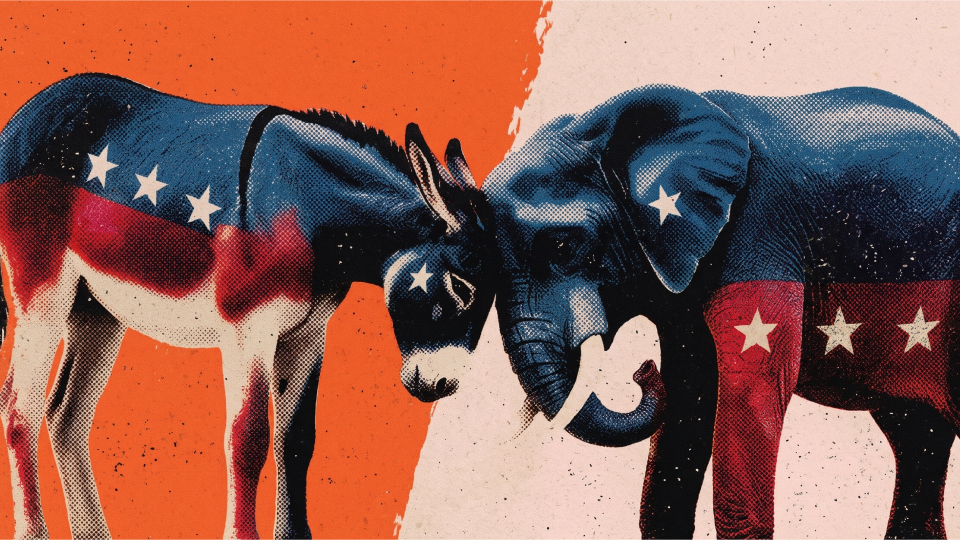
The midterm elections happen halfway through a president’s four-year term. They’re often seen as a barometer of how voters feel about the president’s performance. Historically, they’ve also been tough on the party in power, which lost House seats in 20 of the 23 midterm elections between 1934 and 2022.
All 435 seats in the House of Representatives and roughly a third of the Senate are up for election. Together, these two chambers make up Congress. The midterm vote determines which party controls each chamber for the next two years. Legislation generally needs approval from both chambers and the president, so the result can make it easier or harder for Donald Trump to turn his plans into law.
Changes to company tax rates can affect how much profit businesses keep, while spending decisions can influence demand for their products and services. Those decisions can have consequences for the companies in your portfolio.
What could change after the midterms?
Forecasts have favoured Democrats winning the House, and possibly the Senate too. Nate Silver’s model put their chances at 93% for the House and 75% for the Senate.
If Democrats take either chamber, Trump’s agenda will need to run through a chamber his party doesn’t control, which usually means fewer new laws, more deadlocks and the kind of political squabbles over government spending and debt that have become all too familiar with US politics.
Even without new legislation, Trump retains significant power through executive orders. Tariffs, immigration enforcement, foreign affairs and regulation can all be set at the executive level, and that power doesn’t change on election night.
There are three policy areas that are worth watching.
Spending. The Congressional Budget Office estimates the US government spent US$7.4 trillion in the year to 30 September 2026, a record and roughly US$2 trillion more than it collected. With that level of deficit, the government has to keep passing new spending bills just to keep the government funded, and each new bill is a chance for the opposing party to push back.
If Democrats gain control of either the House or the Senate, healthcare funding could become a bargaining point. They could seek to reduce cuts to government health programs or restore subsidies that help Americans pay for health insurance.
But securing Trump’s support would require compromise. UBS suggests Democrats could postpone cuts to social programs in exchange for higher defence spending. For investors, healthcare businesses receiving government payments and defence companies competing for contracts are the ones to watch within this space.
Tax. Trump’s 2017 Tax Cuts and Jobs Act cut the US corporate tax rate from 35% to 21%, the biggest corporate tax cut in US history. Lower tax means more profit left over, which flows through to dividends, share buybacks and reinvestment for companies.
For investors with shares in US companies, the takeaway is that the corporate tax environment is unlikely to change regardless of the midterm result. Republicans retaining both chambers would make further tax cuts easier. Democrats taking either chamber would make them harder. But because the 21% rate is already in law, raising it would require new legislation surviving Trump’s veto, which is highly unlikely over the next two years.
Tariffs. The costs are already showing up in familiar businesses. At its Q1 2026 earnings, General Motors forecast between US$2.5 billion and US$3.5 billion in tariff costs for the full year, mostly from the 50% tariffs on imported steel and aluminium. More broadly, a KPMG survey of US retailers earlier this year found 55% were planning price hikes in 2026, with 34% now passing more than half of tariff costs to consumers, double the rate seen in spring 2025.
If Republicans retain both the House and Senate, Trump would likely face less congressional resistance to his tariffs. Democratic control of either chamber could bring greater pressure to limit his tariff powers. However, Trump could veto legislation restricting those powers and can still impose tariffs under existing trade authorities. A Democratic win would therefore not necessarily guarantee lower tariffs.
For investors, the question is how successfully affected companies can absorb these costs or whether they pass them on to customers. Any tariff relief would ease pressure on profits, but it isn’t likely in the next two years.
How have shares performed after previous midterm elections?
A tough result for the president’s party hasn’t necessarily meant a tough year for investors.
A Motley Fool analysis of Robert Shiller’s historical US sharemarket data found positive returns in the 12 months following 32 of the 38 midterm elections between 1874 and 2022.
Across all 38 elections, the average return over the following year was 14%, compared with approximately 11% across all 12-month periods since 1871. Past returns are not a reliable indicator of future returns.
The analysis also found little relationship between how many seats the president’s party lost and sharemarket returns over the following year.
However, correlation isn’t causation. Those returns were shaped by far more than the election outcome. Company profits, interest rates, economic conditions and geopolitical events all played a role. The midterm result can shift the policy environment businesses operate in, but on its own it’s an unreliable signal for buying or selling investments.
What should Australian investors be watching?
With Democrats favoured to win at least the House, two things are worth watching for Australians with US shares.
Specific sectors. If Democrats take the House and use healthcare funding as a bargaining chip, hospital operators and Medicaid-focused insurers could see renewed support as the threat of further Medicaid reductions falls. Defence companies could also benefit if Democrats agree to increase defence spending in exchange for other concessions, though with Trump already pushing for a US$1.5 trillion defence budget, this sector seems to have tailwinds regardless of the result.
On the other side, companies most exposed to the ongoing tariff regime, particularly importers and retailers reliant on foreign inputs, will continue to face margin pressure that won’t ease before the 2028 presidential election.
Currency. The midterm result is unlikely to materially move the Australian dollar. For context, the AUD/USD has climbed from around 0.65 in March to roughly 0.70 at the time of writing, with US government spending one of the main drivers.
For Australian investors with US exposure, this ongoing US dollar weakness creates a currency headwind on unhedged holdings. Investors who want to focus on US equity returns with minimised currency effect can consider currency-hedged options including the HGBL Global Shares Currency Hedged ETF which provides hedged developed-markets (ex-Australia) exposure and the HNDQ Nasdaq 100 Currency Hedged ETF depending on their objectives, financial situation, needs and risk tolerance.
The midterm result could shift some sectors, but it’s unlikely to change the broader picture for US shares. The 21% corporate tax rate is in place, the tariff regime is set by executive authority Trump has already used, and the broader policy environment supporting US corporate profitability is unlikely to change materially before the 2028 presidential election.
For Australian investors, the practical takeaway is to look through the short-term volatility. Elections create noise. But the underlying signal is that US corporate earnings have been strong, and the policy environment appears unlikely to materially change.