

One morning at a cafe in his Vermont town, a stranger paid for Ronald Read’s breakfast, assuming he couldn’t afford it. He could.
When Ronald died in 2014, aged 92, his family opened his safe deposit box and found a five-inch stack of share certificates with a portfolio worth around US$8 million.
None of them had known. Ronald had no college degree and was the first in his family to finish high school.
After serving as a military policeman in the Second World War, he spent 25 years filling cars with petrol at a service station. At 58 he took a part-time job as a janitor at JC Penney, sweeping floors and emptying bins for another 17 years.
He drove a second-hand Toyota and wore his clothes until some needed safety pins to hold them together.
So how did a petrol station attendant and part-time janitor end up with US$8 million in shares?
Savings rate vs salary
Ronald’s first lever was his savings rate. As award-winning personal finance author Morgan Housel argues in his book The Psychology of Money, the biggest determinant of your future wealth is your savings rate.
So let’s put the theory to the test. Meet Sarita the Saver and High Income Harry, two hypothetical investors.
Sarita the Saver earns $80,000 a year as a primary school teacher. She has an automatic transfer set up that moves $1,000 into a diversified ETF on the day her salary lands, every single month.
High Income Harry earns $160,000 as a management consultant. He means to invest, but his habits are sporadic. He puts in chunks when his bonus lands, nothing in quieter months. On average, he invests $833 a month.
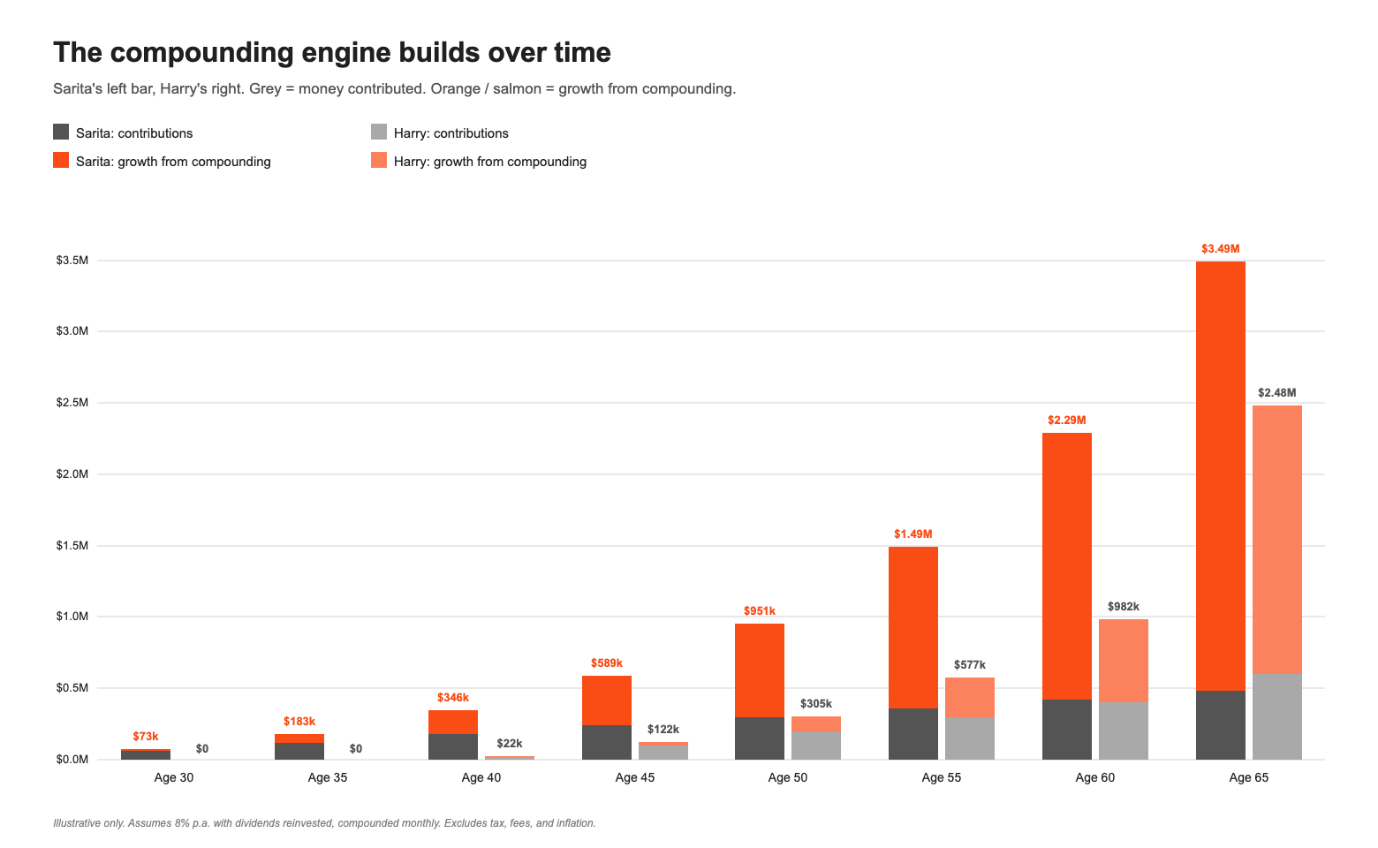
Over 20 years at an 8% average annual return, Sarita’s portfolio is worth approximately $589,000. Harry’s is worth $491,000.
Despite earning half as much as Harry, Sarita ends up around $100,000 ahead. She saved more because she automated it, and life didn’t get a chance to get in the way.
You might be thinking that of course Sarita ends up ahead, she invested more in total. That’s obvious. And you’d be right. But let’s look at another scenario. Savings rate is only part of the story; time in the market is where the real magic happens.
The power of time
Imagine Sarita is 25 and has just landed her first job as a primary school teacher. She starts investing that $1,000 per month straight away and keeps at it for her whole working career.
Harry, meanwhile, is a management consultant. He’s flat out in his early career and never finds the time to think about his personal finances. He eventually gets around to it at 35.
Thanks to his high salary, Harry can afford to put $1,667 per month into the market consistently, $667 more than Sarita every month. He follows her lead and does this diligently for 30 years, until they both retire at 65.
By retirement, Harry has contributed $600,000 of his own money. Sarita has contributed just $480,000, a full $120,000 less than Harry.
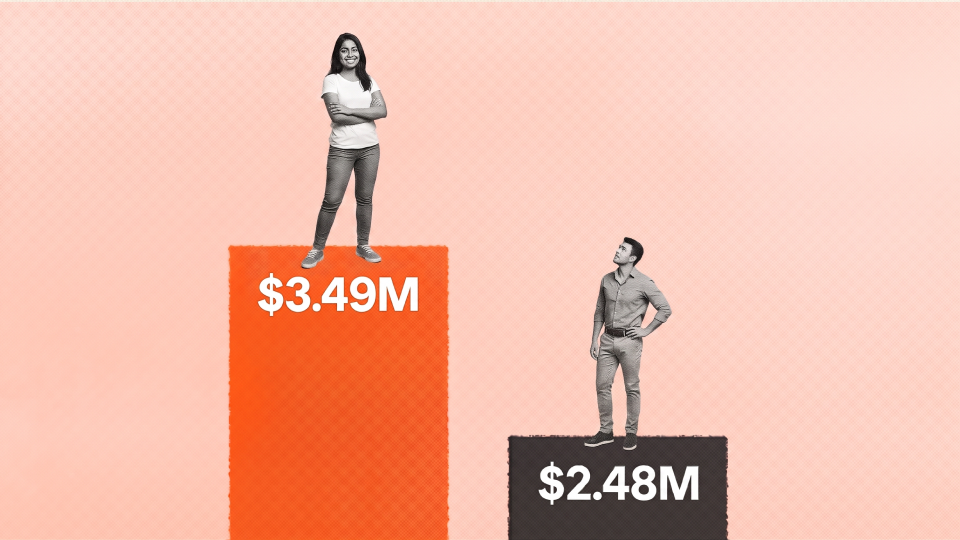
But Sarita’s portfolio is worth approximately $3.49 million. Harry’s is worth approximately $2.48 million.
Despite investing $120,000 less, Sarita ends up around $1 million ahead.
You can’t control your salary. You can’t control whether you receive a bonus, an inheritance or win the lottery. But you can control when you start investing, and whether you stick with it. Those are some of the most powerful levers you have, and they’re entirely in your hands.
The real-life Sarita the Saver
Sarita may be hypothetical, but there is plenty of truth in her story as we saw with Ronald Read.
Ronald built his US$8 million portfolio the same way Sarita built hers. He invested in companies he understood, names like Procter & Gamble, Johnson & Johnson and JP Morgan Chase. He bought shares and held them, sometimes for decades, reinvesting every dividend along the way. He didn’t let short-term market falls scare him into action and remained disciplined over a long period of time.
When Ronald died, he left US$2 million to his stepchildren and friends, US$4.8 million to his local hospital and US$1.2 million to his local library. And in 2022, his local hospital named their new pavilion the Ronald Read Pavilion after his generous donation that helped fund a new expansion.
So if a petrol station attendant and janitor from a small-town in Vermont can build a US$8 million portfolio, then so can anyone who’s willing to be disciplined, start early and let time do the work.
The outcomes in this article do not account for income tax. After-tax returns will vary depending on your individual circumstances. You should seek advice from a registered tax agent.