


The cash rate is one number almost every Australian keeps an eye on, and yesterday it rose again. The Reserve Bank lifted it to 4.85%, its fifth rise since February. That takes the rate from 3.60% at the start of the year to its highest level since 2008.
With the cash rate at this level, many investors may be considering the relative value of investing in the market versus receiving interest from holding cash in an interest savings account or even term deposit.
If you invest regularly, it’s a good moment to look at what history says about sticking to your plan when cash looks its most appealing – remembering that history is just that and not an indicator of the future.
Cash has a place in most people’s finances. But if you’re working towards goals that are years or decades away, there may be reasons to consider keeping your regular investing going while rates are high, depending on your objectives, financial situation, needs and risk tolerance, and they start with understanding what term deposits and savings accounts do and don’t offer.
Term deposits and savings accounts
A term deposit is a simple arrangement whereby you lend a bank a set amount for a fixed period, usually anywhere from a month to five years, and it pays you a fixed rate of interest for the term. That certainty is the big difference from investing. You know your return from day one and the rate stays put even if the RBA changes course.
The trade-off is flexibility. Your money is locked away for the full term, and taking it out early usually means paying a fee or giving up some of the interest. Timing can also work against you; if rates keep rising, you won’t benefit until the term ends.
A high-interest savings account can avoid the lock-up. You can withdraw when you like, which makes it a good fit for an emergency fund or money you plan to invest soon. The rate is variable though, many accounts pay their top rate only if you meet monthly conditions, and you would typically expect a higher rate from term deposits versus these accounts.
If you’re building wealth over the long term, the bigger issue with both is time. Money sitting in cash isn’t invested in the sharemarket, and over long periods Australian shares have historically returned more than cash. The longer your money stays out, the more of any future difference you could miss, although past returns may not be repeated.
The long-term record
Cash and shares do different jobs, and as an investor you’ll see them behave very differently depending on the time horizon you invest over.
Over single year periods Australian shares can have a large variability of returns, with the best year since 1990 returning 45% but the worst year, the 2008 GFC, falling 40%. That’s an 85% difference between the best and worst years. Cash returns were steadier in nominal terms, with just a 17.9% difference and no negative year returns, although inflation could still outpace cash returns, reducing purchasing power. The chart on the left below illustrates these outcomes.
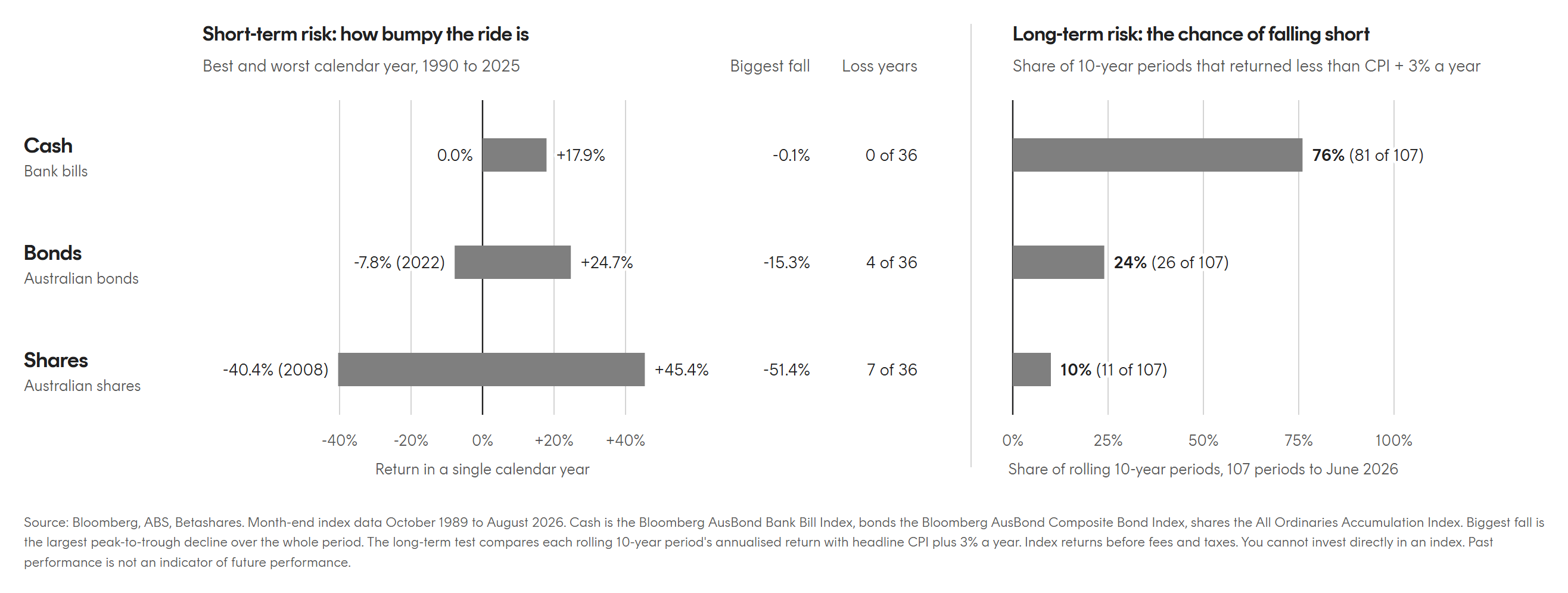
When you extend the investment time frame to ten years, and take into account a hypothetical but realistic goal of achieving a return of the inflation rate plus 3%, the appeal of each asset class looks a little different.
Over 10-year rolling periods examined from 1990 to 2026, cash fell short of the hypothetical CPI +3% return target 76% of the time, while Australian shares fell short just 10% of the time.
With a longer-term horizon and a higher end investment goal, the greater risk for investors may be falling short of their goals.
Keeping your regular investing going
Even so, many investors, especially in a higher rate environment, can struggle to stick to their plan and invest in the market, hoping to time a better entry point. Betashares Senior Portfolio Manager Luke Sheather examined different investment approaches over 22 years of Australian market history and found that even buying at the peak every year left people ahead of waiting in cash. Read more: When is the best time to invest your money?
Dollar-cost averaging means investing a set amount at regular intervals whatever the market is doing, so if you have a regular investment plan you’re already doing it.
Its advantage is it takes timing out of your hands. When prices are lower your fixed amount buys more units and when they’re higher it buys fewer, so over time you buy at a spread of prices without ever having to guess whether today is a good day to start.
Pausing your plan to sit in cash hands the timing decision back to you, because at some point you’ll have to pick a moment to restart. If the market rises while you wait you’ll be buying back in at higher prices and, if it falls, starting again can feel even harder. Every month you skip is also a month that money isn’t invested.
Where cash fits
None of this means every dollar should be in the sharemarket. An emergency fund belongs somewhere you can reach quickly, like a high-interest savings account. If you’re saving for something in the next few years or close to reaching your investment goal the impact of a share market fall is heightened and it may be time to consider safer alternatives.
The risk lies in moving your long-term money as well and switching off the regular contributions that have been building it. Higher cash rates are a good reason to review where your savings are, but they’re a weaker reason to stop investing for goals that are ten or twenty years away.
This article is general information only and does not take into account your objectives, financial situation, or needs. Consider whether it’s appropriate for you and seek independent financial advice before making an investment decision. Investing involves risk, and the value of an investment can go down as well as up. Past performance is not a reliable indicator of future performance. Deposits with authorised deposit-taking institutions are covered by the Financial Claims Scheme up to $250,000 per person per institution. Investments in shares and funds are not covered.