



Over the past week, concerns about whether AI spending can continue, and how it is being funded, led to falls in tech companies.
CoreWeave, a ‘neocloud’ company that rents out AI computing power, fell nearly 30% in a single trading day as yields on its 2031 bonds surged to more than 15%.
Closer to home, data centre operator Firmus withdrew what was set to be one of Australia’s largest share market listings.
Share markets with heavy exposure to AI also fell, including the Nasdaq 100, Japan’s Nikkei 225 and South Korea’s KOSPI, which was one of the worst performing markets, down 16.4%1 for the week.
The funding to build data centres is becoming a bottleneck for AI. Companies are relying more on borrowing as well as issuing new shares to pay for it. This raises the risk of a sharp fall in share prices if interest rates rise or become more volatile from here.
While funding is getting harder to come by, higher borrowing costs may not necessarily be a bad thing for long-term returns. Companies with less debt tend to be better protected than those relying on cheap funding and rising share prices.
Lenders are already treating companies differently. For example, the cost of insuring against Oracle failing to repay its debt (known as a credit default swap) is now much higher than for the broader group of financially strong tech companies. Borrowing costs for other large US tech companies show a similar split.
In our view, AI funding concerns on their own are unlikely to derail share markets while company earnings keep delivering. But they could cause bouts of volatility (sharp ups and downs) in companies that rely heavily on borrowing, such as the newer AI cloud providers.
Company earnings look strong, but what’s happening beneath the surface?
Earnings for S&P 500 companies are forecast to grow 30.7% in the September quarter, compared with a year earlier. Much of this growth comes from computer chip makers in the information technology sector, boosted by spending on AI.
Hyperscalers are still paying for most of this spending from the cash their businesses generate. Oracle is the main exception.
The only sector growing earnings faster than IT is Energy, thanks to higher oil prices than a year ago. Even without Energy, S&P 500 earnings are forecast to grow 26.2%.
| Sector | Earnings $B – 26Q3 | Earnings $B – 25Q3 | Growth $B – 26Q3 | Growth % – 26Q3 |
|---|---|---|---|---|
| Consumer Discretionary | 56.2 | 54.3 | 1.9 | 3.5% |
| Consumer Staples | 33.8 | 32.6 | 1.2 | 3.7% |
| Energy | 58.6 | 25.7 | 32.9 | 128.3% |
| Financials | 121.3 | 114.9 | 6.4 | 5.5% |
| Health Care | 72.3 | 71.5 | 0.9 | 1.2% |
| Industrials | 51.2 | 43.4 | 7.8 | 18.1% |
| Materials | 15.7 | 11.9 | 3.8 | 31.5% |
| Real Estate | 14.7 | 14.2 | 0.6 | 3.9% |
| Information Technology | 256.6 | 154.1 | 102.5 | 66.5% |
| Communication Services | 70.5 | 48.3 | 22.2 | 46.1% |
| Utilities | 23.0 | 21.5 | 1.4 | 6.7% |
| S&P 500 | 773.9 | 592.3 | 181.6 | 30.7% |
| S&P 500 ex-Energy | 715.3 | 566.6 | 148.7 | 26.2% |
Source: LSEG I/B/E/S. As at October 16, 2026.
Earnings growth is still concentrated in tech, but there are signs it is spreading. Analysts expect the ‘Magnificent 7’ to grow earnings more slowly than the other 493 companies in the S&P 500 in the December quarter (23.6% vs. 30.6%) which would mark the first time since late 20222.
Financing concerns are a potential contributor with names like Nvidia indirectly exposed through its equity stakes in CoreWeave and Nebius, although these are small relative to the overall size of the company.
Tighter funding could also slow cloud revenue growth at large tech companies such as Oracle and Microsoft because a meaningful share of the work they’ve already signed up to deliver is for AI developers, namely OpenAI.
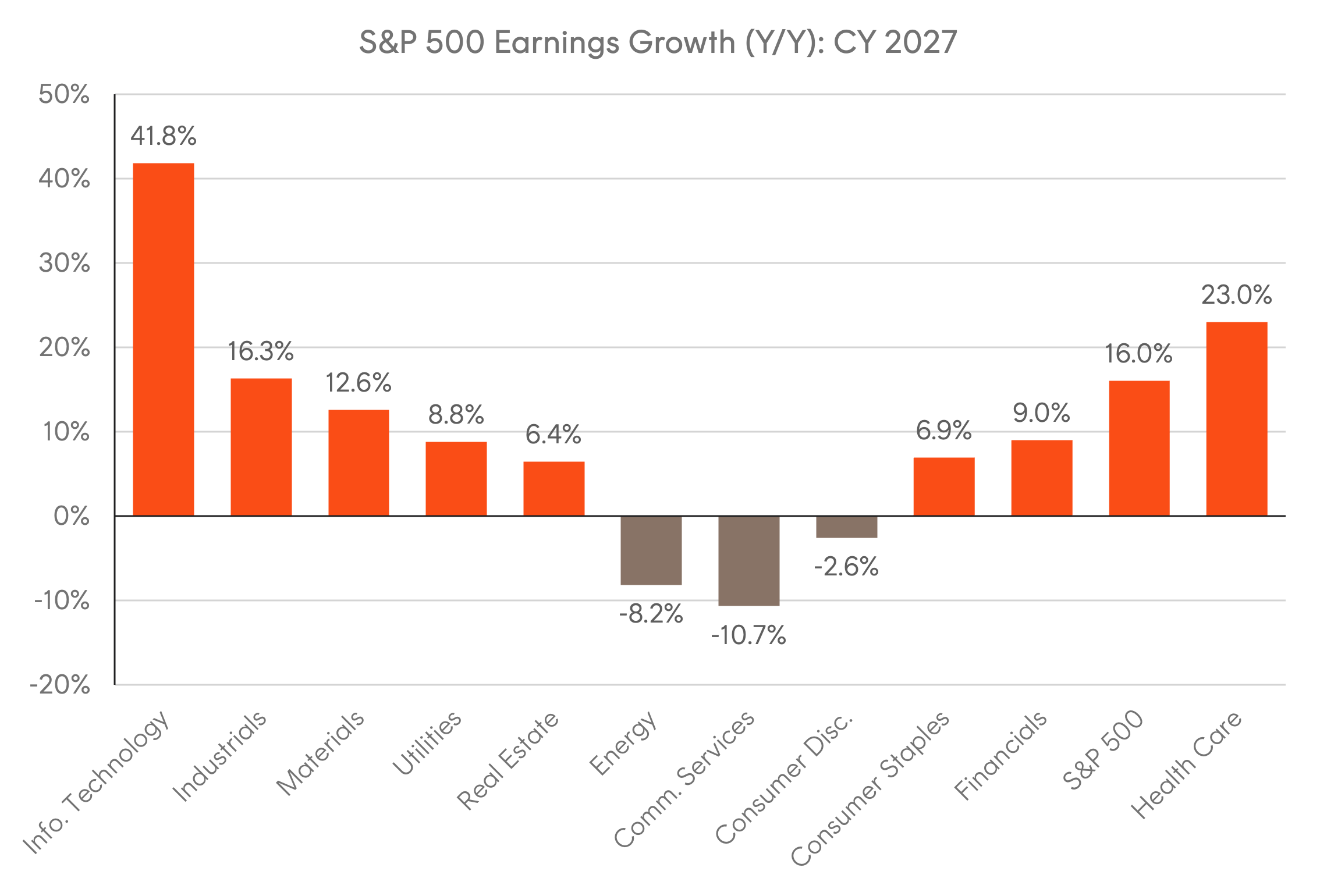
Despite these risks, analysts expect tech to stay in front, with IT sector earnings forecast to grow 41.8% in 2027. The other 493 companies also include AI beneficiaries such as chip makers Broadcom, Micron and AMD, so some of this broadening reflects AI spending flowing through to these names.
Beyond tech, Health Care (23.0%) and Industrials (16.3%) earnings are forecast to grow in line with, or ahead of, the overall index.
Source: FactSet. As at October 16, 2026.
What are we looking out for?
Last week’s price falls reflect real funding risks. But they may also mean some companies with resilient earnings prospects are now priced lower than they were before the sell-off. In our view, the long-term case for technology remains intact, and the earnings strength of large, established tech companies continues to support a diversified holding such as the NDQ Nasdaq 100 ETF.
However, the balance between risk and potential return has shifted. Tighter funding could slow the growth in AI spending and the pace at which analysts lift their earnings forecasts.
For those looking to spread their exposure as earnings growth broadens, funds such as the QUS S&P 500 Equal Weight ETF, which gives each company in the S&P 500 the same weighting, or the EXUS Global Shares Ex US ETF, which invests in developed market companies outside the US, offer two ways to diversify.
In the near term, we’re watching Meta’s results and its spending plans for 2027, including whether spending is slowing relative to revenue growth, how much cash the business generates, and how it is funding its investment.
Beyond company results, we’re also watching how lenders are treating AI-exposed companies, and the US Federal Reserve’s meeting on 27 and 28 October, which could shape the direction of interest rates for the rest of the quarter.