



From 1 July 2027, the way Capital Gains Tax (CGT) is calculated for individuals, trusts and partnerships is set to change. The 50% CGT discount, which currently halves the taxable gain on assets held for more than 12 months, is to be removed. In its place, the original purchase price of an asset (its ‘cost base’) is to be increased in line with inflation before any gain is calculated, an approach known as indexation. Some investment structures, such as superannuation and investment bonds, are taxed differently and may not be affected by the new rules in the same way. However, most people are likely to continue holding at least some investments in their own name, so it is worth understanding how the new rules work.
One important feature of the new rules is that the cost base is calculated differently for a capital gain than for a capital loss. This uneven, or ‘asymmetric’, treatment can create a tax drag, meaning an investor may pay more tax than their real, after-inflation gain would suggest.
How the new CGT tax maths works
Under indexation, the cost base of each asset increases in line with inflation, as measured by the Consumer Price Index (CPI), over the period it is held. But if the asset is sold for:
- Greater than the indexed cost base: a capital gain is recognised, calculated as sale proceeds less the indexed cost base.
- Between the original and indexed cost bases: there is no capital gain or loss.
- Less than the original cost base: a capital loss is recognised, calculated as sale proceeds less the original cost base. Indexation does not apply to losses.
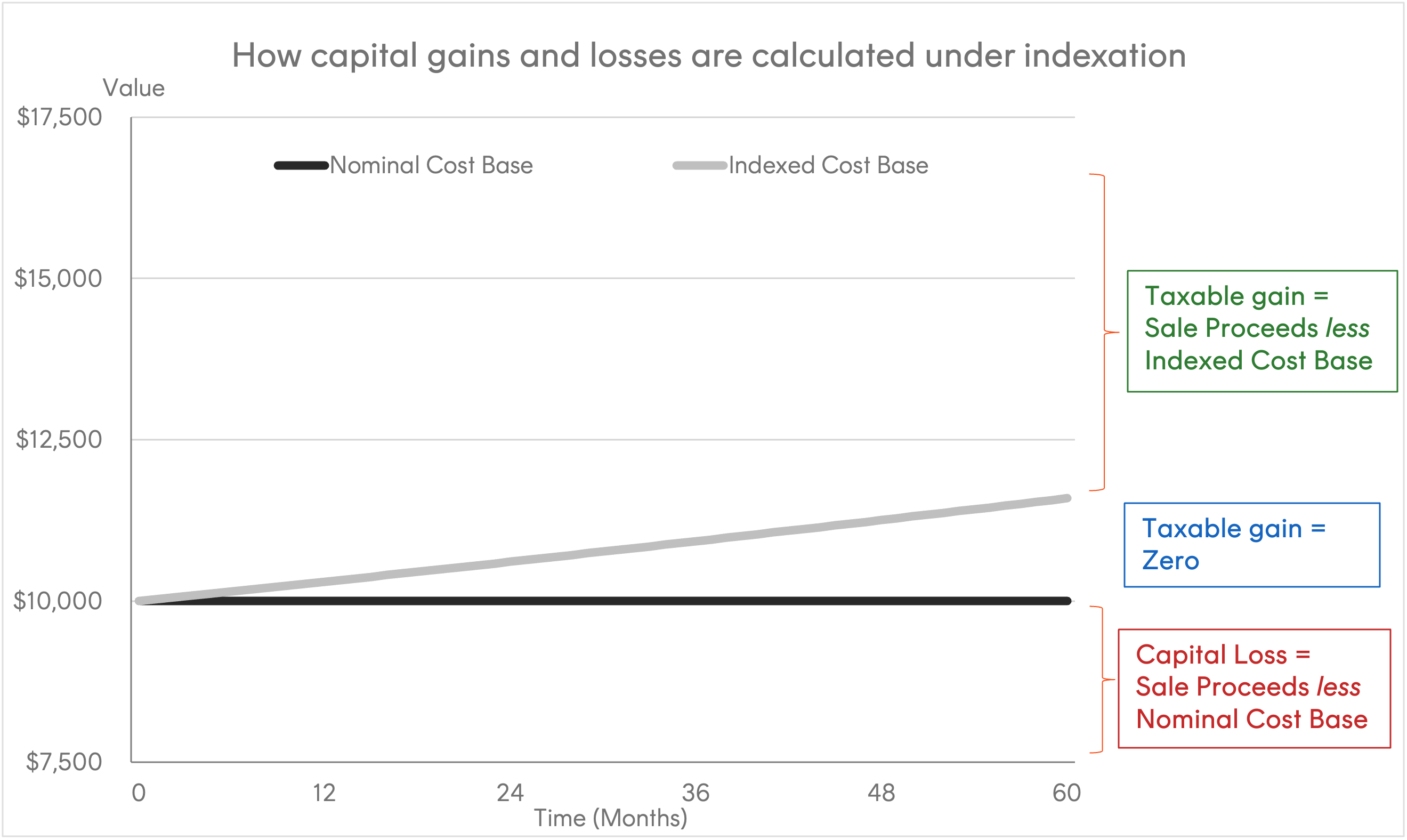
Hypothetical example only, assumes cumulative inflation of 15% over five years (an indexation factor of 1.15). Indexation shown as a linear increase for simplicity. Actual tax outcomes will vary depending on individual circumstances. This is not financial, tax or legal advice.
We coined the phrase ‘Triangle of Sadness’ to describe the widening gap between the indexed and nominal cost base, and the impact of this asymmetric tax treatment. For investors holding a portfolio of direct shares, that asymmetry can result in tax being paid on a real (after-inflation) gain that, across the portfolio as a whole, simply isn’t there. For this reason, we believe a low-turnover, index-tracking ETF (one that buys and sells its holdings infrequently) can be a more tax-efficient way to invest under the new CGT rules than holding a portfolio of shares directly in an individual’s own name. We have written about this topic in the past, to explain the mechanics of how CGT is applied at a share portfolio level (here) and to estimate the potential impact (here).
But the Triangle of Sadness still exists, even for ETF investors
The uneven CGT treatment is most pronounced for a portfolio of individual shares, because single stock prices tend to move around a lot and can perform very differently from one another. But it can still apply to an individual holding several ETFs in their own name.
Consider the following hypothetical example. An individual invests $20,000 across two ETFs, $10,000 into an Equity ETF (which invests in shares) and $10,000 into a Bond ETF (which invests in bonds). Five years later, inflation has lifted the indexed cost base of each ETF to $11,500. The investor then sells both, receiving $14,000 for the Equity ETF and $10,000 for the Bond ETF.
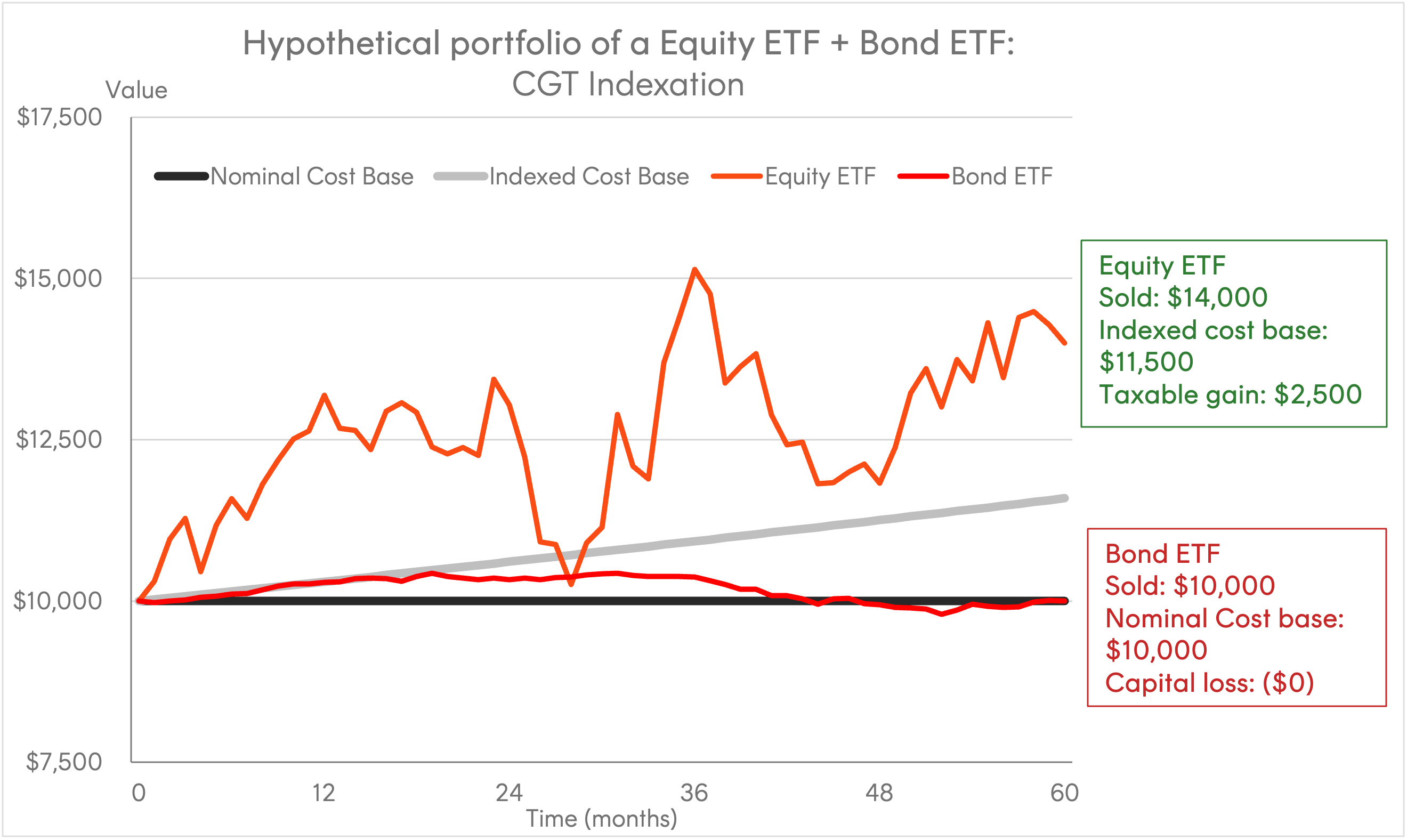
Hypothetical example, assuming CGT indexation treatment, purchase price of each ETF holding is $10,000 and each is held as an investment (on capital account) for 5 years with cumulative inflation of 15% (an indexation factor of 1.15), before being sold for the figures shown. Actual tax outcomes will vary depending on individual circumstances. This is not financial, tax or legal advice.
Capital gains are calculated separately for each asset, with a taxable gain of $2,500 for the Equity ETF and no gain or loss on the Bond ETF. However, across the portfolio as a whole the gain before inflation is $4,000 ($24,000 sale proceeds less $20,000 cost). The indexed cost base has increased by $3,000 to $23,000, so the real, after-inflation gain is only $1,000. Yet the investor is taxed on $2,500, which is 2.5 times the real portfolio gain.
How does a Diversified ETF help?
Now consider the same two ETFs held within a single Diversified ETF, that is, an ETF that holds a mix of other ETFs across asset classes such as shares and bonds. The investor’s cost base is the unit price they paid for the Diversified ETF, not the prices of the underlying ETFs. The Diversified ETF itself is the asset for CGT purposes. Indexation applies to that asset, and any capital gain is based on what it is sold for. The underlying ETFs are not assessed separately.
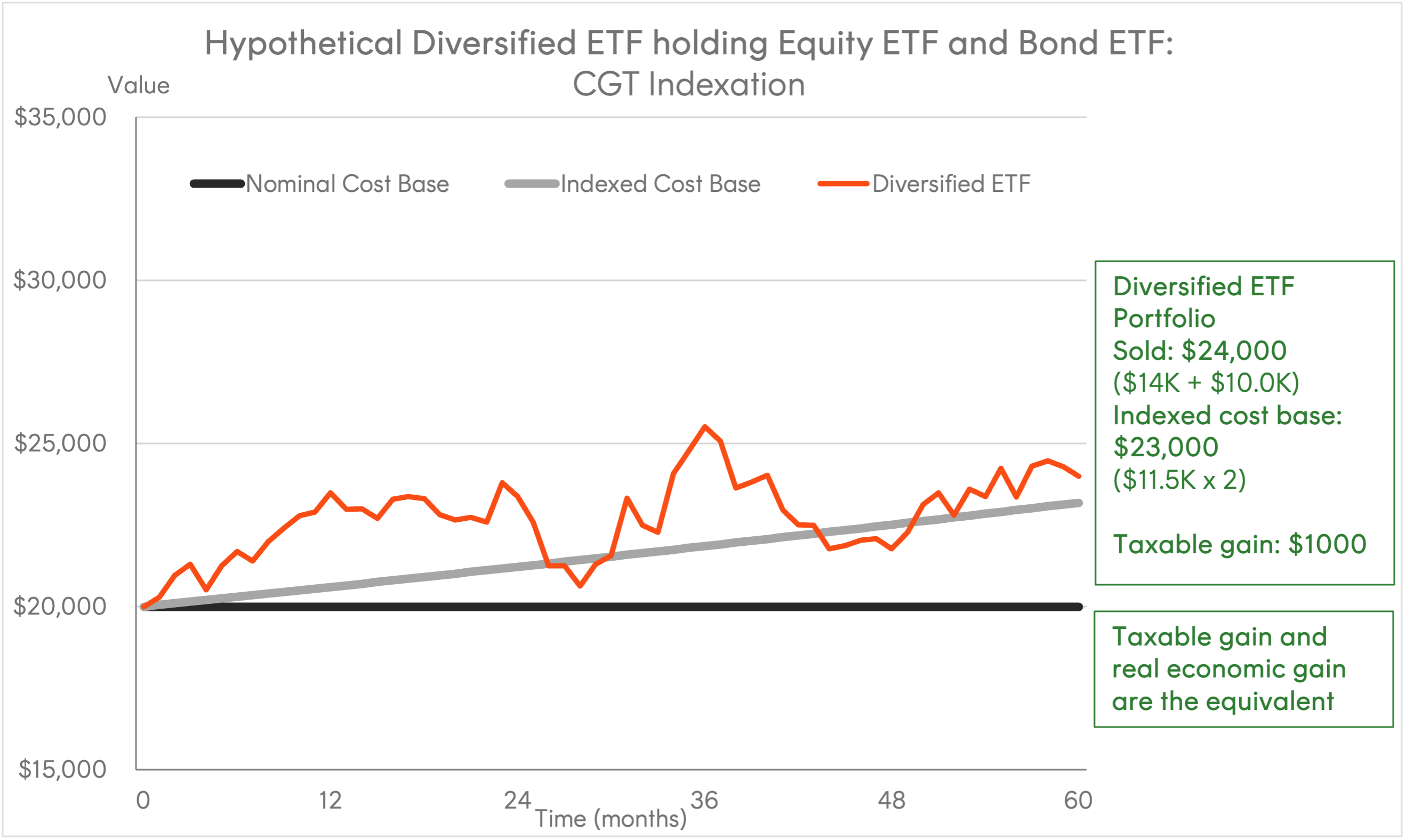
Hypothetical example, assuming CGT indexation treatment, purchase price of Diversified ETF holding is $20,000 and it is held as an investment (on capital account) for 5 years with cumulative inflation of 15% (an indexation factor of 1.15), before being sold for the figure shown. Actual tax outcomes will vary depending on individual circumstances. This is not financial, tax or legal advice.
In the example above, the investor’s cost base is $20,000 and they sell the ETF for $24,000 five years later (the sum of the values of the underlying ETFs at the time). Indexation applies to the entire cost base, resulting in a taxable gain of $1,000, which matches the real, after-inflation gain across the portfolio. In this example, the investor is not penalised with a higher tax bill because the Bond ETF’s price did not keep pace with inflation.
What makes this outcome interesting is that in either scenario above (two separate ETFs or one diversified ETF) the individual investor would have faced the same taxable capital gain of $2,000 under the CGT Discount approach, yet under indexation the taxable gain increases to $2,500 for the first scenario and reduces to only $1,000 for the second scenario.
Combining assets in a single Diversified ETF in this way can be effective for an individual to invest, particularly one who holds some defensive assets such as cash or bonds. Defensive assets generally aim to provide more stable returns than shares, with most of that return coming as income rather than price growth. As a result, their prices may not keep pace with inflation. Pooling them with shares means the taxable capital gain across the whole portfolio may be lower. Depending on asset performance and how much is held in defensive assets, an individual holding a multi asset Diversified ETF may pay little or even no CGT under cost base indexation. Indeed, indexation may result in less tax than the current 50% CGT discount wherever capital growth is less than roughly twice the rate of inflation. In our view, this is a plausible outcome for a Diversified ETF with a balanced or growth risk profile, as part of its return typically comes from income rather than capital growth.1
There is one important caveat to the argument above for a Diversified ETF. The example shown assumes there is no rebalancing of the two underlying ETFs back to the Diversified ETF’s target asset allocation. Rebalancing (periodically buying and selling holdings to bring the mix back to its target) is likely to lead to some capital gains being distributed to investors in the Diversified ETF. This creates a tax drag that can slightly reduce after-tax returns. However, Betashares has adopted a rebalancing strategy that seeks to minimise unnecessary buying and selling. Its diversified portfolios are also built from index-tracking ETFs, which are generally efficient at limiting the capital gains distributed to investors, as discussed here.
Betashares Multi Asset Diversified ETF range
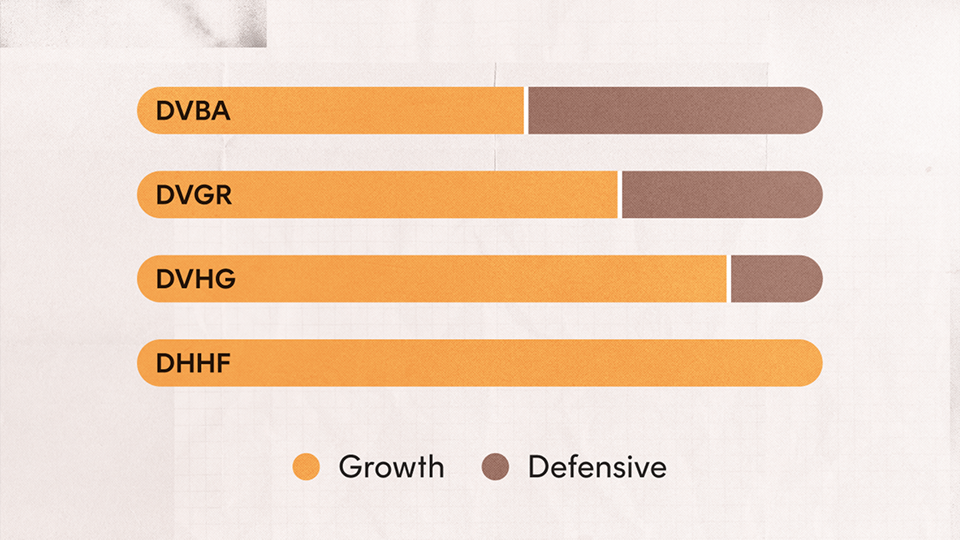
Our multi asset Diversified ETFs provide exposure to over 2,000 companies and 12,000 bonds across Australian and global markets.2 With management fees of 0.19% per year, the lowest fee amongst all-in-one Diversified ETFs currently available in Australia3, they come in a range of risk profiles, designed for investors with different investment objectives and tolerance for risk.
| Ticker | ETF Name | Risk profile | Growth / Defensive | Management Fee |
|---|---|---|---|---|
| DHHF | Betashares All Growth ETF | All Growth | 100% Growth | 0.19% p.a. |
| DVHG | Betashares Diversified High Growth ETF | High Growth | 90% Growth / 10% Defensive | 0.19% p.a. |
| DVGR | Betashares Diversified Growth ETF | Growth | 75% Growth / 25% Defensive | 0.19% p.a. |
| DVBA | Betashares Diversified Balanced ETF | Balanced | 60% Growth / 40% Defensive | 0.19% p.a. |
Beyond the potential tax benefits under CGT indexation, these Betashares Diversified ETFs offer some additional structural features. Our Diversified ETFs:
- Are built using only ETFs, not unlisted funds. Using ETFs as the only underlying investments, rather than unlisted managed funds, has some potential benefits. ETFs can be more tax-efficient than actively managed unlisted funds because they generally buy and sell their holdings less often, and have better mechanisms for limiting the capital gains passed on to investors who remain in the fund.
- Are managed using tax-aware rebalancing. The rebalancing strategy seeks to minimise unnecessary portfolio turnover and the realisation of capital gains, while keeping each Fund aligned with its target asset allocation and intended risk profile.
- Aim to make currency hedging tax efficient. Some underlying ETFs are currency hedged, meaning they aim to reduce the effect of exchange rate movements on returns. Each of these ETFs has elected to apply the Taxation of Financial Arrangements (TOFA) rules to 100% of its assets. This can better align the tax treatment of the currency hedge with that of the underlying investments, which may reduce tax distortions and improve after-tax returns over time.
As with any investment, the value of these ETFs can go down as well as up, and investors may get back less than they invested. ETFs with a higher allocation to growth assets such as shares are likely to see larger rises and falls in value than those holding more defensive assets. Any tax benefit described in this article depends on an investor’s individual circumstances and any changes that make be made to the tax reform legislation.
