


Global week in review: blue wave sinks tech stocks
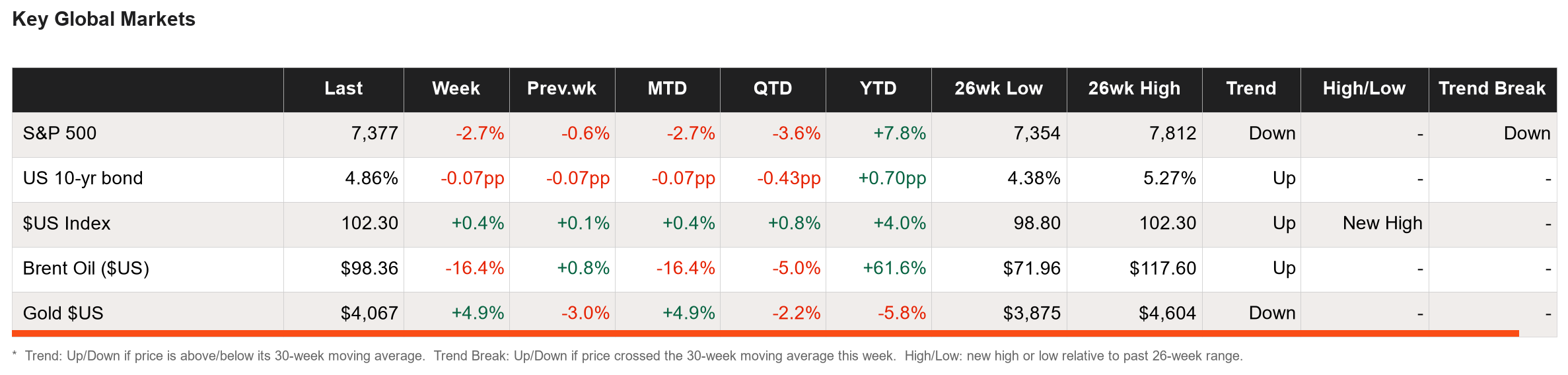
Global stocks endured a bruising week, as the Democrats’ clean sweep of the US midterms – capturing both House and Senate – initially sparked relief before triggering a savage sell-off in AI-exposed technology stocks. Bond yields eased and gold rose modestly on safe-haven flows.
What a whiplash! Markets initially cheered the Democratic victory, apparently on the grounds that congressional scrutiny might curb the hyperscalers’ runaway AI spending, improving their free cash flows. The fact US President Trump meekly accepted the election results and said he was not contemplating new strikes on Iran also helped sentiment.
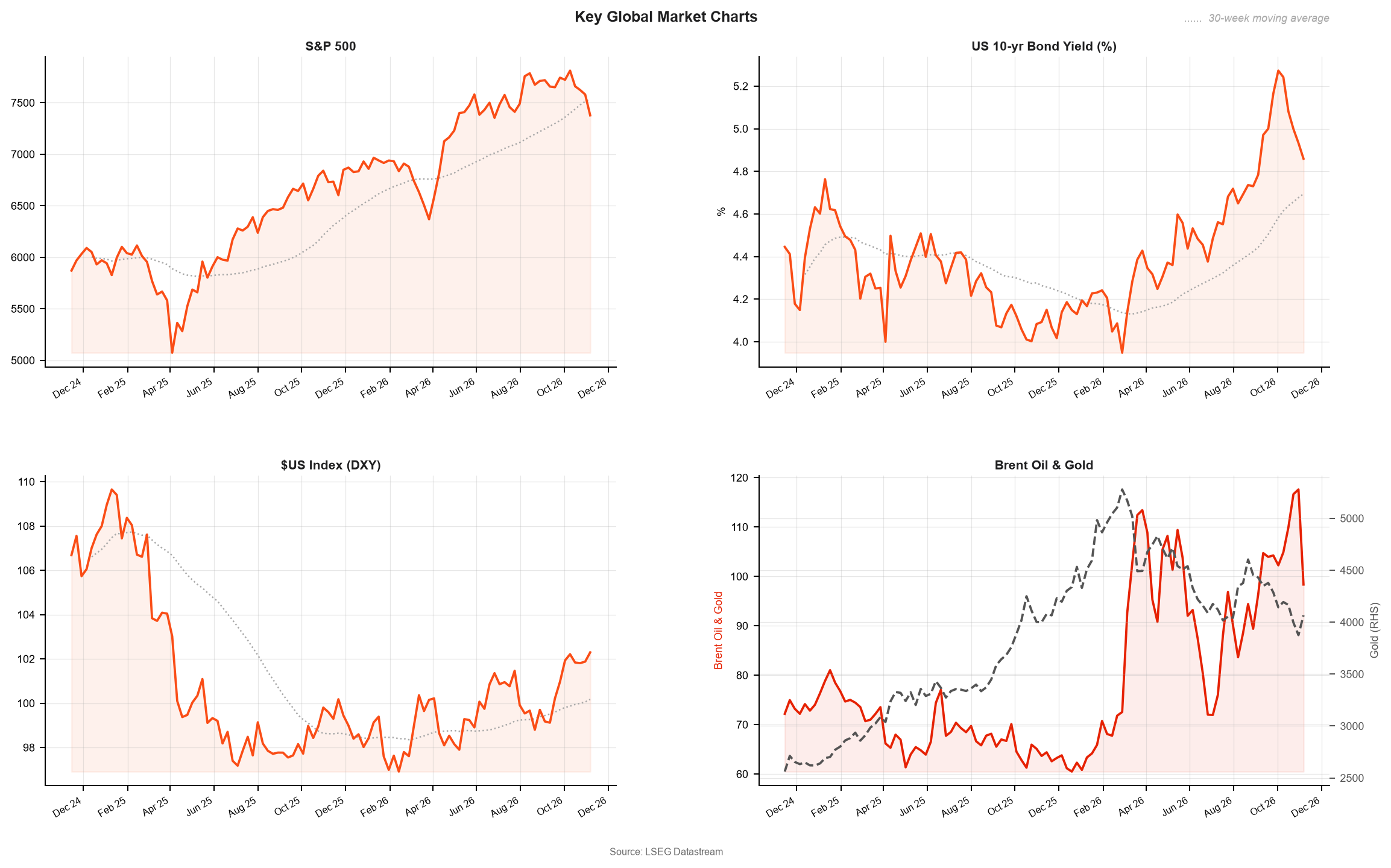
The S&P 500 surged 1.7% on Wednesday. Within 24 hours the same investors had done a complete U-turn, concluding that AI regulation was not so great after all. The S&P 500 plunged 4.4% on Thursday – its worst day since the April 2025 tariff crash – and the Nasdaq 100 fell 5.3% into correction territory.
Equities sold off despite a 16% decline in Brent crude oil prices, amid reports that US-Iran peace talks could again be in the works. Lower oil and falling stock prices helped drag the 10-year Treasury yield down to around 4.86%, even though the market still attaches a 75% probability to a December Fed hike. The Bank of England also moved last week, hiking 25 basis points to 4.00% in an 8-1 vote, its first increase of 2026.
Fed rate hike expectations remain intact due to Friday’s US payrolls result, with a stronger-than-expected 165k jobs gain in October (market 60k) and a decline in the unemployment rate from 4.2% to 4.1%.
Global equity trends: AI trade in correction
The AI trade is now firmly in correction territory, with technology the standout laggard for the fourth consecutive week. The Nasdaq 100’s 5.3% single-day plunge on Thursday crystallised what has been a gradual but persistent de-rating of the theme since mid-June.
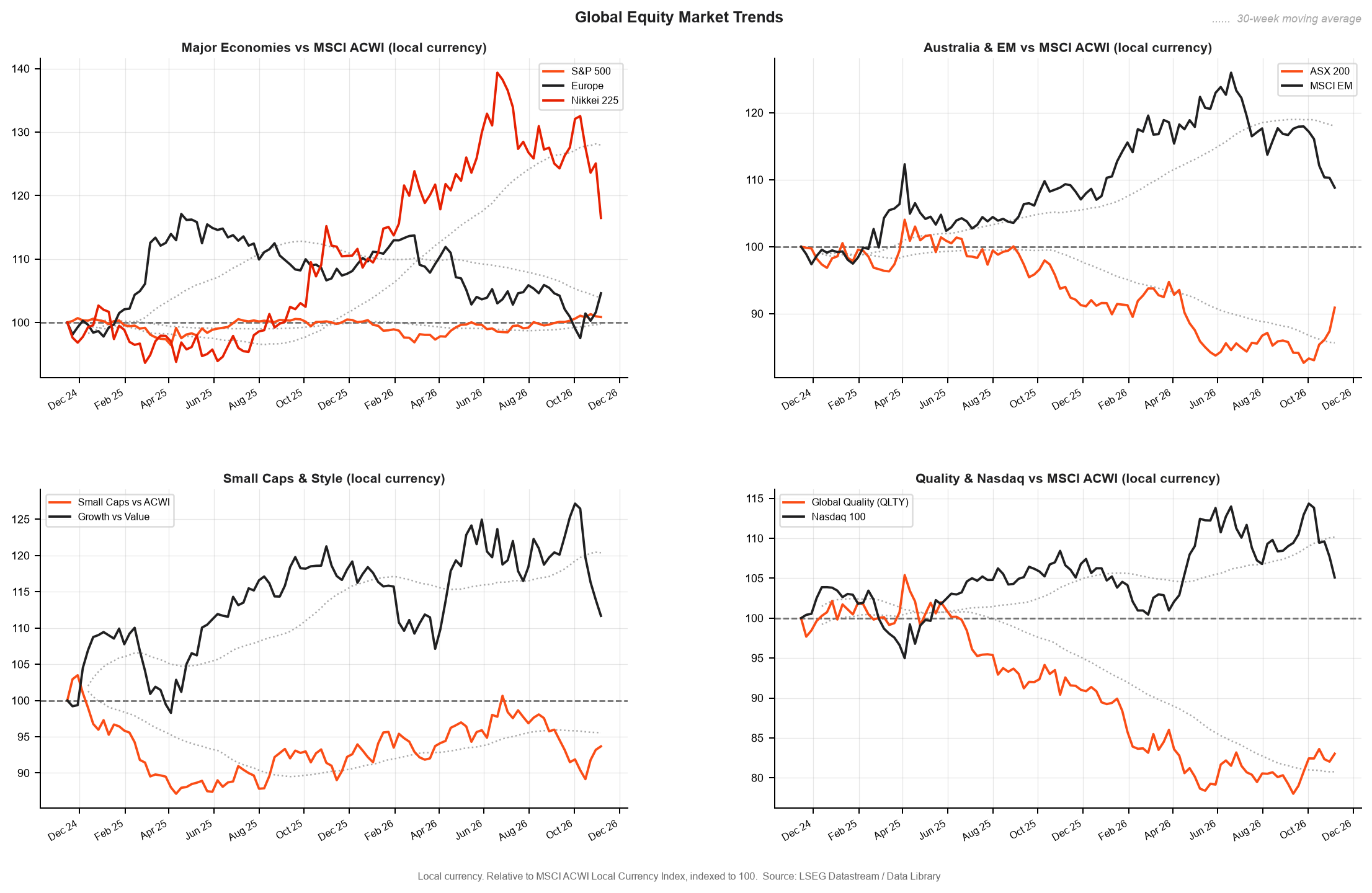
The regional picture is consistent with this: US and Japanese markets – both heavily exposed to AI – underperformed, while value-oriented markets fared relatively better. Note the broader global technology sector did not fall as hard as the pure AI plays, suggesting investors are discriminating between companies at the coal face of the data centre build-out and those with more diversified technology revenue streams.
Interestingly, despite four weeks of tech underperformance, global quality has held up well, as has the financial sector. That is consistent with a market that is rotating defensively rather than outright selling risk.
Energy was also hit last week, reflecting the decline in oil prices.
Global week ahead: US CPI test
The focus this week shifts to Tuesday’s US October CPI report. A more moderate 0.2% gain in core prices is expected after two consecutive 0.3% gains. That would be a welcome reprieve for the market, though another upside surprise would firm up the case for a December Fed hike.
The wildcard remains Iran. Reports of tentative peace proposals keep circulating, but Trump continues to hint at further strikes. Any material escalation would push Brent back above $US100 and reignite inflation fears, while a credible ceasefire deal would provide meaningful relief to both bonds and equities.
Australia week in review: Steve Bradbury and a Cup Day hike
In a classic ‘Steve Bradbury’ performance, the ASX 200 managed a 1.3% gain for the week to 9,021 – holding up remarkably well against the global tech carnage, helped by the local market’s comparatively light exposure to AI-related names.
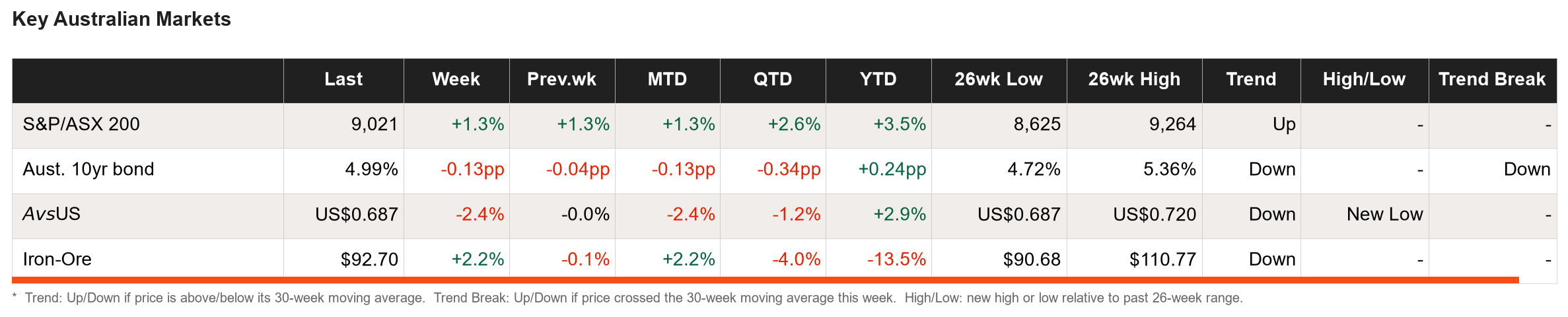
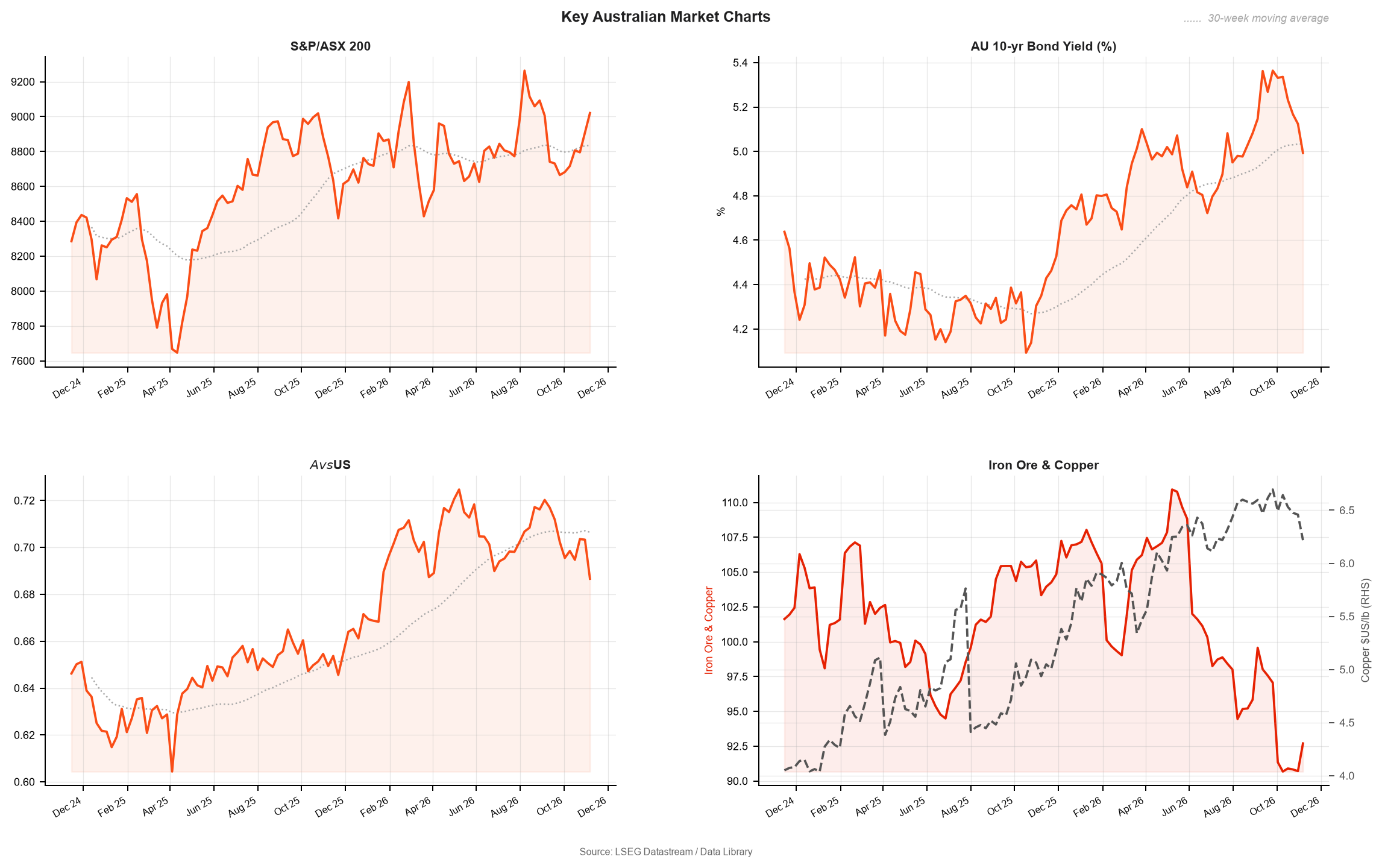
The main local event was the Reserve Bank’s Melbourne Cup Day decision, which delivered its fifth rate hike of the year, lifting the cash rate to 4.85% – an 18-year high. The 6-3 vote split was a mild surprise, with three Board members preferring to hold. Equally notable was the Bank dropping its explicit warning that further increases may be needed. To my mind, however, this simply means December is off the table, not that the cycle is over.
With the RBA’s new forecasts showing inflation uncomfortably above target for several more quarters, I expect the cash rate will need to go to 5.10% in February, barring a breakthrough on the Iran front.
The AUD/USD fell around 2% over the week to around US68.6 cents, reflecting a stronger US dollar following Friday’s payrolls beat and global risk-off sentiment more generally.
Local equity market trends: defensives hold, resources struggle
Australian equities continued their defensive rotation, with financials and healthcare holding firm while resources and technology lagged.
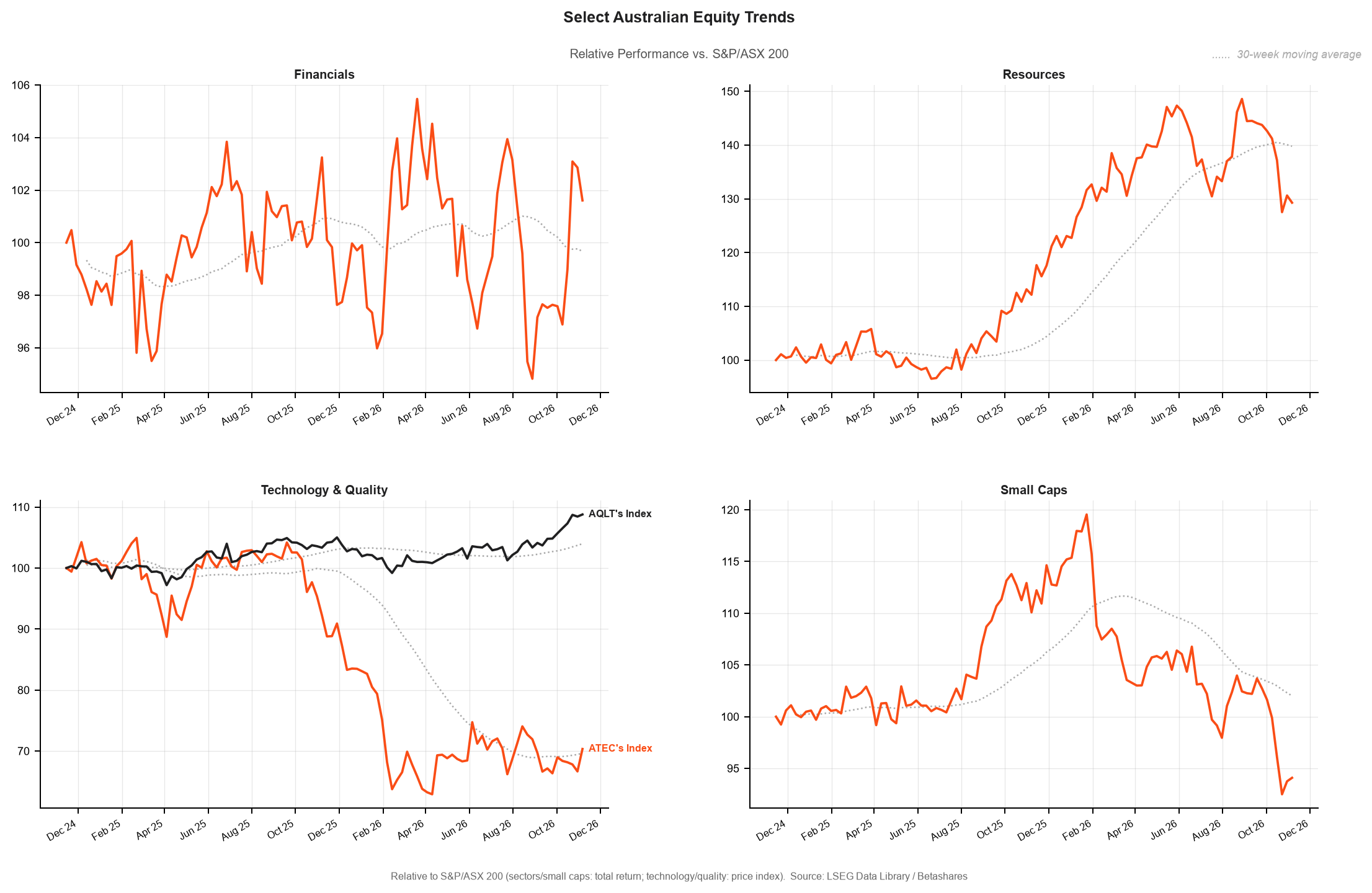
Resources remain under dual pressure – from the ongoing AI-induced risk-off mood and from iron ore hovering around $US93 a tonne on soft Chinese demand signals. Quality continues its steady outperformance while small caps remain in the doldrums.
Australia week ahead: consumer and business pulse
Tuesday also brings two further reads on the state of local consumer and business confidence: the Westpac-Melbourne Institute consumer sentiment survey and the NAB monthly business survey. Neither is likely to make pleasant reading. Consumer sentiment fell 4.7% to 80.4 in October – among the 40 weakest readings on record – while NAB business confidence stood at -13 in September, in the bottom 5% of its history. A further deterioration would reinforce the case for the RBA to pause in December and carefully assess the cumulative impact of five rate hikes.
Have a great week!