

Vinnay Cchoda
7 minutes reading time
For much of the last decade, climate technology has been framed as an innovation story built on novel solutions, venture capital funding rounds and the promise of disruption. But that framing is now outdated.
Climate technology has now moved decisively into its execution phase. The challenge has shifted from the invention of these technologies to whether they can be deployed at sufficient scale, speed and cost. Capital allocation, infrastructure build-out, supply chains and political durability have become the binding constraints.
For investors, this marks a structural shift. Climate technology is no longer a niche growth theme but a key constituent of the infrastructure and capital investment cycle underpinning the global economy.
Why climate tech still matters
The case for climate technology has strengthened in recent times. The physical impacts of climate change are increasingly being felt and have material economic consequences. The Intergovernmental Panel on Climate Change (IPCC) confirms that human-induced climate change has increased the frequency and intensity of extreme heat, heavy rainfall and drought across most regions – raising risks to infrastructure, food systems and productivity[1].
At the same time, the transition is increasingly underpinned by energy system economics rather than environmental policy alone. The International Energy Agency (IEA) estimates that global energy investment exceeded US$3 trillion in 2024, with roughly two-thirds directed towards clean energy, electrification, grids and storage[2].
Global investment in clean energy and fossil fuels, 2015-2024
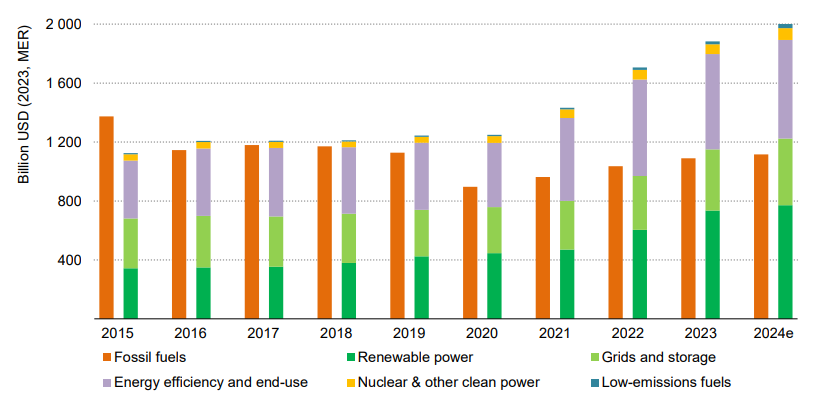
But despite this growth trajectory, current investment levels remain insufficient. BloombergNEF estimates that annual investment would need to rise to US$8 trillion by 2050 to align with a Net Zero pathway[3]. This shortfall is not simply a policy gap but an investment pipeline, implying sustained, long-duration demand for climate-enabling technologies – driven as much by cost competitiveness, energy security and system reliability as by emissions targets.
In that context, climate technology should no longer be viewed as a discretionary or thematic allocation. It represents a structural response to tightening physical constraints and a reconfiguration of the global energy and industrial system.
Climate Funding Gap (US$ trillion)
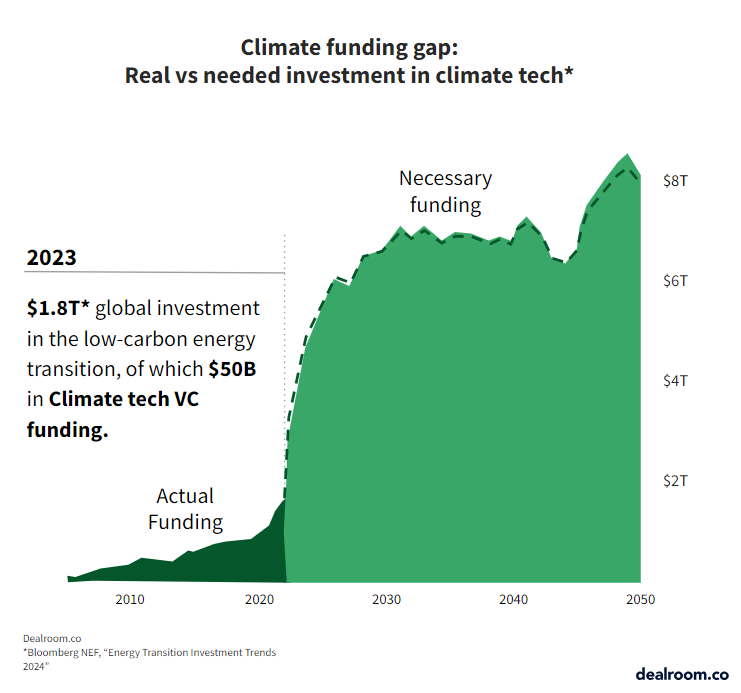
Source: Dealroom.co, BloombergNEF Energy Transition Investment Trends 2024
How the definition of climate technology has broadened
Initial progress in climate technology solutions was framed as a narrow set of venture capital-backed solutions focused on emissions reduction (renewable energy, electric vehicles and carbon markets). Progress was often measured through funding rounds, startup valuations and pilot projects.
That definition has since broadened materially. Climate technology now encompasses the systems required to decarbonise, adapt and reconfigure the global economy. Examples of solutions include grid infrastructure, energy storage, industrial and building electrification, low-carbon and climate-resilient materials, water and waste systems, critical minerals processing and digital tools aimed at optimising energy and resource use.
We have moved beyond the experimental phase and into large-scale deployment. Climate technology is no longer confined to a discrete set of companies but increasingly shapes how capital is allocated across the broader economy.
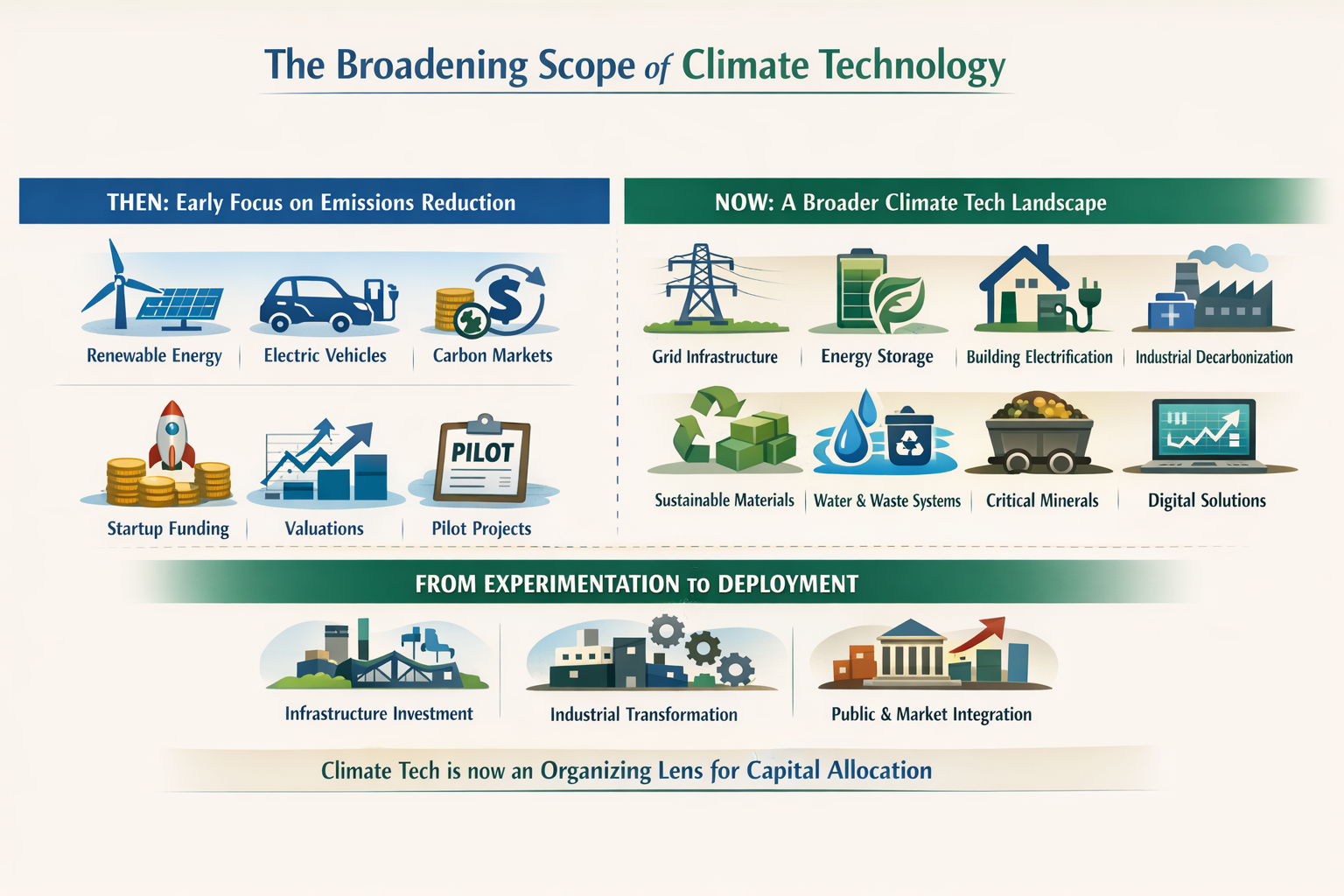
Source: Betashares
The market for ClimateTech funding remains strong, even if venture capital funding is well below its 2021 peak. Dealroom estimates that the combined enterprise value of global climate technology companies reached approximately US$3.9 trillion in 2025, representing ~33-fold growth over the past decade[4]. The magnitude of this growth reflects valuation expansion and the increasing commercialisation and integration of climate-enabling technologies into existing value chains.
Recent geopolitical tensions in the Middle East have reinforced this shift. Disruptions to energy markets and shipping routes have highlighted the continued fragility of global energy supply chains, reinforcing the strategic importance of domestic energy systems and resource security.
Climate tech Enterprise Value (US$ trillion)
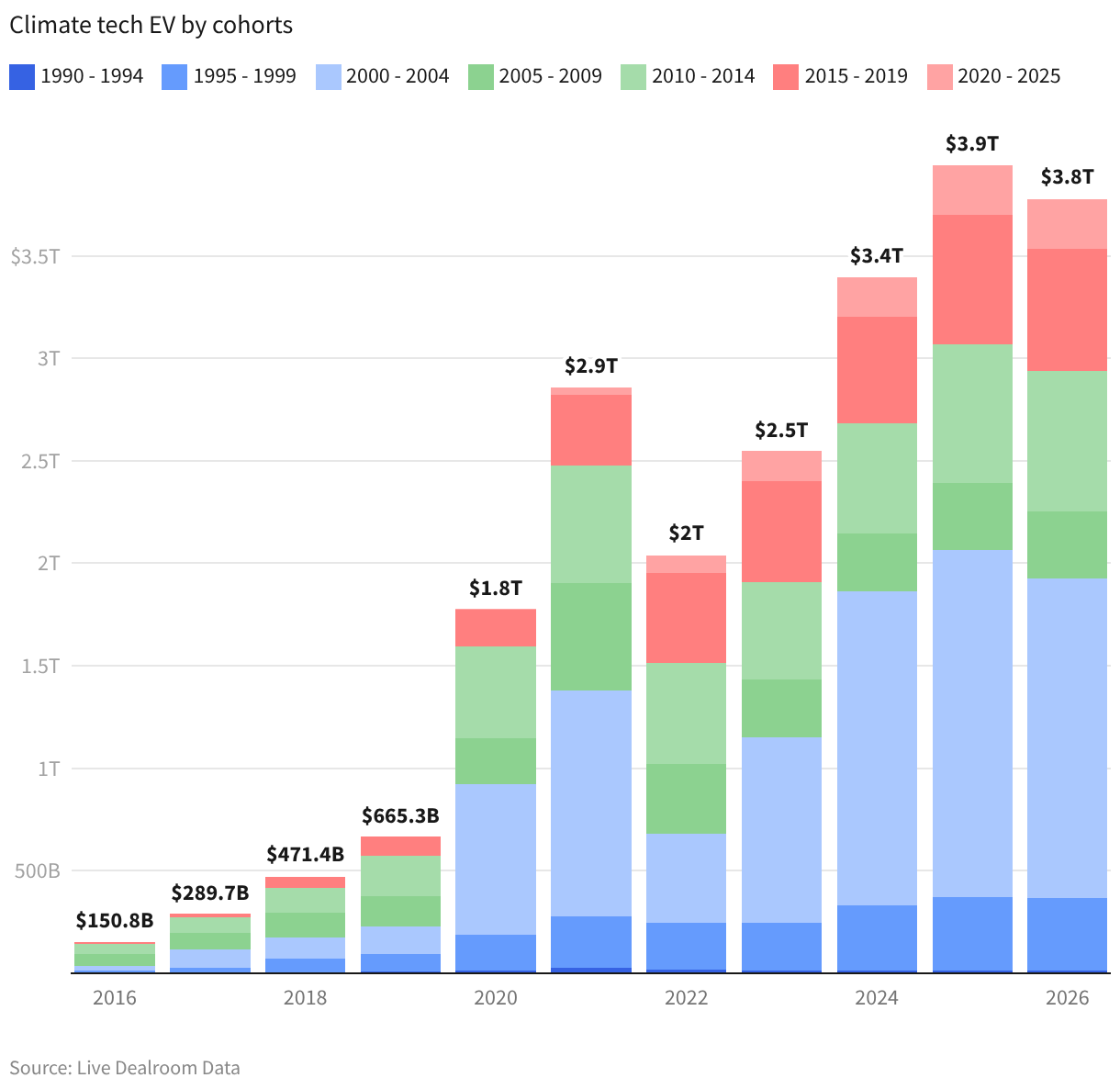
Source: https://dealroom.co/guides/climate-tech
For investors, this reframes climate technology as a structural reallocation of capital. As energy, industrial and transport systems are rebuilt, climate technologies will be embedded in long-lived infrastructure and production assets, meaning the opportunity will be defined by physical capital deployment rather than funding cycles.
Australia’s climate tech strategy takes shape
These dynamics are pulling governments deeper into the climate technology ecosystem. Climate technology is no longer merely supported by policy; it is increasingly shaped by it. Industrial policy, energy security and geopolitical considerations are now central to where and how quickly capital is deployed, and Australia is moving firmly in this direction[5].
A key pillar is the $15 billion National Reconstruction Fund Corporation (NRFC), which is supporting priority initiatives including renewables, low-emissions technologies and value-added resources processing and enabling infrastructure. The NRFC is explicitly designed to crowd in private capital by absorbing early or complex risk that the market may be unwilling to bear alone. This approach complements the Clean Energy Finance Corporation and the Capacity Investment Scheme for firmed renewables, alongside expanded critical minerals strategies[6].
This policy framework is underpinned by Australia’s structural advantages in renewable resources, critical minerals and industrial capability.
Together, these factors create a clear pathway for climate technologies to scale, particularly across grid infrastructure, energy storage and low-carbon industrial processes. For investors, the implications are constructive. Australia’s climate technology ecosystem is increasingly aligned with the build-out of long-lived infrastructure and industrial systems that are likely to underpin the next phase of the transition. Recent developments in the national electricity market, including renewables supplying more than half of generation and multi-billion dollar investment in grid upgrades, highlight that the transition is no longer a technology story but an infrastructure build-out[7].
What climate tech looks like in listed markets
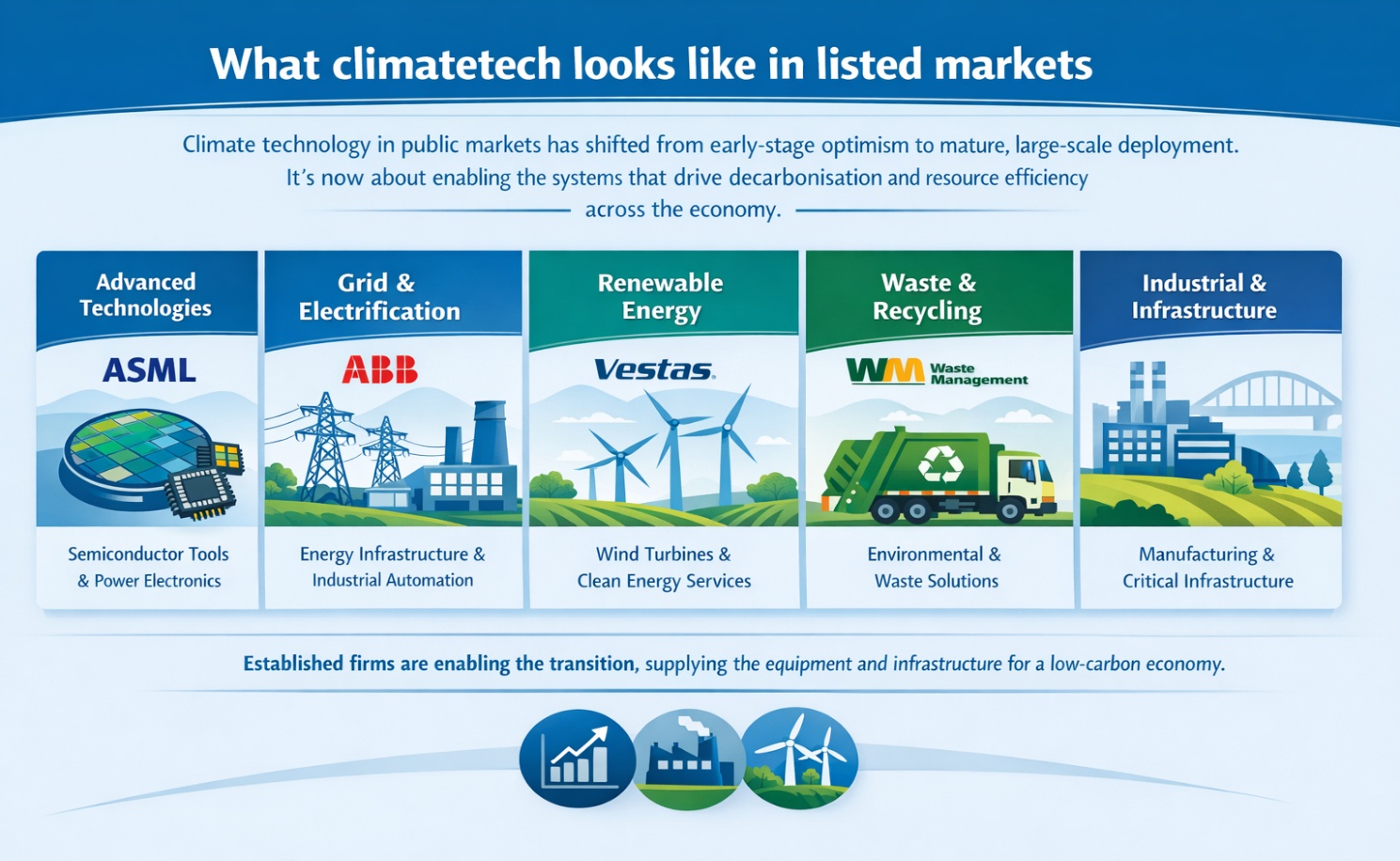
In listed markets, climate technology has shifted from early-stage optimism to a mature, performance-oriented sector, underpinned by scalable deployment in renewables, grid modernisation and industrial decarbonisation. Decarbonisation and adaptation are not discrete projects but system-wide rewiring exercises that span electricity networks, industrial processes, transport, waste and resource efficiency. As a result, many of the companies shaping climate outcomes today are not startups, but established listed firms supplying the equipment, software and infrastructure needed to scale.
A defining feature of listed market climate tech exposure is its emphasis on enablers rather than end-products, with companies such as ASML (NASDAQ: ASML) and ABB (SWX: ABBN) playing key roles – spanning semiconductor tools, grid expansion and industrial electrification.
Manufacturing and infrastructure also remain central. Danish listed Vestas (CPH: VWS) reflects how renewable energy has evolved into a global industrial supply chain with long-dated service revenues, while Waste Management (NYSE: WM) highlights the growing role of waste and recycling systems as environmental infrastructure.
Source: Betashares
Investing in climate tech
For investors, the focus shifts to where capital is being deployed at scale. The opportunity lies less in identifying individual technologies and more in understanding how exposure is constructed and which parts of the system are essential to delivery. This points towards infrastructure, industrial supply chains and enabling technologies benefiting from sustained investment cycles.
ERTH Climate Change Innovation ETF provides exposure to a portfolio of global companies positioned to benefit from climate change mitigation and adaptation. Importantly, this exposure includes early-stage innovators and established companies with scale, robust balance sheets and global revenue bases.
As climate technology becomes increasingly embedded in mainstream capital expenditure and infrastructure cycles, a diversified listed exposure offers a way to participate in the transition without relying on the success of any single technology or policy outcome.
There are risks associated with an investment in ERTH, including market risk, international investment risk, sector risk and non-traditional index methodology risk. Investment value can go up and down. An investment in the Fund should only be considered as a part of a broader portfolio, taking into account your particular circumstances, including your tolerance for risk. For more information on risks and other features of the Fund, please see the Product Disclosure Statement and Target Market Determination, both available on this website.
- https://www.ipcc.ch/report/ar6/syr/ ↑
- https://www.iea.org/reports/world-energy-investment-2024/overview-and-key-findings ↑
- https://about.bnef.com/insights/finance/global-investment-in-the-energy-transition-exceeded-2-trillion-for-the-first-time-in-2024-according-to-bloombergnef-report/ ↑
- https://dealroom.co/guides/climate-tech ↑
- https://www.aph.gov.au/Parliamentary_Business/Bills_Legislation/bd/bd2425/25bd006#:~:text=The%20Bills%20give%20effect%20to,report%20by%205%20September%202024. ↑
- https://www.nrf.gov.au/sites/default/files/documents/2024-08/nrfc_corporate_plan_2024-2025.pdf ↑
- https://www.abc.net.au/news/2026-01-29/australia-hits-power-demand-record-as-renewables-pass-50pc/106280246? ↑