



Two investors start with the same salaries and choose the same investments. But 20 years later, one has a far bigger balance than the other. How might this happen?
The answer is in how the best investors think about building wealth.
When people talk about building wealth, the conversation often jumps straight to what to buy. But that’s not how wealth is built. Long-term wealth comes from habits that influence how much you invest, how long you stay invested, how your portfolio is structured and how you behave during downturns.
Master these four levers and the choice of investments becomes far less critical.
Lever 1: Time over timing
Time is the foundational lever that helps inform all the others. No investor can use the other levers effectively unless they understand the benefits that come with compounding an investment over time.
As a refresher, compounding is the process where earnings from an investment (e.g. capital gains or dividends) are reinvested to generate additional earnings for an investor. In the early and middle years, progress made through compounding can feel slow. Balances grow, but not in a way that looks transformative. This is where many people start questioning their approach.
But what is really occurring during these years is the foundation for what is to come. When you invest money, it earns returns. Those returns then generate returns of their own, and so on.
This layering effect takes time to build but, when done properly and consistently, time can be the most powerful lever in investing. The earlier an investor starts and the longer they stay invested, the more their wealth can compound. If an investor needs real world proof, just ask Warren Buffett: the Oracle of Omaha laid the groundwork of his financial empire from a young age but made the majority of his wealth only after turning 65.
Lever 2: How much you invest
Once you understand how time amplifies returns, the next most important lever is the amount you invest. Thanks to compounding, even modest differences in an investor’s starting capital or the contributions they make can lead to significant benefits in the long run.
For instance, if you invest $100 a week consistently over 20 years into a Betashares Managed Portfolio, compounding will amplify that contribution. But if you invest $120 a week instead, the difference in final wealth could be substantial, even if the portfolio you invest in achieves the same return.
Small increases in contributions can have an outsized impact over time.
Lever 3: How your portfolio is structured
Complex portfolios, overlapping holdings and high costs don’t usually blow things up overnight, but they can chip away at returns and confidence. Over time, complexity also creates more decisions to make.
Here, keeping things simple works best. For instance, if a person were to invest $100 a week in a high-interest savings account at 4% per year, they would earn a reasonable return over time. But if that person invests the same $100 a week in a balanced portfolio made up of 60% shares and 40% bonds, history suggests they could earn more if that money were to be invested purely in shares.
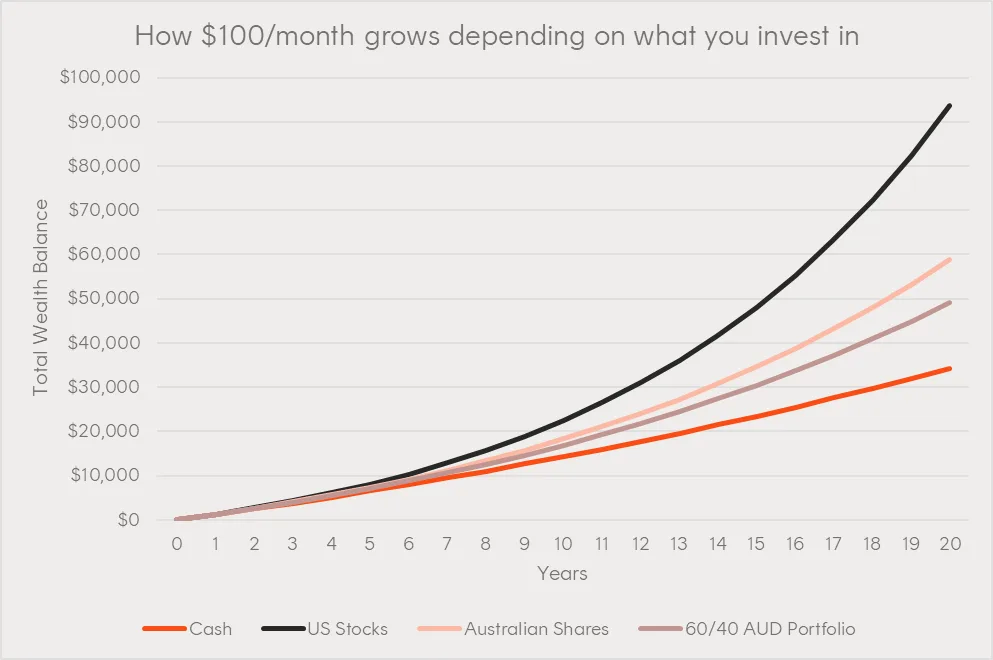 Source: Vanguard, Andex Charts. As at 30 June 2025. Cash represented by Bloomberg AusBond Bank Bill Index. US stocks represented by S&P 500 Total Return Index (in AUD). Australian Shares represented by S&P/ASX All Ordinaries Total Return Index. 60/40 Portfolio consists of 60% weighting to S&P/ASX All Ordinaries Total Return Index and 40% weighting to Bloomberg AusBond Composite 0Yr+ Index. 20-year per annum returns used in each case. Past performance is not an indicator of future performance. You cannot invest directly in an index.
What makes this lever even more powerful is that the amount you invest can be increased as circumstances allow. As an investor’s income grows, they can increase how much they invest. The chart below shows what happens when contributions increase by just $25 a month every three years. As you can see, the gap between steady contributions and growing contributions becomes substantial.
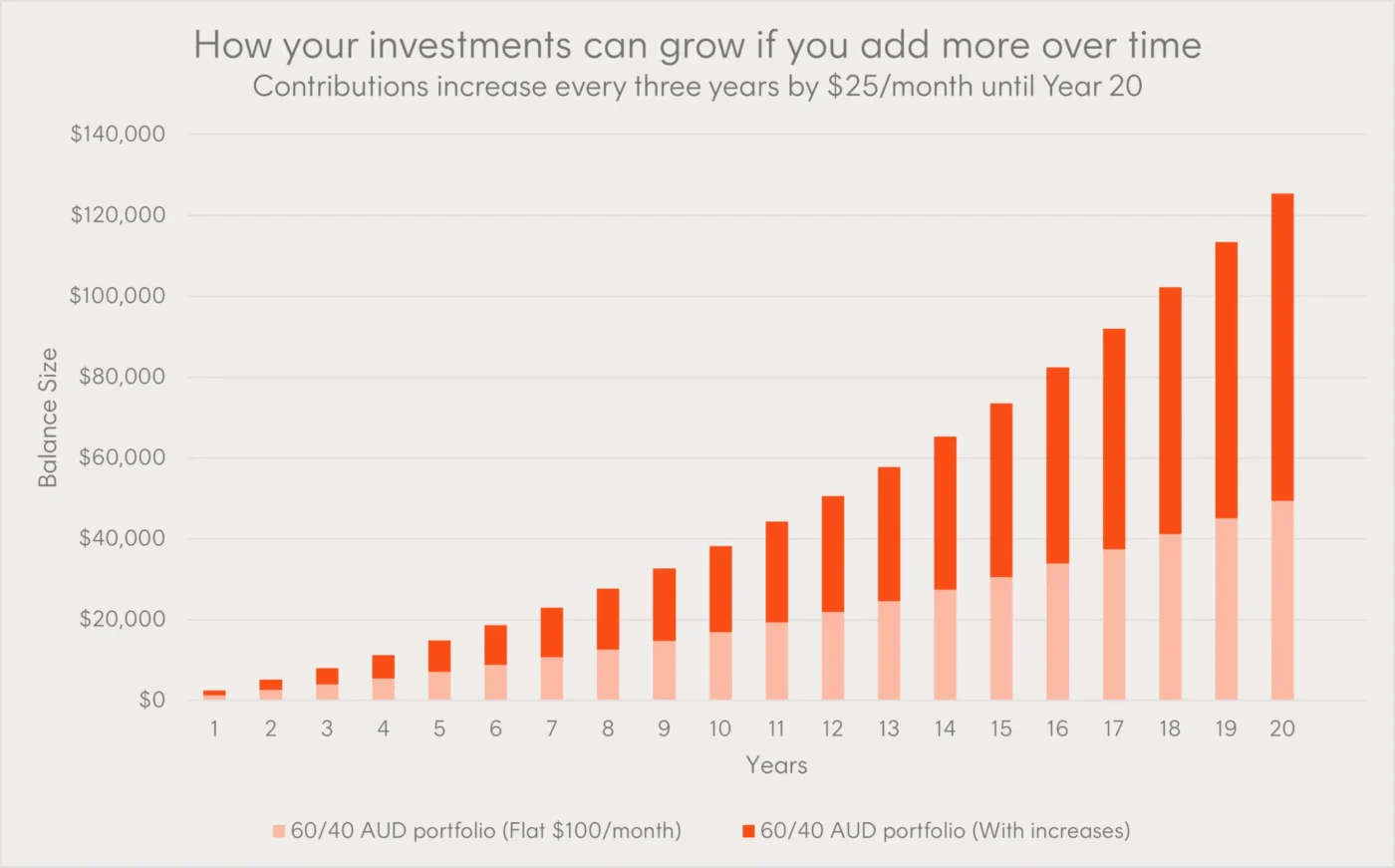
Source: Vanguard, Andex Charts. As at 30 June 2025. Contributions in this example are being made into a 60/40 Portfolio which consists of 60% weighting to S&P/ASX All Ordinaries Total Return Index and 40% weighting to Bloomberg AusBond Composite 0Yr+ Index. 20-year per annum returns used in each case. Past performance is not an indicator of future performance. You cannot invest directly in an index.
No matter what asset you choose, diversification across asset classes can help smooth returns while maintaining growth potential. History shows that not all investments perform well at the same time – which means spreading your capital across different asset classes reduces risk while maintaining growth potential.
Lever 4: Behaviour
Some of the most consequential investing mistakes aren’t caused by a lack of information. They’re caused by adverse reactions to headlines, chasing what’s done well recently or abandoning a strategy when markets feel uncomfortable.
The way to combat these emotions is to commit to an investment plan when markets are volatile. This could involve implementing a 24-hour waiting period, setting up auto-invest for your favoured investments on Betashares Direct or simply not checking your investing platform during sudden selloffs. Betashares Direct allows you to set up regular investments for up to five Betashares ETFs and is available at no additional cost.
The most significant gains in share markets often occur during short, unpredictable periods. Further, research consistently shows that missing just a few of the market’s best days can drastically reduce long term returns.
Disciplined behaviour during volatility can protect wealth more effectively than trying to time the market.
The foundations of long-term wealth
Wealth can be accelerated by big moments or exceptional investments. But for most investors, it’s shaped by the decisions they make consistently over time.
Over 20 years, the cumulative effect of small, disciplined actions can be powerful.
Two investors can earn the same returns and still end up in very different places. The difference is usually not a single investment choice – it’s how consistently they apply the fundamentals.