




The last three years have stress-tested responsible investment frameworks in ways their architects did not anticipate.
Active conflicts have reached their highest level since the end of World War II, geopolitical tensions have intensified and governments have increasingly turned to tariffs, export controls, sanctions and industrial policy as strategic tools alongside diplomacy.1 Companies have absorbed unexpected write-downs, restructured operations and exited markets more rapidly than anticipated and supply chains designed over decades have been reconfigured in just a few years.2
Much of this has barely been reflected in ESG scores, not because ESG has failed but because the world has changed.
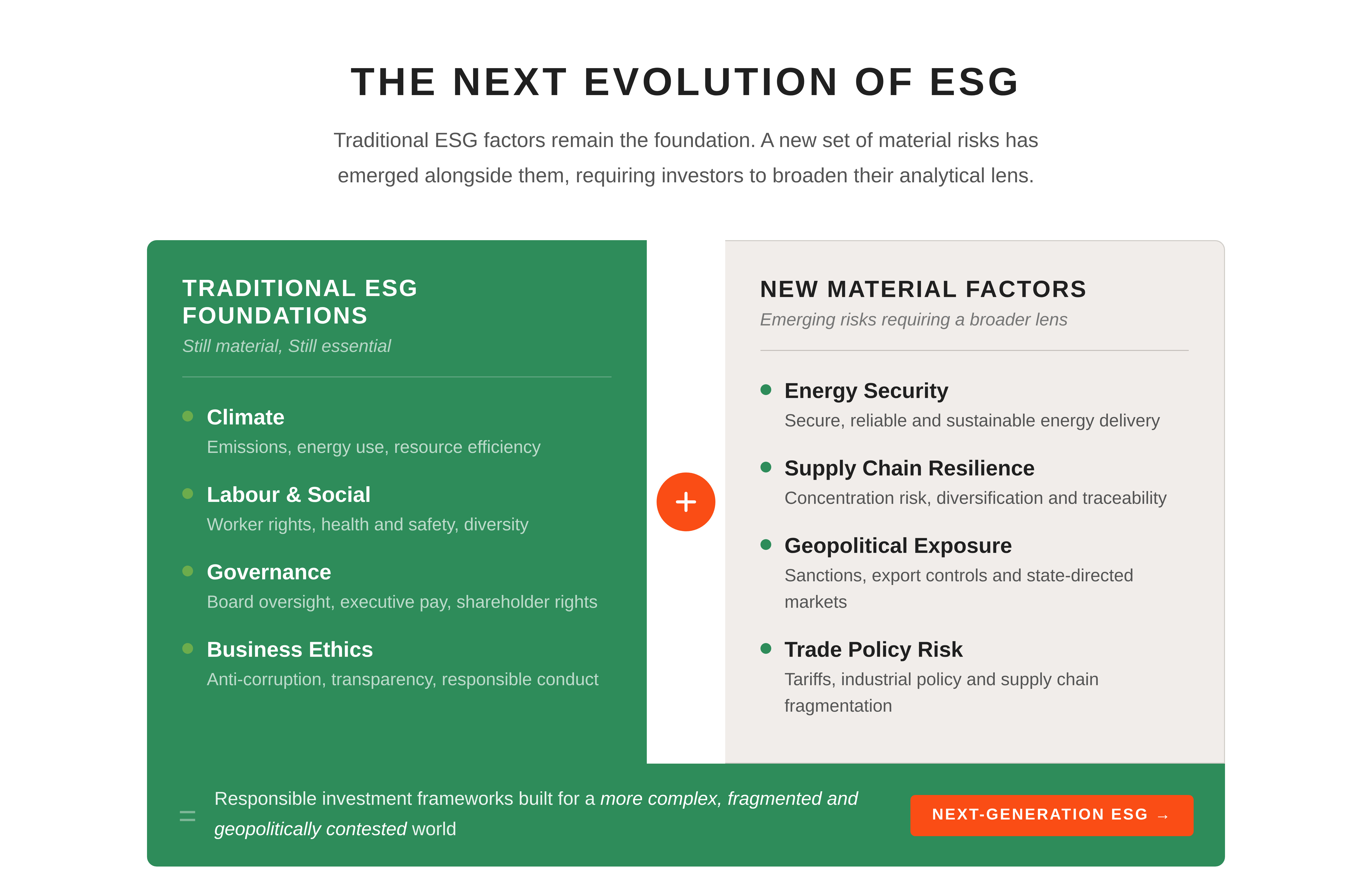
Responsible investment has traditionally focused on how companies behave: investors assessed environmental performance, labour practices, governance standards and corporate ethics to determine whether businesses were creating sustainable long-term value. Those considerations remain firmly in place.
What has changed is the environment in which companies operate. Energy systems are being redesigned around security as well as sustainability. Supply chains are being rebuilt around resilience rather than efficiency. Geopolitical developments that were once considered macroeconomic background noise have become material drivers of corporate performance and investment outcomes.
These developments do not replace traditional ESG considerations. They expand them. Responsible investment is evolving from assessing how companies operate to assessing whether they can remain resilient in a more fragmented and uncertain world. Energy security, supply chain resilience and geopolitical risk have become material investment considerations that many traditional frameworks were not designed to capture.
Source: Betashares
Energy security: From decarbonisation to secure decarbonisation
Perhaps nowhere has this shift been more visible than in energy.
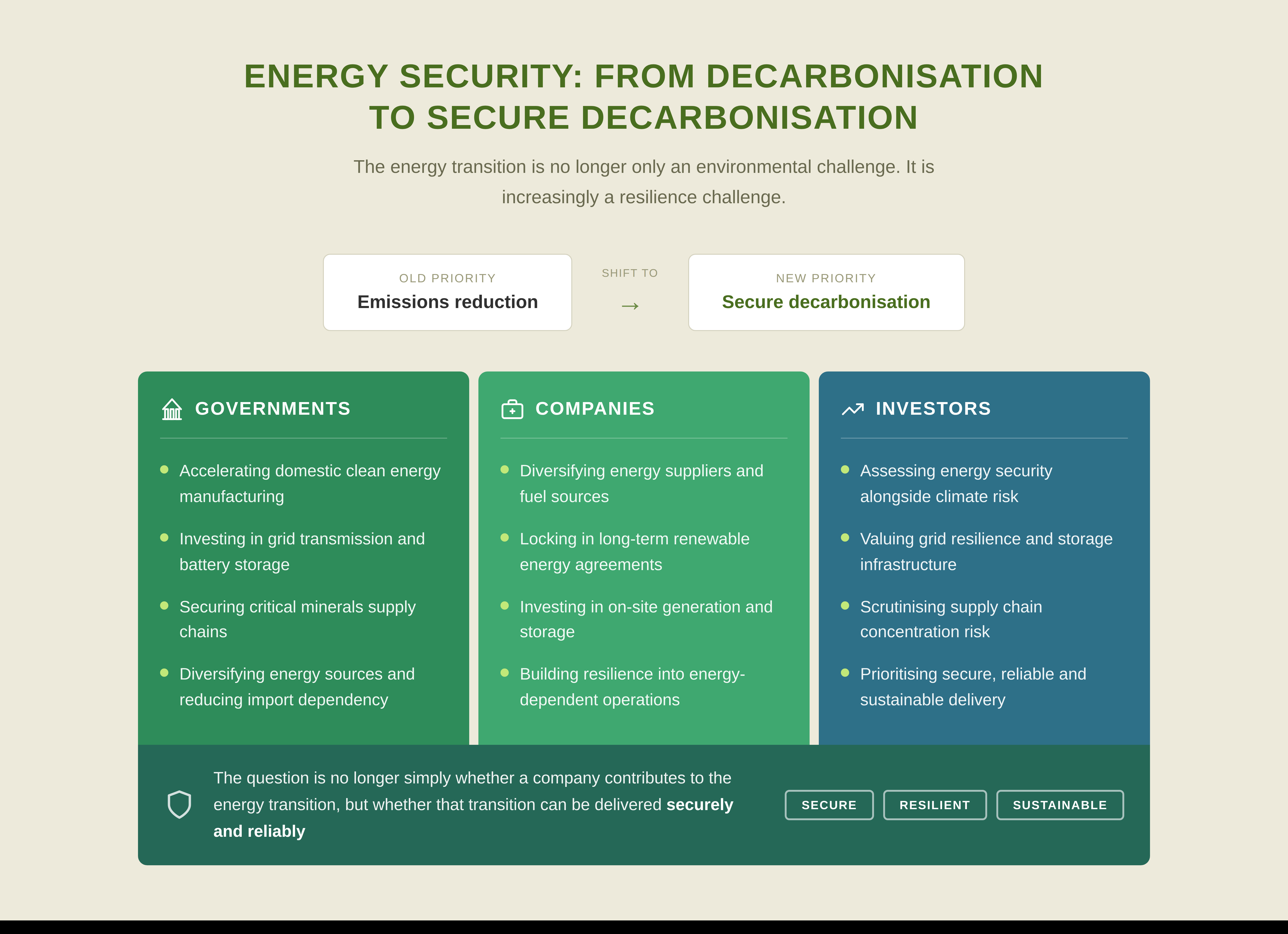
For much of the past decade, responsible investment discussions centred on decarbonisation, emissions reduction and the orderly transition away from fossil fuels. Those objectives remain critical, though energy security has re-emerged as an equally important consideration.3
Recent disruptions to global energy markets have exposed the risks of relying on concentrated fuel sources and vulnerable infrastructure. Across Europe, North America and Asia, governments have accelerated investment in renewable energy, electricity transmission, battery storage, critical minerals and domestic clean energy manufacturing. These investments are not simply intended to reduce emissions. They are also designed to improve resilience, diversify supply and strengthen long-term energy security.4
This represents an important shift for investors. The question is no longer simply whether a company contributes to the energy transition. Increasingly, investors must also consider whether that transition can be delivered securely and reliably.
Projects that improve grid resilience, energy storage or domestic manufacturing capability may create long-term value even where their climate credentials are more nuanced than traditional ESG analysis would suggest. Equally, companies that remain dependent on fragile supply chains or concentrated energy sources may face risks not fully captured by conventional sustainability assessments.
The energy transition is no longer merely an environmental challenge; it is increasingly becoming a resilience challenge as well.
Source: Betashares
Supply chains: From responsible sourcing to resilient sourcing
The clean energy transition depends on supply chains that many investors have rarely needed to examine in detail. Building the infrastructure of a net zero economy, including solar panels, wind turbines, electric vehicles and battery storage, requires enormous quantities of critical minerals such as lithium, cobalt, rare earths, gallium, germanium and graphite.5
These resources are not evenly distributed. Processing capacity is even more concentrated. According to the International Energy Agency, China dominates global processing across many of the minerals essential to low-carbon technologies, creating strategic dependencies that have become increasingly apparent as export controls and trade restrictions have expanded.6
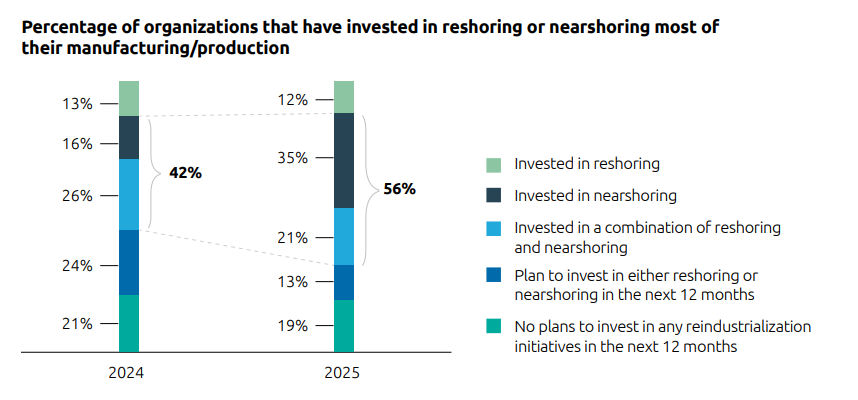
At the same time, companies are fundamentally rethinking how they build and manage supply chains. For decades, global manufacturing was optimised around cost, relying on just-in-time inventory systems and highly concentrated production hubs. Today, resilience has become a strategic objective alongside efficiency.
Companies are increasingly adopting onshoring, nearshoring and friendshoring strategies, diversifying suppliers and relocating production closer to key markets or trusted trading partners. While these approaches may increase costs over the short term, they can reduce exposure to geopolitical tensions, trade disruptions and supply chain shocks while improving operational flexibility and business continuity.
Source: Capgemini Research Institute, Reindustrialisation of Europe and the US
Traditional ESG analysis focused on whether supply chains met appropriate environmental, labour and human rights standards. Those issues remain critically important. Increasingly however investors also need to understand whether supply chains are resilient enough to withstand geopolitical disruption.
An ESG framework that rewards exposure to clean energy technologies without examining how the inputs to those technologies are sourced is not fully accounting for the risks it seeks to manage. Reducing emissions in one part of a portfolio may simultaneously increase exposure to modern slavery, biodiversity impacts or governance failures elsewhere in the value chain. Likewise, assessing supply chains solely through environmental and social metrics, without considering supplier concentration and geopolitical resilience, overlooks an increasingly important driver of long-term investment performance.
Responsible investors now need to evaluate both the integrity and the resilience of global supply chains.
For Australian investors, the implications are particularly significant. Australia is one of the world’s largest producers of lithium, cobalt and rare earths, placing domestic resources companies at the centre of the global energy transition. Investors are likely to assess how those companies manage Indigenous engagement, biodiversity, labour practices and downstream traceability, which will increasingly influence both their social licence to operate and their long-term investment attractiveness.
Geopolitics: From country risk to company risk
Perhaps the biggest change for responsible investment is that geopolitical risk is no longer confined to country-level analysis.
Historically, geopolitical considerations were largely addressed through country exclusions, sanctions screening or sovereign risk assessments. Today, geopolitical exposure exists inside companies themselves.7
Two businesses operating in the same industry may have very different risk profiles depending on where they manufacture, who supplies critical inputs, where their customers are located and how exposed they are to export controls, tariffs or strategic technologies.
A company with strong governance, comprehensive climate disclosures and exemplary labour standards may still face significant investment risk if it depends heavily on a single country for semiconductors, critical minerals or advanced manufacturing. Equally, businesses that have diversified their operations, strengthened supplier relationships and invested in operational resilience may be better positioned to navigate an increasingly fragmented global economy.8
This represents a meaningful evolution in ESG analysis. Responsible investment is no longer solely about assessing how companies manage environmental and social impacts. It is increasingly about understanding whether businesses can sustain long-term value creation in a world characterised by geopolitical uncertainty and more frequent disruption.
The next evolution of responsible investment
Responsible investment has always evolved alongside the risks shaping long-term investment outcomes. Corporate governance failures transformed board oversight into a central investment issue. Climate change expanded the focus to emissions, biodiversity and the low-carbon transition.
Today’s investment landscape is being shaped by a different set of structural forces. Energy security, supply chain resilience and geopolitical fragmentation are becoming material drivers of corporate performance, capital allocation and long-term value creation.
Put simply, energy security (E), supply chains (S) and geopolitics (G) have become the new ESG: a second layer of material factors that responsible investors can no longer afford to overlook.
These developments do not diminish the importance of environmental, social and governance factors. Rather, they require investors to view them through a broader lens. Responsible investment must continue to assess how companies manage climate, human rights and governance risks, while also considering whether those businesses are resilient enough to operate successfully in a more complex and uncertain world.
The next evolution of ESG is not about moving beyond responsible investment. It is about recognising that resilience has become an essential component of sustainability itself.