



For much of the past two decades, Australian investors were rewarded for prioritising capital growth. Today, higher valuations, a shifting interest rate environment and recent tax changes have investors reconsidering where their returns will come from.
The investing landscape has shifted. This isn’t a case for income over growth, but an explanation of why the balance between the two has shifted.
The growth decade
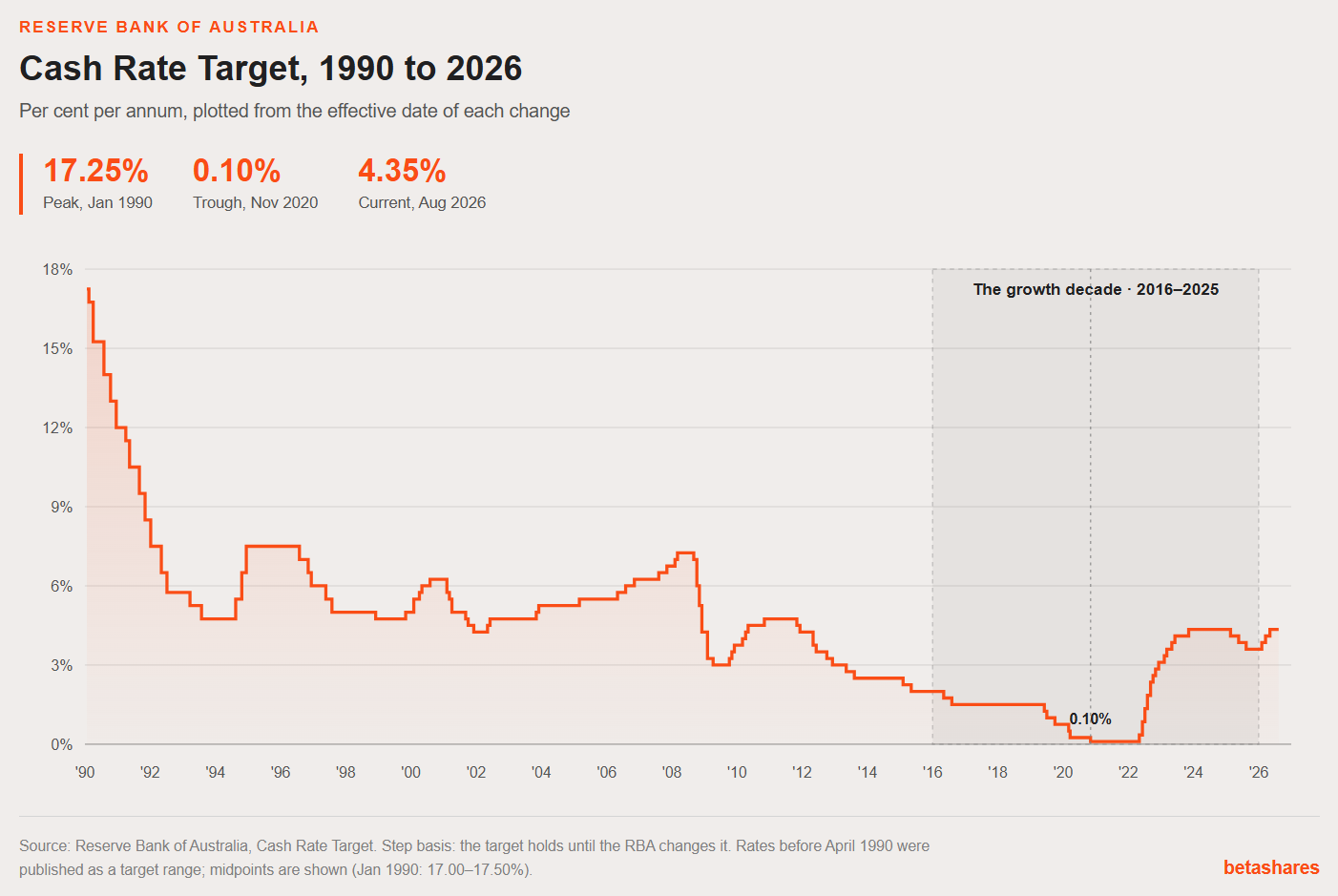
In the decade to 2026, the economy enjoyed an average RBA cash rate of 1.8%, less than half of the 4.6% average since 1990 (RBA). This meant debt was cheap, and businesses and investors alike were awash with cash to invest and expand.
While growth enjoyed low interest rates, income suffered from them. Savings accounts paid lower interest and Australian government 10-year treasury bonds paid an average of just 2.7%. This rate sets an important benchmark for investors: How much can I earn while taking next to no risk?
When it’s low, growth investing looks more attractive than weak yields. Given that this so called risk-free rate averaged 7.3% in the 50 years leading up to 2026, it’s no wonder income investing took a backseat in the past decade.
On top of this, the 50% capital gains tax (CGT) discount effectively halved the amount of CGT paid by investors since 1999, so long as the asset being sold had been held for over a year. This encouraged investing for capital growth.
Income investors benefit from franking credits on dividends, but the tax benefit is lower and no such favourable treatment exists for interest from savings accounts or bonds.
Now, three factors are pushing income back into the foreground.
Why the balance is shifting
Interest rates have raised the floor for income
When the pandemic hit, the RBA dropped interest rates to a record low of 0.1%. Simultaneously, the government pumped nearly $200 billion into the economy.
The economy rallied hard. Too hard. Inflation jumped, hitting nearly 8% by the end of 2022. The RBA slammed on the brakes with 13 rate hikes starting in May 2022, bringing the cash rate to 4.35% in November 2023. Three rate cuts in 2025 were met by three equal rate hikes, keeping the cash rate at 4.35% today.
The income ‘floor’ has been raised. There are now nearly 40 savings accounts available in Australia that pay interest of 5% or more; several have no balance growth or minimum deposit requirements. Australian government 10-year treasury bonds are yielding about the same.
Tax changes have narrowed growth’s advantage
Effective 1 July 2027, Labor’s Federal Budget will remove the 50% CGT discount and revert to an inflation indexation system. While this change would be beneficial if an investor holds an asset long enough to face over 50% inflation, this will not be the case for many short and medium-term investors.
Additionally, capital gains will now face a minimum 30% tax rate, equal to the marginal tax bracket for taxpayers earning between $45,000 and $135,000. Meanwhile, income from stocks, bonds and ETFs remains subject to marginal tax rates.
These two changes collectively reduce the tax advantage growth investing held over income investing.
Higher valuations raise the bar for future growth
In the 10 years before the Covid pandemic, the price-earnings (PE) ratio (the share price divided by earnings per share, a gauge of how expensive a stock is) of the ASX 200 typically hovered around 16. Since the start of 2024, it hasn’t been lower than 20, according to Market Index.
Put differently, $1 of ASX 200 earnings is now 25% more expensive than it was before the pandemic. Stock valuations have ballooned globally and Australia wasn’t spared. Now, growth investors must ask themselves how much further valuations can go.
With income yields increasing, capital growth tax advantages decreasing and growth stocks precariously perched upon lofty valuations, income investing is once again looking relatively attractive.
A question of balance
This isn’t an either-or debate. The past decade just made it easy to deprioritise income without really thinking about it. Low yields, cheap debt and favourable tax treatment for capital gains meant the path of least resistance was growth.
That path still exists, and growth investing remains a strategy that can potentially reward investors for taking on risks. But the conditions that made income an afterthought have materially changed, and investors who haven’t revisited their thinking may be carrying assumptions that no longer hold.
For those looking for income investment options, Betashares’ B.EARN portfolio offers an all-in-one diversified passive income option. It holds 11 Betashares income-focused ETFs, which investors can pick and choose if they would prefer to build their own income sleeve or simply add one or two to their own portfolio.
The more useful question is not whether to be a growth investor or an income investor, but whether you are being deliberate about where your returns come from. A portfolio that earns income through dividends, bonds or high-yield savings alongside capital growth is no longer a conservative retreat, but a considered response to a landscape that looks meaningfully different to the one we navigated for the past decade.