




Most investors are told to keep investing simple: don’t try to time the market, build a diversified portfolio and automate regular contributions.
That said, there are a few stages in every investor’s life where taking a more deliberate role becomes important. As you progress from building your foundation through years of accumulation and towards retirement, your priorities change. What works at one stage may not in another.
We’ll explore the key stages of an investor’s journey and the decisions that become more important at each one.
Stage 1: Starting out
You are not behind if you haven’t started investing in your early 20s. The perfect time to start is right now. Some people are fortunate and begin early, others arrive at it later in life. What matters is starting when your circumstances allow.
Before you begin investing, it often makes sense to build a cash buffer for emergencies, deal with high-interest debt like credit cards, and review your superannuation. Once these foundations are in place, you can start to think about how much to allocate towards investing.
An important first step is deciding how much money you can invest without needing to access it in the foreseeable future. A simple, diversified, low-cost portfolio of global and Australian-based ETFs and shares is more than enough. For those looking for a simple all-in-one option, DHHF Diversified All Growth ETF provides exposure to a diversified portfolio of Australian and global shares in a single trade.
Time and consistent contributions can do much of the heavy lifting.
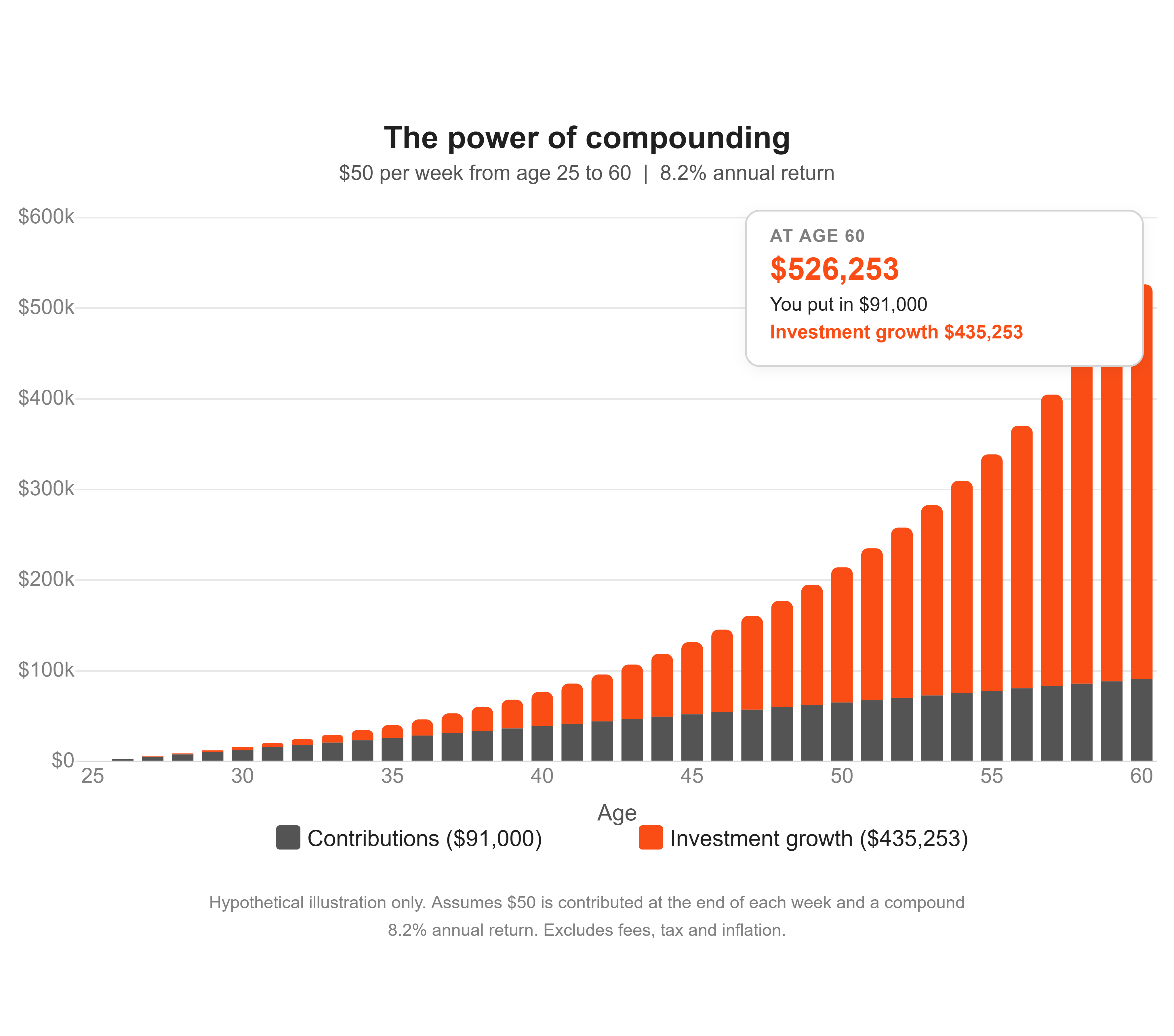
Consider someone who starts investing at 25 and contributes $50 a week, probably what most people spend on lunch every week, until age 60. At a hypothetical return of 8.2% a year, being the long-term historical market return of the ASX 2001, they would contribute $91,000 and build a portfolio totalling approximately $526,000.
In other words, some $435,000 of the final balance would come from the effect of compounding and capital growth, rather than contributions.
Stage 2: The accumulation stage
During the accumulation stage, it’s likely that various demands will compete for your attention. A mortgage, children, a career or even ageing parents. Life can get expensive, and it’s easy to lose sight of continuing to build long-term wealth.
This is when discipline matters far more than sophistication. You don’t need a complicated investing strategy or a market-beating approach. Regular contributions, whether through super or direct investments, can help build wealth steadily over time through the power of compounding. Tools like Betashares Direct’s Auto-invest, which lets you set up recurring investments into up to five Betashares ETFs brokerage-free, can help make this automatic.
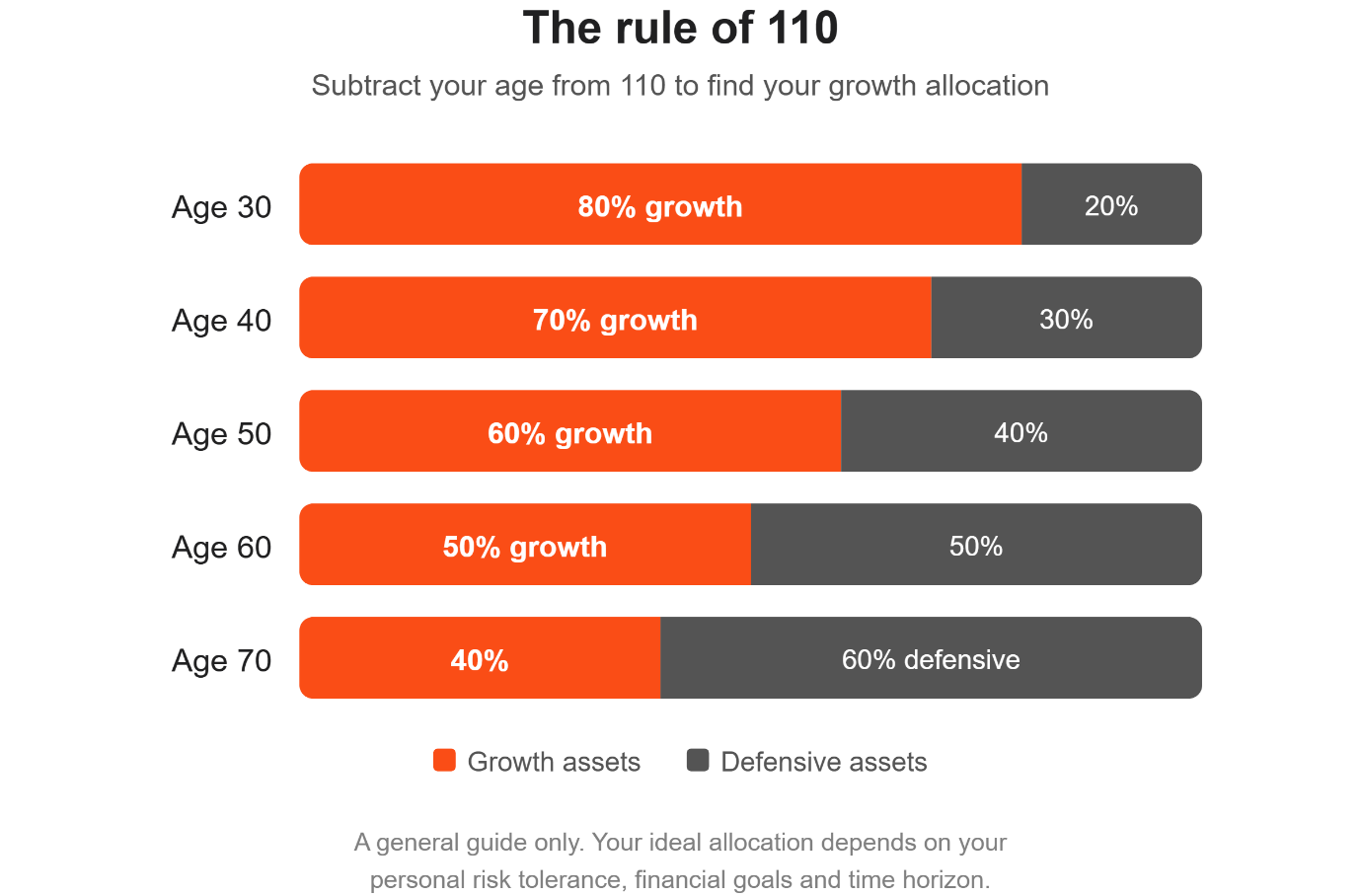
In terms of asset allocation, a useful guide can be the rule of 110. Subtract your age from 110 to determine what percentage of your portfolio should be in growth assets like global equities and what should be in defensive assets like fixed income and cash. For example, a 40-year-old would aim for around 70% of their portfolio to be in growth assets and the remaining 30% in defensive.
Some argue the rule of 110 is too conservative given Australians are living longer and retiring later. The rule of 130 can also be helpful if you think you have a longer time horizon before retirement for a more growth-focused approach. The right allocation for you will depend on your personal risk tolerance and how long you plan to work.
Stage 3: Pre-retirement
Pre-retirement is when careful planning and action can make a meaningful difference in the years ahead. It is important to have a clear idea of when you may stop working, how much you expect to spend and where your retirement income might come from.
A market correction five years before retirement can have a much greater impact than one that occurs when you’re just starting to invest. The concern is not only the fall in portfolio value but the risk of having to sell investments at lower prices to meet regular expenses. This is why gradually increasing your allocation to more defensive assets can make sense as retirement approaches.
This is also the stage when making greater use of super contributions can have a real impact. With retirement getting closer, having less access to the money may be less of a drawback, while the tax advantages can help to accelerate your savings.
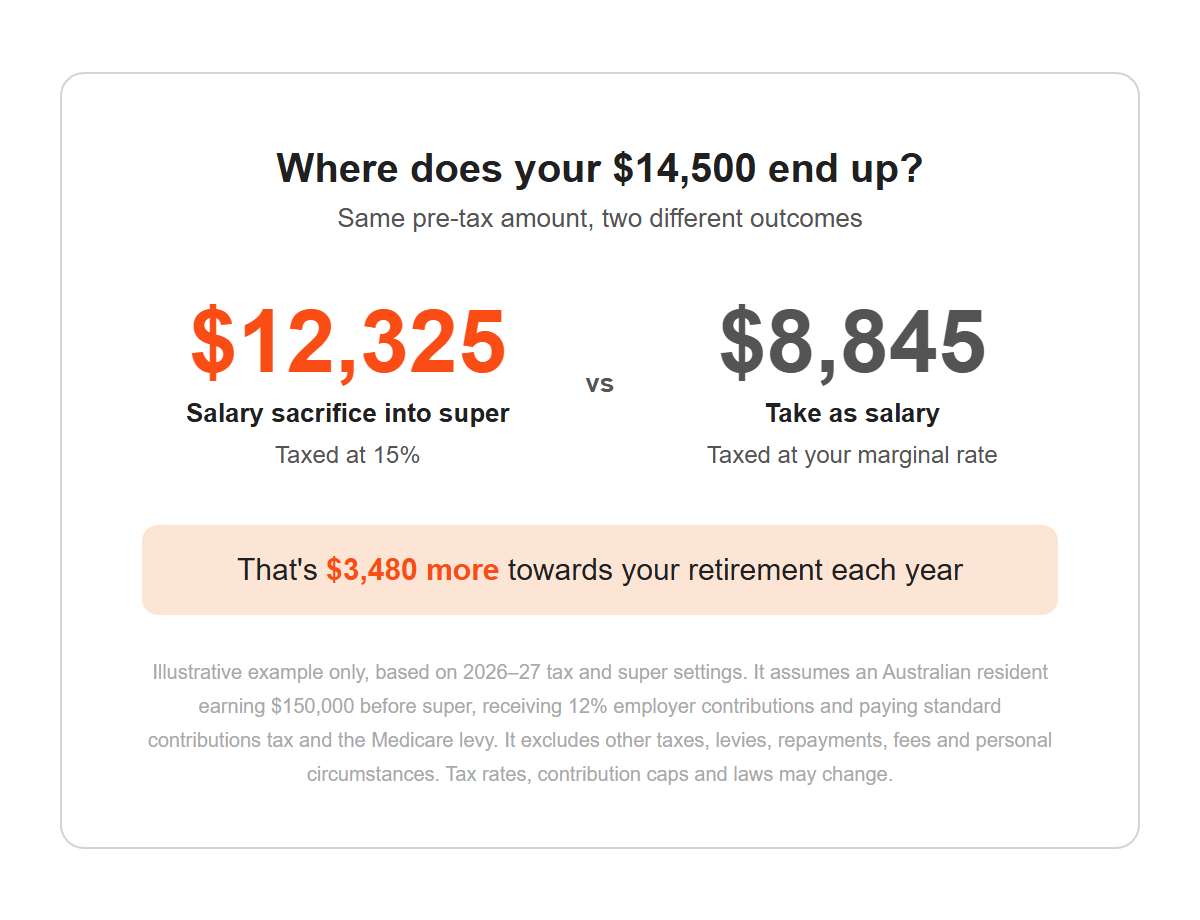
Take someone earning $150,000 a year before super. In the 2026–27 financial year, assuming their full salary is eligible for super guarantee contributions, their employer would contribute $18,000 at the 12% super guarantee rate.
If they have no other concessional contributions, this would leave $14,500 before reaching the annual concessional contributions cap of $32,500. If they salary sacrifice that $14,500, around $12,325 would land in their super after the standard 15% contributions tax. If they took the same amount as salary, they would keep around $8,845 after income tax and the Medicare levy.
That is roughly $3,480 more that could be invested for retirement in a single year. Repeat it over the final five years of work and that is around $17,400 extra in super before including any investment returns.
The exact benefit will depend on factors like your income, existing super contributions and available contribution cap. However, in the years leading up to retirement, directing more pre-tax income into super may be an effective way to build retirement savings.
Stage 4: Retirement
In retirement, the role of your portfolio changes. Instead of building wealth as you’ve done previously, that nest egg you’ve created now needs to fund your lifestyle. Retirement income can come from a combination of sources such as super income streams, the age pension, cash, interest, dividends or the strategic sale of part of your investments.
It’s possible to become too conservative in this phase. Retirement may last for two decades or more and holding too much cash over that period can make it harder for your savings to keep pace with inflation. Depending on your needs and other sources of income, some growth exposure may still have a role in your portfolio.
Retirement decisions are closely connected. How much you withdraw from super, how the remaining balance is invested, tax implications, pension eligibility and estate planning all affect one another. This is where professional financial advice can be valuable.
Putting it all together
Your investment strategy should not change just because another year has passed. It should shift when your goals, timeframes or ability to take risk change.
Early on, setting up a low-cost diversified portfolio should be the main goal. During the accumulation years, the focus is to keep regularly contributing to that portfolio and stay largely invested in growth assets. Before retirement, look to slowly rebalance your portfolio towards defensive assets and think about additional super contributions. And finally, in retirement, ensure your portfolio is able to generate the income required for your lifestyle.
An annual check-in to make sure your investment strategy still reflects your stage of life is important. The aim isn’t to rebuild your portfolio every year, but to check that yesterday’s plan is still fit for today’s life.