




Key points
The Indian share market has had a challenging start to the year despite its emerging market peers rallying ahead on the AI trade. Foreign capital outflows, elevated valuations, deficient rainfalls and a geopolitical shock in the Middle East have dented investor sentiment in the world’s 6th largest economy.
But given recent volatility in AI-linked markets, including the US, South Korea and Taiwan, can India offer diversification benefits to investors’ global equities portfolios?
Why has India been unloved recently?
Even before the Iran war, India’s NIFTY 50 index was facing a number of headwinds.
Elevated valuations and foreign institutional investor (FII) outflows
Indian equities have long commanded a valuation premium over other emerging markets due to the country’s stronger structural growth outlook, high-quality corporate sector and deepening pool of domestic savings.
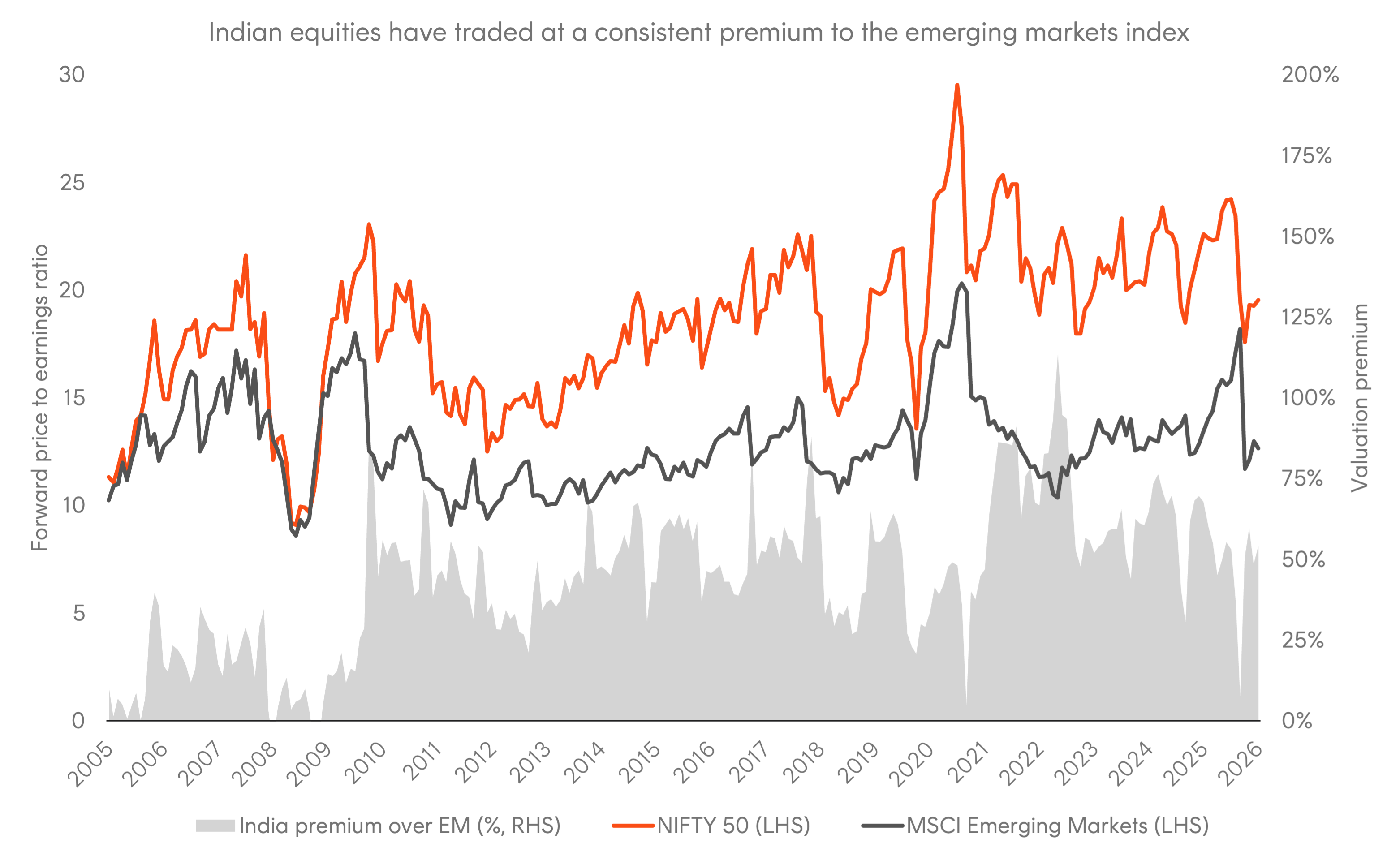
Source: Bloomberg, Betashares. Data from 30 June 2005 to 30 June 2026, monthly. “India” is represented by the NIFTY 50 Index, shown on a 12-month forward (consensus estimate) price-to-earnings ratio. The series shown are outlier-adjusted. You cannot invest directly in an index. Past performance and past valuation levels are not indicative of future performance.
However, more attractive relative growth opportunities in other Asian markets recently have seen up to US$29 billion1 in cumulative Foreign Institutional Investor (FII) outflows in Indian equities within the first half of 2026. While the upward revisions to capex spending by the US hyperscalers have benefited regions and companies positioned further up the AI supply chain (namely Taiwan’s TSMC and South Korea’s SK Hynix and Samsung), India has largely missed out on these gains.
Rupee weakness and the Iran war
Together, these factors have contributed to weakness in the Indian rupee (INR) which has weighed on the local share market. That’s because India’s economy is more domestically oriented than its East Asian emerging market peers, with growth primarily driven by household consumption and domestic investment rather than net exports.
Additionally, India’s reliance on imported energy leaves its external balance particularly vulnerable to higher oil prices. The Iran war and resulting rise in Brent crude oil prices have increased the country’s import bill, while a weaker rupee further magnifies the cost in local currency terms, adding pressure to inflation and the current account deficit.
A brighter path ahead for Indian equities
The confluence of these headwinds has been a drag on India’s NIFTY 50 index performance, but there are some positive catalysts which may drive further upside potential in India given how light investor positioning remains.
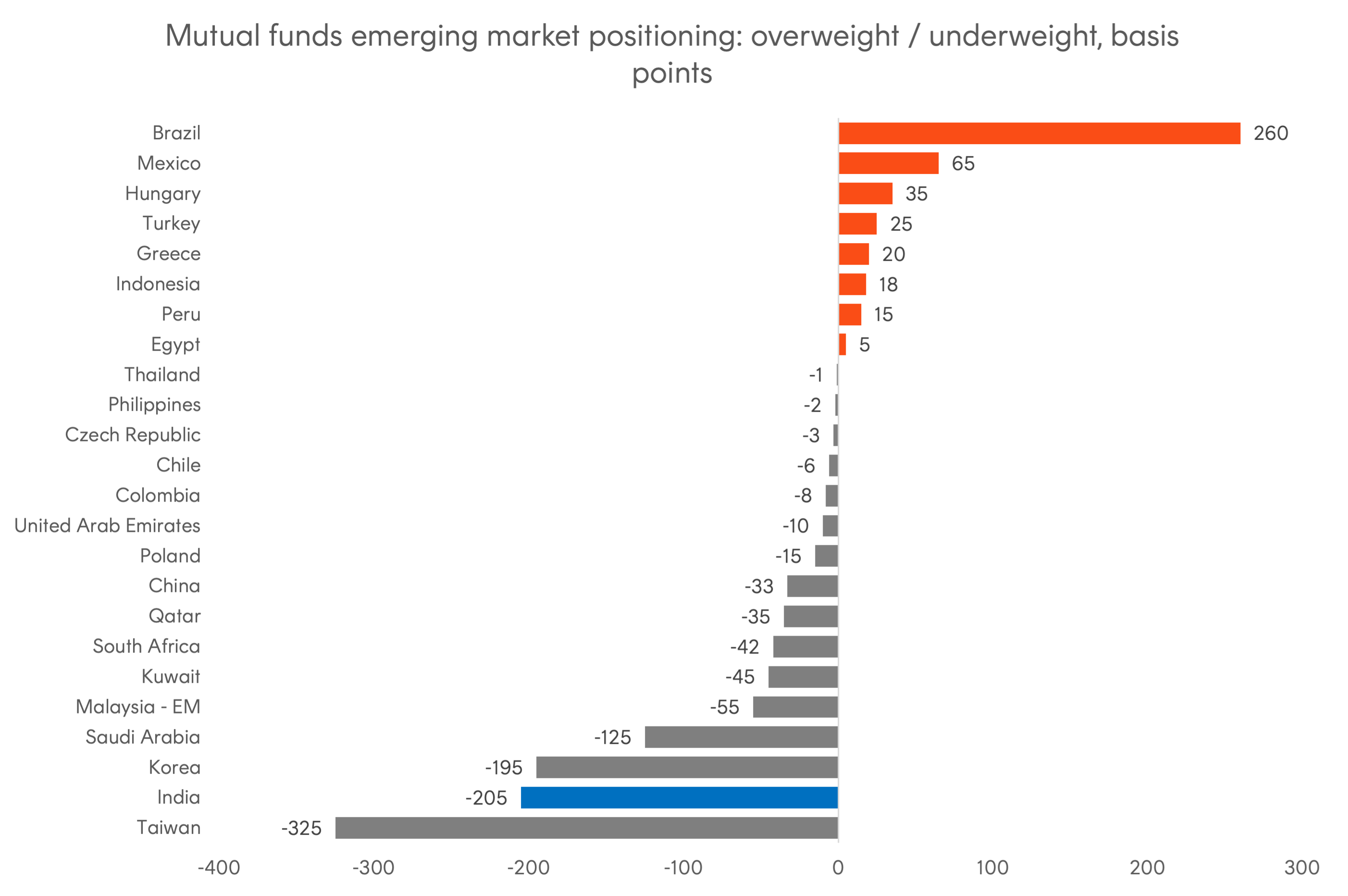
Source: EPFR, FactSet, MSCI, Goldman Sachs Global Investment Research.
Earnings momentum appears to be turning
Earnings growth is showing signs of strength supported by income tax cuts and a recovery in credit growth with state-run banks leading the improvement, while automakers also helped as premium consumption pushed sales to new highs. The Nifty 50 index is forecast to grow earnings by 15.2%2 this year, bringing the forward 12-month price to earnings ratio down to 20.2x3.
That’s seen a recovery in FII flows with foreign institutions purchasing ~$US3 billion4 over the last month. Domestic investor inflows, a recent import duty increase on gold and rising monthly flows in domestic mutual funds through systematic investment plans should also provide further stability to the rupee and India’s external balances.
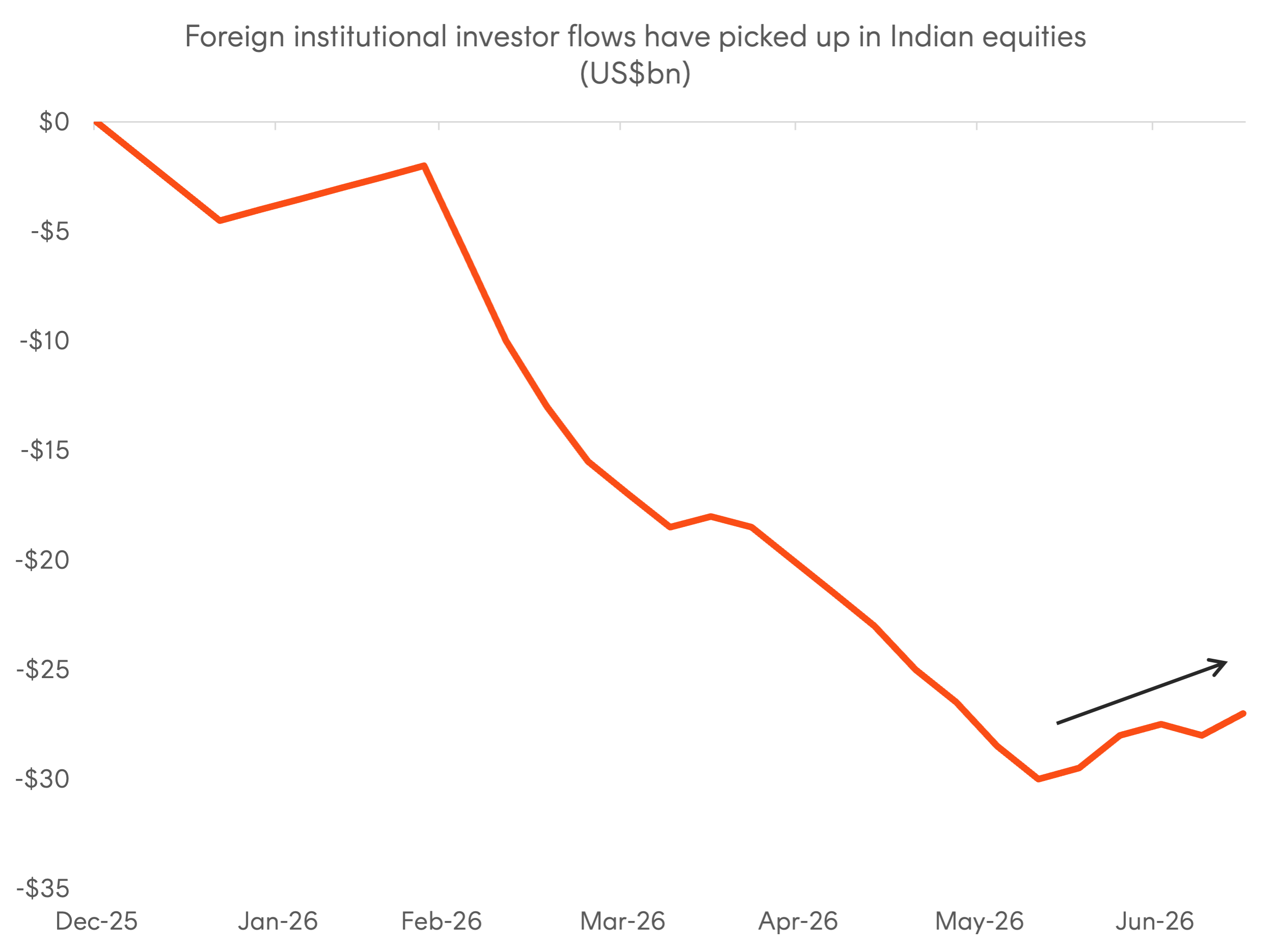
Source: Bloomberg, Goldman Sachs Global Investment Research.
Policy is opening the door to foreign capital
Beyond the earnings and valuation picture, policy measures at the national level should also provide a more supportive backdrop for Indian financial markets. The removal of withholding tax for foreign debt investors could help attract offshore capital into Indian fixed-income markets, while incentives for banks to increase dollar borrowing may improve foreign-currency liquidity.
The capex cycle and its consumer spillovers
Over the longer term, India’s industrial and manufacturing sectors stand to benefit from the FY2026–27 Union Budget‘s continued focus on public infrastructure, manufacturing capacity and supply-side reform. These initiatives could improve logistics, expand productive capacity and support India’s ambition to capture a larger share of global manufacturing supply chains.
The associated investment cycle should also have broader benefits for households and consumer-facing companies. Forecast real GDP growth of around 7%, alongside stronger manufacturing activity, infrastructure development and rising incomes, could support discretionary spending across areas such as automobiles, travel, retail and financial services. This provides a favourable backdrop for both industrial companies directly exposed to capital expenditure and consumer discretionary businesses benefiting from India’s growing middle class.
Investment implications
Looking ahead, Indian equities are likely to remain sensitive to global risk sentiment, oil prices, currency movements and cross-border capital flows, although recent signs of stabilisation suggest that some of these pressures may be easing. At this current juncture, Indian equities may also provide useful diversification benefits to global equity portfolios, given India’s domestically oriented growth drivers and lower direct exposure to AI-related companies that have recently driven volatility across several developed and Asian markets.
One way investors can gain exposure to India’s structural growth opportunity is through the IIND India Quality ETF.
Relative to the Nifty 50 Index, IIND has greater exposure to the Consumer Discretionary and Industrials sectors, providing more direct access to India’s consumption and manufacturing growth opportunities. This positioning may help the portfolio navigate higher input costs and market volatility while supporting more resilient margins and the potential for long-term earnings growth.