




This time last year, we were all confidently feeling the end of a higher rate environment. The RBA had just made its second rate cut and was priming for a third.
It’s taken less than half of 2026 for all that to be undone. The economy is running hot and oil prices are elevated with a fifth of the world’s supply still stranded on the wrong side of the Strait of Hormuz. Inflation, to use the widely popular term, is sticky, and the RBA has made it clear they’re not expecting that to budge until at least mid-next year.
For investors seeking income within their portfolios it can seem like there’s a silver lining here: cash and term deposit rates have gone up, with some climbing over 5%1 in recent weeks – their highest in at least a year.
Yet before rushing into cash and term deposits, investors may want to stop and think: what is the real return I’m getting?
One of the biggest pitfalls I see is investors only looking at the headline figure of income, not income above inflation, or what we call positive real income.
Imagine you had put $100 into a term deposit 10 or 20 years ago. Yes, you would have received income, but that $100 is still $100. How much of your grocery and fuel bill would it have covered then versus today? That is, in very simple terms, the impact of inflation on your core investment.
And so while it may be attractive to put more money into cash when interest rates are higher, you can in fact end up with a negative or very low real return. After all, the very reason that central banks raise rates in the first place is to control inflation, so if you’re getting a good return on cash, your money is likely getting eaten up by inflation at the same time.
I’ll come back to other options that offer both growth and income, but first I want to address a point that you might already be thinking: the allure of cash and term deposits is not just headline yields, but safety. This is particularly pertinent today, when geopolitical tensions seem never-ending, and the resulting market volatility can daunt those who simply want a place to invest their money for income.
When it comes to investing, there are always market jitters. I’m often asked how to avoid so-called black swan events — unexpected, high-impact market disruptions — and my answer is always the same: you can’t. By definition, they’re unpredictable. Rather than trying to anticipate every possible shock, investors should consider managing risks they can see, such as inflation, and diversifying their portfolios to buffer against the ones they cannot.
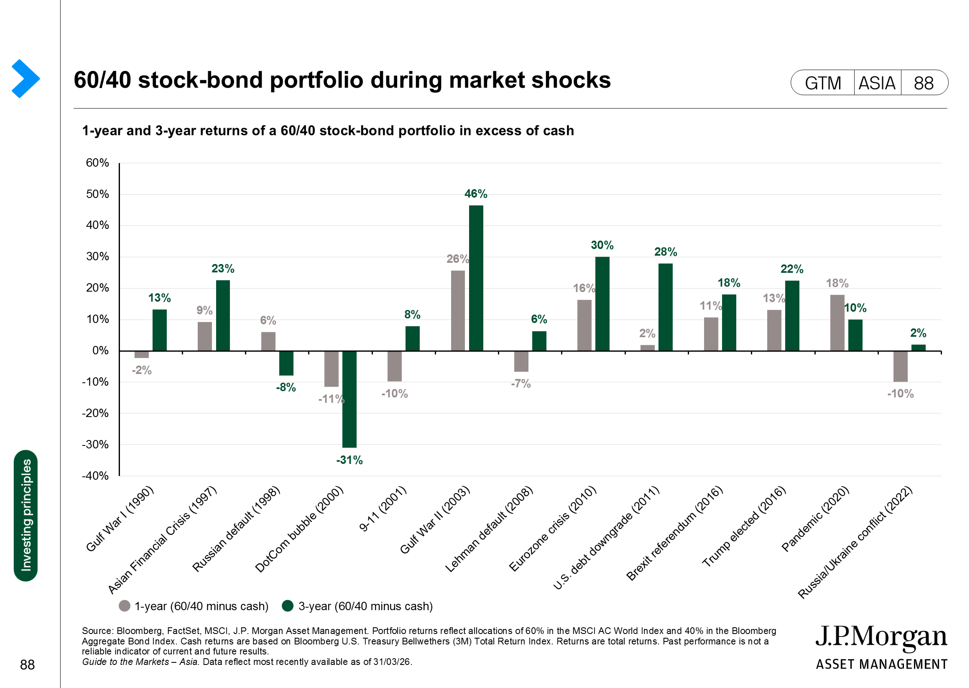
According to our own analysis, a portfolio that is 60% equities and 40% bonds has often outperformed cash over the three years following market shocks, although not in every case. The graph below shows the one- and three-year returns of such a portfolio over cash through events including the Russia-Ukraine conflict, the pandemic and the GFC. It’s a useful reminder that staying invested for the long term is often a better strategy than reacting to every bout of uncertainty.
Which brings us back to the question of building income-producing portfolios. If cash alone isn’t the answer, where should investors be looking to build this diversified portfolio that delivers income, growth and risk management?
It’s useful to remember what sits behind rising inflation: an economy that is still growing strongly. While that is a challenge for central banks, it can also create opportunities for investors. This is one reason why some equities are attractive, because a strong economy usually means strong corporate earnings, which can in turn support both dividend payments and capital growth, providing an income stream that has the potential to grow over time, with the added benefit of franking credits for Australian equities.
Another area is fixed income. Government bonds are offering more attractive yields than they have for years, while corporate bonds and selected areas of the high-yield market can provide additional income opportunities. Together, they form the basis of a broader toolkit for generating income and when it comes to high quality bonds they offer a cushion if the worst case scenario does play out and the black swans take flight.
Of course, opportunities like these shift across different asset classes and income sources over time. In a stable, low-rate environment, a more passive approach to income can work well. But when inflation is moving and central banks are responding to events beyond our borders, the case for active management becomes clearer: the ability to adjust where income is being sourced as conditions change, rather than holding a fixed allocation.
For investors who want this kind of exposure without spending their days analysing bond markets and credit conditions, the JPMorgan Managed Portfolios provide access to active management and experienced portfolio managers and are available through the Betashares Direct platform.
The suite includes the JPMorgan Income Portfolio, which is managed by our firm’s multi-asset solutions team and draws on global research capabilities across equities, fixed income, alternatives and currencies, with periodic rebalancing in response to changing market conditions and our team’s forward-looking views. The current trailing 12 month yield is 6.24% (as at 4 June 2026)2.
Sticky inflation, oil crises, black swan events. There’s little we can do to avoid them. Yet putting all your money into term deposits and cash because they feel safe and offer seemingly attractive rates can, in fact, erode purchasing power over the long term than many investors realise. The challenge is not simply generating income today but ensuring that income keeps pace with inflation and preserves wealth over time.