




Most of us know emotion and investing don’t mix. But knowing that and keeping emotion out of your portfolio can be two very different things.
Buying a company predominantly because you like the brand, panic-selling when markets dip or staying on the sidelines because you’re nervous are all emotional responses. And over time, they can work against the long-term wealth creation investors are trying to achieve.
The reason this matters is that investing usually rewards patience more than reaction. Markets will rise and fall along the way, but investors who are able to stay focused on the long term are generally better placed to benefit from the growth that can occur over time.
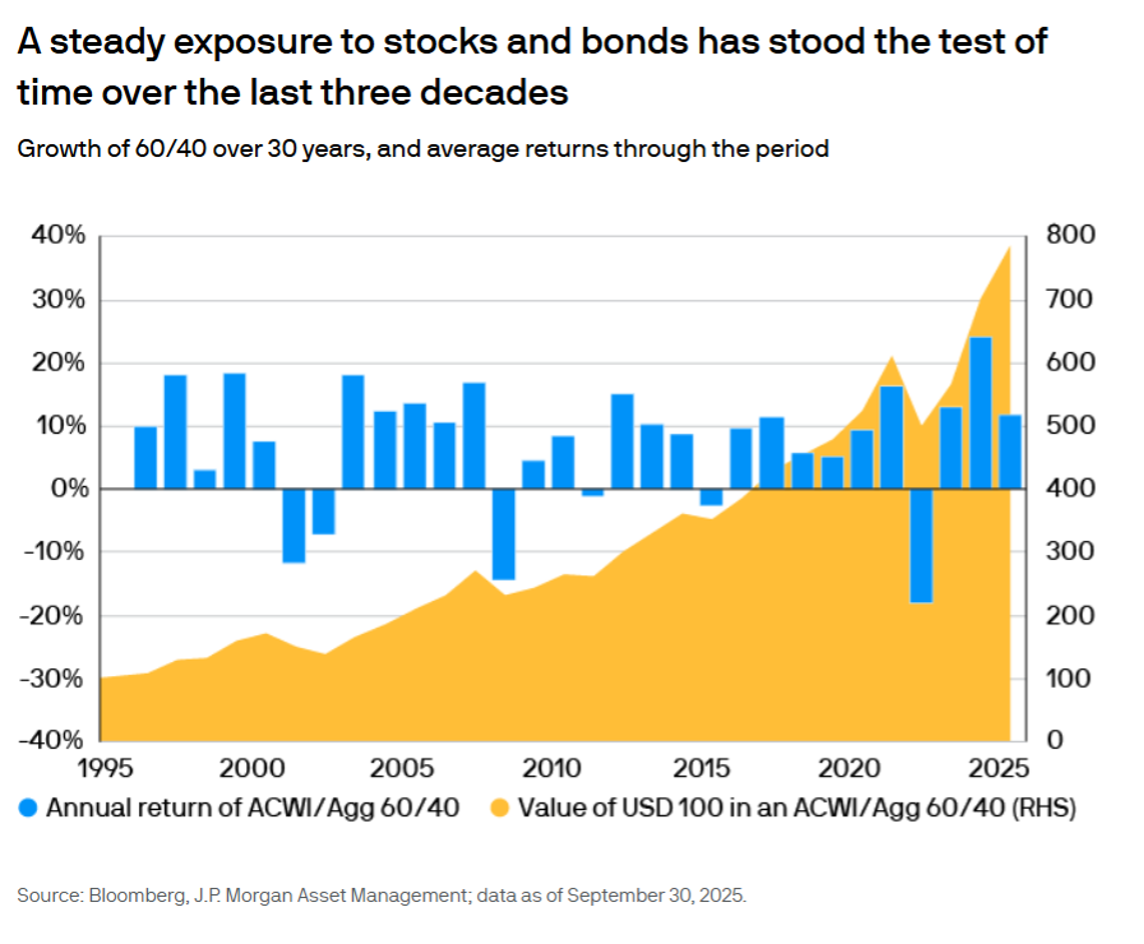
Source: Bloomberg, J.P. Morgan Asset Management, data as of September 30, 2025. Past performance is not a reliable indicator of current and future results. ACWI refers to MSCI All Country World Index and Agg refers to Bloomberg Aggregate Bond Index.
The challenge is that while most investors understand they shouldn’t react emotionally, emotions are hardwired into how we make decisions – after all, we’re human! It can be difficult for an average investor to avoid them when building a well-diversified, properly allocated portfolio.
That’s why, when I’m asked to boil down what it is we do as professional investment managers, it’s simply this: we take the emotion out. And we do this through deep expertise, strong systems and consistent, repeatable processes.
I’ll discuss our process at J.P. Morgan Asset Management as an example. At the heart of our approach is a balance between strategic and tactical investing. A strategic approach allows us to focus on long-term goals and asset allocation, while tactical investing involves making smaller adjustments as market and economic conditions change.
Every year, we undertake a deep research process to develop our long-term capital market assumptions. The framework was originally developed for large institutional investors such as superannuation funds and insurers, before being applied to portfolios designed for individual investors. We’ve done it for 30 years across hundreds of asset classes and markets.
Rather than trying to predict what will happen next month or even year, we’re looking 10 to 15 years ahead. We analyse everything from economic growth and inflation through to major themes such as artificial intelligence and geopolitical change. The goal is simple: build a clear view of how different asset classes are likely to perform over time and use that as the foundation for our portfolios.
Once those portfolios are built, we regularly monitor and rebalance portfolios to keep them aligned with their objectives. We review our assumptions, assess whether conditions have materially changed and make adjustments where necessary, but always with a long-term focus. It’s a process that helps us focus, rather than being distracted by every twist and turn along the way.
Take an example of an adjustment we made recently at J.P. Morgan Asset Management. Our long-term research indicated that emerging markets could play a valuable role in helping diversify portfolios and improve outcomes. However, when the portfolios were first constructed, we didn’t have a suitable strategy available to provide that exposure. When one later became available, we reviewed it through our investment process and added it at an appropriate weight. Importantly, this wasn’t a reaction to a market headline but a considered and strategic move.
Our investment process is supported by research insights from hundreds of investment professionals around the globe, including equity analysts, credit specialists and economists. Most individual investors simply don’t have the time to do this themselves, that’s where the value of a professionally managed portfolio lies. Rather than relying on instinct or reacting to headlines, they’re gaining access to a disciplined investment process, deep research and decades of market experience in order to build a well-diversified, properly allocated portfolio.
This naturally leads to another question: how does that fit alongside passive investing?
In fact, the question shouldn’t be whether active or passive investing is better but how the two can work together. Many portfolios use both. Passive investments can provide broad market exposure and a strong foundation, while active management can be used in areas where deep research, specialist expertise or changing market conditions may create opportunities to add value.
Historically, one of the biggest sources of hesitation around active management was cost. While fees should always be considered carefully, the growing availability of investment strategies through vehicles such as ETFs have helped make sophisticated investment approaches more accessible. Investors who want a professionally managed solution can now access diversified multi-asset portfolios through these structures. For example, the JPMorgan Managed Portfolios are a suite of two diversified, multi-asset portfolios managed by J.P. Morgan Asset Management and distributed through the Betashares Direct platform.
Markets will test your patience from time to time. The challenge is not letting your emotions make decisions for you. That’s why the best investment decisions are often the ones made calmly, consistently and with a long-term perspective. For many investors, a strong benefit of professional investment management is the confidence that a disciplined process is guiding decisions when emotions might otherwise get in the way.
Important Information:
Diversification does not guarantee investment returns or eliminate the risk of loss. Investments involve risks and are not similar or comparable to deposits. Not all investment ideas referenced are suitable for all investors. Provided for information only, not to be construed as investment advice.