

Chamath De Silva
8 minutes reading time
This information is for the use of financial advisers and other wholesale clients only. It must not be distributed to retail clients.
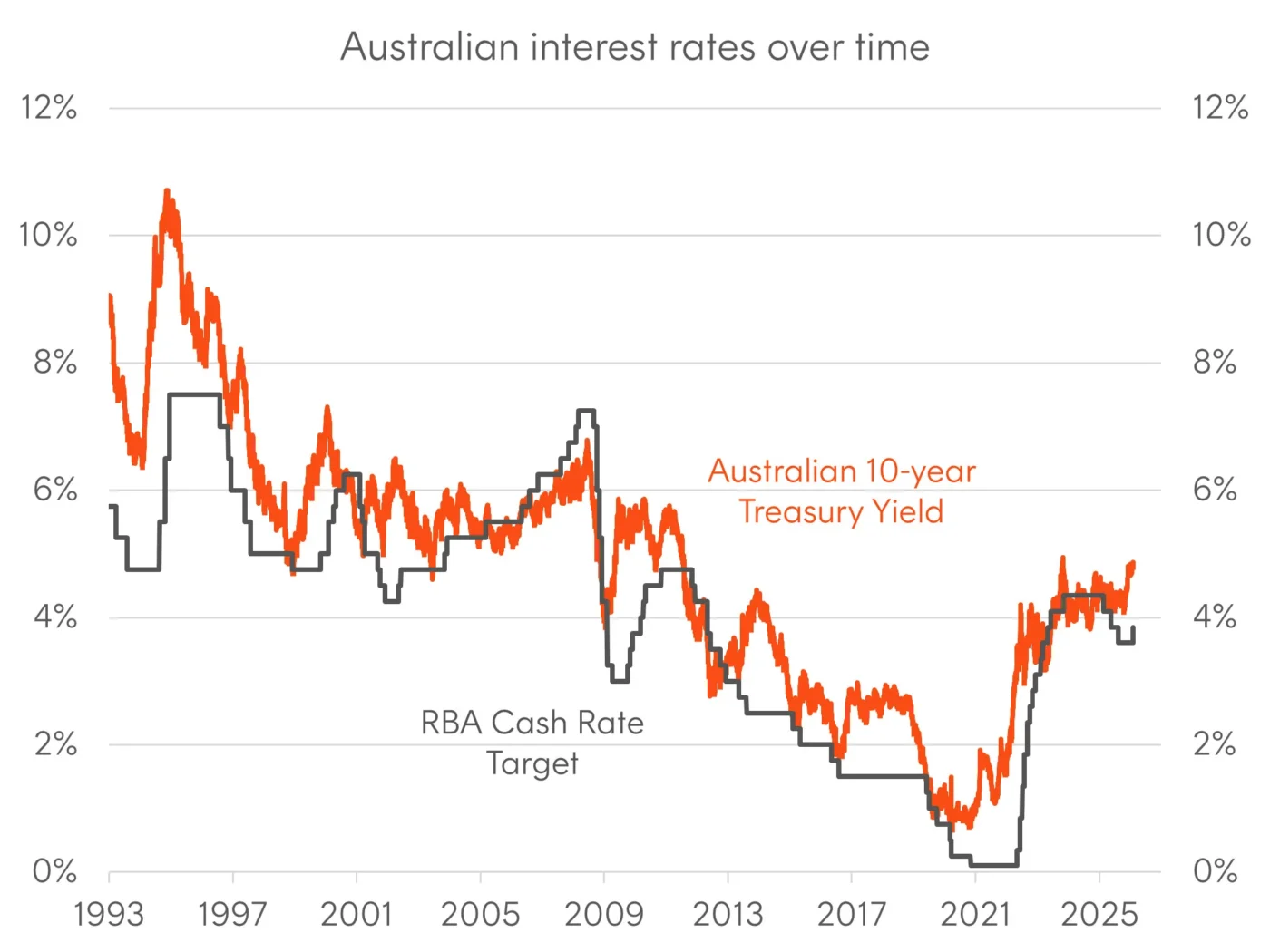
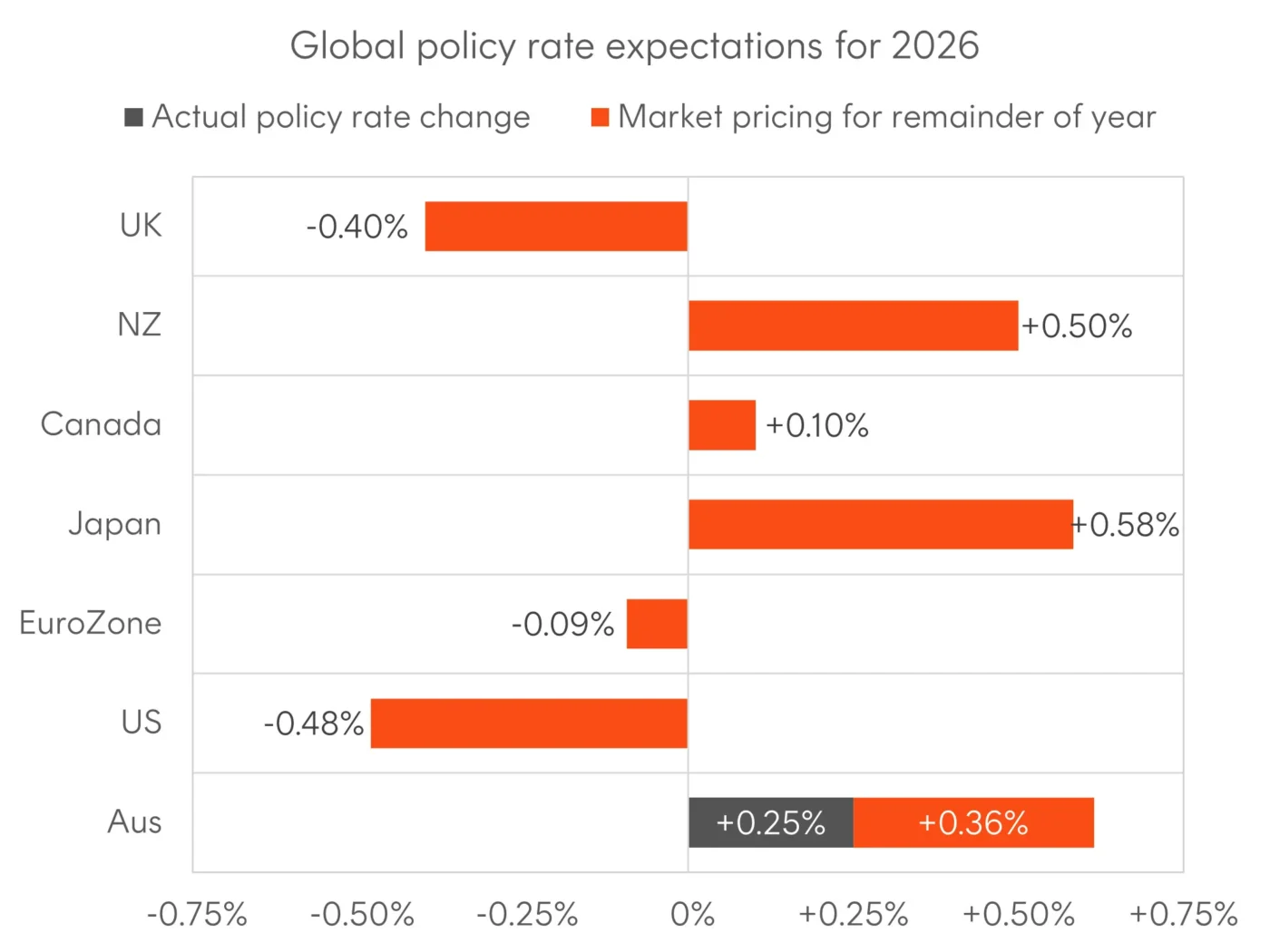
The RBA has officially commenced a new hiking cycle, raising the cash rate target by 25 basis points to 3.85%. While the Bank of Japan has been gradually normalising policy from ultra-accommodative levels since 2024, this makes the RBA arguably the first major central bank to embark on a genuine tightening cycle since the global easing wave began. It also places the RBA firmly at the hawkish end of a widening global policy divergence, particularly relative to the US.
Although this development might at first seem challenging for fixed rate Australian bonds, the historical evidence suggests otherwise. We expect this hiking cycle to be fairly muted by historical standards and more a recalibration towards a neutral setting than an attempt to take policy to highly restrictive levels. If that proves correct, the combination of attractive starting yields and a hiking cycle that’s already priced in should provide a constructive backdrop and a favourable risk-return profile.
Figure 1: Australian Interest Rates Over Time
Sources: Bloomberg, RBA.
Figure 2: Global policy rate expectations for 2026
Sources: Bloomberg, ASX, CME, RBA, Fed, RBNZ, BoE, BoJ, ECB, BoC. As at 3 February 2026.
What’s priced in matters
Australian yields have risen significantly in recent months as markets priced the end of the easing cycle and the emergence of a new hiking cycle. The narrative of an economy running up against capacity constraints amid sticky inflation has taken hold, forcing the RBA to revise up its inflation forecasts and push out the timeline for returning to target.
For bond investors, a critical point to remember is bond yields are forward looking and what matters for excess returns isn’t necessarily what the RBA does per se, but what it delivers relative to what’s priced in and the evolution in policy expectations. Current market pricing is pointing to 1.5 additional hikes priced in for this year, corresponding to a cash rate of 4.25% by year-end. In addition to these policy rate expectations, there’s also arguably a compelling term premium embedded in long-term yields.
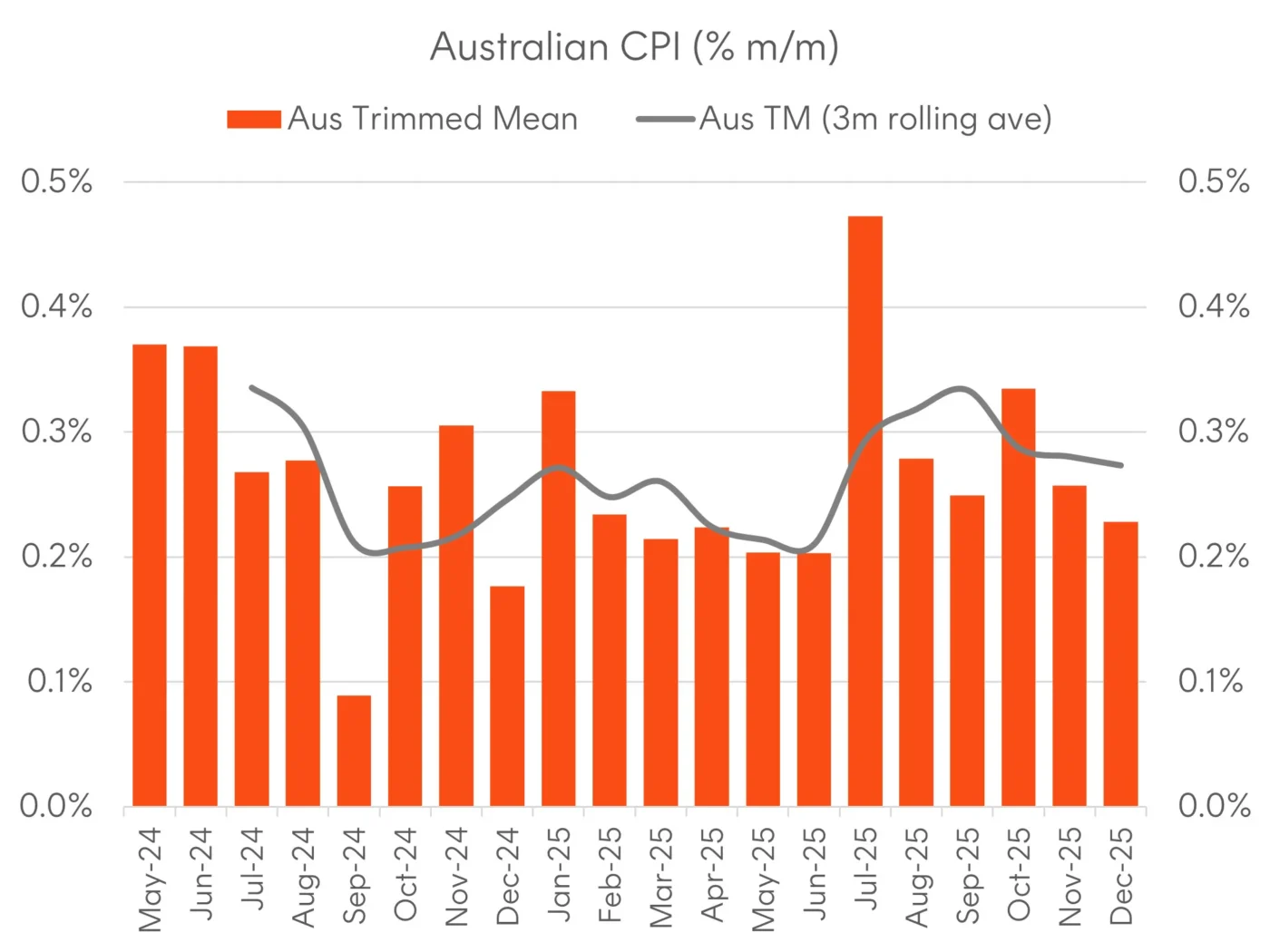
Where the RBA ends up taking the cash rate ultimately hinges on the inflation trajectory. While inflation has been stubborn of late, the recent trend in the monthly trimmed mean CPI series still suggests that underlying price pressures are moderating. That being said, current starting yields do provide a buffer were inflation to re-accelerate, while also providing the potential for meaningful capital gains if inflation were to cool further and rate hike expectations to be unwound.
Figure 3: Australian Monthly Trimmed Mean CPI (% m/m)
Source: ABS. As at 31 December 2025.
No need to fear a hiking cycle
While it might be tempting to assume the start of a hiking cycle presents challenges for long-term fixed rate bonds, the historical evidence is more supportive. Looking at the five hiking cycles since 1993 – when the RBA formally adopted an inflation targeting framework – medium-to-long-term government bonds outperformed cash in four of them over the following 12 months.
The prior hiking cycle that kicked off in May 2022 – the notable exception – started from a dramatically different position. With the cash rate at just 0.10%, the RBA was forced to take policy from ultra-accommodative settings to genuinely restrictive territory in response to the post-pandemic inflation surge. Today’s starting point is far more favourable, with the cash rate arguably close to neutral, and the 10-year yield of 4.87% providing a far more generous buffer.
Figure 4: Prior RBA hiking cycles (1994 to present)
|
Start of hiking cycle |
Starting 10yr yield (at month-end) |
Change in 10yr yield next 12 months |
BBG AusBond |
S&P/ASX 200 12mth total return |
BBG Bank Bill index 12-month return |
|
Aug-1994 |
9.36% |
-0.38% |
+12.55% |
+5.81% |
+7.50% |
|
Nov-1999 |
6.64% |
-0.87% |
+11.24% |
+14.08% |
+6.18% |
|
May-2002 |
6.28% |
-1.40% |
+13.95% |
-6.93% |
+4.95% |
|
Oct-2009 |
5.54% |
-0.34% |
+8.32% |
+4.58% |
+4.45% |
|
May-2022 |
3.35% |
+0.25% |
+1.90% |
+2.90% |
+2.64% |
|
Feb-2026 |
4.87%* |
Sources: Bloomberg, RBA, S&P, ASX; As at 4 February 2026; Past performance is not indicative of future performance; You cannot invest directly in an index. 12-month returns beginning end of the month of the first RBA cash rate increase of the cycle.
A global standout
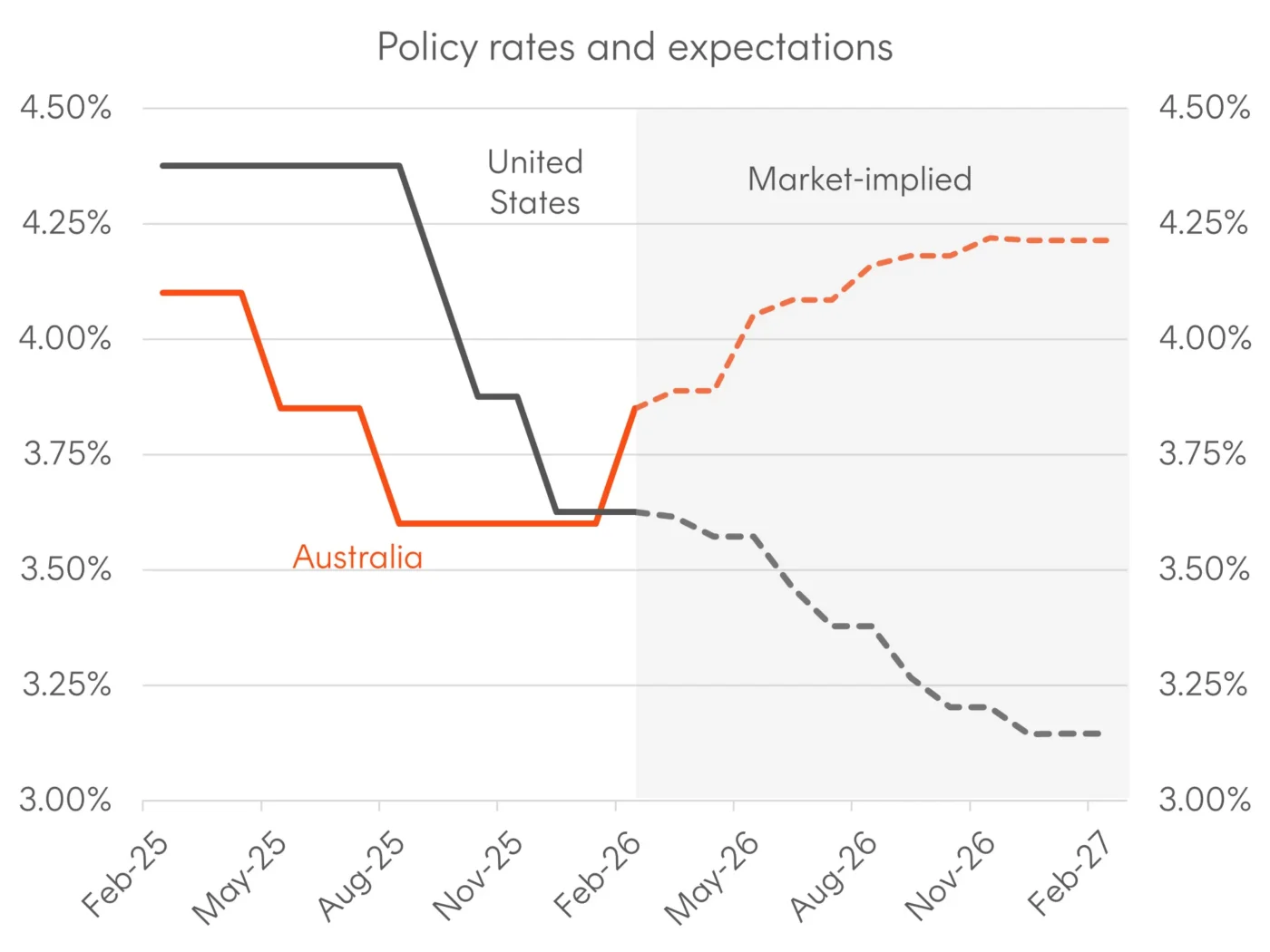
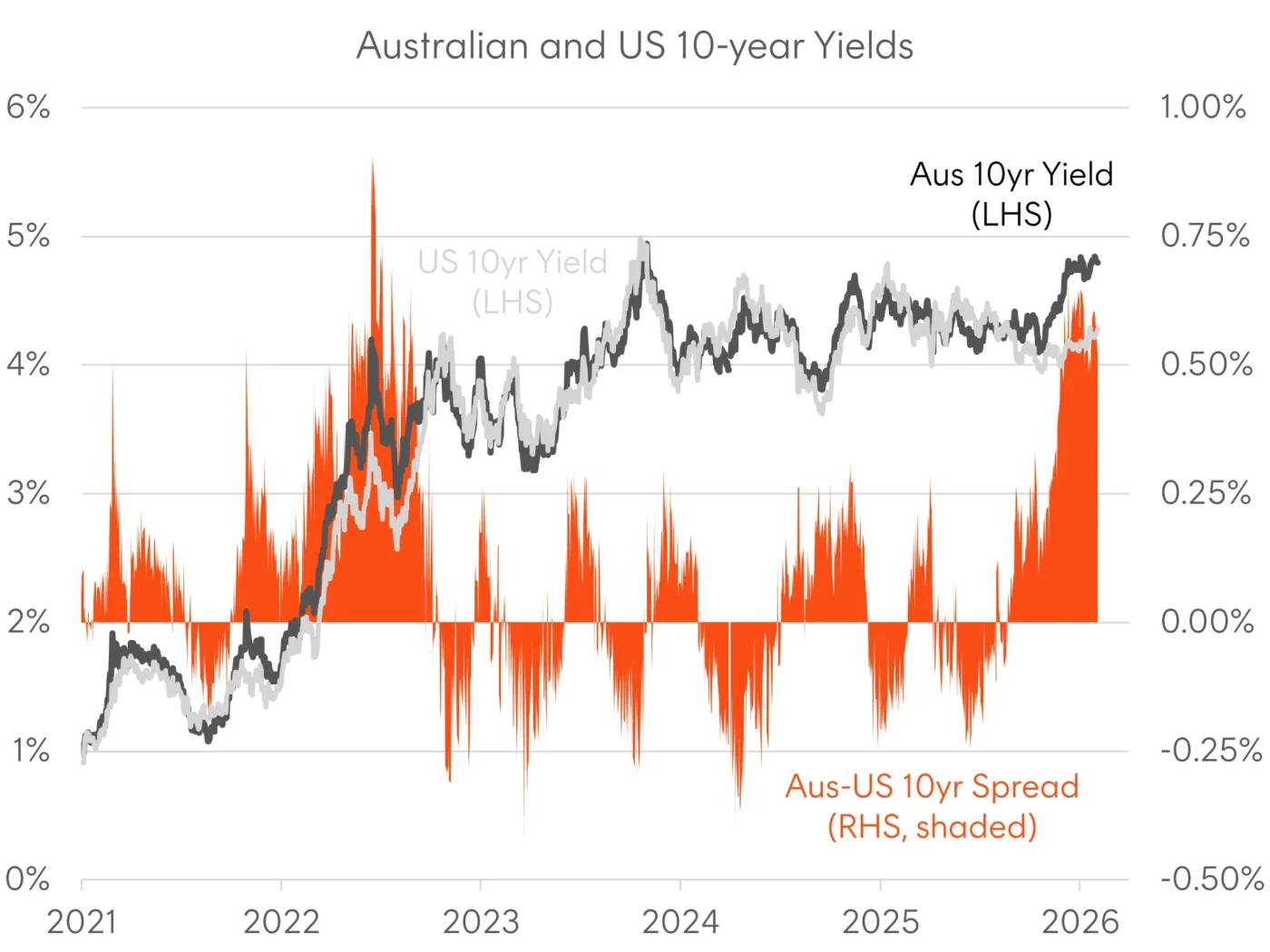
Beyond the domestic picture, Australian government bonds increasingly stand out in a global context. In recent months, Australian yields rose relative to other global bond yields amid a growing divergence in policy rate expectations. We now have an unusual situation of the RBA expected to continue hiking as the Fed continues to cut, with the market now pricing in a +110-basis point spread between the respective policy rates over the next 12 months. This repricing of relative policy expectations has pushed the 10-year yield spread between Australian and US Treasuries to its widest level in over three years.
It’s unclear that such a long-term yield spread is justified and is arguably too wide relative to long-term neutral rates, which arguably creates compelling relative value for domestic fixed income, and scope for outperformance against global bonds.
Figure 5: Australian and US policy rates and expectations
Sources: Bloomberg, RBA, Fed, ASX, CME. As at 4 February 2026.
Figure 6: Australian and US 10-year Yields and Spread
Source: Bloomberg
In addition to the higher yields available, and the potential for a convergence in policy rate expectations, several structural factors make our bond market increasingly attractive from the perspective of global investors:
- Australia still clearly has an independent central bank, with far fewer concerns around central bank independence or “fiscal dominance” compared to some other jurisdictions.
- Australia’s fiscal position and public finances are generally much healthier than other major sovereign debt markets. The contrast with the US, Japan, and the UK is stark, and this fiscal credibility commands a premium in an environment where investors are increasingly focused on sovereign balance sheets.
- Australia retains the coveted AAA sovereign credit rating, which is increasingly scarce.
These factors are supportive for global demand, especially against a backdrop of investors looking to diversify away from US dollar assets more generally, and US Treasuries more specifically. The combination of a hiking cycle that’s already priced in, compelling term premiums, and structural advantages should make Australian government bonds an attractive destination for global capital seeking high-quality sovereign exposure.
Investment implications
In global fixed income, Australia stands out for its relative value compared to global peers. The 10-year yield spread on Commonwealth government to US Treasuries recently hit +60 basis points1 amid expectations of diverging policy, and the market is now pricing in RBA to be hiking as the Fed is cutting. However, we believe the market has gotten ahead of itself in assuming a much higher long-term neutral rate in Australia relative to the US. Australian government bonds provide a favourable risk-return trade-off, and the potential for outperformance against global bonds.
- AGVT Australian Government Bond ETF
- AGVT focuses on 7–12-year Commonwealth, state, and government-related securities, making it an ideal vehicle to express a view that the Australian 10-year yield will decline.
- With a starting yield of around 5.09%, AGVT not only offers capital gains potential if yields decline but also an attractive source of income from the highest-quality segment of the Australian bond market2.
Australian duration offers compelling relative value, while carry available in Australian investment grade credit should help weather a modest spread widening. For investors looking for a benchmark-aware exposure to high quality duration without an outsized allocation to government bonds, a composite bond fund can provide a compelling duration solution without sacrificing the credit quality or liquidity needed in a defensive pillar.
- OZBD Australian Composite Bond ETF
- OZBD is designed as a core portfolio allocation for fixed income as it’s well diversified across Australian government and investment grade corporate fixed rate bonds. It provides exposure to Australian duration in a benchmark-aware manner, while offering a yield pickup over the traditional benchmark index.
- Its enhanced-indexing methodology, developed in partnership with Bloomberg, overcomes the biggest pitfalls with traditional passive benchmark indices, while employing the most effective techniques of active management, but at a fraction of the cost, with a management fee of just 0.19%3.
Sources:
1. As at 4 February 2026. Yields subject to change.
2. As at 4 February 2026. Yields subject to change.
3. Certain additional costs apply. Please refer to PDS.