

David Bassanese
8 minutes reading time


Global week in review: Iran conflict worsens
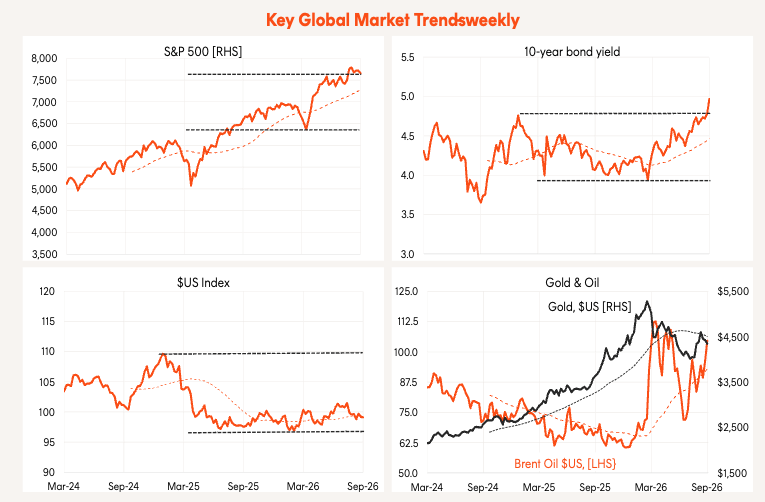
US equities fell last week with an intensification of the Iran conflict sending oil prices and bond yields higher. A firmer-than-expected core US CPI report also heightened expectations of a Fed rate hike this week. AI leaders, meanwhile, warned their technology had a modest risk of wiping out humanity!

Source: Betashares, Bloomberg.
The key development in the Iran conflict last week was the Houthi attacks on Saudi Arabia’s key East-West pipeline, through which the Kingdom has been able to keep exporting some oil despite the closure of the Strait of Hormuz. Over the weekend, Saudi Arabia announced its temporary closure as it assessed the damage and ongoing security threat. The attacks took place in a province in Iraq bordering Iran, known as the Maysan governorate. For its part, Iran is trying to organise a regional meeting to agree on a shipping route through the Strait of Hormuz and what fees it will be able to charge.

Source: Global Energy Monitor
As for the US, President Trump now seems oblivious to the ongoing upward pressure on oil prices and is left simply stating the war will end – and oil prices will come down – immediately after the mid-term elections!
In other news, while the headline CPI inflation gain of 0.4% in August was in line with market expectations, the 0.3% core increase was a touch firmer than the 0.2% the market expected. The net result is that the market increased the odds of a Fed rate hike this week to 86%, even though surveys of economists suggest the result is far from clear cut.
As widely expected, the European Central Bank raised rates 25 basis points last week to 2.5% – its second hike this year – due to above target inflation and the energy price risk of even higher inflation.
Rising oil prices and Fed rate hike fears saw US 10-year bond yield lurch a further 19 basis points last week to 4.97%. US Treasury Secretary Bessent thought he could limit the rise in yields by buying bonds, but Treasury’s announcement of $US 6 billion in purchases fell short of the bazooka that markets were expecting. The bond vigilantes shrugged it off.
Last but not least, an ex-employee of Anthropic issued a dire warning last week that the explosive growth in AI capability meant there was at least a 10% chance it could wipe out humanity in a decade. Yes, you read that right. While today’s AI boom bears many resemblances to past technology booms – from railways to the internet – the apparent threat of human extinction is certainly unique!
This warning may have been easy to dismiss, however, were it not for the fact that no less than the CEO of Anthropic himself, Dario Amodei, warned over the weekend that the industry needed to agree to slow development until sufficient guardrails were put in place. The heads of both OpenAI and xAI, Sam Altman and Elon Musk, agreed.
Whether and how this will come about remains to be seen, especially as getting agreement with China may not be easy (or verifiable). At this stage, the US Congress is also due to leave Washington this week and not return till after the mid-term elections.
As with other global challenges like climate change, getting international agreement to deal with a future potential risk is hard – especially with a US President who still seems more worried about losing AI dominance to China than the technology’s apparent threat to life as we know it.
Global week ahead: Fed meeting
The key event this week will be the US Federal Reserve meeting, concluding on Wednesday (US time). As noted above, while the market thinks it’s close to a done deal, economists (me included) are not so sure.
That said, given the market’s strong expectation, Friday’s higher-than-expected core CPI, the rebound in oil prices and the Fed’s shaky credibility, I suspect the Fed is likely to relent under market pressure and raise rates this week. No doubt this will incur Trump’s wrath, but there’s not much he can do about it.
The Bank of Japan is also expected to raise rates further at its meeting on Friday.
Global equity trends: Technology strongest performer
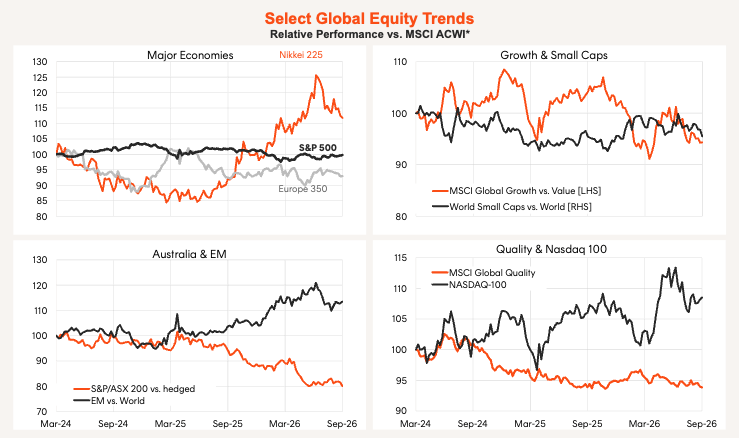
Despite AI concerns, the global technology sector ended higher last week while energy and health care pulled back the most.
Sector trends remain choppy, with technology underperforming since mid-year and more value-orientated sectors such as financials and energy taking up the baton.
*All but value factors. Local currency basis. Source: Betashares, Bloomberg.
Australia week in review: Downbeat confidence
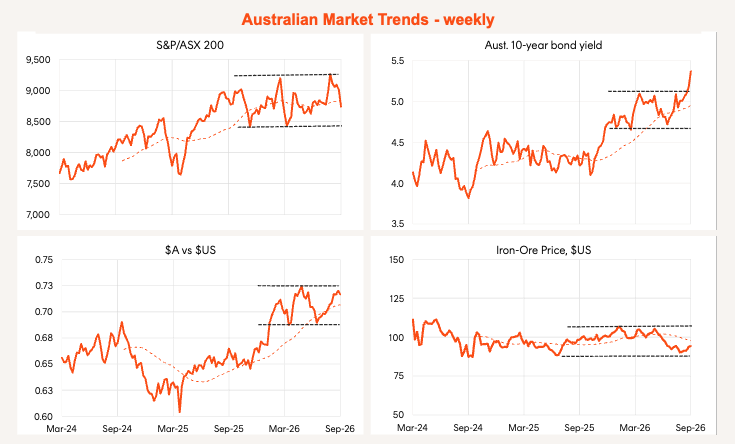
The local market underperformed last week with downbeat business and consumer sentiment reports – along with hawkish commentary from RBA officials – giving investors little reason to cheer.

 Source: Betashares, Bloomberg.
RBA Deputy Governor Andrew Hauser went on ABC’s 7.30 Report last week to warn that the Bank will have to raise interest rates again if inflation proves stickier than currently expected. He noted Australians are rightly furious about the high level of inflation, though the Bank has been cautious about raising rates seeking to bring it down while preserving as much employment growth as possible.
In short, the Bank is facing a balancing act: it can bring down inflation quickly, but at a massive cost to the real economy via recession. Instead, it’s been taking a gradualist approach, which is possible as long as the delayed decline in inflation does not unduly seep into inflation expectations, which would then make bringing inflation down even harder and involve even greater costs to employment.
My sense, however, is that Hauser did not intend to signal a rate rise later this month. Rather, he wanted to acknowledge public frustration with the level of inflation and reiterate the Bank’s determination to bring it down. But he also wanted to explain the nature of the employment versus inflation balancing act the Bank faces and why, so far at least, it has taken a gradualist approach.
To my mind, the case for a September rate hike remains unconvincing and the RBA is, at this stage, still more likely to keep rates on hold.
Why? The higher-than-expected July CPI report could simply be monthly volatility, especially given the more benign Q2 inflation outcome. And while Q2 GDP was a touch higher than expected, it still revealed an economy growing at a below-trend pace. House prices are still falling and, unlike past interest-rate driven cycles, no one can be confident the decline will remain modest given the massive property tax changes in the Federal Budget. Last week’s business and consumer surveys also revealed a notable buckling in confidence.
That said, with other central banks raising rates in recent times, the RBA may feel it needs to join the bandwagon – rather than delay a potential hike until November, following the Q3 CPI report.
Local equity market trends: Resources pullback
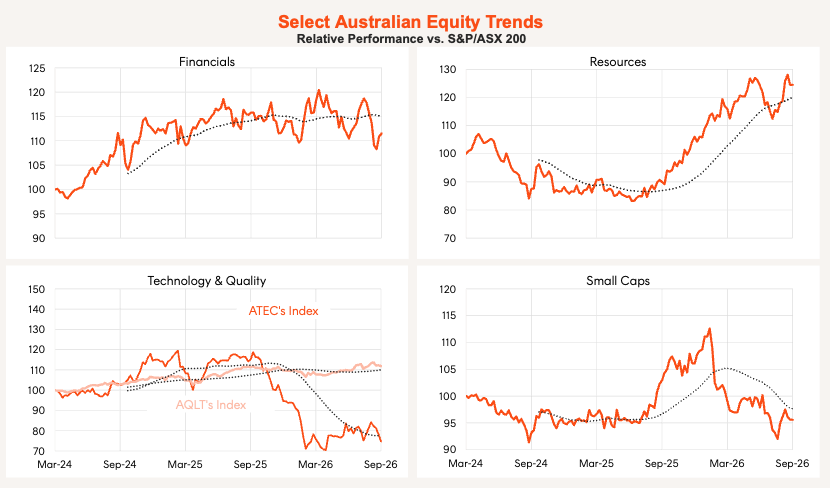
Technology and materials fell hardest last week, with only energy and utilities posting gains among the sectors. The recent outperformance of resources is being challenged by higher global interest rates and the risk to global growth that this entails.
Source: Betashares, Bloomberg.
Australia week ahead: RBA rhetoric
Following on from the RBA Deputy Governor Hauser’s unusual 7.30 Report appearance, there’s an avalanche of other RBA appearances in coming weeks. If the RBA does want to signal its intentions ahead of the Board meeting later this month, it certainly has no shortage of opportunities!
This week, Assistant Governor Sarah Hunter gives a “fireside chat” today, while Governor Bullock and her team provide Parliamentary testimony on Friday. As the Governor has previously noted, she really can’t provide much forward guidance these days even if she wanted to, as the Board is made up of independent minds who may have other opinions.
I suspect the Governor will reiterate the RBA’s determination to bring down inflation though also noting the gradualist approach the Bank has adopted thus far. I’d be surprised if she signalled the Bank had already revised up its inflation outlook, as this would be tantamount to signalling a rate rise at this month’s meeting.
Have a great week!