


For adviser use only. Not for distribution to retail investors.
The Betashares QPON Australian Bank Senior Floating Rate Bond ETF won the Passive Fixed Income category at the 2026 Lonsec Fund Manager of the Year Awards. As Australia’s first bank floating rate bond ETF, QPON opened an institutional part of the bond market to advisers and their clients. Close to a decade later, it remains a precise defensive building block, combining senior bank credit, minimal interest-rate duration, and daily liquidity on the ASX. The Betashares BSUB Australian Major Bank Subordinated Debt ETF applies the same targeted, rules-based approach one rung lower, providing access to Big 4 Tier 2 floating rate bonds for advisers seeking additional income and willing to accept subordination risk.
Bank bonds explained
Bank bonds carry three distinct risks: interest-rate risk, default risk, and credit-spread risk. Interest-rate duration measures sensitivity to changes in yields. Fixed-rate bonds have more of it, while floating rate bonds have their coupons reset with three-month BBSW, keeping duration near zero.
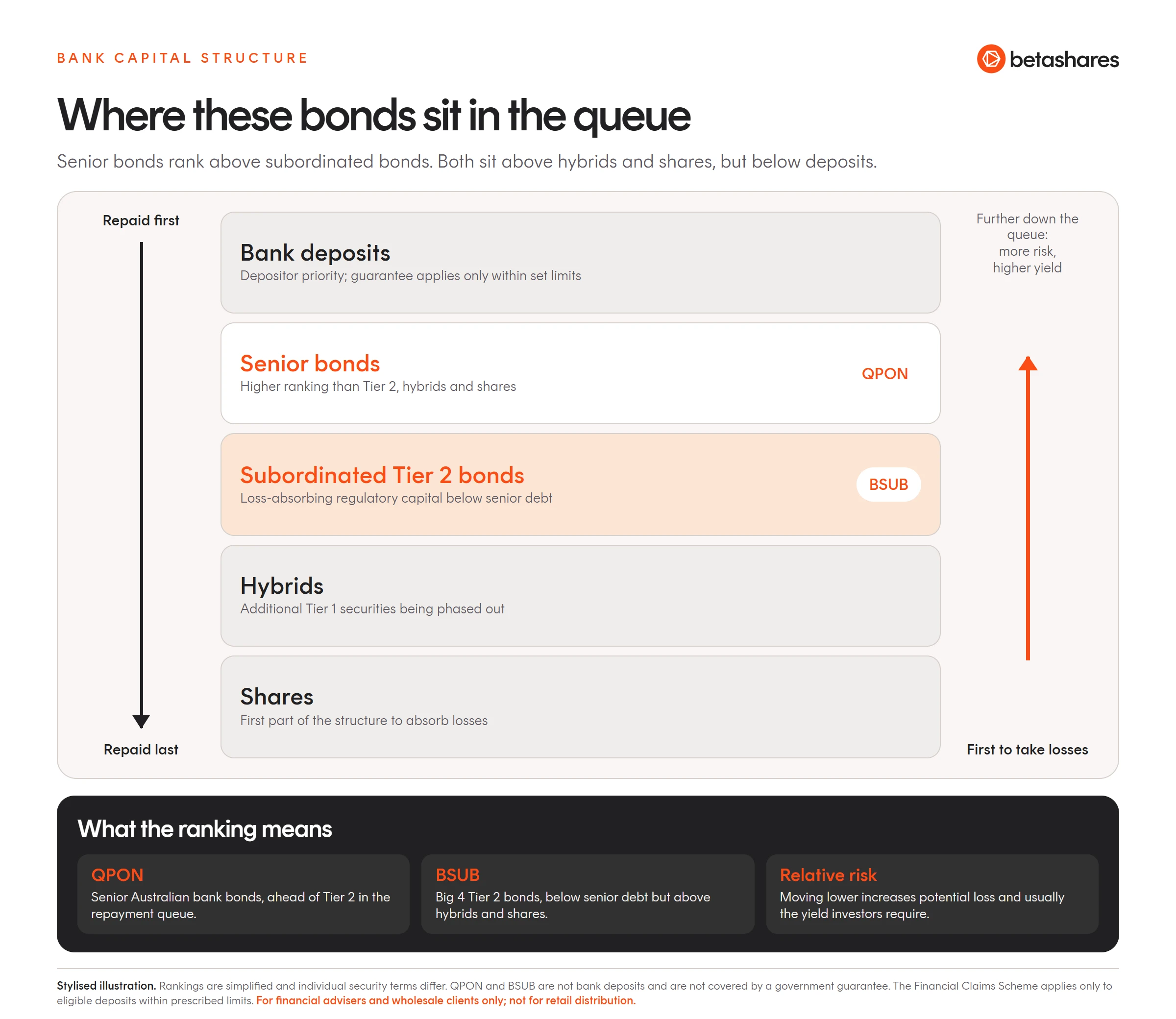
Default risk is the risk of not being repaid. Issuer credit quality captures the likelihood of default, while capital ranking affects the repayment order. Deposits rank ahead of senior bonds, followed by Tier 2, hybrids, and shares. Lower ranking means greater potential loss, requiring a higher margin.
Credit-spread risk is the market risk associated with price changes when that margin changes, even if every payment is made. Spread duration measures this sensitivity. Wider spreads lower prices, while narrower spreads lift them. Being floating rate reduces interest-rate risk, not default or spread risk.
The end of Australian bank hybrids and new opportunities
Bank hybrids (Additional Tier 1, or AT1 capital instruments) have historically been a mainstay of many adviser income portfolios, combining franked income, familiar bank issuers, and daily ASX liquidity. APRA’s decision to phase them out means some long-standing income strategies will need to evolve. As existing hybrids reach their first call dates through to 2032, advisers will need to reconsider both the income and the portfolio role those allocations were designed to provide.
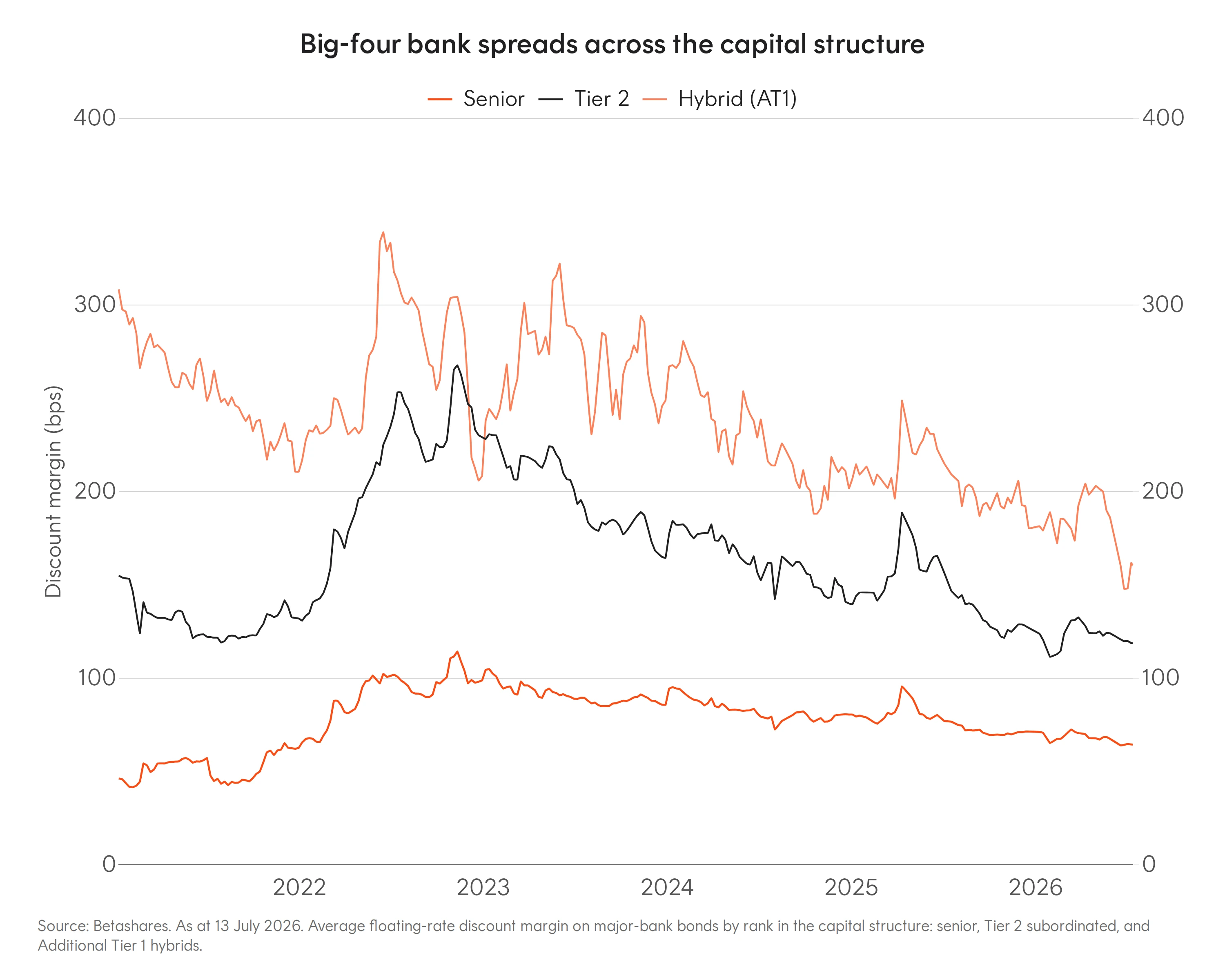
Tier 2 is the closest adjacent rung for investors seeking to retain exposure to major-bank credit. It is issued by the same banks and generally pays floating rate income but ranks above hybrids in the capital structure. It remains loss-absorbing capital at the point of non-viability, yet its stronger ranking is reflected in a lower margin than AT1 and a higher margin than senior debt. The chart below shows how the market has priced those differences, with the discount margin for hybrids grossed up for franking credits.
The smart beta engine: harvesting roll-down
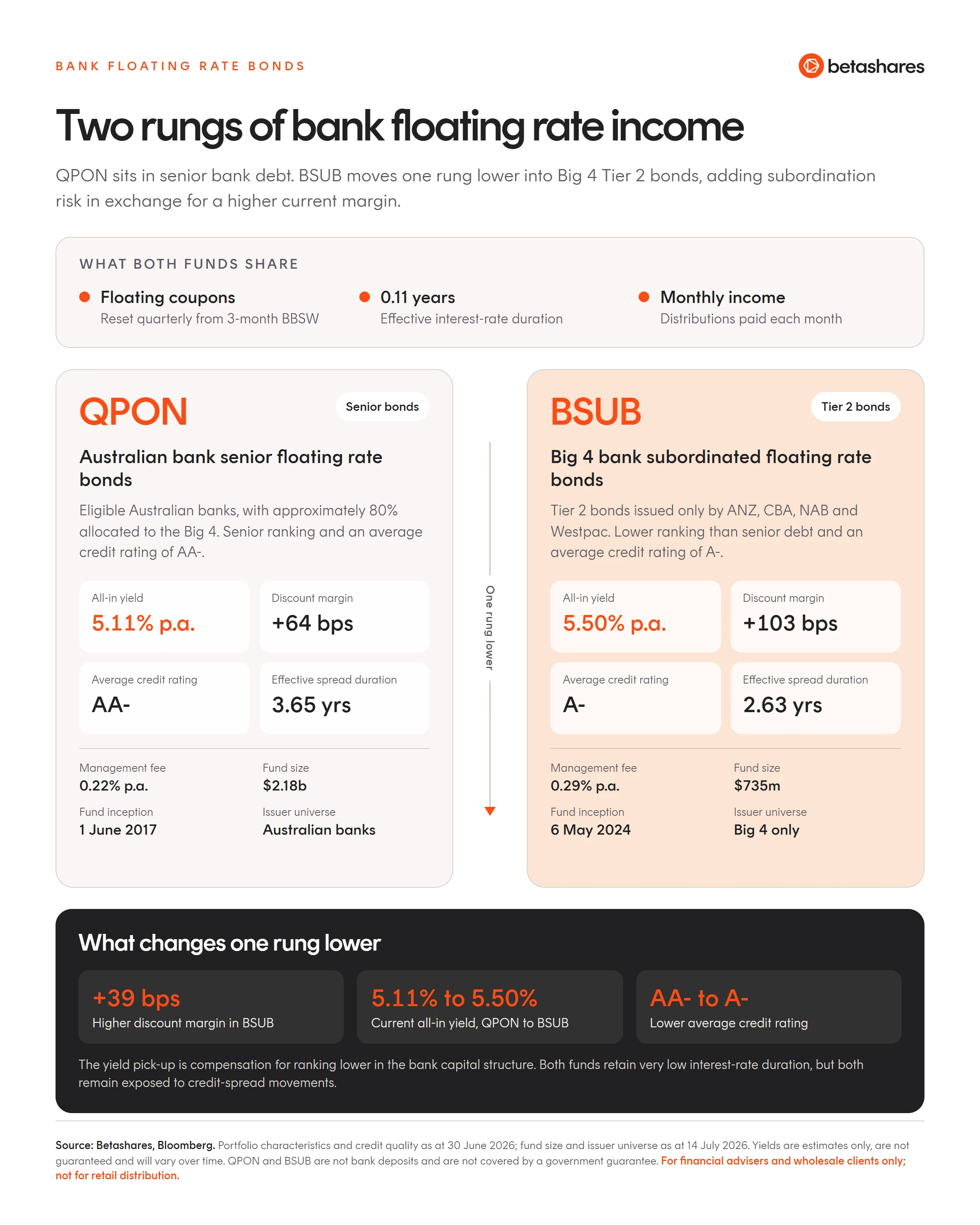
QPON and BSUB target adjacent parts of the bank credit market. QPON holds senior floating rate bonds issued by Australian banks, with 80 per cent allocated to the big four. BSUB holds only big-four Tier 2 floating rate bonds. Both have near-zero interest-rate duration and pay monthly distributions. Within each segment, the available funds can look similar on a platform. What differentiates QPON and BSUB is what their indices are designed to hold and how they rebalance.
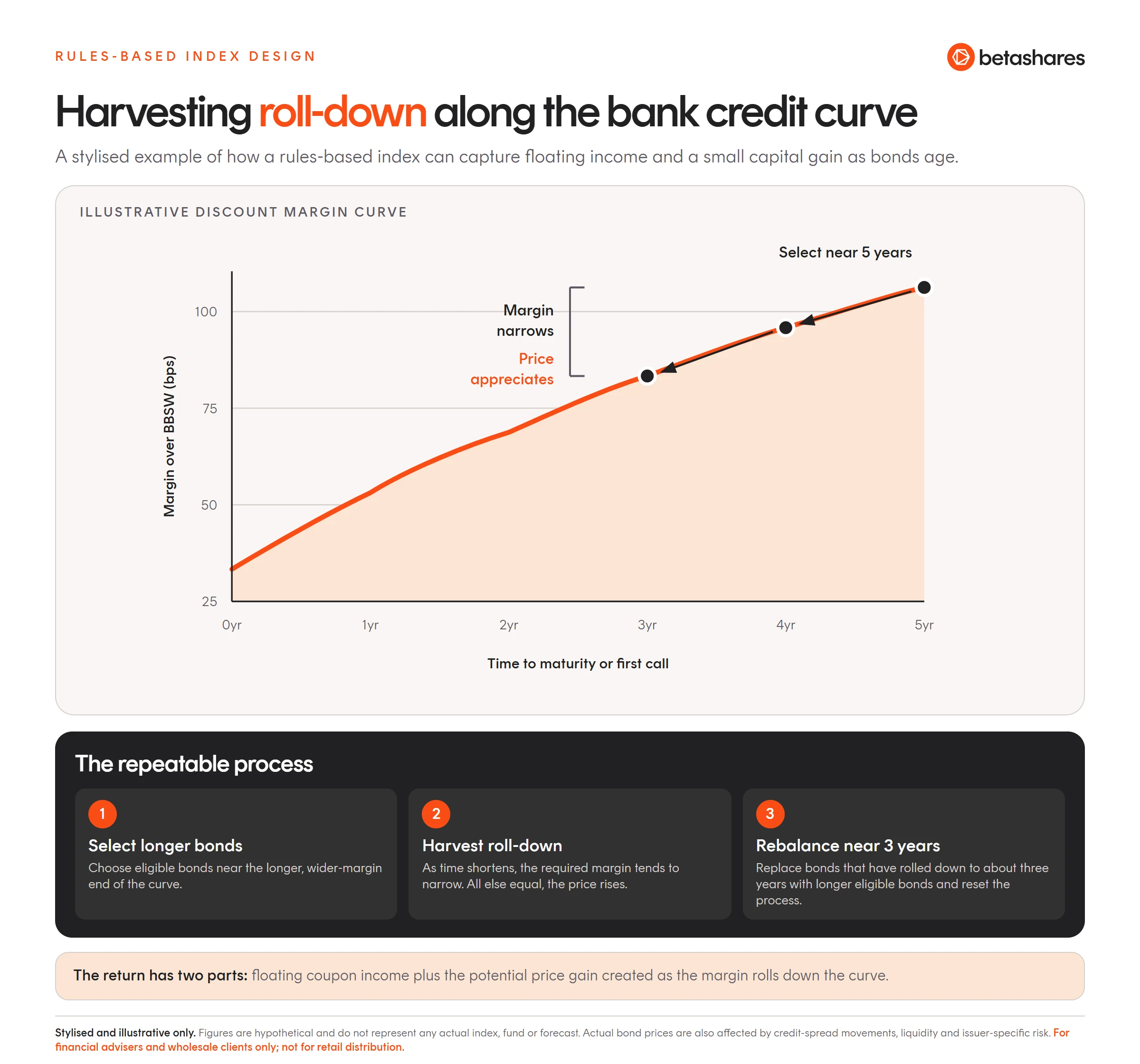
A floating rate bond pays a fixed margin over three-month BBSW. On a normal credit curve, longer bonds trade at wider margins than shorter ones. As a bond rolls towards maturity or an expected first call date, the margin required by the market tends to narrow. The bond still pays its original contractual margin, so its price rises above par.
That price gain is not permanent. As the repayment date approaches, pull-to-par begins to dominate, and the bond’s price converges back towards its face value. The timing of the rebalance therefore matters. The QPON and BSUB indices seek to sell bonds after they have captured the benefit of spread compression, but before pull-to-par erodes that gain, then reinvest in longer bonds with wider margins and renewed roll-down potential.
This is the smart beta engine of systematically harvesting roll-down within a defined bank-only universe, rather than seeking additional yield from lower-quality or less liquid issuers.
The evidence: quality without sacrificing return
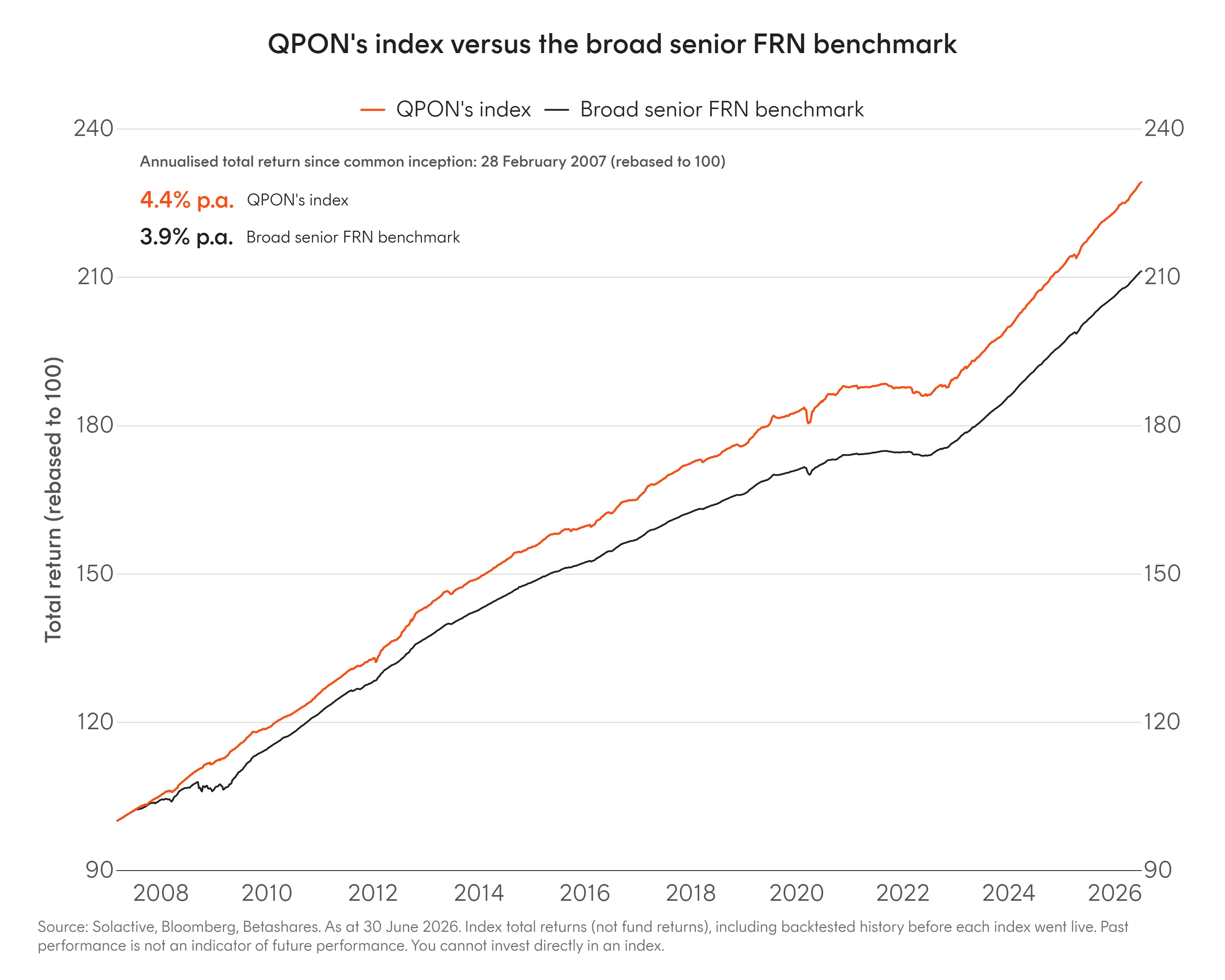
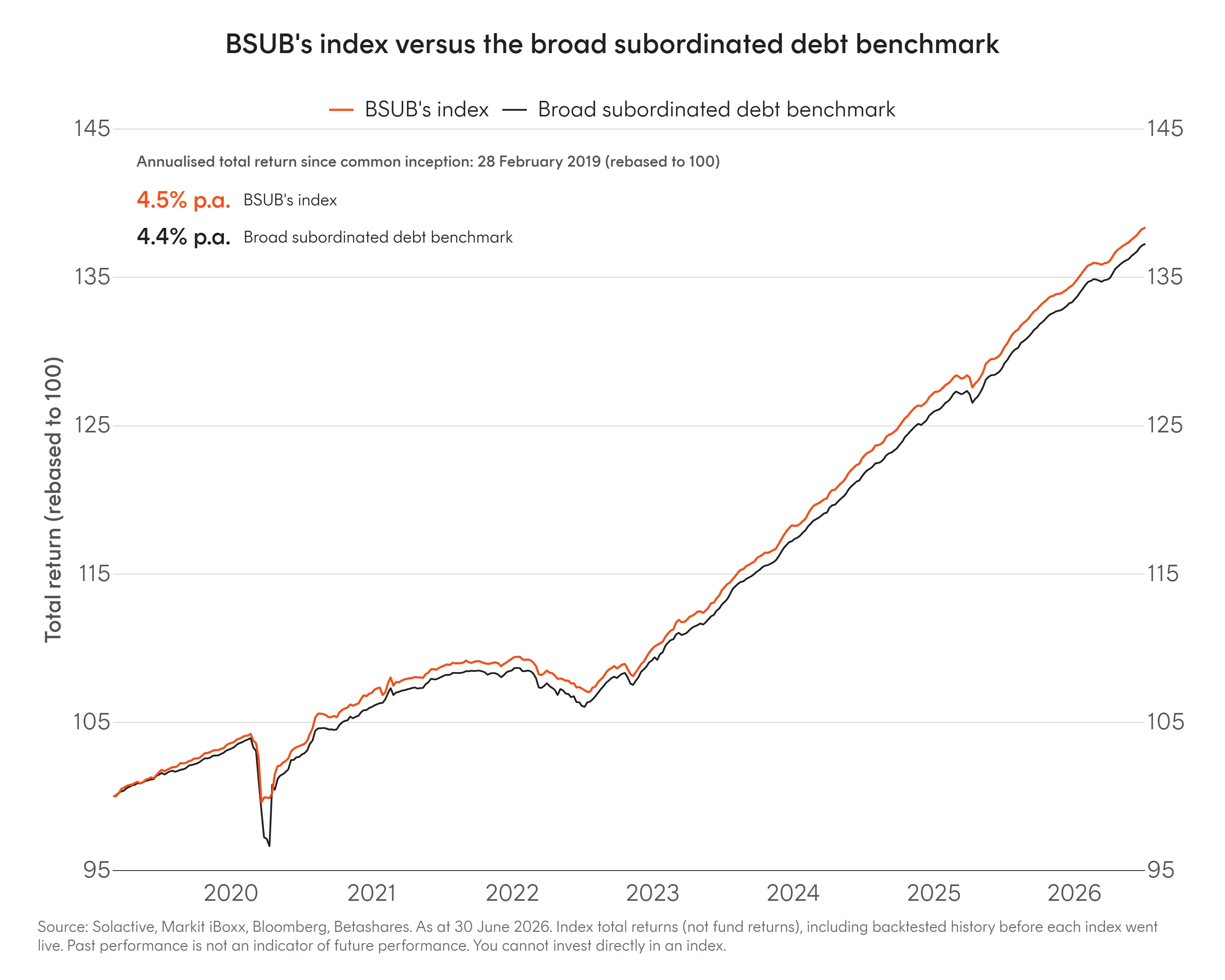
The test is whether a more selective, higher-quality universe can compete with a broader benchmark without relying on lower-rated issuers. Since common inception with the respective broader benchmarks, both indices have done so. QPON’s index has outperformed its broad senior FRN benchmark with virtually the same maximum drawdown. BSUB’s index has delivered a comparable return with a smaller drawdown. The results show that return need not come from moving further down the credit-quality spectrum.
QPON’s index holds senior FRNs issued by Australian banks, with 80 per cent allocated to the four major banks and 20 per cent to other Australian ADIs. The broad benchmark includes a wider mix of issuers, including foreign banks, insurers, and corporates. Over the common index history from March 2007, QPON’s index returned 4.38 per cent p.a., compared with 3.94 per cent p.a. for the broad benchmark. Maximum drawdowns were virtually identical at around 1.8 per cent.
The Tier 2 comparison is even clearer. BSUB’s index holds only major-bank subordinated FRNs, while the broad benchmark also includes generally lower-rated insurers and foreign banks. Despite excluding those higher-margin issuers, the BSUB index has delivered a comparable return with a materially smaller drawdown. It achieved that result without relying on the additional spread available from lower-rated issuers. That is the practical value of a more selective index.