


Heidi Davison works as a commercial property lawyer, so property is part of her professional world. But when it comes to her own finances, she’s taken a different path.
She’s not saving for a house. Instead, Heidi is investing to build something she believes could be more valuable to her: the freedom to choose what comes next.
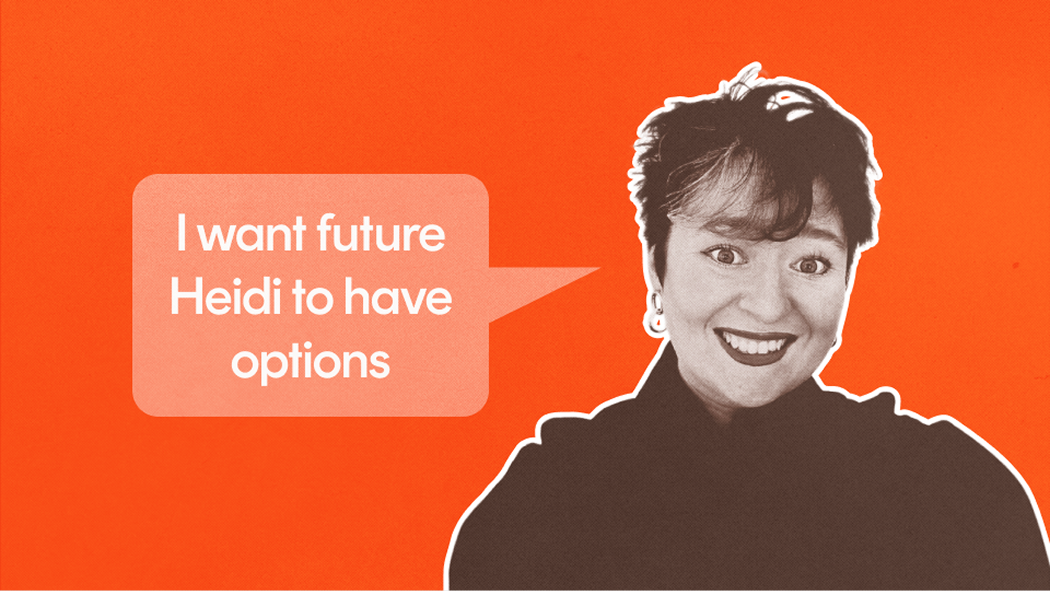
“I want future Heidi to have options,” she says.
That might mean changing careers, taking time away from work, buying a home later without needing a large mortgage or simply having the financial breathing room to make decisions without feeling trapped.
For Heidi, the decision isn’t about rejecting property. It is about recognising that the numbers don’t currently make sense for her.
When the Australian dream doesn’t add up
Heidi has worked through what buying a home would mean in practical terms.
She estimates that a three-bedroom townhouse in her local area might cost around $700,000. With a 20% deposit, she estimates the mortgage repayments would be more than $700 a week at current interest rates.
That’s before accounting for strata fees, council rates, insurance, maintenance and other costs that come with owning a property.
Heidi’s relatively low living costs leave her with room to invest, save and enjoy her life today. She currently rents a home on acreage with her partner and says the arrangement gives her a level of flexibility that buying a home wouldn’t.
“From a financial perspective, the maths does not add up for me,” she says.
She understands why people want to buy a home – stability, security and a place to raise a family. But Heidi doesn’t want to commit most of her income to a single asset if doing so would limit the rest of her financial life.
“I would be over-leveraging myself for one asset,” she says. “That’s not diversification.”
Rather than putting her spare money towards a house deposit, Heidi invests through Betashares Direct, contributing regularly to Betashares Wealth Builder Diversified All Growth Geared (30-40% LVR) Complex ETF, Wealth Builder Global Shares Geared (30-40% LVR) Complex ETF and MSCI Emerging Markets Complex ETF.
For her, the portfolio is a way to build wealth while keeping her future options open.
The approach gives her broad exposure while allowing her to invest regularly with relatively small amounts.
From a single stock to a long-term plan
Heidi’s current strategy is a long way from where she started.
When she first began investing, she created what she jokingly called ‘Heidi’s Fun Bets’. She would put aside spare money until she had $500, then invest it in a single stock she had researched.
One of the stocks rose sharply while she was barely watching it. When Heidi eventually realised how much it had increased, her first reaction was panic. The experience made her realise how difficult it was to constantly monitor individual companies and decide when to buy or sell.
At one stage, Heidi had five individual share investments to keep track of. The research was interesting, but keeping track of it all became too much.
“I couldn’t do that to myself,” she says. “The amount of due diligence was killing me over time.”
From there, Heidi began looking for a more structured approach. She read widely, listened to finance podcasts and thought more carefully about the role of different investments.
Her work has also influenced the way she thinks about money. As a commercial property lawyer, she sees leverage and risk more than the average person. She says the experience has helped her separate the risk of an investment from the lifestyle decisions surrounding it.
A large mortgage might be appropriate for one person and not for another. The same is true of any investment strategy.
“There’s no one-size-fits-all solution,” she says. “You make sacrifices based on what you want.”
“There’s no one-size-fits-all solution. You make sacrifices based on what you want.”
Investing in future choices
Every week, Heidi invests $150 into GHHF Betashares Wealth Builder Diversified All Growth Geared (30-40% LVR) Complex ETF and GGBL Wealth Builder Global Shares Geared (30-40% LVR) Complex ETF. She makes the contribution after being paid, regardless of what markets are doing.
The routine is deliberately repetitive, allowing her to keep investing without constantly having to decide whether the timing is right.
When markets fall, she sometimes invests more.
“I treat shares like grocery shopping,” she says. “When prices are lower I act like they’re on sale.”
That long-term mindset is important because Heidi is still in what she considers the hardest stage of investing: accumulation.
At this point, most of the progress is being driven by her own income, discipline and regular contributions. She has set herself a goal of reaching $100,000 invested over the next few years.
After that, she hopes compounding may play a more noticeable role, although returns are not guaranteed and the portfolio’s value can fall as well as rise.
“The accumulation stage is probably the hardest. You’re putting most of your own labour and effort into it. Once you reach a certain point, the money starts doing more of the work.”
Heidi’s goal is not to predict exactly where she will live or what she will be doing decades from now. It is to avoid making decisions today that leave her with fewer choices later.
For now, she’s investing to keep those choices open.
