



For financial adviser and wholesale client use only. Not to be distributed or made available to any retail clients.
The Budget’s tax reforms have been consequential for investors in several ways. With the 50% capital gains tax discount replaced with inflation indexation, and minimum 30% tax rate on real gains, many investors are looking for investment options that may offer the potential for more tax-effective outcomes.
Investment bonds are one of them. They have been available for decades but have only recently shown renewed interest, as high income earners look for places to invest tax-effectively beyond super, whose appeal at high balances is being challenged by Div 296. For a taxpayer on the top 47% marginal rate, an investment bond may warrant consideration given all earnings within the structure (interest, dividends, and realised cap gains) are taxed at a maximum rate of 30%. Franking credits can also help to bring down the effective internal tax rate.
The choice of investment within an investment bond is also an important consideration. Passive, index tracking ETFs tend to be more tax efficient than their unlisted managed fund counterparts due to low levels of turnover and the ability to ‘stream’ capital gains to external market makers, which helps to reduce overall tax liabilities for unitholders. More details on these two drivers can be found in this article here.
To help illustrate the potential benefits, we’ve put these concepts together and undertaken a hypothetical scenario analysis for a $100,000 initial investment held for ten years in an investment bond. The example considers the outcomes for a range of income and capital growth rates. The final figures below are inclusive of all tax paid within the investment bond and assumes no capital gains are realised until maturity.
Hypothetical example: Investment bond value after 10 years ($100,000 initial investment)
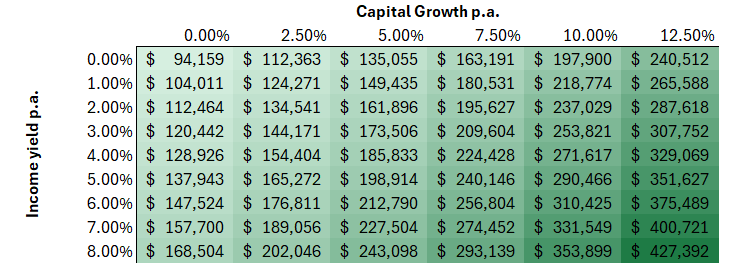
Source: Betashares. Illustrative modelling only, not a forecast, and every figure changes with the assumptions. $100,000 invested for 10 years and fully withdrawn at the end; includes franking credits of 0.30% p.a. of the investment; inflation and cost base indexation 2.5% p.a. Earnings are taxed at 30% within the investment bond. The bond bears 0.60% p.a. in fees (pre-tax). Future results are inherently uncertain. Actual outcomes may differ materially. Example is based on certain assumptions which may not be correct. You should therefore not place undue reliance on such information.
Difference in outcomes: Investment bond versus 47% marginal tax rate
We then compared these outcomes for the investment bond to the after-tax outcomes of an investor holding the same underlying asset in their own name at a marginal tax rate of 47% The following figures shows the dollar difference in final outcomes where positive green values mean the investment bond came out ahead and negative red cells mean holding directly came out ahead.
Interestingly, the analysis shows its own ‘triangle of sadness’ where the hypothetical investor did best when capital growth was equal to CPI, being 2.5% here given the real gain here would be nil, while the bond still paid tax on its nominal earnings each year. In this example, lower income tends to favour direct ownership too.
More broadly however, the investment bond came out ahead across most scenarios due to the rate differential (30% versus 47%) compounding annually. There were also a much larger range of potential positive outcomes (white and green cells) compared to negative outcomes (red cells) which could increase the appeal of such a structure for a high marginal tax rate payer invested in a higher growth and/or higher income exposure.
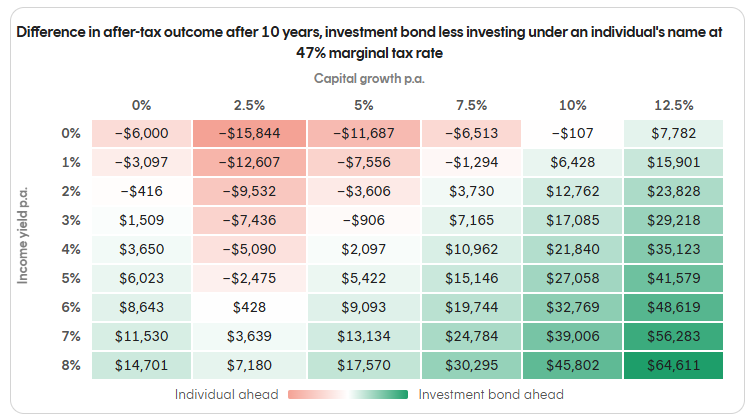
Source: Betashares. Illustrative modelling only, not a forecast, and every figure changes with the assumptions. $100,000 invested for 10 years and fully withdrawn at the end; includes franking credits of 0.30% p.a. of the investment; inflation and cost base indexation 2.5% p.a. The individual pays a 47% marginal rate with capital gains indexation; the bond is taxed at 30% within the bond. The bond bears 0.60% p.a. in fees (pre-tax). Future results are inherently uncertain. Actual outcomes may differ materially. Example is based on certain assumptions which may not be correct. You should therefore not place undue reliance on such information.
Of course, this is an illustrative model only based on assumptions listed above, and is not a recommendation to invest or adopt any investment strategy. Investors should consider obtaining professional advice before making any investment decision.
Important Caveat
It’s worth noting that this analysis assumes an investor holds only a single asset in their own name, like an all-in-one diversified ETF. If an investor directly held a portfolio of investment assets (e.g., multiple funds or a portfolio of shares), the potential tax benefits with holding assets around the inflation rate may be reduced. Under the scenarios modelled, this may result in an investment bond producing a better after-tax outcome.