

David Bassanese
6 minutes reading time


Global week in review: Iranian standoff
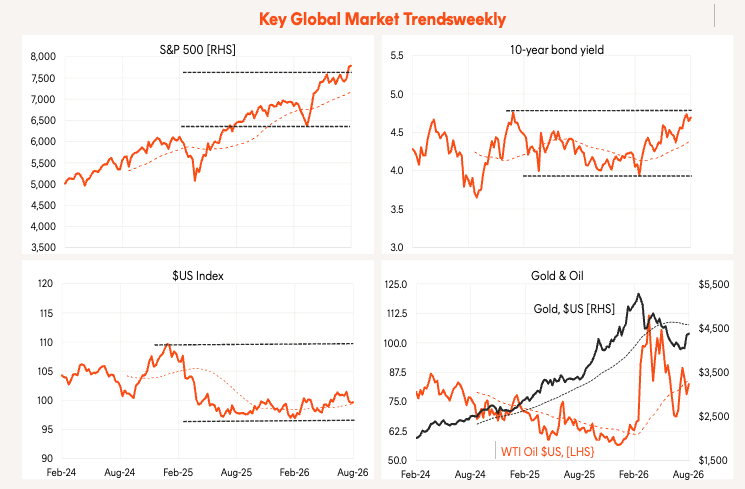
US equities inched up last week to a new record high, helped by no further escalation in the Iran war, encouraging technology news and a relatively benign inflation report.

Source: Betashares, Bloomberg.
The war in Iran has settled into a standoff: America is blocking Iranian ports and Iran is blocking the Strait of Hormuz. Iran says it won’t reopen the Strait until various demands are met and the US is so far not inclined to roll over. Iran is hoping political pressure on Trump will intensify as we get closer to mid-term elections. Meanwhile, the US is hoping increasing economic pressure on the Regime might get it to the negotiating table. We watch and wait.
Despite continued disruption to global oil supply, prices remain remarkably contained – West Texas crude oil prices rose 5% last week to $US82.40.
Demand destruction in parts of Asia especially is helping, as is alternative Middle East pipeline supply routes bypassing the Strait. The world has also run down inventories. Finally, a shortage of refining capacity has placed an effective constraint on crude oil demand (and prices) while still allowing a blowout in the price of refined products – the difference between refined and non-refined oil price is known as the “crack spread”.
Economic news was more encouraging, with US core consumer prices rising only 0.2% in July, allowing annual core inflation to ease to 2.5% from 2.6%. It should be enough to keep the Fed on hold at next month’s policy meeting, and my base case remains that the Fed won’t need to raise interest rates this year. This should be supportive of both bond and equity markets along with gold, although could see the $US retrace some of its strength so far this year.
It was also a good week for the AI trade, with CoreWeave and Super Micro Computer releasing strong sales projections. Both are benefiting from the strong ongoing demand for data centres to support the boom in AI services.
Global week ahead: FOMC minutes
There’s largely only second-tier data in the United States and elsewhere this week, with a focus likely to be on Wednesday’s minutes from the latest Fed meeting. With three of 11 Fed members voting for a rate increase, there will be some interest in what the minutes imply about the intensity of the tightening debate.
That said, the importance of the minutes has likely dissipated somewhat in recent weeks with benign inflation and soft payroll results reducing market fears of a September rate increase.
Global equity trends: Energy strongest performer
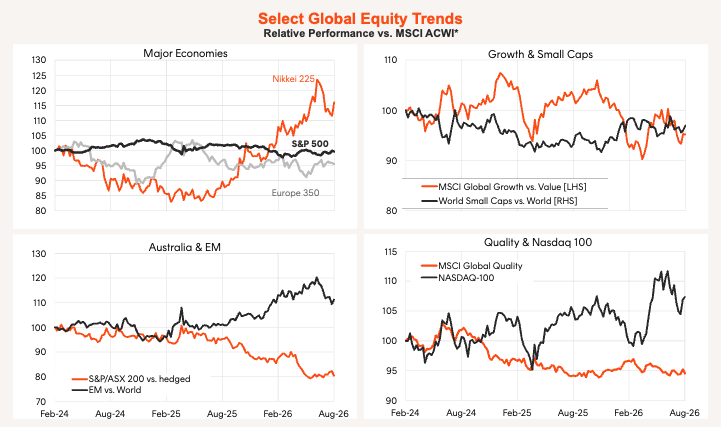
Energy was the strongest global sector last week although technology also outperformed. By region, Japan and emerging markets bounced back well.
Sector trends remain choppy, with technology underperforming since mid-year, and more value-orientated sectors such as financials and energy taking up the baton.
*All but value factors. Local currency basis. Source: Betashares, Bloomberg.
Australia week in review: Hawkish RBA hold
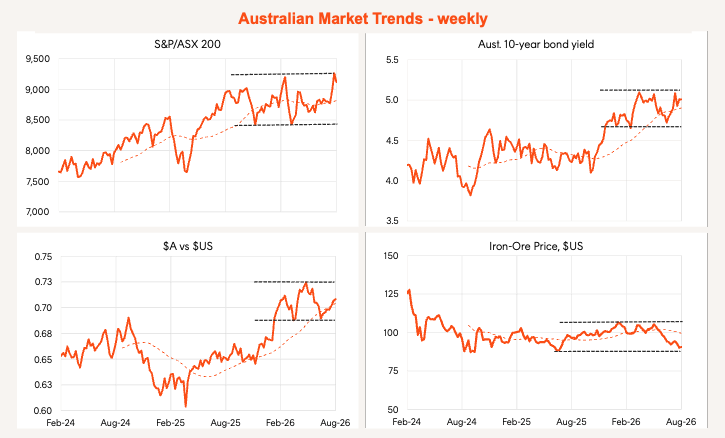
After recent strong performance, local stocks underperformed last week, not helped by the subdued economic outlook and lingering fears of an RBA rate hike.

Source: Betashares, Bloomberg.
As expected, the Reserve Bank left interest rates unchanged at last week’s policy meeting, although warned that upside risks to inflation and interest rates remain.
To my mind, the key takeaway from the RBA’s latest comments is that interest rates will remain on hold provided the Bank does not need to revise up its inflation forecasts any further. As it stands, its forecasts imply 0.8% gains in trimmed mean inflation over the next two quarters – the same as in the June quarter – which seem achievable provided economic growth and capacity pressures continue to ease.
Economic data remained subdued. The National Australia Bank business survey suggested business confidence is wallowing at below-average levels, and there was a relatively large (but not surprising) 5% decline in home loans in the June quarter. The value of lending to investors dropped by 10%. Those hoping for a big bounce in first home buyer interest would be disappointed – lending was essentially flat after a 4.8% drop in the March quarter.
Consistent with the subdued local backdrop, the release of Commonwealth Bank’s earnings report did not inspire much confidence. Although the CBA posted reasonably good profits, it followed several other major banks in noting a post-Budget slump in mortgage applications, although it did suggest some stabilisation in recent weeks.
Local equity market trends: Rotation to resources
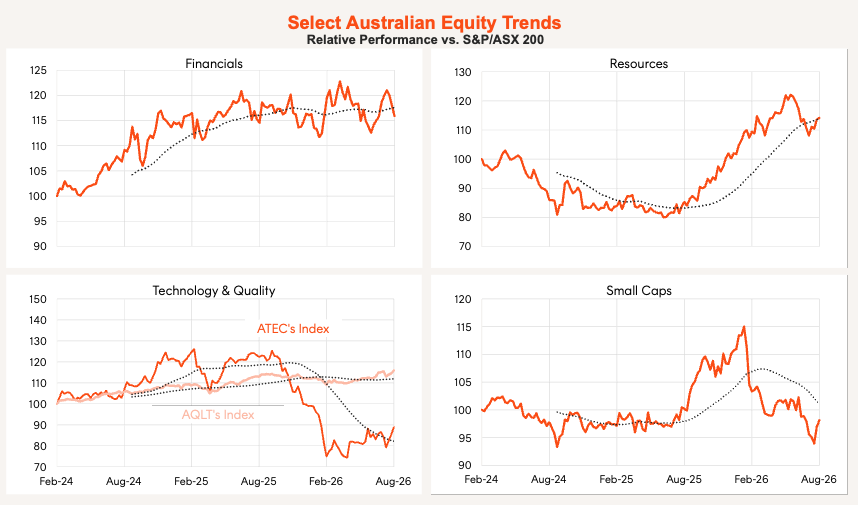
Utilities, energy and technology did best last week, supporting a gradual rotation to resources from financials in recent weeks. A tentative recovery in small-cap and technology relative performance also appears underway.
Source: Betashares, Bloomberg.
Australia week ahead: Wages & employment
Wednesday sees the release of the June quarter wage price index. Annual growth in wages has been broadly steady at around 3.3% since late 2024, even as the unemployment rate has edged up from 4.0% to 4.2% by the March quarter. In recent months the unemployment rate has edged up further to 4.4%, with the RBA expecting it to gradually keep rising to 4.6% by June 2027.
This labour market softening should eventually result in a slowing in wage growth to around 3% or a bit less, which in turn would help lower still sticky consumer price inflation, especially in the services sector. But it’s probably too early to expect much deceleration in wage growth in the June quarter.
Thursday sees the release of the July labour market report. Following a surprise 76k surge in employment in June, a more moderate employment gain – or potentially a fall – should be on the cards. Another strong employment gain – even if the unemployment rate held steady at 4.4% – would concern the RBA as it would suggest strong labour force growth is continuing to fuel growth in the economy.
One number to watch is the underemployment rate, which has lifted in recent months, suggesting more Australians are working fewer hours than they would like.
Have a great week!